Nigeria Outdoor LED Lighting Market Summary
The nigeria outdoor led lighting market was estimated at USD 404 Million in 2025 and is projected to reach USD 570 Million by 2032, growing at a CAGR of 5.6% from 2026 to 2032.
Nigeria Outdoor LED Lighting Market Year-wise Growth Rate and Key Drivers
This graph highlights how the Nigeria Outdoor LED Lighting Market has steadily grown over the past five years, supported by major growth factors.
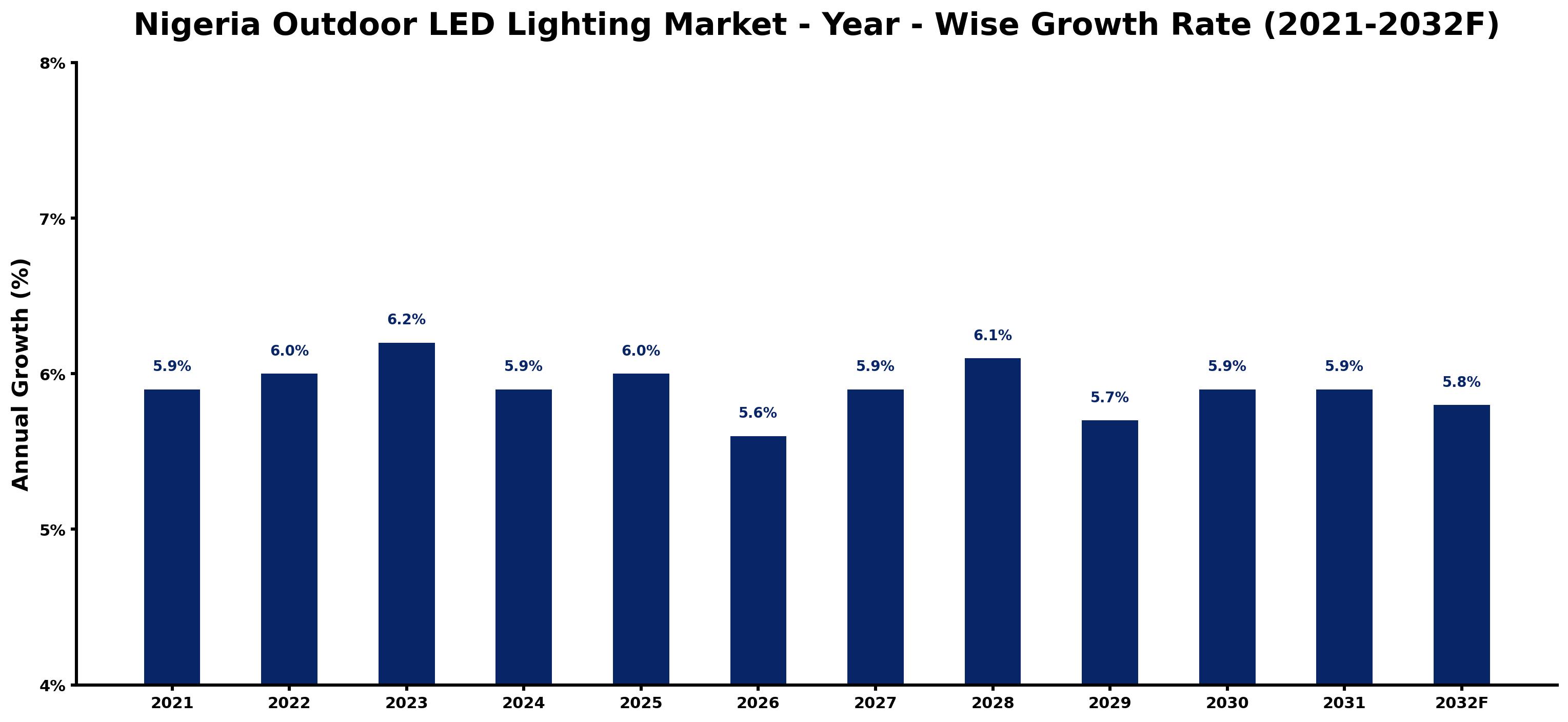
The table below presents the year wise growth rates along with the key drivers influencing the market
| Year | Growth Rate | Major Drivers |
| 2021 | 5.9% | Urbanization spurred infrastructure projects requiring efficient outdoor lighting solutions. |
| 2022 | 6.0% | Increased focus on renewable energy solutions pushed LED adoption in public spaces. |
| 2023 | 6.2% | Emerging smart city initiatives showcased the potential of connected outdoor lighting. |
| 2024 | 5.9% | Competitive pricing from local manufacturers boosted LED installations across Nigeria. |
| 2025 | 6.0% | Public-private partnerships began funding sustainable lighting projects in underserved areas. |
| 2026 | 5.6% | Consumer awareness campaigns highlighted energy savings associated with LED technology. |
| 2027 | 5.9% | Rural electrification projects incorporated outdoor lighting, enhancing community safety and visibility. |
| 2028 | 6.1% | Technological innovations improved LED durability in Nigeria's challenging weather conditions. |
| 2029 | 5.7% | Transportation sector investments led to lighting upgrades along highways and major roads. |
| 2030 | 5.9% | Corporate social responsibility programs began funding community-based lighting initiatives. |
| 2031 | 5.9% | Architectural trends favored LED solutions for aesthetic and functional outdoor applications. |
| 2032 | 5.8% | Collaborations between manufacturers and local governments drove widespread adoption across regions. |
Note - Market size estimations and growth projections presented in this report are based on 6Wresearch's advanced forecasting approach, validated with industry datasets as of June 2026.
Nigeria Outdoor LED Lighting Market Synopsis
The Nigeria Outdoor LED Lighting Market is projected to reach 5.6% and witness significant growth during the forecast period (2026-2032). This market expansion is primarily driven by an increasing need for energy-efficient lighting systems, coupled with heightened consumer awareness regarding the various advantages of LED lighting products. As urbanization accelerates and industrialization intensifies, the demand for innovative lighting solutions is poised to rise substantially. Additionally, favorable economic conditions and supportive government initiatives are further expected to bolster market growth.
Nigeria Outdoor LED Lighting Market Growth Drivers
The primary drivers for the Nigeria Outdoor LED Lighting Market include:
- The rapid pace of urbanization in Nigeria is creating a larger demand for outdoor lighting solutions, particularly in growing metropolitan areas.
- Technological advancements in LED lighting are leading to improved efficiency and performance, making these products more appealing to both consumers and businesses.
- The increasing focus on sustainability and environmental responsibility encourages the transition towards energy-efficient lighting options, helping to reduce carbon footprints.
- Government incentives, such as tax reductions and subsidies for solar-powered outdoor LED lights, are making these options more financially accessible for consumers and businesses alike.
- Growing investments from both public and private sectors in the country's infrastructure development are expected to create a favorable environment for the outdoor LED lighting market to flourish.
Nigeria Outdoor LED Lighting Market Trends and Opportunities
The Nigeria Outdoor LED Lighting Market is currently experiencing several pivotal trends that present opportunities for growth:
- The adoption of smart lighting systems is gaining traction, as municipalities and businesses seek to integrate advanced technologies such as IoT devices for enhanced control and efficiency.
- There is a noticeable shift towards the use of solar-powered LED lights, driven by the abundant sunlight in Nigeria and an increasing preference for renewable energy sources.
- Retail and commercial sectors are witnessing a surge in demand for aesthetically pleasing outdoor lighting, prompting innovation in design and functionality.
- Partnerships between government bodies and private enterprises are fostering development initiatives aimed at boosting local manufacturing of LED products, reducing reliance on imports.
- The exploration of new application areas, such as outdoor recreational spaces and transportation hubs, is expanding the potential market for outdoor LED lighting products.
Nigeria Outdoor LED Lighting Market Challenges and Restraints
Despite its promising growth, the Nigeria Outdoor LED Lighting Market faces several challenges:
- High initial costs associated with the installation of LED lighting systems can deter adoption, particularly among small business owners and residential consumers.
- Limited access to financing and investment for infrastructure projects can hinder the pace of market development.
- Infrastructure issues, such as inadequate power supply and maintenance challenges, may affect the reliable performance of LED lighting systems.
- Market competition from alternative lighting technologies, such as traditional incandescent and fluorescent lighting, poses a threat to market penetration.
- Consumer misconceptions regarding the longevity and effectiveness of LED products can slow down market acceptance and growth.
Nigeria Outdoor LED Lighting Market Government Investment and Initiatives
Government investment and initiatives are pivotal in shaping the Nigeria Outdoor LED Lighting Market. Various strategies aim to enhance energy efficiency and promote sustainable practices:
- The Nigerian government has implemented policies encouraging the adoption of energy-efficient lighting solutions, supported by financial incentives aimed at consumers and businesses.
- Public spending on infrastructure development often includes provisions for improved outdoor lighting, thereby driving demand for modern LED solutions.
- Initiatives to promote solar energy use, particularly in rural areas, are gaining momentum, with outdoor LED lighting often being a key component of these projects.
- Collaboration with international organizations to develop green energy projects reinforces the commitment to sustainable lighting solutions across the country.
- Ongoing government campaigns to raise awareness of environmental issues serve to further prompt the adoption of energy-efficient technologies like LEDs.
Nigeria Outdoor LED Lighting Market Latest Developments (May 2025 - June 2026)
Recent developments in the Nigeria Outdoor LED Lighting Market from May 2025 to June 2026 highlight significant shifts in industry dynamics:
- There has been a noticeable increase in the launch of innovative LED products tailored to specific needs in the outdoor lighting segment, reflecting advancements in technology.
- Investment in research and development activities has amplified, focusing on improving the efficiency and lifespan of LED lighting solutions.
- Public-private partnerships aimed at enhancing urban infrastructure have gained traction, particularly in major cities, expanding the reach of outdoor LED lighting systems.
- Awareness campaigns by non-governmental organizations (NGOs) promoting the advantages of LED usage have contributed to a growing acceptance among local communities.
- Regional trade expos and conferences have increased, showcasing the latest in LED technology and fostering collaboration between stakeholders in the outdoor lighting sector.
Nigeria Outdoor LED Lighting Market - Key Attractiveness of the Report
- 10 Years of Market Numbers
- Historical Data Starting from 2022 to 2025
- Base Year: 2025
- Forecast Data until 2032
- Key Performance Indicators Impacting the Market
- Major Upcoming Developments and Projects
Key Highlights of the Report:
- Nigeria Outdoor LED Lighting Market Outlook
- Market Size of Nigeria Outdoor LED Lighting Market, 2025
- Forecast of Nigeria Outdoor LED Lighting Market, 2032F
- Historical Data and Forecast of Nigeria Outdoor LED Lighting Revenues & Volume for the Period 2022-2032F
- Nigeria Outdoor LED Lighting Market Trend Evolution
- Nigeria Outdoor LED Lighting Market Drivers and Challenges
- Nigeria Outdoor LED Lighting Price Trends
- Nigeria Outdoor LED Lighting Porter's Five Forces
- Nigeria Outdoor LED Lighting Industry Life Cycle
- Historical Data and Forecast of Nigeria Outdoor LED Lighting Market Revenues & Volume By Installation Type for the Period 2022-2032F
- Historical Data and Forecast of Nigeria Outdoor LED Lighting Market Revenues & Volume By New for the Period 2022-2032F
- Historical Data and Forecast of Nigeria Outdoor LED Lighting Market Revenues & Volume By Retrofit for the Period 2022-2032F
- Historical Data and Forecast of Nigeria Outdoor LED Lighting Market Revenues & Volume By Wattage Type for the Period 2022-2032F
- Historical Data and Forecast of Nigeria Outdoor LED Lighting Market Revenues & Volume By Less than 50W for the Period 2022-2032F
- Historical Data and Forecast of Nigeria Outdoor LED Lighting Market Revenues & Volume By 50W to 100W for the Period 2022-2032F
- Historical Data and Forecast of Nigeria Outdoor LED Lighting Market Revenues & Volume By More than 100W for the Period 2022-2032F
- Nigeria Outdoor LED Lighting Import Export Trade Statistics
- Market Opportunity Assessment By Installation Type
- Market Opportunity Assessment By Wattage Type
- Nigeria Outdoor LED Lighting Top Companies Market Share
- Nigeria Outdoor LED Lighting Competitive Benchmarking By Technical and Operational Parameters
- Nigeria Outdoor LED Lighting Company Profiles
- Nigeria Outdoor LED Lighting Key Strategic Recommendations






































