Nigeria Penicillin Market Size Growth Rate
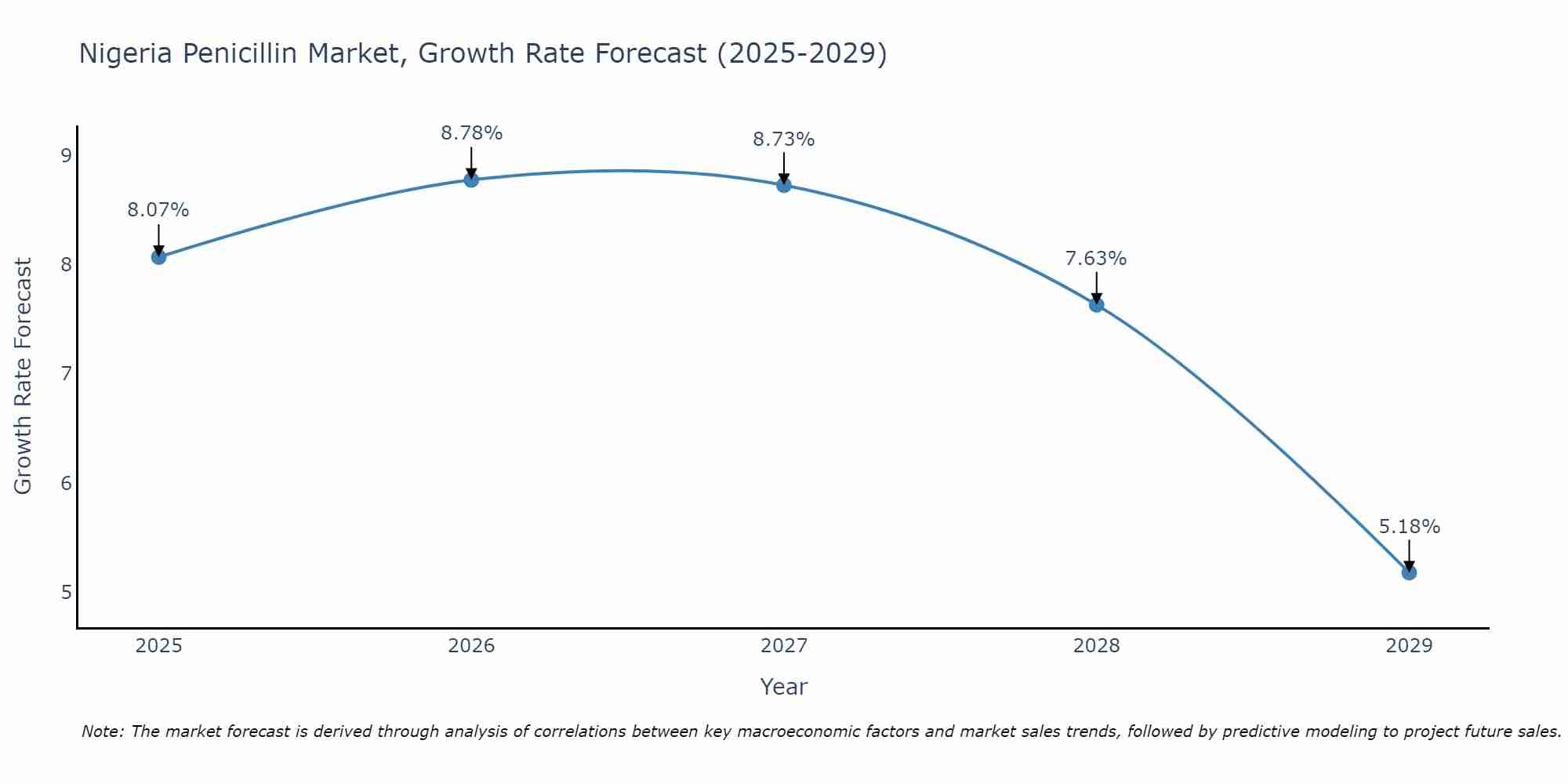
The Nigeria Penicillin Market is projected to witness mixed growth rate patterns during 2025 to 2029. The growth rate begins at 8.07% in 2025, climbs to a high of 8.78% in 2026, and moderates to 5.18% by 2029.
Nigeria Penicillin Market Overview
The Nigeria Penicillin market is characterized by a growing demand for antibiotics due to the increasing prevalence of infectious diseases in the country. Penicillin, as a widely used antibiotic, holds a significant share in the Nigerian pharmaceutical market. Factors such as rising healthcare expenditure, a growing population, and improving access to healthcare facilities are driving the demand for penicillin-based products. Key players in the market include both domestic pharmaceutical companies and multinational corporations. The market is also witnessing increasing investment in research and development for the production of more effective and affordable penicillin formulations to cater to the diverse healthcare needs of the Nigerian population. Regulatory initiatives aimed at ensuring the quality and safety of penicillin products are also influencing market dynamics in Nigeria.
Nigeria Penicillin Market Trends
The Nigeria Penicillin market is experiencing growth driven by increasing cases of bacterial infections and the expanding healthcare sector. With a growing population and rising awareness about the importance of antibiotics, there is a higher demand for penicillin products in Nigeria. The market is also witnessing a shift towards the use of advanced formulations and combination drugs for more effective treatment outcomes. Generic versions of penicillin are becoming increasingly popular due to their affordability and accessibility. Additionally, collaborations between pharmaceutical companies and healthcare providers are contributing to the market`s expansion. Overall, the Nigeria Penicillin market is expected to continue growing in the coming years, driven by factors such as increasing healthcare spending and advancements in medical infrastructure.
Nigeria Penicillin Market Challenges
In the Nigeria Penicillin market, some key challenges include the presence of counterfeit or substandard products, inadequate regulatory oversight leading to potential safety concerns for consumers, and limited access to quality healthcare services in remote areas. Additionally, pricing pressures and competition from cheaper generic alternatives can impact the market growth. The lack of awareness among healthcare professionals and patients about the appropriate use of Penicillin and antibiotic resistance poses a significant challenge as well. Supply chain inefficiencies, such as distribution and storage issues, can further hamper the availability of Penicillin products in certain regions. Addressing these challenges will require collaboration between government regulatory bodies, pharmaceutical companies, healthcare providers, and other stakeholders to ensure the availability of safe and effective Penicillin products across Nigeria.
Nigeria Penicillin Market Investment Opportunities
The Nigeria Penicillin Market offers promising investment opportunities due to the increasing demand for antibiotics in the country`s healthcare sector. With a growing population and rising awareness about healthcare, there is a continuous need for penicillin to treat various bacterial infections. Investors can consider opportunities in the manufacturing and distribution of penicillin products, as well as research and development of new formulations to cater to specific healthcare needs in Nigeria. Additionally, partnerships with local healthcare providers and government agencies can help in expanding market reach and ensuring regulatory compliance. Overall, investing in the Nigeria Penicillin Market can be a lucrative option given the country`s healthcare landscape and the ongoing demand for essential antibiotics like penicillin.
Nigeria Penicillin Market Government Policy
The Nigerian government has implemented strict regulations and policies governing the Penicillin market to ensure the safety and efficacy of antibiotics in the country. The National Agency for Food and Drug Administration and Control (NAFDAC) oversees the registration and approval of Penicillin products, ensuring they meet quality standards and are safe for consumption. Additionally, the government has put in place measures to combat the proliferation of counterfeit Penicillin drugs, which pose a significant threat to public health. These policies aim to regulate the production, distribution, and sale of Penicillin in Nigeria, safeguarding the population from the risks associated with substandard or fake antibiotics. Overall, the government`s stringent regulations in the Penicillin market are crucial for promoting public health and ensuring the effectiveness of antibiotic treatment in the country.
Nigeria Penicillin Market Future Outlook
The Nigeria Penicillin market is expected to witness steady growth in the coming years, driven by factors such as increasing healthcare infrastructure development, rising awareness about the importance of antibiotics, and a growing number of infectious diseases. The demand for penicillin is likely to be fueled by the country`s large population and the corresponding high incidence of bacterial infections. Additionally, the government`s efforts to improve access to healthcare services and the presence of key market players investing in research and development activities are expected to further boost market growth. However, challenges such as counterfeit drugs and regulatory hurdles may pose a threat to market expansion. Overall, the Nigeria Penicillin market is poised for growth, with opportunities for market players to capitalize on the increasing demand for antibiotics in the country.
Key Highlights of the Report:
- Nigeria Penicillin Market Outlook
- Market Size of Nigeria Penicillin Market, 2021
- Forecast of Nigeria Penicillin Market, 2031
- Historical Data and Forecast of Nigeria Penicillin Revenues & Volume for the Period 2021 - 2031
- Nigeria Penicillin Market Trend Evolution
- Nigeria Penicillin Market Drivers and Challenges
- Nigeria Penicillin Price Trends
- Nigeria Penicillin Porter's Five Forces
- Nigeria Penicillin Industry Life Cycle
- Historical Data and Forecast of Nigeria Penicillin Market Revenues & Volume By Product for the Period 2021 - 2031
- Historical Data and Forecast of Nigeria Penicillin Market Revenues & Volume By Bulk for the Period 2021 - 2031
- Historical Data and Forecast of Nigeria Penicillin Market Revenues & Volume By Dosage for the Period 2021 - 2031
- Historical Data and Forecast of Nigeria Penicillin Market Revenues & Volume By Type for the Period 2021 - 2031
- Historical Data and Forecast of Nigeria Penicillin Market Revenues & Volume By Aminopenicillin for the Period 2021 - 2031
- Historical Data and Forecast of Nigeria Penicillin Market Revenues & Volume By Antipseudomonal Penicillin for the Period 2021 - 2031
- Historical Data and Forecast of Nigeria Penicillin Market Revenues & Volume By Beta-lactamase Inhibitor for the Period 2021 - 2031
- Historical Data and Forecast of Nigeria Penicillin Market Revenues & Volume By Natural Penicillin for the Period 2021 - 2031
- Historical Data and Forecast of Nigeria Penicillin Market Revenues & Volume By Penicillinase-resistant Penicillin for the Period 2021 - 2031
- Historical Data and Forecast of Nigeria Penicillin Market Revenues & Volume By Manufacturing Process for the Period 2021 - 2031
- Historical Data and Forecast of Nigeria Penicillin Market Revenues & Volume By Synthetic Process for the Period 2021 - 2031
- Historical Data and Forecast of Nigeria Penicillin Market Revenues & Volume By Natural Process for the Period 2021 - 2031
- Historical Data and Forecast of Nigeria Penicillin Market Revenues & Volume By Semisynthetic Process for the Period 2021 - 2031
- Historical Data and Forecast of Nigeria Penicillin Market Revenues & Volume By Mode of Delivery for the Period 2021 - 2031
- Historical Data and Forecast of Nigeria Penicillin Market Revenues & Volume By Oral for the Period 2021 - 2031
- Historical Data and Forecast of Nigeria Penicillin Market Revenues & Volume By Intramuscular for the Period 2021 - 2031
- Historical Data and Forecast of Nigeria Penicillin Market Revenues & Volume By Intravenous for the Period 2021 - 2031
- Historical Data and Forecast of Nigeria Penicillin Market Revenues & Volume By End User for the Period 2021 - 2031
- Historical Data and Forecast of Nigeria Penicillin Market Revenues & Volume By Hospitals for the Period 2021 - 2031
- Historical Data and Forecast of Nigeria Penicillin Market Revenues & Volume By Clinics for the Period 2021 - 2031
- Historical Data and Forecast of Nigeria Penicillin Market Revenues & Volume By Research Institutes for the Period 2021 - 2031
- Historical Data and Forecast of Nigeria Penicillin Market Revenues & Volume By Others for the Period 2021 - 2031
- Nigeria Penicillin Import Export Trade Statistics
- Market Opportunity Assessment By Product
- Market Opportunity Assessment By Type
- Market Opportunity Assessment By Manufacturing Process
- Market Opportunity Assessment By Mode of Delivery
- Market Opportunity Assessment By End User
- Nigeria Penicillin Top Companies Market Share
- Nigeria Penicillin Competitive Benchmarking By Technical and Operational Parameters
- Nigeria Penicillin Company Profiles
- Nigeria Penicillin Key Strategic Recommendations






































