Nigeria Spinning Machinery Market Size, Share & Growth Rate
The Nigeria Spinning Machinery Market was estimated at USD 176 Million in 2025 and is projected to reach USD 231 Million by 2032, growing at a CAGR of 4.0% from 2026 to 2032. This growth is underpinned by a robust expansion of the local textile industry, driven by increasing domestic and international demand for yarn. Government initiatives aimed at enhancing local production capabilities further boost market prospects, positioning Nigeria as a burgeoning hub for textile manufacturing.
Nigeria Spinning Machinery Market Year-wise Growth Rate and Key Drivers
This graph highlights how the Nigeria Spinning Machinery Market has steadily grown over the years, supported by major growth factors.
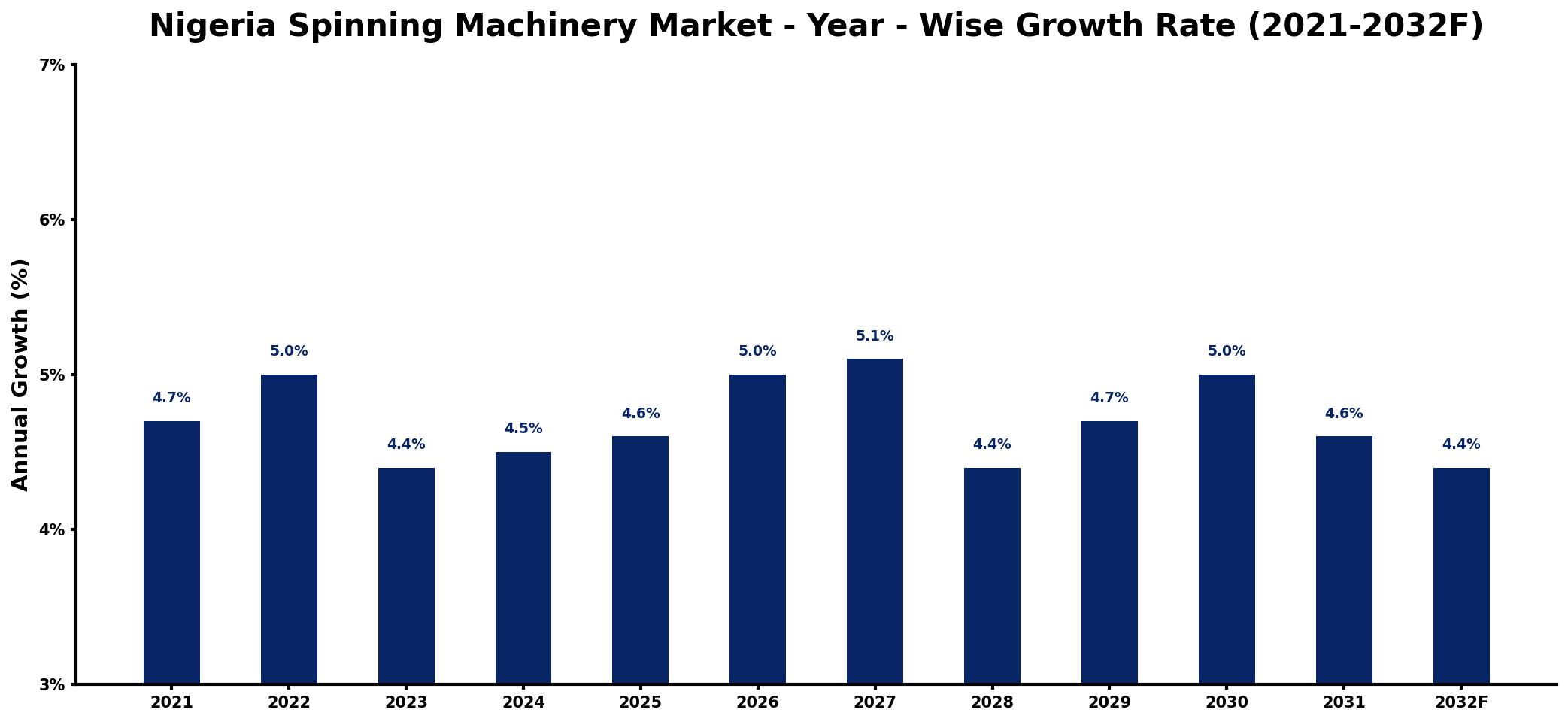
The table below presents the year‑wise growth rates along with the key drivers influencing the market
| Year | Growth Rate | Major Drivers |
| 2021 | 4.7% | Rising textile production capacity |
| 2022 | 5.0% | Increased investment in manufacturing |
| 2023 | 4.4% | Growing export opportunities emerging |
| 2024 | 4.5% | Expansion of local textile firms |
| 2025 | 4.6% | Strengthening supply chain networks |
| 2026 | 5.0% | Technological advancements in production |
| 2027 | 5.1% | Surge in consumer demand trends |
| 2028 | 4.4% | Diversification of textile applications |
| 2029 | 4.7% | Enhanced collaboration with stakeholders |
| 2030 | 5.0% | Growing sustainability initiatives adopted |
| 2031 | 4.6% | Increased government support programs |
| 2032 | 4.4% | Emerging market potential recognized |
Note: Market size estimations and growth projections presented in this report are based on 6Wresearch's proprietary forecasting methodology, utilizing the latest available industry data, government publications, and primary research inputs.
Nigeria Spinning Machinery Market Synopsis
The Nigeria spinning machinery market is at a pivotal juncture, fueled by the country's commitment to revitalizing its textile sector. Recent governmental policies have led to an influx of investments, fostering a renewed interest in modern spinning technologies that promise higher efficiency and quality in yarn production.
As Nigeria continues to develop its manufacturing capabilities, particularly in textiles, there is a marked shift towards adopting advanced spinning machinery. This trend not only enhances productivity but also reflects a growing awareness of sustainability practices among manufacturers seeking to minimize their environmental impact.
Nigeria Spinning Machinery Market Key Takeaways
- The market is projected to grow steadily, reaching USD 231 Million by 2032.
- Increased demand for textiles drives the need for modern spinning technologies.
- Sustainability is becoming a focal point, with eco-friendly machinery gaining traction.
- Government initiatives support local production, reducing reliance on imports.
- Investment opportunities in maintenance and supply services are on the rise.
Evaluation of Restraints in Nigeria Spinning Machinery Market
Despite promising growth prospects, the Nigeria spinning machinery market grapples with significant restraints. High import tariffs on machinery inflate operational costs, making it challenging for new spinning mills to establish themselves. Additionally, the country faces a shortage of skilled labor capable of operating advanced machinery, hindering operational efficiency. Infrastructure deficiencies, particularly concerning power supply and transportation, exacerbate these challenges, leading to delays and increased costs in the supply chain.
Nigeria Spinning Machinery Market Trends
The Nigeria spinning machinery market is witnessing a technological renaissance, with increasing investments in automation and computerized machinery. This transition aims to enhance yarn quality while simultaneously reducing labor costs. A noteworthy trend is the rise of compact spinning technology, which not only boosts yarn strength but also aligns with sustainability goals by minimizing energy consumption. Such advancements position local manufacturers to compete effectively in both domestic and international markets.
Nigeria Spinning Machinery Market Opportunities
Investment opportunities abound within the Nigeria spinning machinery market, particularly as the textile sector continues to expand. There is a significant demand for cutting-edge spinning equipment, as local manufacturers seek to modernize their operations. Investors can explore avenues in supplying high-quality machinery, establishing spinning mills, or offering maintenance and repair services to existing operations. The favorable regulatory environment, coupled with an increasing consumer base, creates a lucrative landscape for investment.
Government Initiatives in the Nigeria Spinning Machinery Market
The Nigerian government has launched several initiatives to bolster the spinning machinery market. The National Industrial Revolution Plan (NIRP) serves as a cornerstone for boosting local manufacturing, particularly within textiles. Import restrictions and tariffs are strategically employed to support domestic production and limit reliance on foreign goods. Furthermore, policies aimed at enhancing the Cotton, Textile, and Garment (CTG) value chain are designed to increase local manufacturers' competitiveness, fostering an environment conducive to growth.
Future Insights of the Nigeria Spinning Machinery Market
Looking ahead, the Nigeria spinning machinery market is poised for substantial growth between 2026 and 2032. The interplay of rising disposable incomes, urbanization, and an expanding population will sustain demand for textiles. As governmental support for the sector continues, coupled with technological advancements in automation and digitalization, manufacturers will be equipped to optimize productivity. This trajectory not only promises growth for existing players but also invites new entrants to capitalize on the burgeoning market opportunities.
Nigeria Spinning Machinery Market Latest Developments (2025 - 2026)
Recent developments in the Nigeria spinning machinery market signal a shift towards greater modernization. Industry stakeholders are increasingly focusing on R&D to develop cutting-edge machinery tailored to local needs. Additionally, partnerships between government entities and private sector players are emerging, aimed at enhancing the training of skilled labor to meet the demand for modern spinning technology. These initiatives reflect a collective effort to overcome existing challenges and position Nigeria as a leader in textile manufacturing.
Nigeria Spinning Machinery Market - Key Attractiveness of the Report
- 10 Years of Market Numbers
- Historical Data Starting from 2022 to 2025
- Base Year: 2025
- Forecast Data until 2032
- Key Performance Indicators Impacting the Market
- Major Upcoming Developments and Projects
Key Highlights of the Report:
- Nigeria Spinning Machinery Market Outlook
- Market Size of Nigeria Spinning Machinery Market, 2025
- Forecast of Nigeria Spinning Machinery Market, 2032
- Historical Data and Forecast of Nigeria Spinning Machinery Revenues & Volume for the Period 2022-2032F
- Nigeria Spinning Machinery Market Trend Evolution
- Nigeria Spinning Machinery Market Drivers and Challenges
- Nigeria Spinning Machinery Price Trends
- Nigeria Spinning Machinery Porter's Five Forces
- Nigeria Spinning Machinery Industry Life Cycle
- Historical Data and Forecast of Nigeria Spinning Machinery Market Revenues & Volume By Type for the Period 2022-2032F
- Historical Data and Forecast of Nigeria Spinning Machinery Market Revenues & Volume By Ring for the Period 2022-2032F
- Historical Data and Forecast of Nigeria Spinning Machinery Market Revenues & Volume By Rotor Spinning for the Period 2022-2032F
- Historical Data and Forecast of Nigeria Spinning Machinery Market Revenues & Volume By Material for the Period 2022-2032F
- Historical Data and Forecast of Nigeria Spinning Machinery Market Revenues & Volume By Natural for the Period 2022-2032F
- Historical Data and Forecast of Nigeria Spinning Machinery Market Revenues & Volume By Synthetic for the Period 2022-2032F
- Historical Data and Forecast of Nigeria Spinning Machinery Market Revenues & Volume By Others for the Period 2022-2032F
- Historical Data and Forecast of Nigeria Spinning Machinery Market Revenues & Volume By End-Use Industry for the Period 2022-2032F
- Historical Data and Forecast of Nigeria Spinning Machinery Market Revenues & Volume By Clothing for the Period 2022-2032F
- Historical Data and Forecast of Nigeria Spinning Machinery Market Revenues & Volume By Textile for the Period 2022-2032F
- Historical Data and Forecast of Nigeria Spinning Machinery Market Revenues & Volume By Other Industry for the Period 2022-2032F
- Nigeria Spinning Machinery Import Export Trade Statistics
- Market Opportunity Assessment By Type
- Market Opportunity Assessment By Material
- Market Opportunity Assessment By End-Use Industry
- Nigeria Spinning Machinery Top Companies Market Share
- Nigeria Spinning Machinery Competitive Benchmarking By Technical and Operational Parameters
- Nigeria Spinning Machinery Company Profiles
- Nigeria Spinning Machinery Key Strategic Recommendations






































