Nigeria Vetiver Oil Market Top 5 Importing Countries and Market Competition (HHI) Analysis
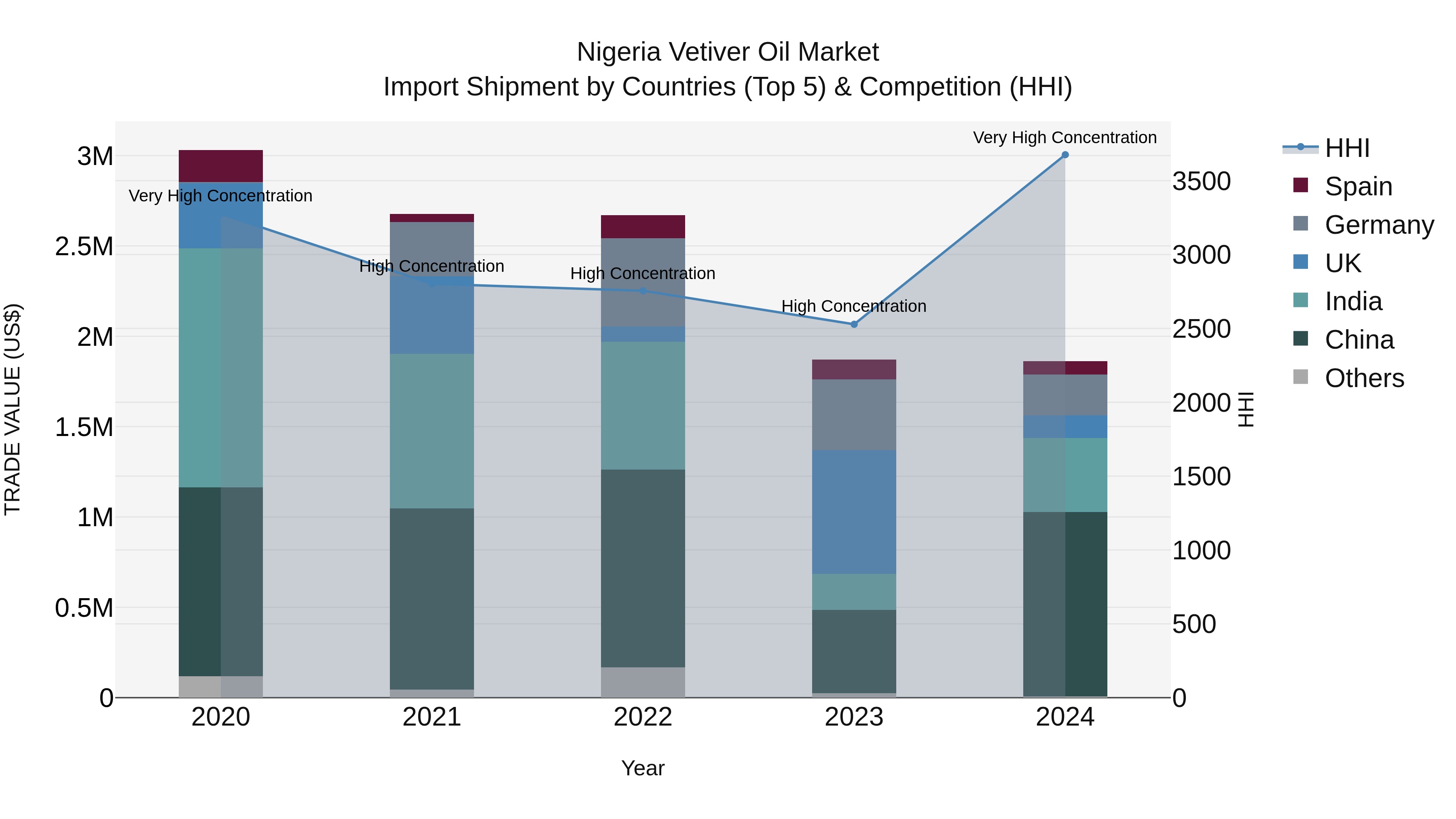
The import shipments of vetiver oil to Nigeria in 2024 continue to be dominated by key exporters such as China, India, Germany, UK, and Spain. The market shows signs of high concentration, with the Herfindahl-Hirschman Index (HHI) reaching very high levels in 2024 compared to 2023. The industry experienced a negative Compound Annual Growth Rate (CAGR) of -11.45% from 2020 to 2024, with a slight decline in the growth rate from 2023 to 2024. Despite challenges, the Nigerian market for vetiver oil imports remains competitive with significant contributions from top exporting countries.
Nigeria Vetiver Oil Market Overview
The Nigeria vetiver oil market pertains to the cultivation, extraction, and trade of vetiver essential oil, derived from the roots of the vetiver grass (Vetiveria zizanioides). Vetiver oil is valued for its aromatic properties and is used in perfumery, cosmetics, aromatherapy, and traditional medicine. This market involves farmers, essential oil producers, traders, and end-users and is influenced by factors such as agricultural practices, market demand for natural ingredients, and regulatory standards for essential oils.
Drivers of the market
The vetiver oil market in Nigeria is driven by the rising demand for natural and organic products in the cosmetic and fragrance industries. Vetiver oil`s therapeutic properties, such as its use in aromatherapy and traditional medicine, also boost its demand. Increasing awareness about the benefits of vetiver oil in skincare and personal care products further supports market growth. Additionally, the agricultural sector`s interest in cultivating vetiver for soil erosion control and other environmental benefits contributes to the market`s expansion.
Challenges of the market
The vetiver oil market in Nigeria faces obstacles such as limited cultivation and production capacity, which restricts the supply of raw materials. The lack of modern processing facilities and technology results in lower quality oil, affecting its competitiveness in the global market. Additionally, inadequate market access and the absence of established supply chains make it difficult for local producers to reach international buyers. Economic constraints and limited government support for the vetiver industry further hinder the growth and development of this market in Nigeria.
Government Policy of the market
The Nigeria government supports the cultivation and processing of vetiver for its oil due to its potential economic benefits. Policies include incentives for small and medium-sized enterprises (SMEs) engaged in vetiver oil production, support for research and development, and efforts to promote Nigeria vetiver oil in international markets as part of the non-oil export diversification strategy.
Key Highlights of the Report:
- Nigeria Vetiver Oil Market Outlook
- Market Size of Nigeria Vetiver Oil Market, 2024
- Forecast of Nigeria Vetiver Oil Market, 2031
- Historical Data and Forecast of Nigeria Vetiver Oil Revenues & Volume for the Period 2021-2031
- Nigeria Vetiver Oil Market Trend Evolution
- Nigeria Vetiver Oil Market Drivers and Challenges
- Nigeria Vetiver Oil Price Trends
- Nigeria Vetiver Oil Porter's Five Forces
- Nigeria Vetiver Oil Industry Life Cycle
- Historical Data and Forecast of Nigeria Vetiver Oil Market Revenues & Volume By Application for the Period 2021-2031
- Historical Data and Forecast of Nigeria Vetiver Oil Market Revenues & Volume By Medical for the Period 2021-2031
- Historical Data and Forecast of Nigeria Vetiver Oil Market Revenues & Volume By Food & Beverage for the Period 2021-2031
- Historical Data and Forecast of Nigeria Vetiver Oil Market Revenues & Volume By Spa & Relaxation for the Period 2021-2031
- Nigeria Vetiver Oil Import Export Trade Statistics
- Market Opportunity Assessment By Application
- Nigeria Vetiver Oil Top Companies Market Share
- Nigeria Vetiver Oil Competitive Benchmarking By Technical and Operational Parameters
- Nigeria Vetiver Oil Company Profiles
- Nigeria Vetiver Oil Key Strategic Recommendations






































