Norway Anti Reflective Glass Market Growth Rate Analysis (2025 - 2031)
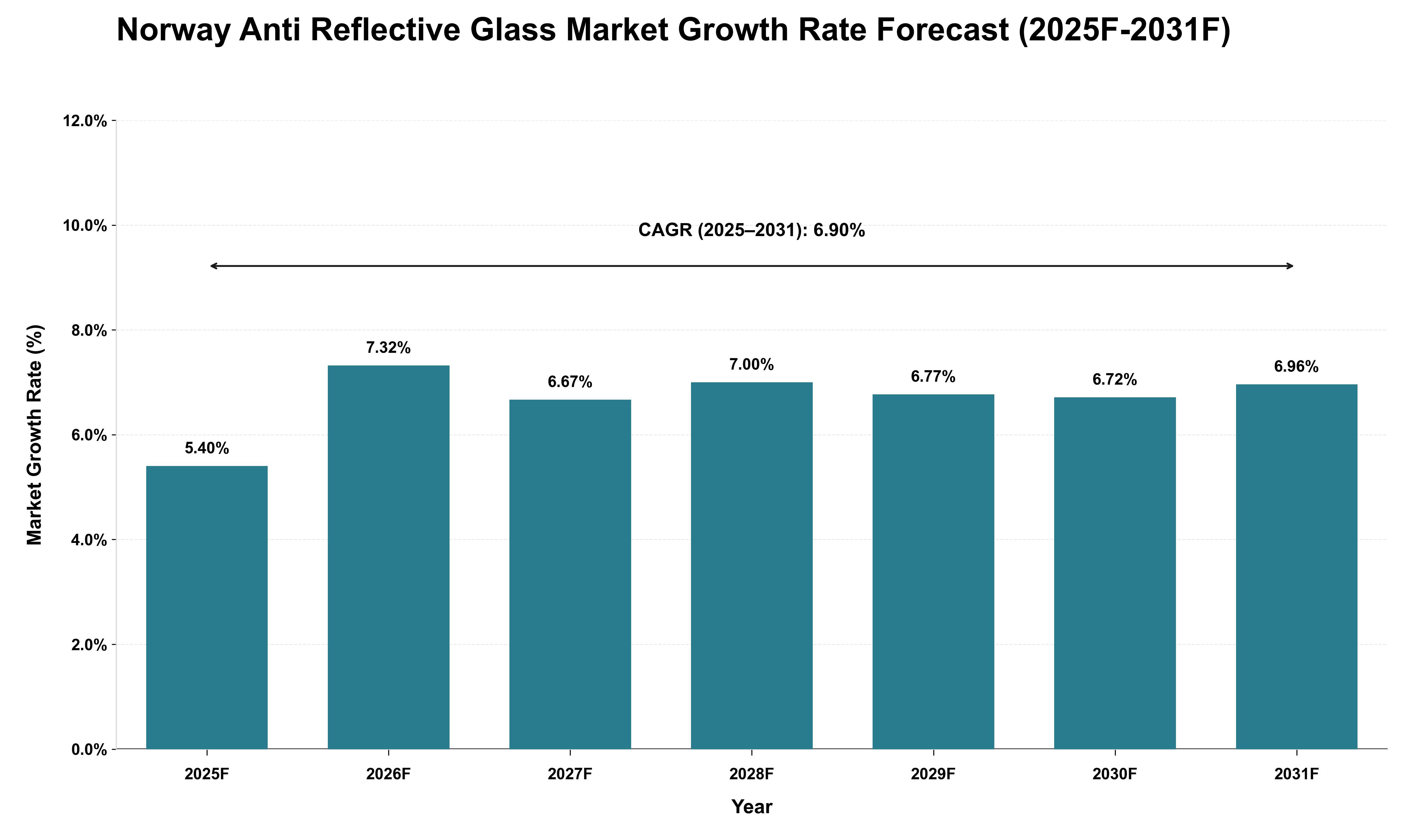
The forecasted growth trajectory for the Norway anti-reflective glass market will exhibit a notable acceleration in the early years, with an initial growth rate of 5.40% in 2025, followed by a peak of 7.32% in 2026, before stabilizing around the mid-6% range through to 2031. This pattern suggests that supply chain dynamics and input costs will play critical roles in shaping market performance. As demand for advanced optical materials increases across various sectors, including electronics and automotive, manufacturers will likely face pressures related to raw material sourcing and logistics. The anticipated CAGR of 6.90% indicates that while growth may moderate after the initial surge, sustained investment in production efficiency and technological advancements will be essential to mitigate rising input costs and maintain competitive pricing. Consequently, fluctuations in global supply chains could significantly influence profitability within this sector during the forecast period.
Key Highlights of the Report:
- Norway Anti Reflective Glass Market Outlook
- Market Size of Norway Anti Reflective Glass Market, 2024
- Forecast of Norway Anti Reflective Glass Market, 2031
- Historical Data and Forecast of Norway Anti Reflective Glass Revenues & Volume for the Period 2021-2031
- Norway Anti Reflective Glass Market Trend Evolution
- Norway Anti Reflective Glass Market Drivers and Challenges
- Norway Anti Reflective Glass Price Trends
- Norway Anti Reflective Glass Porter`s Five Forces
- Norway Anti Reflective Glass Industry Life Cycle
- Historical Data and Forecast of Norway Anti Reflective Glass Market Revenues & Volume By Type for the Period 2021-2031
- Historical Data and Forecast of Norway Anti Reflective Glass Market Revenues & Volume By Double Layers for the Period 2021-2031
- Historical Data and Forecast of Norway Anti Reflective Glass Market Revenues & Volume By Four Layers for the Period 2021-2031
- Historical Data and Forecast of Norway Anti Reflective Glass Market Revenues & Volume By Others for the Period 2021-2031
- Historical Data and Forecast of Norway Anti Reflective Glass Market Revenues & Volume By Application for the Period 2021-2031
- Historical Data and Forecast of Norway Anti Reflective Glass Market Revenues & Volume By Architectural Windows for the Period 2021-2031
- Historical Data and Forecast of Norway Anti Reflective Glass Market Revenues & Volume By Instrumentation Windows for the Period 2021-2031
- Historical Data and Forecast of Norway Anti Reflective Glass Market Revenues & Volume By Electronic Displays for the Period 2021-2031
- Historical Data and Forecast of Norway Anti Reflective Glass Market Revenues & Volume By Picture Framing Glass for the Period 2021-2031
- Historical Data and Forecast of Norway Anti Reflective Glass Market Revenues & Volume By Showcase Glass for the Period 2021-2031
- Historical Data and Forecast of Norway Anti Reflective Glass Market Revenues & Volume By Cold Storage Displays for the Period 2021-2031
- Historical Data and Forecast of Norway Anti Reflective Glass Market Revenues & Volume By Lamps Glass for the Period 2021-2031
- Historical Data and Forecast of Norway Anti Reflective Glass Market Revenues & Volume By Others for the Period 2021-2031
- Norway Anti Reflective Glass Import Export Trade Statistics
- Market Opportunity Assessment By Type
- Market Opportunity Assessment By Application
- Norway Anti Reflective Glass Top Companies Market Share
- Norway Anti Reflective Glass Competitive Benchmarking By Technical and Operational Parameters
- Norway Anti Reflective Glass Company Profiles
- Norway Anti Reflective Glass Key Strategic Recommendations






































