Norway Lubricants Market Growth Rate Analysis (2025 - 2031)
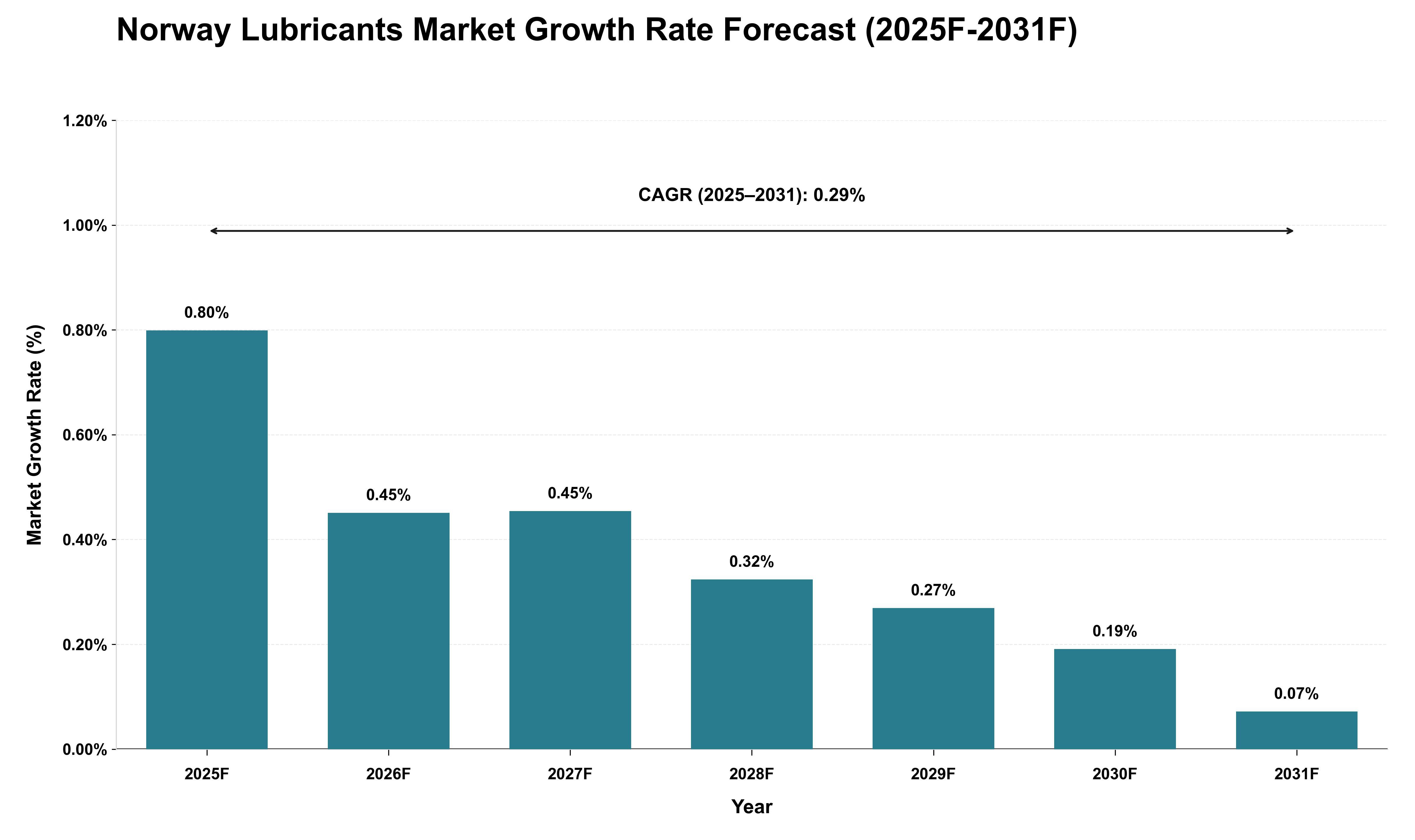
The Norway lubricants market will experience a gradual transition influenced by technological advancements and product substitution dynamics over the forecast period. As the industry adapts to increasing environmental regulations, there will be a shift towards bio-based and synthetic lubricants, which are expected to gain traction despite the overall modest CAGR of 0.29%. The annual growth rates will likely reflect this transition, with initial increases in 2025 at 0.80% tapering off to just 0.07% by 2031. This deceleration may stem from heightened import dependencies as domestic production struggles to keep pace with evolving consumer preferences for more sustainable options. Additionally, cyclical trends in automotive and industrial sectors will impact lubricant demand, as fluctuations in production levels could lead to varying consumption patterns throughout the forecast horizon. Overall, these factors will shape a nuanced landscape for lubricant products in Norway, emphasizing innovation and adaptability amidst changing market conditions.
Key Highlights of the Report:
- Norway Lubricants Market Outlook
- Market Size of Norway Lubricants Market, 2024
- Forecast of Norway Lubricants Market, 2031
- Historical Data and Forecast of Norway Lubricants Revenues & Volume for the Period 2021-2031
- Norway Lubricants Market Trend Evolution
- Norway Lubricants Market Drivers and Challenges
- Norway Lubricants Price Trends
- Norway Lubricants Porter`s Five Forces
- Norway Lubricants Industry Life Cycle
- Historical Data and Forecast of Norway Lubricants Market Revenues & Volume By Base oil for the Period 2021-2031
- Historical Data and Forecast of Norway Lubricants Market Revenues & Volume By Mineral Oil for the Period 2021-2031
- Historical Data and Forecast of Norway Lubricants Market Revenues & Volume By Synthetic Oil for the Period 2021-2031
- Historical Data and Forecast of Norway Lubricants Market Revenues & Volume By Bio-based Oil for the Period 2021-2031
- Historical Data and Forecast of Norway Lubricants Market Revenues & Volume By Product Type for the Period 2021-2031
- Historical Data and Forecast of Norway Lubricants Market Revenues & Volume By Engine Oil for the Period 2021-2031
- Historical Data and Forecast of Norway Lubricants Market Revenues & Volume By Hydraulic fluid for the Period 2021-2031
- Historical Data and Forecast of Norway Lubricants Market Revenues & Volume By Metalworking fluid for the Period 2021-2031
- Historical Data and Forecast of Norway Lubricants Market Revenues & Volume By Gear Oil for the Period 2021-2031
- Historical Data and Forecast of Norway Lubricants Market Revenues & Volume By Compressor oil for the Period 2021-2031
- Historical Data and Forecast of Norway Lubricants Market Revenues & Volume By Grease for the Period 2021-2031
- Historical Data and Forecast of Norway Lubricants Market Revenues & Volume By Turbine Oil for the Period 2021-2031
- Historical Data and Forecast of Norway Lubricants Market Revenues & Volume By Others for the Period 2021-2031
- Historical Data and Forecast of Norway Lubricants Market Revenues & Volume By End-Use Industry for the Period 2021-2031
- Historical Data and Forecast of Norway Lubricants Market Revenues & Volume By Transportation for the Period 2021-2031
- Historical Data and Forecast of Norway Lubricants Market Revenues & Volume By Industrial for the Period 2021-2031
- Norway Lubricants Import Export Trade Statistics
- Market Opportunity Assessment By Base oil
- Market Opportunity Assessment By Product Type
- Market Opportunity Assessment By End-Use Industry
- Norway Lubricants Top Companies Market Share
- Norway Lubricants Competitive Benchmarking By Technical and Operational Parameters
- Norway Lubricants Company Profiles
- Norway Lubricants Key Strategic Recommendations






































