Norway Turmeric Market Growth Rate Analysis (2025 - 2031)
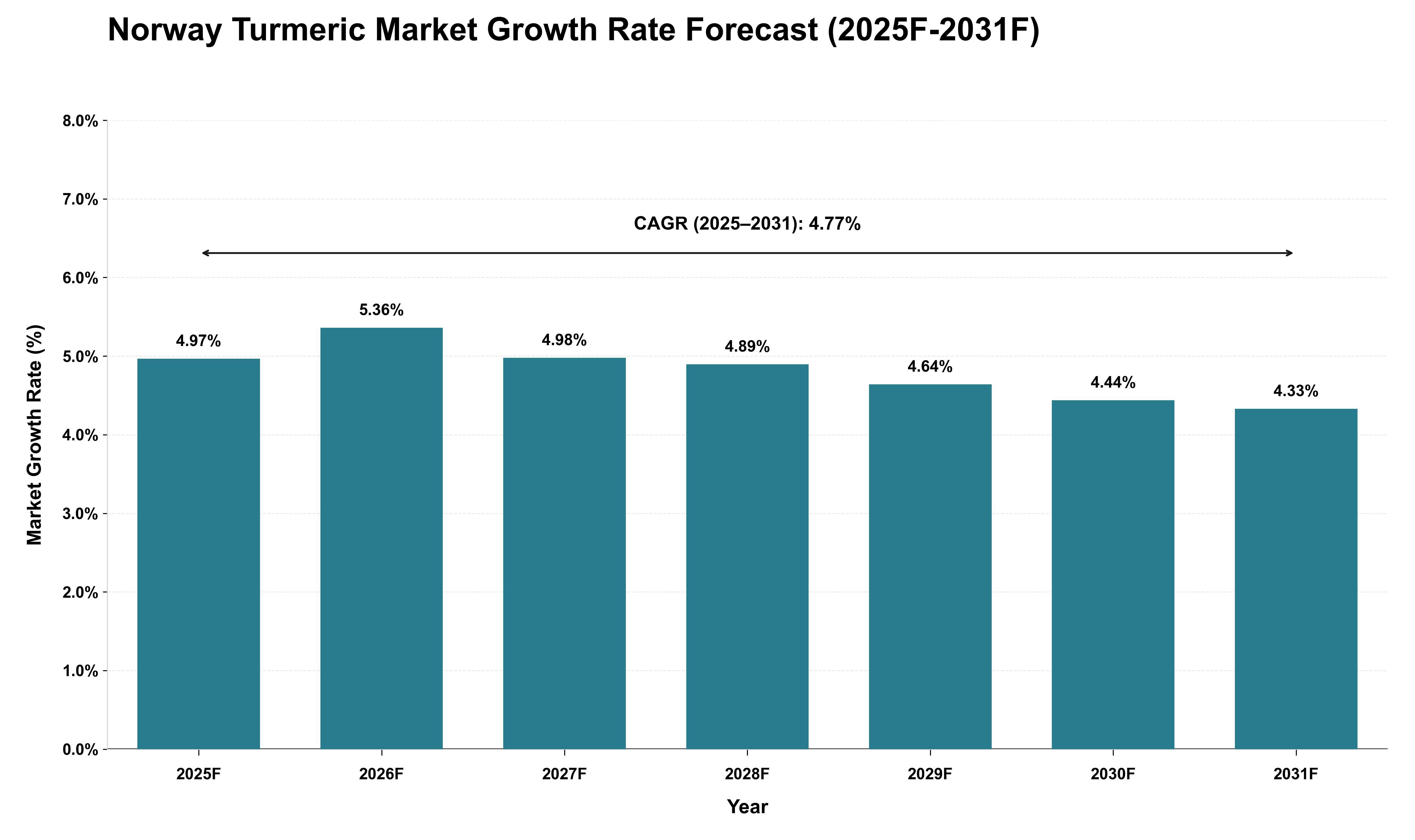
The Norway turmeric market is projected to experience a compound annual growth rate of 4.77% from 2025 to 2031, reflecting a robust demand trajectory influenced by evolving consumer preferences and health trends. Regulatory frameworks surrounding food safety and import standards will play a crucial role in shaping market dynamics, as Norway's stringent regulations may impact the sourcing and pricing of turmeric imports. The annual growth rates indicate an initial acceleration in demand, peaking at 5.36% in 2026, likely driven by increased awareness of turmeric's health benefits and its incorporation into dietary practices. However, as the forecast progresses, growth rates are expected to gradually decline, suggesting potential challenges such as import dependency on specific regions and fluctuations in global supply chains that could affect availability and pricing stability. Overall, the interplay between regulatory policies and cyclical market trends will be pivotal in determining the future landscape of the turmeric market in Norway.
Key Highlights of the Report:
- Norway Turmeric Market Outlook
- Market Size of Norway Turmeric Market, 2025
- Forecast of Norway Turmeric Market, 2032
- Historical Data and Forecast of Norway Turmeric Revenues & Volume for the Period 2022 - 2032F
- Norway Turmeric Market Trend Evolution
- Norway Turmeric Market Drivers and Challenges
- Norway Turmeric Price Trends
- Norway Turmeric Porter's Five Forces
- Norway Turmeric Industry Life Cycle
- Historical Data and Forecast of Norway Turmeric Market Revenues & Volume By Type for the Period 2022 - 2032F
- Historical Data and Forecast of Norway Turmeric Market Revenues & Volume By Organic for the Period 2022 - 2032F
- Historical Data and Forecast of Norway Turmeric Market Revenues & Volume By Conventional for the Period 2022 - 2032F
- Historical Data and Forecast of Norway Turmeric Market Revenues & Volume By Processed for the Period 2022 - 2032F
- Historical Data and Forecast of Norway Turmeric Market Revenues & Volume By Infused for the Period 2022 - 2032F
- Historical Data and Forecast of Norway Turmeric Market Revenues & Volume By Others for the Period 2022 - 2032F
- Historical Data and Forecast of Norway Turmeric Market Revenues & Volume By Form for the Period 2022 - 2032F
- Historical Data and Forecast of Norway Turmeric Market Revenues & Volume By Powder for the Period 2022 - 2032F
- Historical Data and Forecast of Norway Turmeric Market Revenues & Volume By Whole for the Period 2022 - 2032F
- Historical Data and Forecast of Norway Turmeric Market Revenues & Volume By Extracts for the Period 2022 - 2032F
- Historical Data and Forecast of Norway Turmeric Market Revenues & Volume By Capsules for the Period 2022 - 2032F
- Historical Data and Forecast of Norway Turmeric Market Revenues & Volume By Application for the Period 2022 - 2032F
- Historical Data and Forecast of Norway Turmeric Market Revenues & Volume By Culinary Use for the Period 2022 - 2032F
- Historical Data and Forecast of Norway Turmeric Market Revenues & Volume By Medicinal Use for the Period 2022 - 2032F
- Historical Data and Forecast of Norway Turmeric Market Revenues & Volume By Skincare for the Period 2022 - 2032F
- Historical Data and Forecast of Norway Turmeric Market Revenues & Volume By Herbal Therapy for the Period 2022 - 2032F
- Historical Data and Forecast of Norway Turmeric Market Revenues & Volume By Nutritional Supplements for the Period 2022 - 2032F
- Historical Data and Forecast of Norway Turmeric Market Revenues & Volume By End Use for the Period 2022 - 2032F
- Historical Data and Forecast of Norway Turmeric Market Revenues & Volume By Households for the Period 2022 - 2032F
- Historical Data and Forecast of Norway Turmeric Market Revenues & Volume By Pharmaceuticals for the Period 2022 - 2032F
- Historical Data and Forecast of Norway Turmeric Market Revenues & Volume By Personal Care for the Period 2022 - 2032F
- Historical Data and Forecast of Norway Turmeric Market Revenues & Volume By Alternative Medicine for the Period 2022 - 2032F
- Historical Data and Forecast of Norway Turmeric Market Revenues & Volume By Nutraceuticals for the Period 2022 - 2032F
- Historical Data and Forecast of Norway Turmeric Market Revenues & Volume By End Use for the Period 2022 - 2032F
- Historical Data and Forecast of Norway Turmeric Market Revenues & Volume By Professional Tattooing for the Period 2022 - 2032F
- Historical Data and Forecast of Norway Turmeric Market Revenues & Volume By Tattoo Studios for the Period 2022 - 2032F
- Norway Turmeric Import Export Trade Statistics
- Market Opportunity Assessment By Type
- Market Opportunity Assessment By Form
- Market Opportunity Assessment By Application
- Market Opportunity Assessment By End Use
- Market Opportunity Assessment By End Use
- Norway Turmeric Top Companies Market Share
- Norway Turmeric Competitive Benchmarking By Technical and Operational Parameters
- Norway Turmeric Company Profiles
- Norway Turmeric Key Strategic Recommendations






































