Oman AI in Telecommunication Market Size & Growth Rate (2026-2032)
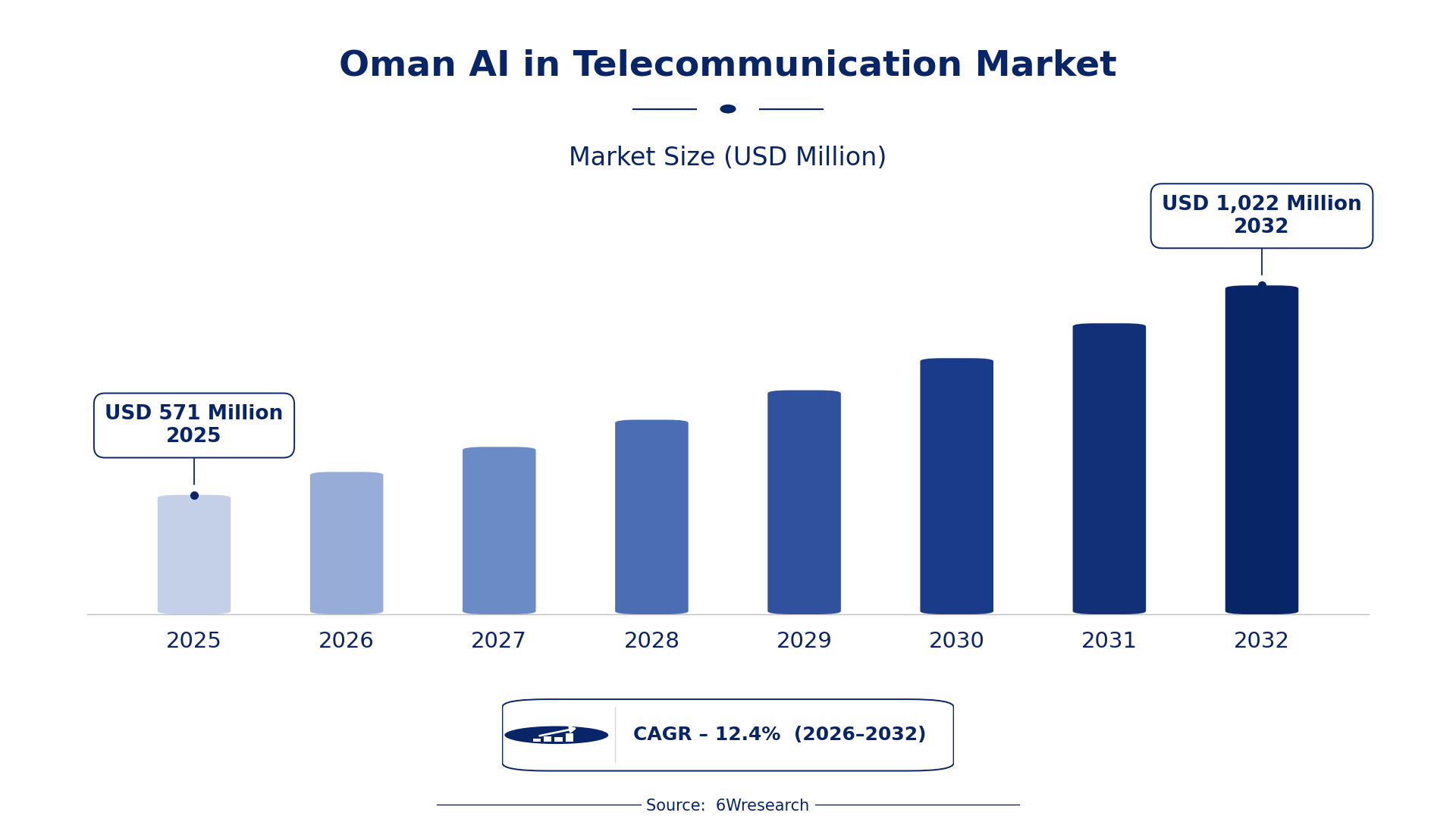
The Oman AI in Telecommunication Market was estimated at USD 571 Million in 2025 and is projected to reach USD 1022 Million by 2032, growing at a CAGR of 12.4% from 2026 to 2032.
Oman AI in Telecommunication Market Synopsis
At the forefront of the Oman AI in Telecommunication market is the rapid adoption of advanced technologies by telecom operators. This embrace of innovation is reshaping network performance and enhancing customer experience, primarily through AI-driven solutions that automate processes and optimize resources.
Investments in AI tools are becoming commonplace as telecom companies strive to improve operational efficiency while controlling costs. Government initiatives aimed at promoting digital transformation are further propelling the integration of AI, setting the stage for a competitive environment in the telecommunications sector.
Oman AI in Telecommunication Market Year-wise Growth Rate and Key Drivers
This graph illustrates the annual growth rates of the Oman AI in Telecommunication Market from 2021 to 2032, highlighting a steady upward trajectory and projected expansion over the forecast period.
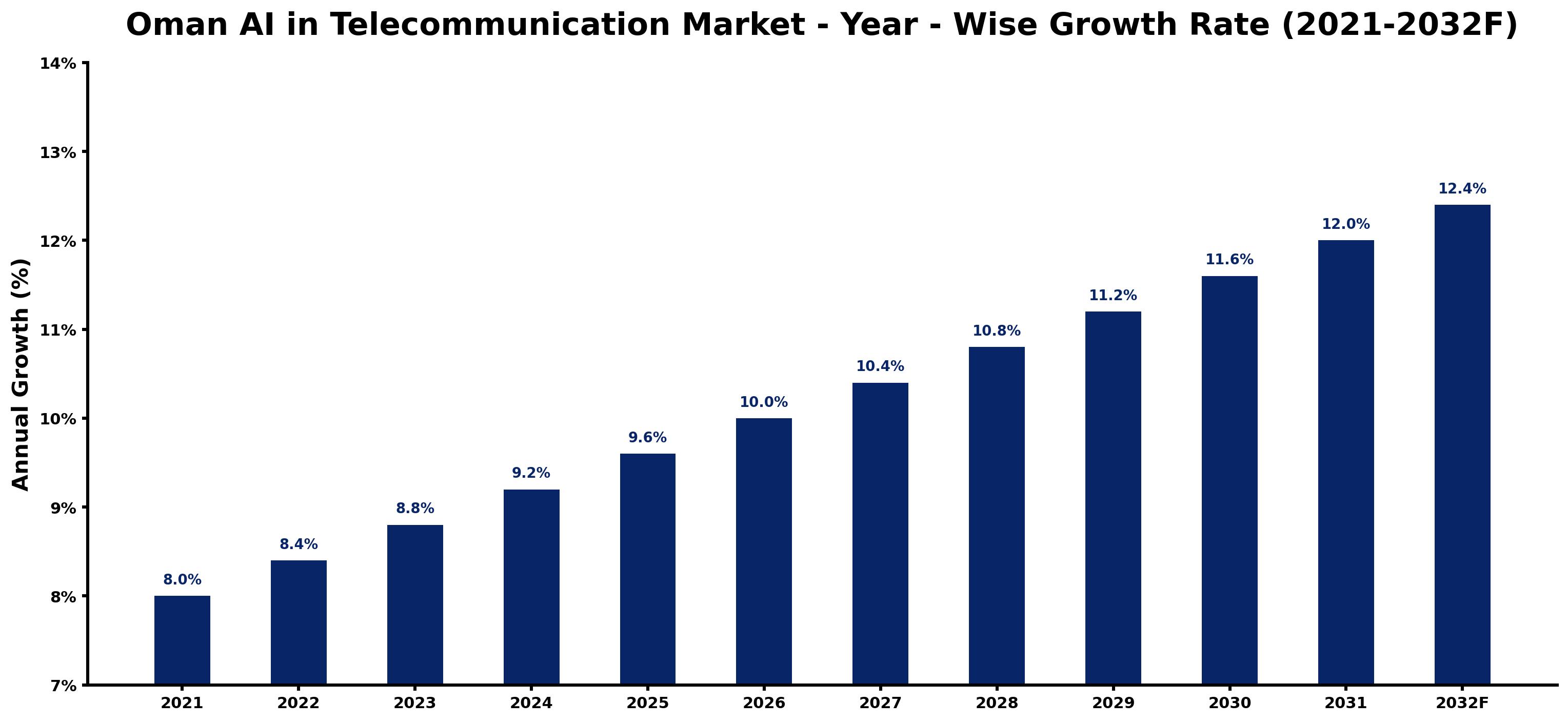
The table below presents the year‑wise growth rates along with the key drivers influencing the market
| Year | Growth Rate | Major Drivers |
| 2021 | 8.0% | Telecom Regulatory Authority supports AI technology adoption. |
| 2022 | 8.4% | Oman Vision 2040 emphasizes AI integration in telecom. |
| 2023 | 8.8% | Increased smartphone penetration fuels AI-driven telecom solutions. |
| 2024 | 9.2% | Ongoing collaboration with global tech firms enhances capabilities. |
| 2025 | 9.6% | Government incentives promote AI research in telecommunications. |
| 2026 | 10.0% | Rising internet connectivity boosts AI service demand. |
| 2027 | 10.4% | Local startups innovate AI applications for telecom efficiency. |
| 2028 | 10.8% | 5G rollout facilitates advanced AI telecommunications services. |
| 2029 | 11.2% | Telecom companies invest in AI for customer service optimization. |
| 2030 | 11.6% | Increased focus on cybersecurity enhances AI infrastructure. |
| 2031 | 12.0% | Public-private partnerships accelerate AI projects in telecom. |
| 2032 | 12.4% | Regional tech conferences showcase AI advancements in telecom. |
Note: Market size estimations and growth projections presented in this report are based on 6Wresearch's proprietary forecasting methodology, utilizing the latest available industry data, government publications, and primary research inputs.
Oman AI in Telecommunication Market Key Takeaways
Below are some of the specific key takeaways from the market, including:
- The market is experiencing growth driven by the increasing adoption of AI technologies.
- Key applications include predictive maintenance, customer service automation, and network optimization.
- Oman’s government is actively supporting initiatives to enhance AI integration in telecommunications.
- Investment opportunities are emerging across various AI-powered segments in the telecom sector.
- Challenges include high initial investments and the need for skilled AI professionals.
Evaluation of Restraints in Oman AI in Telecommunication Market
Despite the promising growth prospects, several restraints are hindering the full potential of the Oman AI in Telecommunication market. A primary concern is the high upfront investment required to implement AI technologies effectively. Many companies are grappling with the skills gap, as there is a pronounced need for professionals who can develop and manage AI solutions. Additionally, data privacy and security issues present ongoing challenges, complicating the integration of AI systems with existing telecommunications infrastructure. The regulatory environment also raises compliance hurdles, further complicating the path to adopting innovative AI applications.
Oman AI in Telecommunication Market Trends
Several key trends are shaping the Oman AI in Telecommunication market. The rise of machine learning and natural language processing technologies is facilitating more effective customer interactions through chatbots and virtual assistants. Telecom companies are increasingly focusing on personalized marketing strategies, utilizing data analytics to gain deeper insights into consumer behavior. As 5G technology continues to roll out, its integration with AI solutions is expected to enhance service quality and operational efficiency further, underscoring the vital role that AI will play in the sector’s future.
Oman AI in Telecommunication Market Opportunities
Significant investment opportunities abound in the Oman AI in Telecommunication market. Companies can capitalize on the growing demand for AI-driven solutions to optimize network operations and enhance the customer experience. Potential areas for investment include AI-powered customer service platforms, predictive maintenance systems for infrastructure, and advanced data analytics tools for operational insights. Collaborations with local telecom providers and alignment with government-supported initiatives are essential for leveraging these opportunities and driving future growth in this dynamic sector.
Government Initiatives in the Oman AI in Telecommunication Market
The Omani government is playing a crucial role in advancing AI adoption in the telecommunications sector through targeted initiatives and regulatory frameworks. By promoting digital transformation, the government aims to position Oman as a leader in AI-driven telecommunication services. The focus on collaboration between telecom companies and AI providers is also essential for fostering innovation.
- A recently completed initiative aimed at upgrading the national digital infrastructure to support AI applications across telecom services.
- Current efforts involve a regulatory framework developed by the Telecommunications Regulatory Authority (TRA) to facilitate AI integration in the industry.
- Planned public-private partnerships to enhance AI capabilities within telecom companies by 2027.
- A digital innovation program initiated in early 2026 to boost R&D in AI technologies for telecommunications.
Future Insights of the Oman AI in Telecommunication Market
Looking ahead to 2026-2032, the Oman AI in Telecommunication market is expected to witness substantial growth as AI solutions become integral to service delivery. The demand for enhanced customer interactions and optimized network management will drive the adoption of AI-powered technologies. Government initiatives aimed at digital transformation will further contribute to the sector's evolution, fostering a competitive environment that encourages innovation and operational efficiency. As the market matures, the interplay between advanced AI applications and evolving consumer expectations will shape the future of telecommunications in Oman.
Oman AI in Telecommunication Market Latest Developments
In the past year, the Oman AI in Telecommunication market has seen a flurry of activities aimed at strengthening AI integration within the industry. Telecom operators are increasingly exploring collaborations with tech vendors to enhance their AI capabilities, setting the stage for a more connected future.
- A major regional operator initiated a project in early 2025 to deploy AI-driven customer service solutions, enhancing user experience through automated support.
- An ongoing partnership between a telecom firm and an AI solution provider launched in late 2025 aims to develop predictive maintenance systems for telecom infrastructure.
- A planned rollout of a new AI platform set to begin in Q3 2026 will optimize network management processes.
- A technology vendor currently conducting trials on AI analytics tools that are expected to boost decision-making in telecom operations by mid-2026.
Oman AI in Telecommunication Market - Key Attractiveness of the Report
- 10 Years of Market Numbers
- Historical Data Starting from 2022 to 2025
- Base Year: 2025
- Forecast Data until 2032
- Key Performance Indicators Impacting the Market
- Major Upcoming Developments and Projects
Key Highlights of the Report:
- Oman AI in Telecommunication Market Outlook
- Market Size of Oman AI in Telecommunication Market, 2025
- Forecast of Oman AI in Telecommunication Market, 2032
- Historical Data and Forecast of Oman AI in Telecommunication Revenues & Volume for the Period 2022-2032F
- Oman AI in Telecommunication Market Trend Evolution
- Oman AI in Telecommunication Market Drivers and Challenges
- Oman AI in Telecommunication Price Trends
- Oman AI in Telecommunication Porter's Five Forces
- Oman AI in Telecommunication Industry Life Cycle
- Historical Data and Forecast of Oman AI in Telecommunication Market Revenues & Volume By Application for the Period 2022-2032F
- Historical Data and Forecast of Oman AI in Telecommunication Market Revenues & Volume By Customer analytics for the Period 2022-2032F
- Historical Data and Forecast of Oman AI in Telecommunication Market Revenues & Volume By Network security for the Period 2022-2032F
- Historical Data and Forecast of Oman AI in Telecommunication Market Revenues & Volume By Network optimization for the Period 2022-2032F
- Historical Data and Forecast of Oman AI in Telecommunication Market Revenues & Volume By Self-diagnostics for the Period 2022-2032F
- Historical Data and Forecast of Oman AI in Telecommunication Market Revenues & Volume By Virtual assistance for the Period 2022-2032F
- Historical Data and Forecast of Oman AI in Telecommunication Market Revenues & Volume By Others (contact center analytics and marketing campaign analytics) for the Period 2022-2032F
- Historical Data and Forecast of Oman AI in Telecommunication Market Revenues & Volume By Component for the Period 2022-2032F
- Historical Data and Forecast of Oman AI in Telecommunication Market Revenues & Volume By Solutions for the Period 2022-2032F
- Historical Data and Forecast of Oman AI in Telecommunication Market Revenues & Volume By Services for the Period 2022-2032F
- Historical Data and Forecast of Oman AI in Telecommunication Market Revenues & Volume By Deployment Mode for the Period 2022-2032F
- Historical Data and Forecast of Oman AI in Telecommunication Market Revenues & Volume By Cloud for the Period 2022-2032F
- Historical Data and Forecast of Oman AI in Telecommunication Market Revenues & Volume By On-premises for the Period 2022-2032F
- Historical Data and Forecast of Oman AI in Telecommunication Market Revenues & Volume By Technology for the Period 2022-2032F
- Historical Data and Forecast of Oman AI in Telecommunication Market Revenues & Volume By Machine learning and deep learning for the Period 2022-2032F
- Historical Data and Forecast of Oman AI in Telecommunication Market Revenues & Volume By Natural Language Processing (NLP) for the Period 2022-2032F
- Oman AI in Telecommunication Import Export Trade Statistics
- Market Opportunity Assessment By Application
- Market Opportunity Assessment By Component
- Market Opportunity Assessment By Deployment Mode
- Market Opportunity Assessment By Technology
- Oman AI in Telecommunication Top Companies Market Share
- Oman AI in Telecommunication Competitive Benchmarking By Technical and Operational Parameters
- Oman AI in Telecommunication Company Profiles
- Oman AI in Telecommunication Key Strategic Recommendations






































