Oman Decorative tile Market Summary
The oman decorative tile market was estimated at USD 313 Million in 2025 and is projected to reach USD 437 Million by 2032, growing at a CAGR of 6.0% from 2026 to 2032.
Oman Decorative tile Market Year-wise Growth Rate and Key Drivers
This graph highlights how the Oman Decorative tile Market has steadily grown over the past five years, supported by major growth factors.
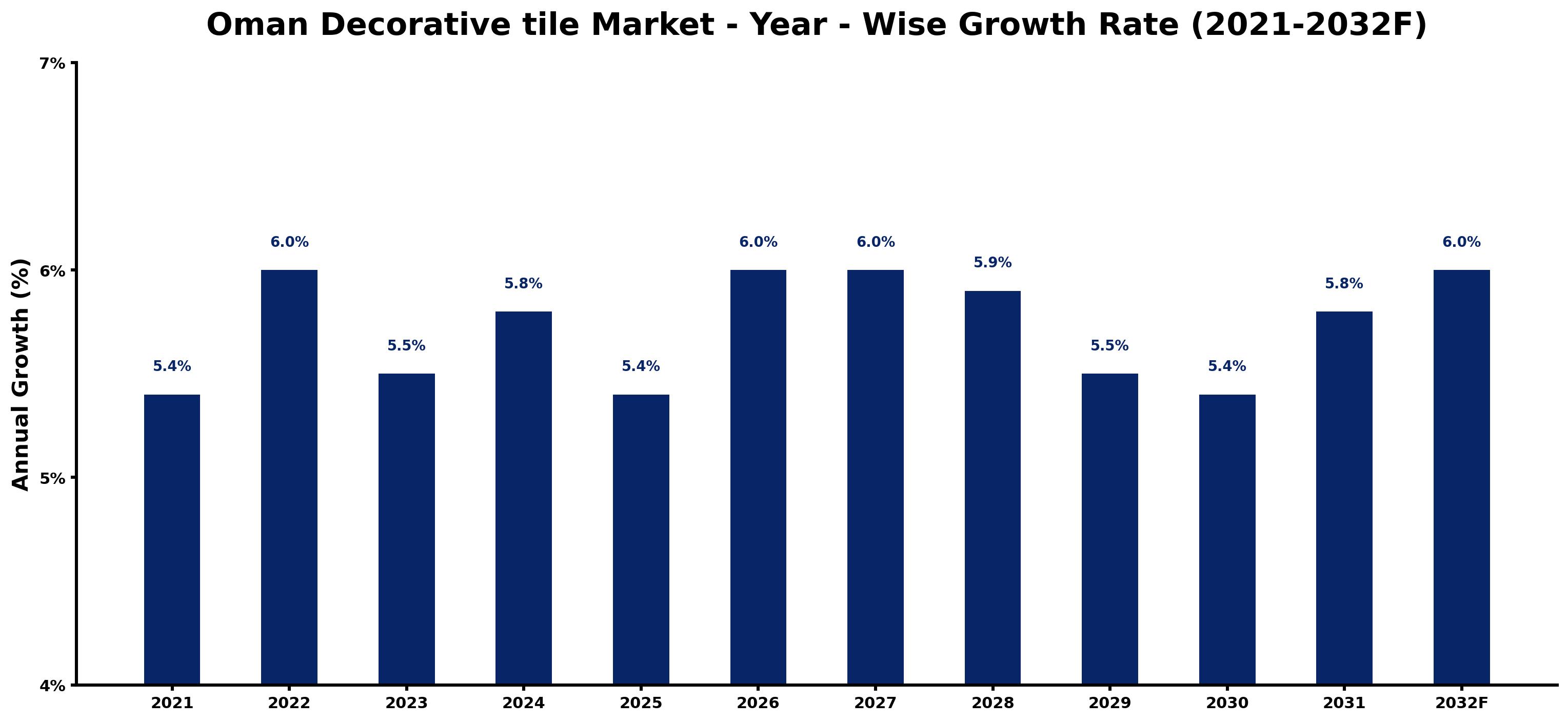
The table below presents the year wise growth rates along with the key drivers influencing the market
| Year | Growth Rate | Major Drivers |
| 2021 | 5.4% | Post-lockdown retail projects catalyzed a rebound in decorative tile installations. |
| 2022 | 6.0% | Increased focus on luxury residential properties boosted demand for premium tiles. |
| 2023 | 5.5% | Tourism recovery spurred investments in hotels needing unique decorative tiles. |
| 2024 | 5.8% | Urbanization trends continued, highlighting the necessity for residential embellishments. |
| 2025 | 5.4% | Local craftsmanship initiatives gained traction, enhancing the appeal of traditional designs. |
| 2026 | 6.0% | Sustainability concerns prompted a shift to eco-friendly tile manufacturing methods. |
| 2027 | 6.0% | Infrastructure expansion projects necessitated durable, aesthetically pleasing flooring solutions. |
| 2028 | 5.9% | Growing expatriate population diversified tastes, demanding innovative tile designs. |
| 2029 | 5.5% | Digital platforms enabled easier access to international tile collections for consumers. |
| 2030 | 5.4% | Collaborations between architects and tile manufacturers yielded unique, custom tile offerings. |
| 2031 | 5.8% | Technological advancements reduced production costs, allowing for competitive pricing strategies. |
| 2032 | 6.0% | Increased global trade agreements opened markets for diverse tile imports into Oman. |
Note - Market size estimations and growth projections presented in this report are based on 6Wresearch's advanced forecasting approach, validated with industry datasets as of June 2026.
Oman Decorative tile Market Synopsis
The Oman Decorative tile Market is projected to reach 6.0% and witness significant growth during the forecast period (2026-2032). This expansion is largely influenced by the robust construction activities across various sectors, including residential, commercial, and public infrastructure. Decorative tiles have increasingly become a preferred choice for enhancing both the aesthetic appeal and functionality of spaces, driven by rising disposable incomes and a shift towards modern interior design preferences. The market is characterized by diverse offerings including ceramic, porcelain, glass, and stone tiles, catering to a wide array of consumer preferences.
Oman Decorative tile Market Growth Drivers
A multitude of factors are propelling the growth of the Oman Decorative tile Market. Firstly, the increase in urbanization is creating demand for more sophisticated interior design solutions. Homeowners and commercial developers seek to create visually appealing environments, thus turning to decorative tiles as a key feature. Secondly, higher disposable incomes among the population allow consumers to invest more in home improvement and renovations, further increasing tile sales. Additionally, the government's commitment to infrastructure development, exemplified by major projects under the Oman Vision 2040 plan, is enhancing the demand for decorative tiles in both commercial and residential construction.
Oman Decorative tile Market Trends and Opportunities
Current trends in the Oman Decorative tile Market exhibit a growing preference for unique and customized designs, with consumers increasingly seeking personalization in their living and working spaces. The rise of sustainable and eco-friendly tiles, incorporating recycled materials, reflects a broader shift towards environmental consciousness among consumers. Moreover, advancements in digital printing technologies are enabling manufacturers to produce intricate designs, meeting the demand for modern aesthetic preferences. Consequently, these trends create ample opportunities for companies to innovate and differentiate their product offerings, thereby capturing a larger market share.
Oman Decorative tile Market Challenges and Restraints
While the Oman Decorative tile Market presents numerous growth opportunities, it is not without challenges. A primary concern is the intensifying competition from both local and international tile manufacturers, which exerts pricing pressure and necessitates continuous innovation. Fluctuating raw material prices, particularly for ceramics and porcelain, can adversely impact production costs, thereby threatening profit margins. Furthermore, any economic slowdown in the region may reduce consumer spending on home improvement projects, inhibiting demand for decorative tiles. Additional challenges include logistical issues that can hamper timely delivery and inventory management, complicating operations for businesses within the market.
Oman Decorative tile Market Investment Opportunities
The Oman Decorative tile Market is rich with investment opportunities, particularly due to the heightened demand for visually appealing and high-quality tiles. Investors could explore establishing local manufacturing facilities, which would not only cater to the growing domestic demand but also help decrease reliance on imports. Opportunities also exist in enhancing distribution channels and establishing showrooms to present a varied selection of tiles, as there is a trend towards personalized design choices. Partnerships with architects and interior designers can further open avenues for supplying decorative tiles for diverse residential and commercial projects in the region.
Oman Decorative tile Market Government Investment and Initiatives
Government policies regarding the Oman Decorative tile Market are focusing on fostering local production, ensuring sustainability, and upholding quality standards. Policymakers are advocating for the utilization of locally sourced materials to bolster domestic manufacturers and lessen import dependencies. Regulatory frameworks are also being established to guarantee the environmental sustainability of production processes, which include efficient waste management and resource conservation. Quality control regulations are critical in maintaining high standards for decorative tiles, thus protecting consumer interests and enhancing the reputation of Omani products, both nationally and internationally. Furthermore, the government may offer incentives to industries investing in research and innovation to transform the decorative tile sector.
Oman Decorative tile Market Latest Developments (May 2025 - June 2026)
During the period from May 2025 to June 2026, the Oman Decorative tile Market has observed noteworthy developments. The emphasis on sustainability has intensified, with manufacturers increasingly adopting eco-friendly practices and materials in their production processes. Innovations in design, particularly through the use of advanced digital technologies, have enabled a broader range of personalized tile options. The market is also seeing collaborations between suppliers and building contractors, aligning goals in meeting the rising demands for aesthetically pleasing interiors. Public spending on infrastructure remains robust, ensuring a continuous influx of projects requiring decorative tile solutions, thus driving market momentum.
Oman Decorative tile Market - Key Attractiveness of the Report
- 10 Years of Market Numbers
- Historical Data Starting from 2022 to 2025
- Base Year: 2025
- Forecast Data until 2032
- Key Performance Indicators Impacting the Market
- Major Upcoming Developments and Projects
Key Highlights of the Report:
- Oman Decorative tile Market Outlook
- Market Size of Oman Decorative tile Market, 2025
- Forecast of Oman Decorative tile Market, 2032F
- Historical Data and Forecast of Oman Decorative tile Revenues & Volume for the Period 2022-2032F
- Oman Decorative tile Market Trend Evolution
- Oman Decorative tile Market Drivers and Challenges
- Oman Decorative tile Price Trends
- Oman Decorative tile Porter's Five Forces
- Oman Decorative tile Industry Life Cycle
- Historical Data and Forecast of Oman Decorative tile Market Revenues & Volume By Type for the Period 2022-2032F
- Historical Data and Forecast of Oman Decorative tile Market Revenues & Volume By Ceramic Wall Tiles for the Period 2022-2032F
- Historical Data and Forecast of Oman Decorative tile Market Revenues & Volume By Vinyl Wall Tiles for the Period 2022-2032F
- Historical Data and Forecast of Oman Decorative tile Market Revenues & Volume By Stone Wall Tiles for the Period 2022-2032F
- Historical Data and Forecast of Oman Decorative tile Market Revenues & Volume By Other Types for the Period 2022-2032F
- Historical Data and Forecast of Oman Decorative tile Market Revenues & Volume By End-users for the Period 2022-2032F
- Historical Data and Forecast of Oman Decorative tile Market Revenues & Volume By Residential for the Period 2022-2032F
- Historical Data and Forecast of Oman Decorative tile Market Revenues & Volume By Commercial for the Period 2022-2032F
- Historical Data and Forecast of Oman Decorative tile Market Revenues & Volume By Application for the Period 2022-2032F
- Historical Data and Forecast of Oman Decorative tile Market Revenues & Volume By Flooring for the Period 2022-2032F
- Historical Data and Forecast of Oman Decorative tile Market Revenues & Volume By Wall Coverings for the Period 2022-2032F
- Historical Data and Forecast of Oman Decorative tile Market Revenues & Volume By Other Applications for the Period 2022-2032F
- Oman Decorative tile Import Export Trade Statistics
- Market Opportunity Assessment By Type
- Market Opportunity Assessment By End-users
- Market Opportunity Assessment By Application
- Oman Decorative tile Top Companies Market Share
- Oman Decorative tile Competitive Benchmarking By Technical and Operational Parameters
- Oman Decorative tile Company Profiles
- Oman Decorative tile Key Strategic Recommendations






































