Oman Gallium Market Size Growth Rate
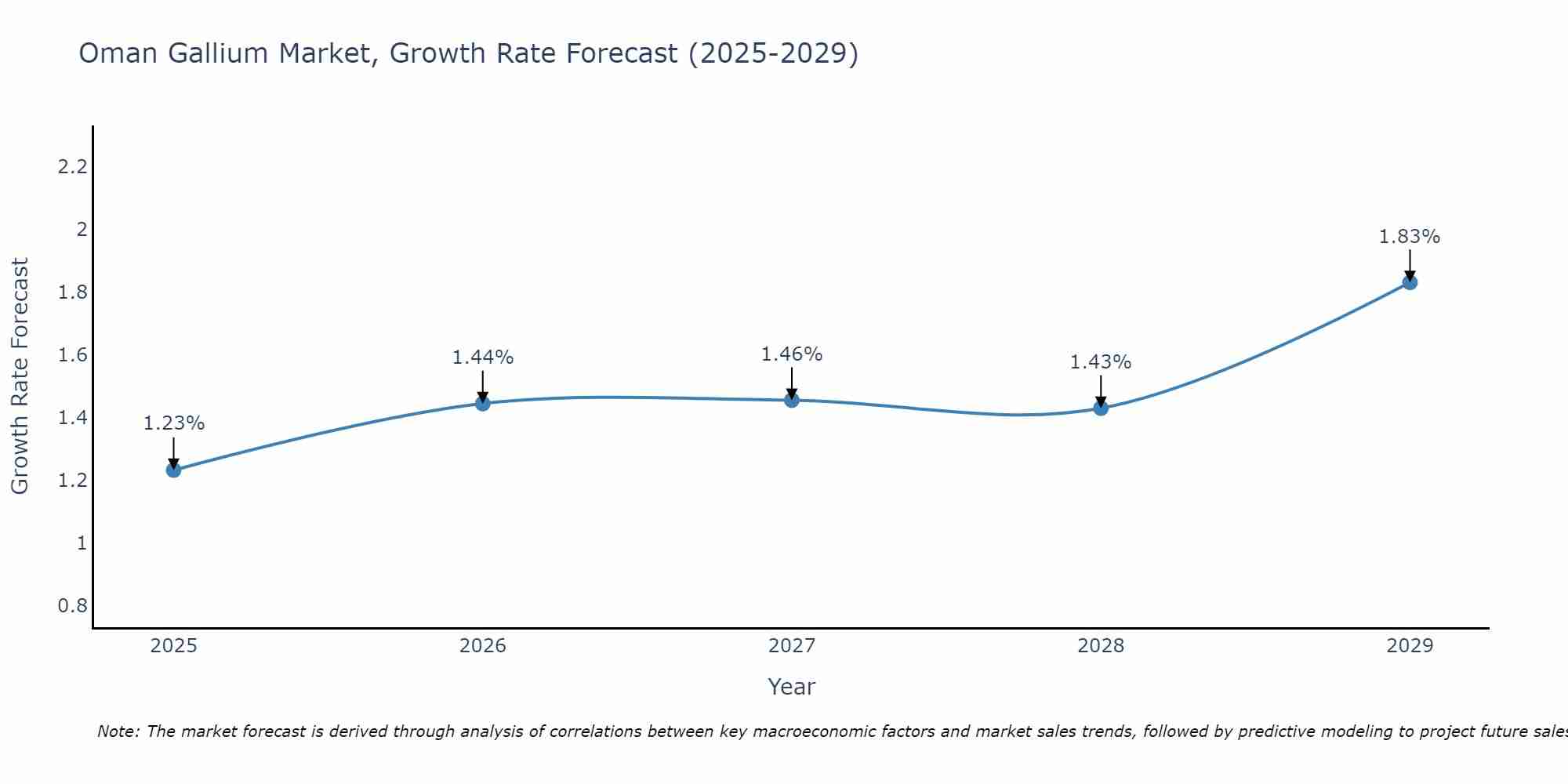
The Oman Gallium Market is projected to witness mixed growth rate patterns during 2025 to 2029. Commencing at 1.23% in 2025, growth builds up to 1.83% by 2029.
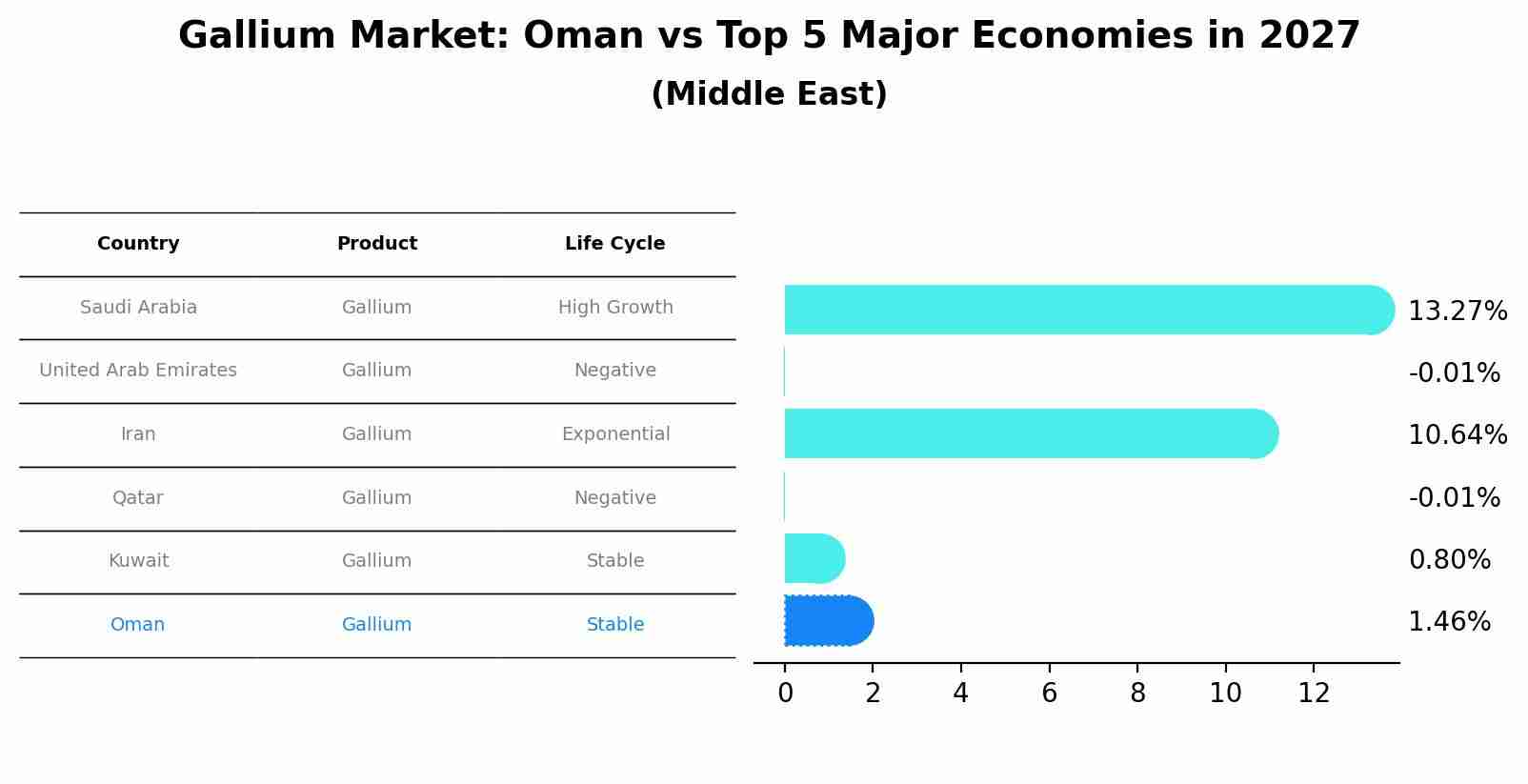
Gallium Market: Oman vs Top 5 Major Economies in 2027 (Middle East)
In the Middle East region, the Gallium market in Oman is projected to expand at a stable growth rate of 1.46% by 2027. The largest economy is Saudi Arabia, followed by United Arab Emirates, Iran, Qatar and Kuwait.
Oman Gallium Market Overview
The Oman Gallium market is experiencing steady growth due to increasing demand from the electronics industry, particularly for the production of semiconductors and LEDs. Gallium`s unique properties, such as high heat conductivity and low melting point, make it a crucial component in advanced technology applications. The market is also driven by the growing adoption of gallium nitride (GaN) technology in various sectors, including automotive, aerospace, and telecommunications. Oman`s strategic location and abundant natural resources further contribute to the country`s position as a key player in the global gallium market. However, fluctuations in raw material prices and the need for continuous innovation in manufacturing processes pose challenges to market growth. Overall, the Oman Gallium market is poised for expansion, driven by technological advancements and increasing demand for high-performance electronic devices.
Oman Gallium Market Trends
The Oman Gallium Market is currently experiencing growth due to the increasing demand for gallium in various industries such as electronics, semiconductors, and solar energy. Gallium is a key component in the production of LED lights, which are becoming more popular for their energy efficiency. The market is also being driven by the growing adoption of gallium nitride (GaN) technology in power electronics and RF devices. Additionally, the shift towards renewable energy sources is boosting the demand for gallium in solar panels. As a result, manufacturers in Oman are focusing on expanding their production capacities to meet the rising demand for gallium in both domestic and international markets. Overall, the future outlook for the Oman Gallium Market appears promising with continued growth opportunities.
Oman Gallium Market Challenges
The Oman Gallium Market faces several challenges, including limited availability of raw materials, fluctuating global demand, and intense competition from other gallium-producing countries. The market heavily relies on imported gallium due to insufficient domestic production capacity, leading to supply chain disruptions and increased costs. Additionally, the volatility in global demand for gallium, driven by factors such as rapid technological advancements and geopolitical tensions, poses a major challenge for market stability and growth in Oman. Furthermore, the presence of established gallium producers in countries like China and the United States creates intense competition, making it difficult for Oman to establish itself as a key player in the global gallium market. Addressing these challenges will require strategic investments in infrastructure, technology, and market diversification to enhance Oman`s competitiveness in the gallium market.
Oman Gallium Market Investment Opportunities
The Oman Gallium market presents attractive investment opportunities due to the increasing demand for gallium in various industries such as electronics, telecommunications, and renewable energy. With gallium being a crucial component in the production of semiconductors, LEDs, and solar panels, the market is poised for growth. Additionally, Oman`s strategic location and stable political environment make it an ideal investment destination for companies looking to tap into the growing gallium market. Investing in gallium production or related technologies in Oman could prove to be lucrative as the global demand for gallium continues to rise, driven by advancements in technology and the shift towards clean energy sources.
Oman Gallium Market Government Policy
The government of Oman has implemented several policies to support the development of the Gallium market in the country. These policies include providing incentives for investment in Gallium production facilities, promoting research and development in Gallium technology, and fostering partnerships with international companies to enhance the country`s position in the global Gallium market. Additionally, the government has set regulations to ensure sustainable extraction practices and environmental protection in Gallium mining operations. By creating a conducive business environment and encouraging innovation in the Gallium sector, Oman aims to diversify its economy and leverage its natural resources effectively.
Oman Gallium Market Future Outlook
The future outlook for the Oman Gallium Market appears promising, driven by growing demand from industries such as electronics, telecommunications, and renewable energy. Gallium`s unique properties make it an essential component in semiconductors, LEDs, and solar panels, positioning it as a key material for technological advancements. Additionally, ongoing research and development activities focused on enhancing gallium-based products are expected to further drive market growth. The increasing adoption of gallium in 5G technology and electric vehicles is also anticipated to bolster demand in the coming years. However, factors such as fluctuating prices of raw materials and global economic conditions could pose challenges to the market`s growth trajectory. Overall, the Oman Gallium Market is likely to witness steady expansion driven by technological advancements and increasing applications across various industries.
Key Highlights of the Report:
- Oman Gallium Market Outlook
- Market Size of Oman Gallium Market, 2024
- Forecast of Oman Gallium Market, 2031
- Historical Data and Forecast of Oman Gallium Revenues & Volume for the Period 2021 - 2031
- Oman Gallium Market Trend Evolution
- Oman Gallium Market Drivers and Challenges
- Oman Gallium Price Trends
- Oman Gallium Porter's Five Forces
- Oman Gallium Industry Life Cycle
- Historical Data and Forecast of Oman Gallium Market Revenues & Volume By Applications for the Period 2021 - 2031
- Historical Data and Forecast of Oman Gallium Market Revenues & Volume By LED for the Period 2021 - 2031
- Historical Data and Forecast of Oman Gallium Market Revenues & Volume By Laser Diodes for the Period 2021 - 2031
- Historical Data and Forecast of Oman Gallium Market Revenues & Volume By Integrated Circuits for the Period 2021 - 2031
- Historical Data and Forecast of Oman Gallium Market Revenues & Volume By Solar Cells for the Period 2021 - 2031
- Oman Gallium Import Export Trade Statistics
- Market Opportunity Assessment By Applications
- Oman Gallium Top Companies Market Share
- Oman Gallium Competitive Benchmarking By Technical and Operational Parameters
- Oman Gallium Company Profiles
- Oman Gallium Key Strategic Recommendations






































