Oman Gambling Market Summary
The oman gambling market was estimated at USD 1019 Million in 2025 and is projected to reach USD 1448 Million by 2032, growing at a CAGR of 6.0% from 2026 to 2032.
Oman Gambling Market Year-wise Growth Rate and Key Drivers
This graph highlights how the Oman Gambling Market has steadily grown over the past five years, supported by major growth factors.
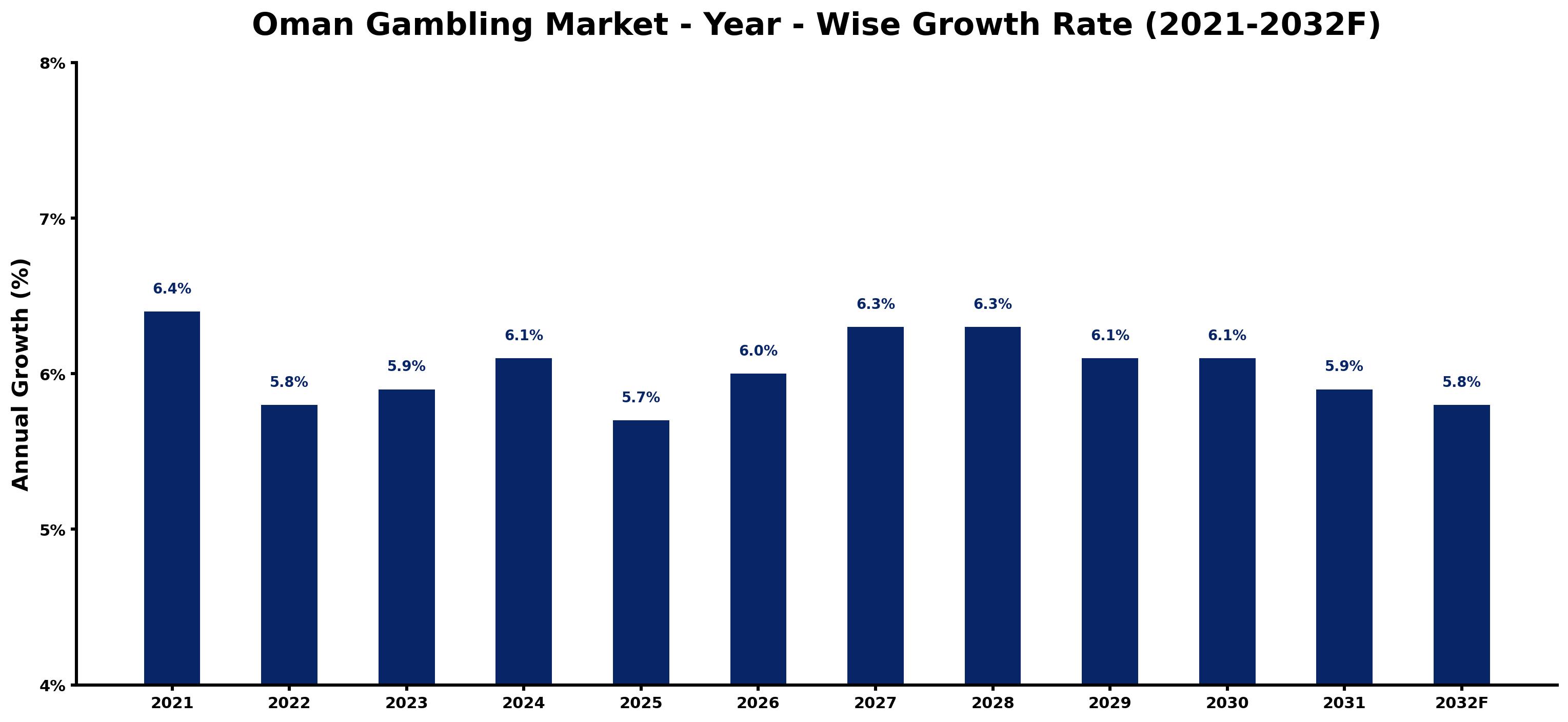
The table below presents the year wise growth rates along with the key drivers influencing the market
| Year | Growth Rate | Major Drivers |
| 2021 | 6.4% | COVID-19 reshaped entertainment, prompting interest in online gambling options. |
| 2022 | 5.8% | International tourism began reopening, introducing new patrons to local gambling venues. |
| 2023 | 5.9% | Local communities expressed curiosity about integrating gaming into cultural events. |
| 2024 | 6.1% | Partnerships with established international gaming brands began forming lucrative collaborations. |
| 2025 | 5.7% | Technological innovations in mobile gaming transformed user experience and engagement levels. |
| 2026 | 6.0% | Regional competitors started implementing successful gambling regulations to attract tourists. |
| 2027 | 6.3% | Consumer preferences shifted towards immersive experiences, enhancing the appeal of casinos. |
| 2028 | 6.3% | E-commerce growth allowed seamless gambling integration into online retail platforms. |
| 2029 | 6.1% | Demographics shifted, with younger populations favoring gaming as a leisure activity. |
| 2030 | 6.1% | Local businesses began offering gambling-related events, boosting community participation and interest. |
| 2031 | 5.9% | Infrastructure improvements supported increased visitor numbers to gambling establishments. |
| 2032 | 5.8% | Public perceptions evolved, normalizing gambling as a mainstream entertainment option. |
Note - Market size estimations and growth projections presented in this report are based on 6Wresearch's advanced forecasting approach, validated with industry datasets as of June 2026.
Oman Gambling Market Synopsis
The Oman Gambling Market is projected to reach 6.0% and witness significant growth during the forecast period (2026-2032). Currently, the gambling landscape in Oman is characterized by stringent Islamic laws that effectively prohibit all forms of gambling activities. As such, there exists no legal infrastructure for casinos or betting establishments. The government enforces these prohibitions rigorously, with severe penalties imposed on individuals participating in unauthorized gambling activities. Despite these challenges, notable trends have emerged, particularly with the rise of online gambling among Omanis utilizing international platforms. This report delves into the dynamics of the Oman Gambling Market, exploring its trends, challenges, investment opportunities, and future outlook.
Oman Gambling Market Trends and Opportunities
The Oman Gambling Market remains largely undeveloped due to legislative restrictions; however, there is a discernible shift in participant behavior influenced by global trends in online gambling. Omanis are increasingly accessing international gambling sites, seeking entertainment and potential financial returns. This growing inclination towards online gambling presents opportunities for foreign companies willing to adapt to local culture and legal frameworks.
- The shift towards digital platforms reflects a broader societal change, highlighting the disparity between legal restrictions and evolving consumer behaviors.
- International gambling companies have begun to take note of this trend, with a focus on digital marketing strategies targeted at Omanis.
- Research indicates that as access to technology improves, the popularity of online gambling is expected to rise, prompting potential changes in consumer engagement.
- There is a notable interest in exploring regulatory frameworks that could enable restricted gambling activities within designated zones, aligning with regulatory compliance.
- Cultural sensitivity remains paramount for any engagement with the market; understanding the religious implications is critical for success.
Oman Gambling Market Challenges and Restraints
The challenges faced by the Oman Gambling Market are deeply rooted in the Islamic laws that govern the country. The strict legal framework effectively stifles any potential for a legitimate gambling industry.
- Gambling is viewed as haram under Sharia law, leading to societal disapproval that further complicates any attempts to legitimize gambling activities.
- The absence of legal gambling infrastructure limits consumer access, pushing activities underground where they remain unregulated and potentially unsafe.
- Severe governmental penalties for unauthorized gambling activities create significant risk for participants, reinforcing the current non-legal status of gambling.
- The population's cultural norms, which abhor gambling, present a formidable barrier against any proposals for legalized options.
- The lack of support from both governmental and financial institutions further hinders the establishment of a formal gambling market.
Oman Gambling Market Investment Opportunities
Despite the prohibitive legal environment, there are potential investment avenues associated with the Oman Gambling Market, particularly in complementary sectors.
- The development of luxury resorts and entertainment complexes could attract visitors from neighboring regions where gambling is permitted, thereby enhancing tourism.
- Investments in online gaming platforms that respect local laws may yield opportunities for growth while minimizing legal risks.
- Collaboration with local authorities to establish regulated gaming zones could pave the way for future developments, although this would require careful negotiation and planning.
- Engaging in the broader tourism sector may yield indirect benefits; entertainment options that resonate with Omani values may appeal to both locals and tourists.
- Enhancing digital entertainment offerings tailored to local preferences could provide a lucrative market niche for investors.
Oman Gambling Market Government Investment and Initiatives
The government of Oman maintains a stringent policy framework governing any form of gambling due to religious considerations. Currently, there is no public investment targeted at developing a gambling market, as gaming activities remain illegal.
Nevertheless, the government has expressed interest in boosting tourism in recent years, which could impact the future of regulated gambling options. Potential initiatives include:
- Exploration of tourism-centric investments that focus on creating luxurious and entertainment-rich environments.
- Public discussions surrounding the liberalization of regulations could emerge as part of broader economic strategies to enhance tourism revenue.
- Incentives may be considered for hospitality development projects that indirectly enhance entertainment options without infringing on the current legal framework.
- Investment in infrastructure aimed at attracting regional tourists might indirectly influence Oman's gambling stance in the long run.
- The government continuously seeks methods to protect its citizens from unauthorized gambling operations, which could shape future policy discussions.
Oman Gambling Market Latest Developments (May 2025 - June 2026)
Recent developments within the Oman Gambling Market have reinforced the ongoing legal constraints against gambling activities. While the government continues to enforce strict regulations, emerging digital technologies have facilitated a subtle increase in online engagement from locals on international platforms. This trend is prompting discussions around regulatory adaptations, although no formal announcements have been made. The societal discourse surrounding gambling reflects an evolving perspective, particularly within the younger demographic, but substantial changes in legislation remain unlikely in the immediate future.
Oman Gambling Market - Key Attractiveness of the Report
- 10 Years of Market Numbers
- Historical Data Starting from 2022 to 2025
- Base Year: 2025
- Forecast Data until 2032
- Key Performance Indicators Impacting the Market
- Major Upcoming Developments and Projects
Key Highlights of the Report:
- Oman Gambling Market Outlook
- Market Size of Oman Gambling Market, 2025
- Forecast of Oman Gambling Market, 2032F
- Historical Data and Forecast of Oman Gambling Revenues & Volume for the Period 2022-2032F
- Oman Gambling Market Trend Evolution
- Oman Gambling Market Drivers and Challenges
- Oman Gambling Price Trends
- Oman Gambling Porter's Five Forces
- Oman Gambling Industry Life Cycle
- Historical Data and Forecast of Oman Gambling Market Revenues & Volume By Product Type for the Period 2022-2032F
- Historical Data and Forecast of Oman Gambling Market Revenues & Volume By Betting for the Period 2022-2032F
- Historical Data and Forecast of Oman Gambling Market Revenues & Volume By Casino for the Period 2022-2032F
- Historical Data and Forecast of Oman Gambling Market Revenues & Volume By Lottery for the Period 2022-2032F
- Historical Data and Forecast of Oman Gambling Market Revenues & Volume By Others for the Period 2022-2032F
- Historical Data and Forecast of Oman Gambling Market Revenues & Volume By Channel Type for the Period 2022-2032F
- Historical Data and Forecast of Oman Gambling Market Revenues & Volume By Offline for the Period 2022-2032F
- Historical Data and Forecast of Oman Gambling Market Revenues & Volume By Online for the Period 2022-2032F
- Historical Data and Forecast of Oman Gambling Market Revenues & Volume By Virtual Reality VR for the Period 2022-2032F
- Historical Data and Forecast of Oman Gambling Market Revenues & Volume By Platform for the Period 2022-2032F
- Historical Data and Forecast of Oman Gambling Market Revenues & Volume By Land-Based for the Period 2022-2032F
- Historical Data and Forecast of Oman Gambling Market Revenues & Volume By Online for the Period 2022-2032F
- Oman Gambling Import Export Trade Statistics
- Market Opportunity Assessment By Product Type
- Market Opportunity Assessment By Channel Type
- Market Opportunity Assessment By Platform
- Oman Gambling Top Companies Market Share
- Oman Gambling Competitive Benchmarking By Technical and Operational Parameters
- Oman Gambling Company Profiles
- Oman Gambling Key Strategic Recommendations






































