Oman Government Cloud Market Size & Growth Rate (2026-2032)
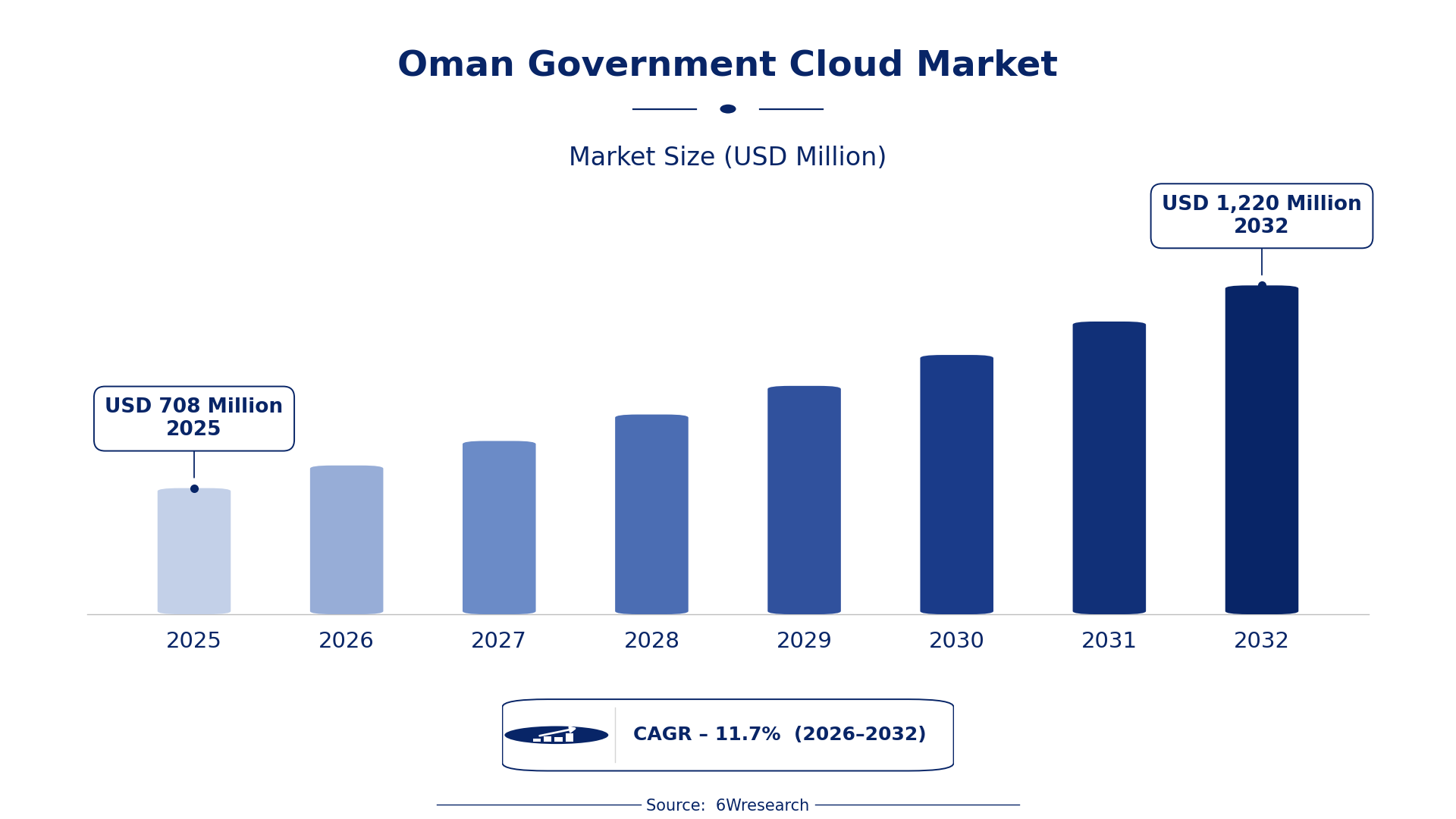
The Oman Government Cloud Market was estimated at USD 708 Million in 2025 and is projected to reach USD 1220 Million by 2032, growing at a CAGR of 11.7% from 2026 to 2032.
Oman Government Cloud Market Synopsis
The primary force driving the Oman Government Cloud Market is the government's strategic initiative to modernize its IT infrastructure. This modernization is not merely about technology; it’s a commitment to enhancing service delivery and operational efficiency within government agencies.
As government entities shift towards cloud-based solutions, the focus is on scalability and security. This shift is creating a fertile environment for cloud service providers to offer tailored solutions that meet the specific demands of the public sector, paving the way for innovation and improved citizen engagement.
Oman Government Cloud Market Year-wise Growth Rate and Key Drivers
This graph illustrates the annual growth rates of the Oman Government Cloud Market from 2021 to 2032, highlighting a steady upward trajectory and projected expansion over the forecast period.
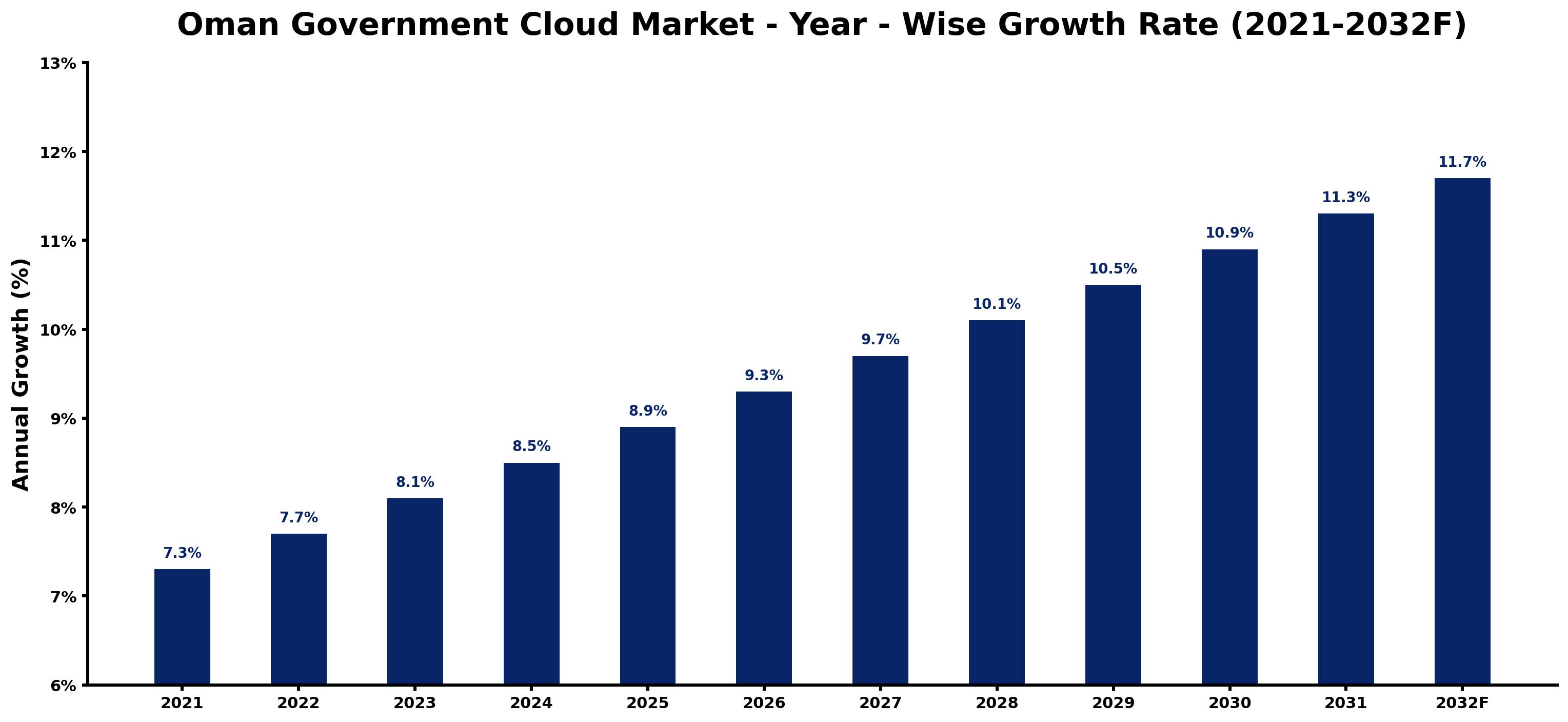
The table below presents the year‑wise growth rates along with the key drivers influencing the market
| Year | Growth Rate | Major Drivers |
| 2021 | 7.3% | Omani government's Digital Oman strategy adoption acceleration. |
| 2022 | 7.7% | Implementation of e-Government initiatives by Ministry of Transport. |
| 2023 | 8.1% | Increased cybersecurity mandates enhancing cloud service adoption. |
| 2024 | 8.5% | National Digital Strategy promoting cloud-based government services. |
| 2025 | 8.9% | Growing public sector need for scalable data solutions. |
| 2026 | 9.3% | Rising investment in ICT infrastructure by government entities. |
| 2027 | 9.7% | Supportive regulations from the Telecommunications Regulatory Authority. |
| 2028 | 10.1% | Boost in remote work policies post-pandemic fostering cloud use. |
| 2029 | 10.5% | Integration of AI in government services driving cloud demand. |
| 2030 | 10.9% | Collaborations with global cloud services enhancing local capabilities. |
| 2031 | 11.3% | Focus on data sovereignty increasing local cloud adoption. |
| 2032 | 11.7% | Growing acceptance of cloud technology among government officials. |
Note: Market size estimations and growth projections presented in this report are based on 6Wresearch's proprietary forecasting methodology, utilizing the latest available industry data, government publications, and primary research inputs.
Oman Government Cloud Market Key Takeaways
Below are some of the specific key takeaways from the market, including:
- Cloud adoption is critical for enhancing operational efficiency in government agencies.
- The market is characterized by increasing investments in data centers and cybersecurity measures.
- Demand for secure and scalable cloud solutions is growing, particularly in e-government services.
- Government initiatives support local cloud service providers, fostering a collaborative environment.
- The need for skilled IT professionals remains a significant challenge for the sector.
Evaluation of Restraints in Oman Government Cloud Market
Data security concerns and regulatory compliance issues are the primary restraints affecting the Oman Government Cloud Market. Government agencies handle sensitive information, which necessitates stringent security protocols to mitigate risks of data breaches. Compliance with local and international regulations adds another layer of complexity, as agencies must navigate various data protection laws. on top of that, the shortage of skilled IT professionals hampers the effective implementation and management of cloud solutions, making it crucial to address these challenges to fully realize the benefits of cloud adoption.
Oman Government Cloud Market Trends
Several trends are shaping the Oman Government Cloud Market. The ongoing push for digital transformation is leading to increased cloud service adoption across various sectors. on top of that, the demand for data management solutions is rising, driven by the increasing volume of data generated by government entities. Notably, there’s a growing emphasis on cybersecurity measures, as agencies recognize the importance of safeguarding citizen data. The integration of advanced technologies like AI and IoT into government operations is also fostering demand for innovative cloud solutions.
Oman Government Cloud Market Opportunities
The Oman Government Cloud Market presents multiple growth opportunities. Increased demand for e-government services is a significant driver, with agencies seeking to enhance service delivery through cloud platforms. Additionally, the need for disaster recovery capabilities and compliance with data protection regulations further opens avenues for cloud service providers. As public sector organizations continue to embrace digital solutions, there is ample room for innovative offerings tailored to their specific requirements.
Government Initiatives in the Oman Government Cloud Market
The Omani government is actively shaping the cloud market through various initiatives aimed at promoting digital transformation. By prioritizing cloud adoption, the government is setting a foundation for enhanced service delivery and operational efficiency within public sector organizations. The proactive stance on regulatory frameworks ensures that cloud services align with national security and data protection requirements, further boosting confidence in cloud technologies.
- A recently completed initiative launched the Oman Government Network (OGN), focusing on providing reliable and cost-effective cloud services to government entities.
- Currently underway is a national data localization policy to ensure data sovereignty and compliance with local regulations.
- A planned public-private partnership is expected to enhance cloud infrastructure capabilities by 2028.
- Ongoing training programs aim to address the shortage of skilled IT professionals in the sector.
- Future regulatory frameworks are being developed to promote billing transparency and service accountability among cloud providers.
Future Insights of the Oman Government Cloud Market
The outlook for the Oman Government Cloud Market from 2026 to 2032 appears promising. With the government doubling down on digital transformation initiatives, demand for cloud services is set to rise significantly. Investments in smart city projects and advanced technologies will further bolster the market. As agencies increasingly recognize the benefits of cloud solutions, the focus will shift towards innovative applications that enhance citizen engagement and operational agility. This trajectory suggests a dynamic future for cloud service providers aiming to meet the evolving needs of the government sector.
Oman Government Cloud Market Latest Developments
In the past year, the Oman Government Cloud Market has seen various developments that reflect the commitment to advancing cloud technology within government operations. This activity indicates a strong alignment with national priorities to enhance digital capabilities and service delivery.
- A major technology vendor launched a new cloud service platform tailored for government agencies, initiated in Q1 2025 and set to complete by mid-2025.
- An ongoing collaboration between government bodies and local cloud providers is enhancing cybersecurity measures for sensitive data management.
- A rollout expected to begin in late 2025 aims to upgrade the national data infrastructure to support increased cloud utilization.
- A recent initiative to establish data protection guidelines was completed in early 2025, ensuring compliance with international standards.
- Plans for a new training academy focused on cloud technology are currently in development, with expectations to launch by early 2026.
Oman Government Cloud Market - Key Attractiveness of the Report
- 10 Years of Market Numbers
- Historical Data Starting from 2022 to 2025
- Base Year: 2025
- Forecast Data until 2032
- Key Performance Indicators Impacting the Market
- Major Upcoming Developments and Projects
Key Highlights of the Report:
- Oman Government Cloud Market Outlook
- Market Size of Oman Government Cloud Market, 2025
- Forecast of Oman Government Cloud Market, 2032
- Historical Data and Forecast of Oman Government Cloud Revenues & Volume for the Period 2022-2032F
- Oman Government Cloud Market Trend Evolution
- Oman Government Cloud Market Drivers and Challenges
- Oman Government Cloud Price Trends
- Oman Government Cloud Porter's Five Forces
- Oman Government Cloud Industry Life Cycle
- Historical Data and Forecast of Oman Government Cloud Market Revenues & Volume By Solutions for the Period 2022-2032F
- Historical Data and Forecast of Oman Government Cloud Market Revenues & Volume By Cloud Storage for the Period 2022-2032F
- Historical Data and Forecast of Oman Government Cloud Market Revenues & Volume By Disaster Recovery for the Period 2022-2032F
- Historical Data and Forecast of Oman Government Cloud Market Revenues & Volume By Identity and Access Management (IAM) for the Period 2022-2032F
- Historical Data and Forecast of Oman Government Cloud Market Revenues & Volume By Risk and compliance management for the Period 2022-2032F
- Historical Data and Forecast of Oman Government Cloud Market Revenues & Volume By Others (reporting and analytics, and security and vulnerability) for the Period 2022-2032F
- Historical Data and Forecast of Oman Government Cloud Market Revenues & Volume By Services for the Period 2022-2032F
- Historical Data and Forecast of Oman Government Cloud Market Revenues & Volume By Training, consulting, and education for the Period 2022-2032F
- Historical Data and Forecast of Oman Government Cloud Market Revenues & Volume By Support and Maintenance for the Period 2022-2032F
- Historical Data and Forecast of Oman Government Cloud Market Revenues & Volume By Integration and Migration for the Period 2022-2032F
- Historical Data and Forecast of Oman Government Cloud Market Revenues & Volume By Service Model for the Period 2022-2032F
- Historical Data and Forecast of Oman Government Cloud Market Revenues & Volume By Infrastructure as a Service (IaaS) for the Period 2022-2032F
- Historical Data and Forecast of Oman Government Cloud Market Revenues & Volume By Platform as a Service (PaaS) for the Period 2022-2032F
- Historical Data and Forecast of Oman Government Cloud Market Revenues & Volume By Software as a Service (SaaS) for the Period 2022-2032F
- Historical Data and Forecast of Oman Government Cloud Market Revenues & Volume By Deployment Model for the Period 2022-2032F
- Historical Data and Forecast of Oman Government Cloud Market Revenues & Volume By Public Cloud for the Period 2022-2032F
- Historical Data and Forecast of Oman Government Cloud Market Revenues & Volume By Private Cloud for the Period 2022-2032F
- Historical Data and Forecast of Oman Government Cloud Market Revenues & Volume By Hybrid Cloud for the Period 2022-2032F
- Oman Government Cloud Import Export Trade Statistics
- Market Opportunity Assessment By Solutions
- Market Opportunity Assessment By Services
- Market Opportunity Assessment By Service Model
- Market Opportunity Assessment By Deployment Model
- Oman Government Cloud Top Companies Market Share
- Oman Government Cloud Competitive Benchmarking By Technical and Operational Parameters
- Oman Government Cloud Company Profiles
- Oman Government Cloud Key Strategic Recommendations






































