Oman Inorganic Pigments Market Size, Share & Growth Rate
The Oman Inorganic Pigments Market was estimated at USD 169 Million in 2025 and is projected to reach USD 234 Million by 2032, growing at a CAGR of 4.8% from 2026 to 2032. This growth trajectory is fueled largely by increasing demand from the construction and automotive sectors, both of which require high-performance pigments for enhanced durability and visual appeal. The emphasis on sustainable and eco-friendly production methods further amplifies the market's potential, positioning Oman as a competitive player in the global inorganic pigments landscape.
Oman Inorganic Pigments Market Year-wise Growth Rate and Key Drivers
This graph highlights how the Oman Inorganic Pigments Market has steadily grown over the years, supported by major growth factors.
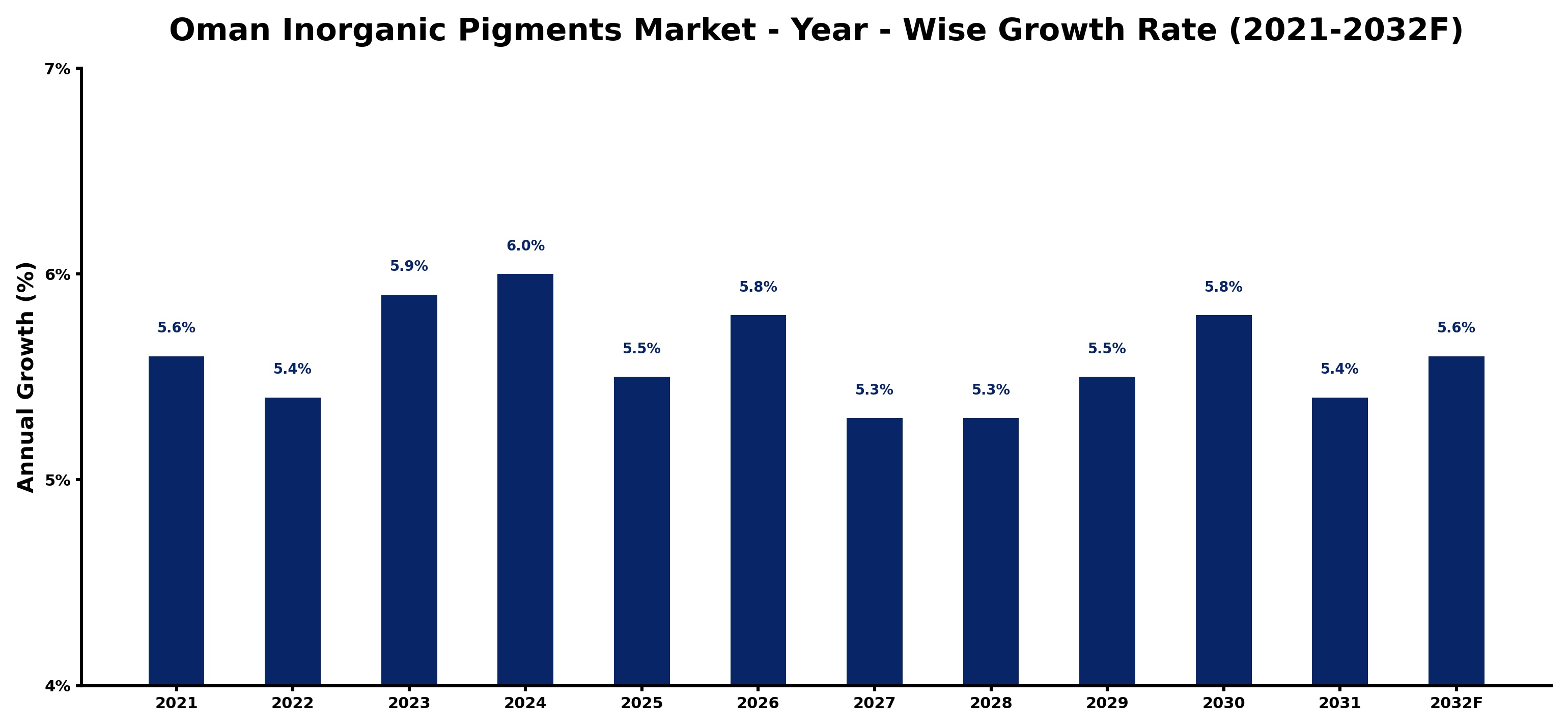
The table below presents the year‑wise growth rates along with the key drivers influencing the market
| Year | Growth Rate | Major Drivers |
| 2021 | 5.6% | Construction sector demand increased |
| 2022 | 5.4% | Automotive industry growth accelerated |
| 2023 | 5.9% | Paint and coatings market expanded |
| 2024 | 6.0% | Infrastructure projects stimulated demand |
| 2025 | 5.5% | Consumer goods sector thrived significantly |
| 2026 | 5.8% | Sustainable products gained popularity |
| 2027 | 5.3% | Technological advancements enhanced production |
| 2028 | 5.3% | Export opportunities broadened market reach |
| 2029 | 5.5% | Regulatory support encouraged innovation |
| 2030 | 5.8% | Market diversification attracted investments |
| 2031 | 5.4% | Local manufacturing capabilities improved |
| 2032 | 5.6% | Environmental awareness drove preferences |
Note - Market size estimations and growth projections presented in this report are based on 6Wresearch's advanced forecasting approach, validated with industry datasets as of June 2026.
Oman Inorganic Pigments Market Synopsis
In Oman, the inorganic pigments market is characterized by a notable demand for color stability and resistance to environmental factors, which are critical in the construction and coatings industries. The shift towards high-quality, sustainable pigments underscores a growing awareness among manufacturers regarding environmental regulations and consumer preferences.
Furthermore, technological advancements in pigment production are enabling manufacturers to meet the stringent quality standards set forth by various industries. This not only enhances product offerings but also strengthens the competitive position of Omani suppliers in regional and international markets.
Oman Inorganic Pigments Market Key Takeaways
- The market is predominantly driven by growth in the construction and automotive sectors.
- Government policies are actively promoting environmentally friendly pigment production.
- There is a rising demand for high-performance pigments that offer durability and color stability.
- Technological advancements are facilitating the development of innovative pigment solutions.
- Environmental compliance is becoming increasingly important for manufacturers in this sector.
Evaluation of Restraints in Oman Inorganic Pigments Market
Despite the promising growth, the Oman Inorganic Pigments Market faces several restraints that could temper its expansion. One significant challenge is ensuring pigment color consistency and stability across different production batches, which can lead to inconsistencies in end products. Additionally, manufacturers must navigate a complex landscape of environmental regulations that govern pigment production processes. These regulations often impose strict limits on emissions and waste, requiring companies to invest in compliance technologies and practices. Meeting these industry-specific performance requirements adds further complexity, as businesses strive to balance quality with regulatory adherence.
Oman Inorganic Pigments Market Trends
Current trends in the Oman Inorganic Pigments Market include an increasing focus on sustainability and eco-friendly production techniques. As awareness of environmental issues grows, manufacturers are integrating greener practices into their operations. This not only enhances the appeal of their products but also aligns with global efforts toward sustainability. Another trend is the rise of digitalization in production processes, facilitating real-time quality control and efficiency improvements. Moreover, the ongoing development of advanced pigment formulations that enhance performance in coatings and plastics is shaping the future of this market.
Oman Inorganic Pigments Market Opportunities
Opportunities for growth in the Oman Inorganic Pigments Market are manifold. The burgeoning construction industry in Oman is a major catalyst, with investments in infrastructure projects creating heightened demand for high-performance pigments. Additionally, the automotive sector is exploring innovative applications for inorganic pigments, enhancing vehicle aesthetics while ensuring durability. Collaboration with research institutions to develop novel pigment technologies can further drive market expansion. As the global focus shifts toward sustainability, there is also a growing market for eco-friendly inorganic pigments, offering companies a chance to differentiate their products and capture a larger market share.
Government Initiatives in the Oman Inorganic Pigments Market
The government of Oman is taking proactive steps to bolster the inorganic pigments market through various initiatives. Policies encouraging the production of high-quality, environmentally friendly pigments are being implemented, including financial incentives aimed at manufacturers. These initiatives support research and development for innovative pigment technologies while setting stringent regulatory standards for product quality and environmental compliance. By advocating the use of inorganic pigments in critical sectors such as paints, coatings, and plastics, the government is enhancing both product quality and sustainability in the market.
Future Insights of the Oman Inorganic Pigments Market
Looking ahead to 2026-2032, the Oman Inorganic Pigments Market is expected to continue its upward trajectory, propelled by an expanding construction sector and evolving automotive applications. The increasing demand for sustainable pigments will likely drive innovations and investments in greener production methods. Furthermore, enhanced collaboration between industry stakeholders and academic institutions may yield groundbreaking developments in pigment technology, paving the way for new applications and market segments. As Oman's infrastructure projects ramp up, the inorganic pigments market stands to benefit from sustained growth and diversification.
Oman Inorganic Pigments Market Latest Developments (May 2025 - June 2026)
Recent developments in the Oman Inorganic Pigments Market indicate a concerted push towards innovation and sustainability. Companies are increasingly adopting advanced production technologies to enhance the quality and performance of their pigment offerings. Additionally, partnerships aimed at research into eco-friendly alternatives are becoming more common, reflecting the market's commitment to reducing environmental impacts. Investments in local manufacturing capabilities are expected to rise, driven by both domestic demand and export opportunities. This evolving landscape showcases the dynamic nature of the market as it adapts to both local and global trends.
Oman Inorganic Pigments Market - Key Attractiveness of the Report
- 10 Years of Market Numbers
- Historical Data Starting from 2022 to 2025
- Base Year: 2025
- Forecast Data until 2032
- Key Performance Indicators Impacting the Market
- Major Upcoming Developments and Projects
Key Highlights of the Report:
- Oman Inorganic Pigments Market Outlook
- Market Size of Oman Inorganic Pigments Market, 2025
- Forecast of Oman Inorganic Pigments Market, 2032
- Historical Data and Forecast of Oman Inorganic Pigments Revenues & Volume for the Period 2022-2032F
- Oman Inorganic Pigments Market Trend Evolution
- Oman Inorganic Pigments Market Drivers and Challenges
- Oman Inorganic Pigments Price Trends
- Oman Inorganic Pigments Porter's Five Forces
- Oman Inorganic Pigments Industry Life Cycle
- Historical Data and Forecast of Oman Inorganic Pigments Market Revenues & Volume By Type for the Period 2022-2032F
- Historical Data and Forecast of Oman Inorganic Pigments Market Revenues & Volume By Titanium Dioxide for the Period 2022-2032F
- Historical Data and Forecast of Oman Inorganic Pigments Market Revenues & Volume By Iron Oxide, Cadmium for the Period 2022-2032F
- Historical Data and Forecast of Oman Inorganic Pigments Market Revenues & Volume By Carbon Blank for the Period 2022-2032F
- Historical Data and Forecast of Oman Inorganic Pigments Market Revenues & Volume By Lead Chromate for the Period 2022-2032F
- Historical Data and Forecast of Oman Inorganic Pigments Market Revenues & Volume By Chromium Oxide for the Period 2022-2032F
- Historical Data and Forecast of Oman Inorganic Pigments Market Revenues & Volume By Others for the Period 2022-2032F
- Historical Data and Forecast of Oman Inorganic Pigments Market Revenues & Volume By Colour for the Period 2022-2032F
- Historical Data and Forecast of Oman Inorganic Pigments Market Revenues & Volume By Red for the Period 2022-2032F
- Historical Data and Forecast of Oman Inorganic Pigments Market Revenues & Volume By Yellow for the Period 2022-2032F
- Historical Data and Forecast of Oman Inorganic Pigments Market Revenues & Volume By Orange for the Period 2022-2032F
- Historical Data and Forecast of Oman Inorganic Pigments Market Revenues & Volume By Green for the Period 2022-2032F
- Historical Data and Forecast of Oman Inorganic Pigments Market Revenues & Volume By Blue for the Period 2022-2032F
- Historical Data and Forecast of Oman Inorganic Pigments Market Revenues & Volume By Black for the Period 2022-2032F
- Historical Data and Forecast of Oman Inorganic Pigments Market Revenues & Volume By White for the Period 2022-2032F
- Historical Data and Forecast of Oman Inorganic Pigments Market Revenues & Volume By Others for the Period 2022-2032F
- Historical Data and Forecast of Oman Inorganic Pigments Market Revenues & Volume By Chemistry for the Period 2022-2032F
- Historical Data and Forecast of Oman Inorganic Pigments Market Revenues & Volume By Oxide for the Period 2022-2032F
- Historical Data and Forecast of Oman Inorganic Pigments Market Revenues & Volume By Silicate for the Period 2022-2032F
- Historical Data and Forecast of Oman Inorganic Pigments Market Revenues & Volume By Carbonate for the Period 2022-2032F
- Historical Data and Forecast of Oman Inorganic Pigments Market Revenues & Volume By Sulphate for the Period 2022-2032F
- Historical Data and Forecast of Oman Inorganic Pigments Market Revenues & Volume By Sulphide for the Period 2022-2032F
- Historical Data and Forecast of Oman Inorganic Pigments Market Revenues & Volume By Others for the Period 2022-2032F
- Historical Data and Forecast of Oman Inorganic Pigments Market Revenues & Volume By Grade for the Period 2022-2032F
- Historical Data and Forecast of Oman Inorganic Pigments Market Revenues & Volume By Food Grade for the Period 2022-2032F
- Historical Data and Forecast of Oman Inorganic Pigments Market Revenues & Volume By Pharmaceutical Grade for the Period 2022-2032F
- Historical Data and Forecast of Oman Inorganic Pigments Market Revenues & Volume By Industrial Grade for the Period 2022-2032F
- Historical Data and Forecast of Oman Inorganic Pigments Market Revenues & Volume By Others for the Period 2022-2032F
- Historical Data and Forecast of Oman Inorganic Pigments Market Revenues & Volume By Form for the Period 2022-2032F
- Historical Data and Forecast of Oman Inorganic Pigments Market Revenues & Volume By Powder for the Period 2022-2032F
- Historical Data and Forecast of Oman Inorganic Pigments Market Revenues & Volume By Liquid for the Period 2022-2032F
- Historical Data and Forecast of Oman Inorganic Pigments Market Revenues & Volume By Application for the Period 2022-2032F
- Historical Data and Forecast of Oman Inorganic Pigments Market Revenues & Volume By Plastics for the Period 2022-2032F
- Historical Data and Forecast of Oman Inorganic Pigments Market Revenues & Volume By Paints & Coatings for the Period 2022-2032F
- Historical Data and Forecast of Oman Inorganic Pigments Market Revenues & Volume By Printing Inks for the Period 2022-2032F
- Historical Data and Forecast of Oman Inorganic Pigments Market Revenues & Volume By Glass & Ceramics for the Period 2022-2032F
- Historical Data and Forecast of Oman Inorganic Pigments Market Revenues & Volume By Cosmetics for the Period 2022-2032F
- Historical Data and Forecast of Oman Inorganic Pigments Market Revenues & Volume By Paper Industry for the Period 2022-2032F
- Historical Data and Forecast of Oman Inorganic Pigments Market Revenues & Volume By Food Industry for the Period 2022-2032F
- Historical Data and Forecast of Oman Inorganic Pigments Market Revenues & Volume By Others for the Period 2022-2032F
- Oman Inorganic Pigments Import Export Trade Statistics
- Market Opportunity Assessment By Type
- Market Opportunity Assessment By Colour
- Market Opportunity Assessment By Chemistry
- Market Opportunity Assessment By Grade
- Market Opportunity Assessment By Form
- Market Opportunity Assessment By Application
- Oman Inorganic Pigments Top Companies Market Share
- Oman Inorganic Pigments Competitive Benchmarking By Technical and Operational Parameters
- Oman Inorganic Pigments Company Profiles
- Oman Inorganic Pigments Key Strategic Recommendations






































