Pakistan Anti Reflective Glass Market Size, Share & Growth Rate
The Pakistan Anti Reflective Glass Market was estimated at USD 208 Million in 2025 and is projected to reach USD 275 Million by 2032, growing at a CAGR of 4.1% from 2026 to 2032. This growth is propelled by escalating demand in the construction, automotive, and electronics sectors, as industries increasingly prioritize energy efficiency and glare reduction. Furthermore, rising disposable incomes are driving consumers to seek high-quality products that enhance visibility and aesthetics.
Pakistan Anti Reflective Glass Market Year-wise Growth Rate and Key Drivers
This graph highlights how the Pakistan Anti Reflective Glass Market has steadily grown over the years, supported by major growth factors.
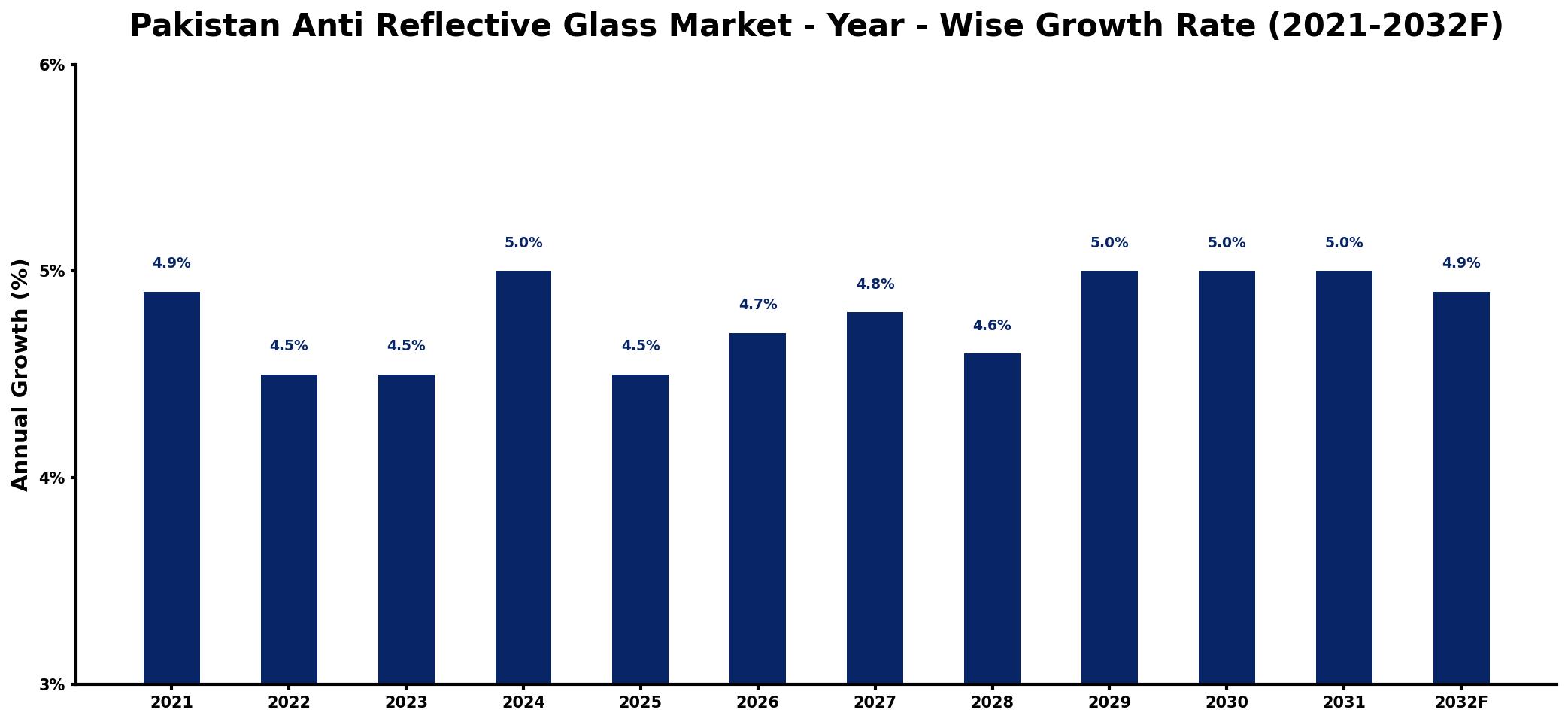
The table below presents the year‑wise growth rates along with the key drivers influencing the market
| Year | Growth Rate | Major Drivers |
| 2021 | 4.9% | Rising construction sector investments |
| 2022 | 4.5% | Increased demand for energy efficiency |
| 2023 | 4.5% | Growth in automotive manufacturing sector |
| 2024 | 5.0% | Surge in architectural innovations |
| 2025 | 4.5% | Expansion of electronic device market |
| 2026 | 4.7% | Growing preference for sustainable materials |
| 2027 | 4.8% | Increased focus on safety regulations |
| 2028 | 4.6% | Demand from renewable energy projects |
| 2029 | 5.0% | growing downstream application demand |
| 2030 | 5.0% | Rise in urbanization trends |
| 2031 | 5.0% | Increased adoption of smart technologies |
| 2032 | 4.9% | stronger distribution network expansion |
Note: Market size estimations and growth projections presented in this report are based on 6Wresearch's proprietary forecasting methodology, utilizing the latest available industry data, government publications, and primary research inputs.
Pakistan Anti Reflective Glass Market Synopsis
The primary force shaping the Pakistan Anti Reflective Glass Market today is the burgeoning construction sector. As urbanization accelerates and infrastructure projects expand, the demand for innovative building materials, including anti-reflective glass, is on the rise. This product is increasingly recognized for its glare-reduction properties and energy efficiency, making it a favored choice among architects and builders.
Moreover, the electronic consumer market is a significant contributor to the growth of this segment. The proliferation of electronic displays and touchscreens necessitates materials that enhance visibility and reduce distractions. As technology evolves, anti-reflective glass is finding its place in both luxury and everyday applications, thus broadening its market appeal.
Pakistan Anti Reflective Glass Market Key Takeaways
- The market is experiencing steady growth, driven primarily by advancements in technology and sustainability trends.
- Increased urbanization and infrastructure development are fueling demand across the construction sector.
- The automotive industry is integrating anti-reflective glass to enhance safety and driving experience.
- Consumer electronics are increasingly adopting anti-reflective glass to meet user demands for better visibility.
- Investment opportunities abound, particularly in innovative manufacturing processes and energy-efficient applications.
Evaluation of Restraints in Pakistan Anti Reflective Glass Market
Despite the positive growth trajectory, the market faces several restraints. A significant challenge is the limited awareness of the advantages of anti-reflective glass among both consumers and businesses. Many remain unaware of its benefits, which slows adoption rates. Additionally, the higher cost of anti-reflective glass compared to traditional options can deter price-sensitive buyers. Supply chain issues, including inconsistent product quality and availability, also hinder market expansion. Furthermore, the presence of counterfeit products can erode consumer trust, creating a need for robust quality assurance and awareness campaigns to foster market growth.
Pakistan Anti Reflective Glass Market Trends
In the evolving landscape of the Pakistan Anti Reflective Glass Market, notable trends include a significant shift towards energy-efficient construction practices. As regulations tighten around building materials, there is a growing preference for sustainable options. Furthermore, the increasing adoption of smart technologies in buildings and vehicles is driving demand for advanced anti-reflective glass solutions, offering both performance enhancements and aesthetic improvements. Additionally, consumer preferences are shifting towards products that not only serve functional purposes but also enhance the overall visual appeal of spaces.
Pakistan Anti Reflective Glass Market Opportunities
The prospects for investment in the Pakistan Anti Reflective Glass Market are robust. With an expanding construction sector, there is a pressing demand for high-quality, energy-efficient glass products. Moreover, innovations in manufacturing processes offer a pathway to develop new anti-reflective solutions that cater to evolving consumer needs. Areas such as solar energy, where glare reduction is critical, present particularly lucrative opportunities. Investors are encouraged to focus on the intersection of technology and sustainability to capitalize on the growing consumer awareness surrounding these factors.
Government Initiatives in the Pakistan Anti Reflective Glass Market
Government initiatives in Pakistan are playing a pivotal role in promoting the adoption of energy-efficient materials like anti-reflective glass. Policymakers are increasingly emphasizing the importance of sustainability in building practices, facilitating regulations and incentives that encourage the use of eco-friendly materials. This has led to a growing integration of anti-reflective glass in both commercial and residential projects. Such initiatives reflect a broader commitment to improving urban infrastructure while addressing environmental concerns, thereby supporting market growth.
Future Insights of the Pakistan Anti Reflective Glass Market
Looking ahead to the period from 2026 to 2032, the Pakistan Anti Reflective Glass Market is set for promising growth. The increasing emphasis on energy efficiency and sustainability will continue to drive demand, particularly in the construction and automotive sectors. As awareness of the benefits of anti-reflective glass grows, coupled with advancements in glass manufacturing technologies, the market is poised for substantial expansion. Overall, a convergence of consumer demand for quality and government support for sustainable practices is expected to bolster market growth in the foreseeable future.
Pakistan Anti Reflective Glass Market Latest Developments (2025 - 2026)
Recent developments in the Pakistan Anti Reflective Glass Market indicate a strong shift towards innovation and sustainable practices. Manufacturers are increasingly focusing on enhancing product quality and diversifying their offerings to meet the growing consumer demand for energy-efficient solutions. New technologies are being adopted to improve the performance of anti-reflective glass, allowing for better glare reduction and visibility. Additionally, collaborations between manufacturers and technology firms are becoming more common, aimed at developing products that cater to the evolving needs of the construction and automotive industries.
Pakistan Anti Reflective Glass Market - Key Attractiveness of the Report
- 10 Years of Market Numbers
- Historical Data Starting from 2022 to 2025
- Base Year: 2025
- Forecast Data until 2032
- Key Performance Indicators Impacting the Market
- Major Upcoming Developments and Projects
Key Highlights of the Report:
- Pakistan Anti Reflective Glass Market Outlook
- Market Size of Pakistan Anti Reflective Glass Market, 2025
- Forecast of Pakistan Anti Reflective Glass Market, 2032
- Historical Data and Forecast of Pakistan Anti Reflective Glass Revenues & Volume for the Period 2022-2032F
- Pakistan Anti Reflective Glass Market Trend Evolution
- Pakistan Anti Reflective Glass Market Drivers and Challenges
- Pakistan Anti Reflective Glass Price Trends
- Pakistan Anti Reflective Glass Porter's Five Forces
- Pakistan Anti Reflective Glass Industry Life Cycle
- Historical Data and Forecast of Pakistan Anti Reflective Glass Market Revenues & Volume By Type for the Period 2022-2032F
- Historical Data and Forecast of Pakistan Anti Reflective Glass Market Revenues & Volume By Double Layers for the Period 2022-2032F
- Historical Data and Forecast of Pakistan Anti Reflective Glass Market Revenues & Volume By Four Layers for the Period 2022-2032F
- Historical Data and Forecast of Pakistan Anti Reflective Glass Market Revenues & Volume By Others for the Period 2022-2032F
- Historical Data and Forecast of Pakistan Anti Reflective Glass Market Revenues & Volume By Application for the Period 2022-2032F
- Historical Data and Forecast of Pakistan Anti Reflective Glass Market Revenues & Volume By Architectural Windows for the Period 2022-2032F
- Historical Data and Forecast of Pakistan Anti Reflective Glass Market Revenues & Volume By Instrumentation Windows for the Period 2022-2032F
- Historical Data and Forecast of Pakistan Anti Reflective Glass Market Revenues & Volume By Electronic Displays for the Period 2022-2032F
- Historical Data and Forecast of Pakistan Anti Reflective Glass Market Revenues & Volume By Picture Framing Glass for the Period 2022-2032F
- Historical Data and Forecast of Pakistan Anti Reflective Glass Market Revenues & Volume By Showcase Glass for the Period 2022-2032F
- Historical Data and Forecast of Pakistan Anti Reflective Glass Market Revenues & Volume By Cold Storage Displays for the Period 2022-2032F
- Historical Data and Forecast of Pakistan Anti Reflective Glass Market Revenues & Volume By Lamps Glass for the Period 2022-2032F
- Historical Data and Forecast of Pakistan Anti Reflective Glass Market Revenues & Volume By Others for the Period 2022-2032F
- Pakistan Anti Reflective Glass Import Export Trade Statistics
- Market Opportunity Assessment By Type
- Market Opportunity Assessment By Application
- Pakistan Anti Reflective Glass Top Companies Market Share
- Pakistan Anti Reflective Glass Competitive Benchmarking By Technical and Operational Parameters
- Pakistan Anti Reflective Glass Company Profiles
- Pakistan Anti Reflective Glass Key Strategic Recommendations






































