Pakistan Data Center Market Size & Growth Rate (2026-2032)
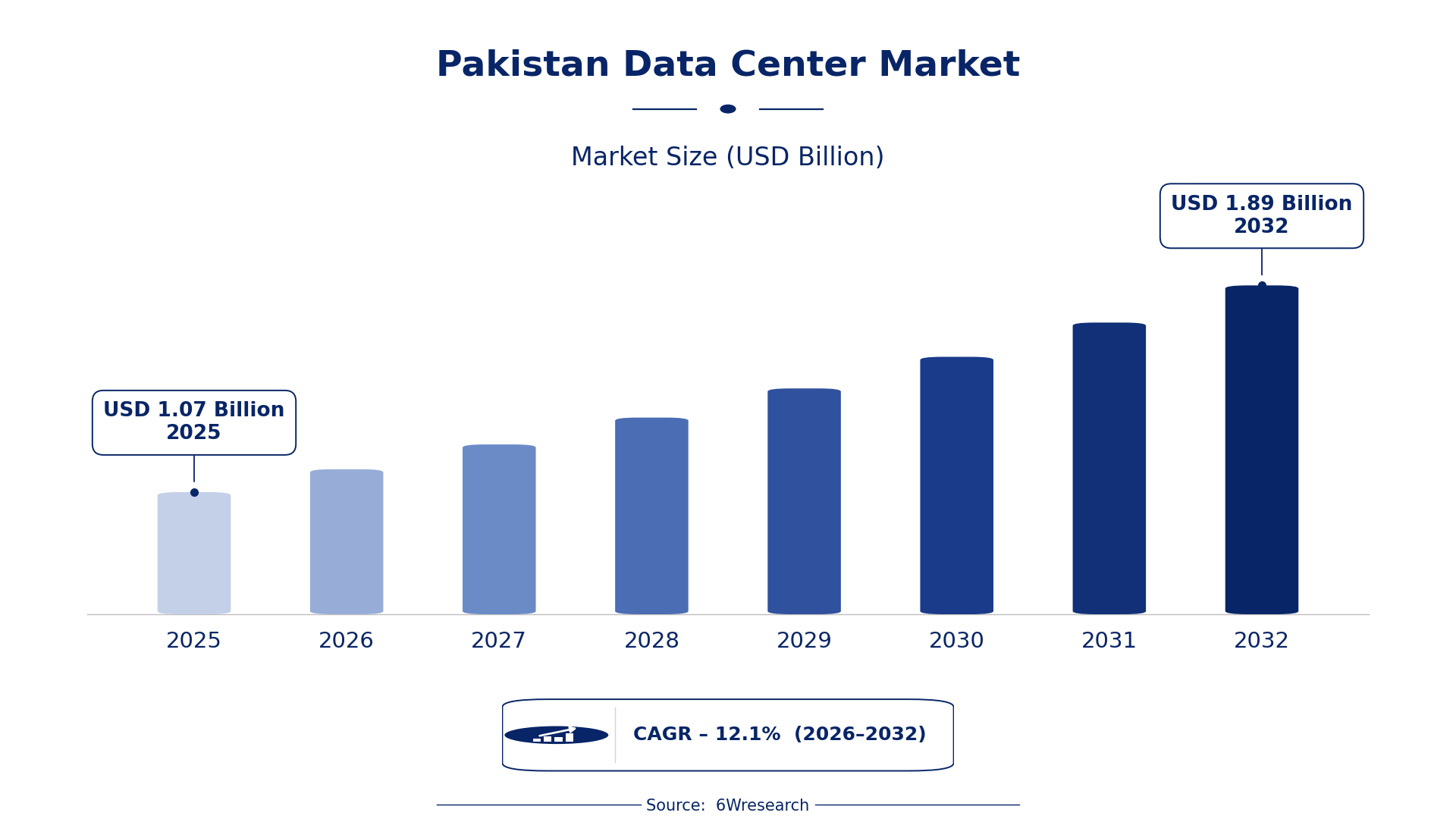
The Pakistan Data Center Market was estimated at USD 1070 Million in 2025 and is projected to reach USD 1885 Million by 2032, growing at a CAGR of 12.1% from 2026 to 2032.
Pakistan Data Center Market Synopsis
The Pakistan Data Center Market has recently gained remarkable momentum, fueled by surging digitalization and cloud adoption across various sectors. However, this growth is just the beginning; the market is on the brink of a more substantial transformation as key players increase their investments and infrastructure developments ramp up.
As organizations increasingly embrace digital solutions, the demand for efficient data management and processing capabilities has never been higher. This trajectory is likely to continue as local and international players recognize Pakistan’s potential as a regional data center hub, particularly in urban centers like Karachi and Lahore.
Pakistan Data Center Market Year-wise Growth Rate and Key Drivers
This graph illustrates the annual growth rates of the Pakistan Data Center Market from 2021 to 2032, highlighting a steady upward trajectory and projected expansion over the forecast period.
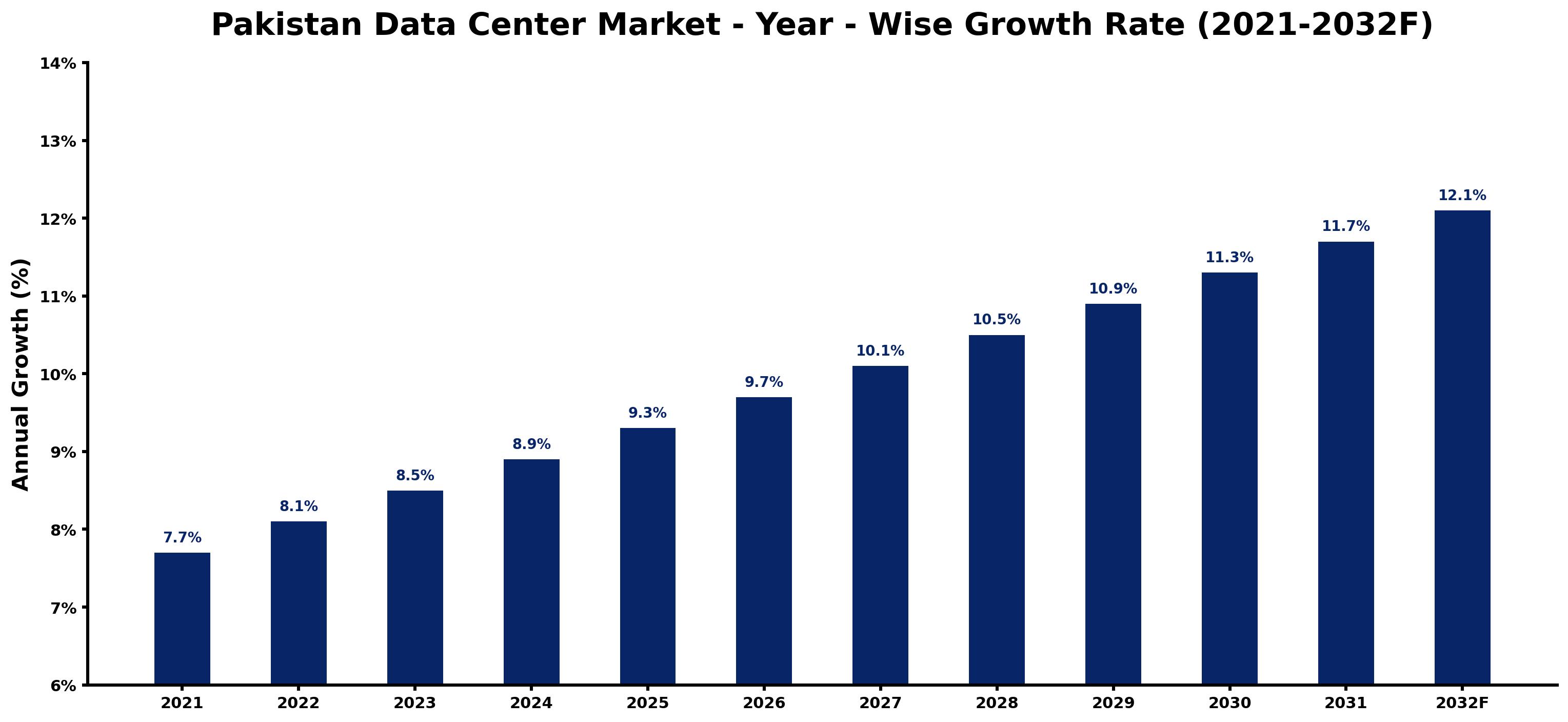
The table below presents the year‑wise growth rates along with the key drivers influencing the market
| Year | Growth Rate | Major Drivers |
| 2021 | 7.7% | Launch of Pakistan's National Data Center policy. |
| 2022 | 8.1% | Increased internet penetration among urban youth demographic. |
| 2023 | 8.5% | Government incentives for local tech startups boosting demand. |
| 2024 | 8.9% | Regulatory support for cloud computing services adoption. |
| 2025 | 9.3% | Growth of local e-commerce fueling data storage needs. |
| 2026 | 9.7% | Rising cybersecurity awareness driving data protection services. |
| 2027 | 10.1% | Telecom reforms stimulating investment in data center infrastructure. |
| 2028 | 10.5% | Increased reliance on digital education platforms post-pandemic. |
| 2029 | 10.9% | Surge in remote working trends enhancing cloud service uptake. |
| 2030 | 11.3% | Development of renewable energy initiatives for sustainable data centers. |
| 2031 | 11.7% | Emergence of AI applications increasing data processing requirements. |
| 2032 | 12.1% | Government-backed initiatives promoting tech industry growth. |
Note: Market size estimations and growth projections presented in this report are based on 6Wresearch's proprietary forecasting methodology, utilizing the latest available industry data, government publications, and primary research inputs.
Pakistan Data Center Market Key Takeaways
Below are some of the specific key takeaways from the market, including:
- Rising demand for cloud services is a primary driver of market growth.
- Government initiatives aim to enhance IT infrastructure and promote digitalization.
- Karachi and Lahore are emerging as key data center hubs attracting investment.
- Challenges such as power reliability and skilled labor shortages persist.
- Emerging technologies like IoT and AI are creating new infrastructure demands.
Evaluation of Restraints in Pakistan Data Center Market
The Pakistan Data Center Market faces several pressing challenges that could hinder its growth trajectory. Chief among these are infrastructure inadequacies, particularly concerning power supply and internet connectivity. Frequent power outages can disrupt operations and lead to data integrity issues, while limited internet access affects service quality. on top of that, security concerns—ranging from cyber threats to physical risks—further complicate the operational landscape. The high initial setup costs and a shortage of skilled professionals in the sector also contribute to the market's constraints, making it difficult for providers to scale and compete effectively.
Pakistan Data Center Market Trends
Several trends are currently shaping the Pakistan Data Center Market. The increasing focus on digital transformation across industries is driving demand for advanced data center solutions. Adoption of technologies such as IoT, artificial intelligence, and big data analytics necessitates infrastructure capable of supporting high-speed processing and storage capabilities. Additionally, there is a noticeable shift towards sustainability, with providers exploring renewable energy options to mitigate operational costs and enhance environmental responsibility.
Pakistan Data Center Market Opportunities
Opportunities for growth in the Pakistan Data Center Market are abundant. The development of edge computing facilities is essential to meet the needs of low-latency applications, particularly as IoT devices proliferate. Partnerships with global data center providers can enhance connectivity and open access to international markets, while investments in renewable energy can align with sustainability goals. The government's commitment to promoting digitalization and expanding e-commerce also presents a fertile ground for local and international players looking to capitalize on emerging market demands.
Government Initiatives in the Pakistan Data Center Market
Government policy plays a crucial role in shaping the Pakistan Data Center Market, influencing regulatory frameworks and investment climates. Recent initiatives have focused on enhancing IT infrastructure, improving data protection measures, and incentivizing private sector investments. These policies not only support the establishment of data centers but also aim to align with international standards, creating a conducive environment for growth.
- A regulatory framework introduced in 2020 mandates data center operators to adhere to international standards for infrastructure and security.
- Current initiatives aim to provide tax breaks and reduced tariffs on IT equipment to stimulate sector investment.
- A national digital infrastructure upgrade programme is underway to bolster connectivity and service quality across the country.
- Future plans include a public-private partnership expected to enhance IT infrastructure access by 2028.
Future Insights of the Pakistan Data Center Market
Looking ahead to 2026-2032, the Pakistan Data Center Market is set for substantial growth. The ongoing digital transformation across sectors will continue to escalate demand for advanced data services. With increased internet penetration and the proliferation of smart technologies, the need for reliable and scalable data infrastructure will become paramount. As both local and global players invest heavily in modern facilities, the market will likely solidify its position as a regional powerhouse, provided that challenges like power reliability and regulatory hurdles are effectively addressed.
Pakistan Data Center Market Latest Developments
In the past year, the Pakistan Data Center Market has seen notable developments that signal a strong push towards modernization and investment. Providers are actively expanding their capabilities to meet the growing demand for data services, while government initiatives continue to lay the groundwork for a robust market environment.
- A major technology vendor announced plans in late 2023 to expand its data center footprint in Karachi, with completion expected by mid-2025.
- In early 2024, a leading regional operator launched a new cloud service offering targeted at local businesses, enhancing access to scalable solutions.
- Currently ongoing is a collaborative project aimed at improving data protection measures among local providers, expected to conclude by late 2024.
- A rollout of new renewable energy solutions is planned for 2026 to reduce operational costs and environmental impact.
Pakistan Data Center Market - Key Attractiveness of the Report
- 10 Years of Market Numbers
- Historical Data Starting from 2022 to 2025
- Base Year: 2025
- Forecast Data until 2032
- Key Performance Indicators Impacting the Market
- Major Upcoming Developments and Projects
Key Highlights of the Report:
- Pakistan Data Center Market Outlook
- Market Size of Pakistan Data Center Market, 2025
- Forecast of Pakistan Data Center Market, 2032
- Historical Data and Forecast of Pakistan Data Center Revenues & Volume for the Period 2022-2032F
- Pakistan Data Center Market Trend Evolution
- Pakistan Data Center Market Drivers and Challenges
- Pakistan Data Center Price Trends
- Pakistan Data Center Porter's Five Forces
- Pakistan Data Center Industry Life Cycle
- Historical Data and Forecast of Pakistan Data Center Market Revenues & Volume By Component for the Period 2022-2032F
- Historical Data and Forecast of Pakistan Data Center Market Revenues & Volume By Electrical for the Period 2022-2032F
- Historical Data and Forecast of Pakistan Data Center Market Revenues & Volume By Mechanical for the Period 2022-2032F
- Historical Data and Forecast of Pakistan Data Center Market Revenues & Volume By Networking for the Period 2022-2032F
- Historical Data and Forecast of Pakistan Data Center Market Revenues & Volume By Racks for the Period 2022-2032F
- Historical Data and Forecast of Pakistan Data Center Market Revenues & Volume By Security Systems for the Period 2022-2032F
- Historical Data and Forecast of Pakistan Data Center Market Revenues & Volume By Fire Systems for the Period 2022-2032F
- Historical Data and Forecast of Pakistan Data Center Market Revenues & Volume By Vertical for the Period 2022-2032F
- Historical Data and Forecast of Pakistan Data Center Market Revenues & Volume By Banking Financial Services & Insurance (BFSI) for the Period 2022-2032F
- Historical Data and Forecast of Pakistan Data Center Market Revenues & Volume By Government for the Period 2022-2032F
- Historical Data and Forecast of Pakistan Data Center Market Revenues & Volume By IT & Telecom for the Period 2022-2032F
- Historical Data and Forecast of Pakistan Data Center Market Revenues & Volume By Media for the Period 2022-2032F
- Historical Data and Forecast of Pakistan Data Center Market Revenues & Volume By Retail for the Period 2022-2032F
- Historical Data and Forecast of Pakistan Data Center Market Revenues & Volume By Manufacturing for the Period 2022-2032F
- Historical Data and Forecast of Pakistan Data Center Market Revenues & Volume By Others for the Period 2022-2032F
- Pakistan Data Center Import Export Trade Statistics
- Market Opportunity Assessment By Component
- Market Opportunity Assessment By Vertical
- Pakistan Data Center Top Companies Market Share
- Pakistan Data Center Competitive Benchmarking By Technical and Operational Parameters
- Pakistan Data Center Company Profiles
- Pakistan Data Center Key Strategic Recommendations






































