Pakistan Fish Market Size, Share & Growth Rate
The Pakistan Fish Market was estimated at USD 322 Million in 2025 and is projected to reach USD 460 Million by 2032, growing at a CAGR of 5.2% from 2026 to 2032. This growth is primarily driven by an increasing domestic demand for seafood, supported by rising disposable incomes and a shift towards healthier protein alternatives. Moreover, export opportunities are expanding as international markets show a growing preference for sustainably sourced Pakistani seafood.
Pakistan Fish Market Year-wise Growth Rate and Key Drivers
This graph highlights how the Pakistan Fish Market has steadily grown over the years, supported by major growth factors.
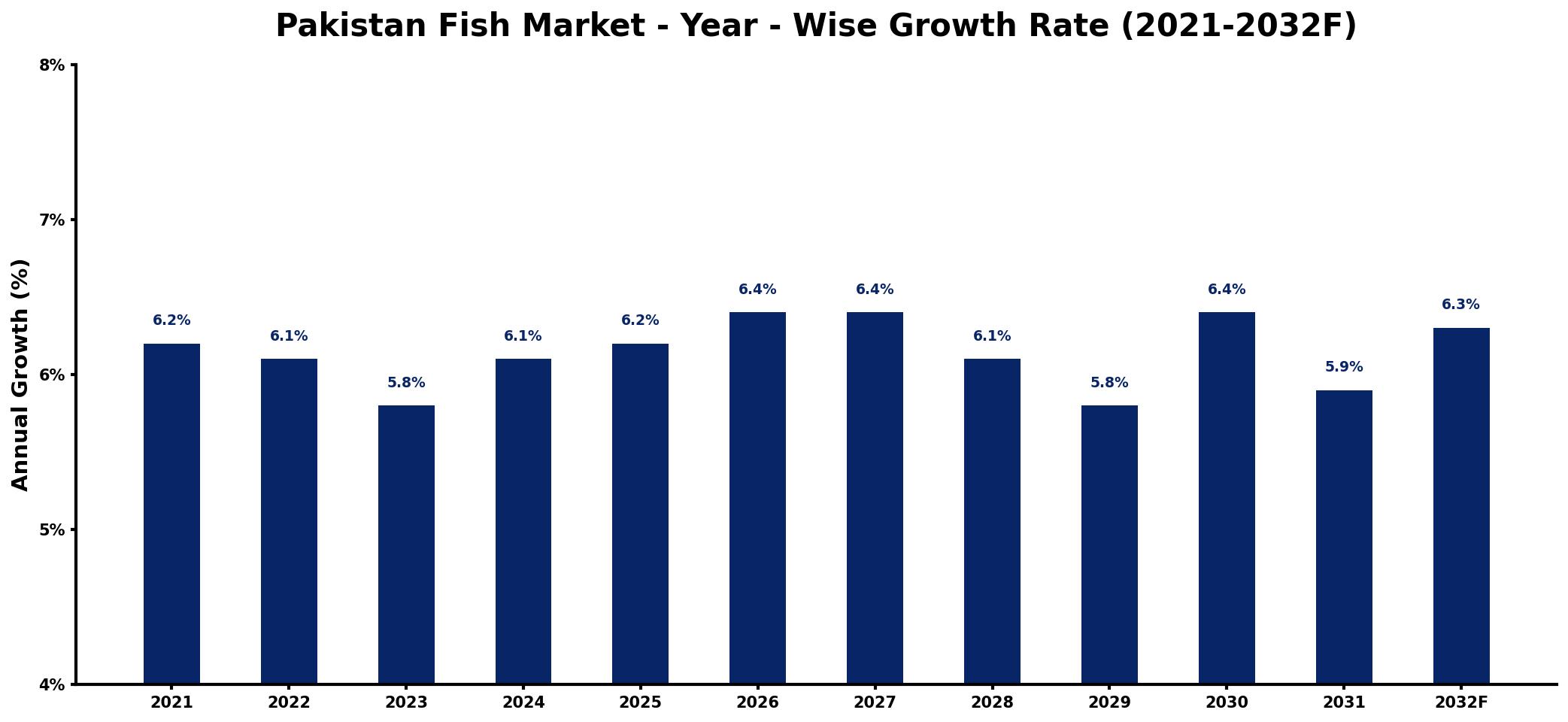
The table below presents the year‑wise growth rates along with the key drivers influencing the market
| Year | Growth Rate | Major Drivers |
| 2021 | 6.2% | Rising consumer health consciousness |
| 2022 | 6.1% | Increased export opportunities overseas |
| 2023 | 5.8% | Growing popularity of seafood cuisine |
| 2024 | 6.1% | Expansion of aquaculture facilities |
| 2025 | 6.2% | Higher disposable income levels |
| 2026 | 6.4% | rising demand from electronics |
| 2027 | 6.4% | Emergence of new distribution channels |
| 2028 | 6.1% | Increased local tourism activities |
| 2029 | 5.8% | Adoption of innovative preservation techniques |
| 2030 | 6.4% | Strengthening regional trade agreements |
| 2031 | 5.9% | Growing demand for organic products |
| 2032 | 6.3% | Rising interest in culinary education |
Note: Market size estimations and growth projections presented in this report are based on 6Wresearch's proprietary forecasting methodology, utilizing the latest available industry data, government publications, and primary research inputs.
Pakistan Fish Market Synopsis
Recently, the Pakistan Fish Market has experienced a resurgence as local and international consumers seek fresh seafood options. However, the sector is on a transformative path towards sustainability and modernization to secure its future growth. Efforts to address infrastructure challenges and improve quality standards are crucial as the market moves forward.
As consumer preferences evolve towards ethically sourced and value-added products, the market's trajectory is set to shift dramatically. The integration of technology in supply chain management and consumer engagement through online platforms is becoming increasingly vital, potentially reshaping how seafood is marketed and sold.
Pakistan Fish Market Key Takeaways
- The market is projected to grow at a CAGR of 5.2%, reaching USD 460 Million by 2032.
- There is a growing consumer preference for sustainable and ethically sourced seafood products.
- Technological advancements are enhancing supply chain efficiency and product quality.
- Investment opportunities in aquaculture and modern processing facilities are on the rise.
- The government is actively supporting the sector with policies aimed at sustainability and infrastructure development.
Evaluation of Restraints in Pakistan Fish Market
Despite its potential, the Pakistan Fish Market faces significant restraints. Inconsistent supply due to overfishing and environmental fluctuations hampers stability. Poor storage and transportation infrastructure leads to spoilage, adversely affecting quality and availability. Furthermore, the prevalence of middlemen complicates pricing transparency, often resulting in price manipulations that can disadvantage both sellers and buyers. Addressing these challenges requires a concerted effort to enhance infrastructure, establish quality standards, and foster direct market access.
Pakistan Fish Market Trends
Several trends are currently reshaping the Pakistan Fish Market. A marked increase in the demand for ready-to-cook fish and marinated seafood products is evident, catering to the convenience-driven consumer base. The rise of e-commerce platforms has facilitated online sales, allowing consumers greater access to fresh seafood. Concurrently, a growing interest in exotic fish varieties is emerging, reflecting a shift in culinary experimentation among consumers. As sustainability becomes a central concern, producers are increasingly focusing on eco-friendly practices to align with market demands.
Pakistan Fish Market Opportunities
The market is ripe for investment in numerous sectors. Fish farming operations present a viable solution to meet local consumption needs, while modernizing traditional fish markets through enhanced infrastructure can significantly improve product quality and reduce waste. Establishing seafood processing plants targeting international markets is another lucrative opportunity, particularly if supported by sustainable practices. Moreover, the advancement of aquaculture technologies promises to boost production efficiency, paving the way for robust industry growth.
Government Initiatives in the Pakistan Fish Market
The Pakistani government has implemented various initiatives to bolster the fish market sector. Establishing fisheries departments at federal and provincial levels aims to regulate and support sustainable fishing practices. Additionally, programs providing training and technical assistance to fishermen and aquaculture practitioners help improve industry standards. Financial assistance through subsidies and loans is being offered to facilitate investments in modern infrastructure. These efforts reflect a commitment to developing the fish market while ensuring environmental sustainability and food security.
Future Insights of the Pakistan Fish Market
Looking ahead to 2026-2032, the Pakistan Fish Market is positioned for steady growth. Factors such as increasing domestic seafood consumption and enhanced export capabilities will drive this trend. Advancements in technology, coupled with infrastructure improvements, promise to streamline supply chains and enhance product quality. However, the market must address issues like overfishing and competition from imported seafood to maintain its momentum. If managed effectively, the sector can achieve robust growth while adopting sustainable practices that benefit the industry and the environment.
Pakistan Fish Market Latest Developments (2025 - 2026)
Recent developments in the Pakistan Fish Market reflect a strong focus on modernization and sustainability. Initiatives to improve infrastructure at fish landing sites are underway, enhancing product quality and safety. There is also a notable uptick in partnerships between local producers and international buyers, aimed at expanding export opportunities. Moreover, the introduction of new technology for better supply chain management is being embraced, promising more efficient operations and greater market accessibility for local fishermen.
Pakistan Fish Market - Key Attractiveness of the Report
- 10 Years of Market Numbers
- Historical Data Starting from 2022 to 2025
- Base Year: 2025
- Forecast Data until 2032
- Key Performance Indicators Impacting the Market
- Major Upcoming Developments and Projects
Key Highlights of the Report:
- Pakistan Fish Market Outlook
- Market Size of Pakistan Fish Market, 2025
- Forecast of Pakistan Fish Market, 2032
- Historical Data and Forecast of Pakistan Fish Revenues & Volume for the Period 2022-2032F
- Pakistan Fish Market Trend Evolution
- Pakistan Fish Market Drivers and Challenges
- Pakistan Fish Price Trends
- Pakistan Fish Porter's Five Forces
- Pakistan Fish Industry Life Cycle
- Historical Data and Forecast of Pakistan Fish Market Revenues & Volume By Fish Type for the Period 2022-2032F
- Historical Data and Forecast of Pakistan Fish Market Revenues & Volume By Inland Fishes for the Period 2022-2032F
- Historical Data and Forecast of Pakistan Fish Market Revenues & Volume By Marine Fishes for the Period 2022-2032F
- Historical Data and Forecast of Pakistan Fish Market Revenues & Volume By Shrimps for the Period 2022-2032F
- Historical Data and Forecast of Pakistan Fish Market Revenues & Volume By Scampi for the Period 2022-2032F
- Historical Data and Forecast of Pakistan Fish Market Revenues & Volume By Product Type for the Period 2022-2032F
- Historical Data and Forecast of Pakistan Fish Market Revenues & Volume By Fresh for the Period 2022-2032F
- Historical Data and Forecast of Pakistan Fish Market Revenues & Volume By Frozen for the Period 2022-2032F
- Historical Data and Forecast of Pakistan Fish Market Revenues & Volume By Canned for the Period 2022-2032F
- Historical Data and Forecast of Pakistan Fish Market Revenues & Volume By Others for the Period 2022-2032F
- Historical Data and Forecast of Pakistan Fish Market Revenues & Volume By Distribution Channel for the Period 2022-2032F
- Historical Data and Forecast of Pakistan Fish Market Revenues & Volume By Retail for the Period 2022-2032F
- Historical Data and Forecast of Pakistan Fish Market Revenues & Volume By Institutional for the Period 2022-2032F
- Historical Data and Forecast of Pakistan Fish Market Revenues & Volume By Sector for the Period 2022-2032F
- Historical Data and Forecast of Pakistan Fish Market Revenues & Volume By Organised for the Period 2022-2032F
- Historical Data and Forecast of Pakistan Fish Market Revenues & Volume By Unorganised for the Period 2022-2032F
- Pakistan Fish Import Export Trade Statistics
- Market Opportunity Assessment By Fish Type
- Market Opportunity Assessment By Product Type
- Market Opportunity Assessment By Distribution Channel
- Market Opportunity Assessment By Sector
- Pakistan Fish Top Companies Market Share
- Pakistan Fish Competitive Benchmarking By Technical and Operational Parameters
- Pakistan Fish Company Profiles
- Pakistan Fish Key Strategic Recommendations






































