Pakistan Telecom Services Market Size, Share & Growth Rate
The Pakistan Telecom Services Market was estimated at USD 318 Million in 2025 and is projected to reach USD 438 Million by 2032, growing at a CAGR of 4.7% from 2026 to 2032. This growth trajectory is primarily driven by the increasing penetration of smartphones and the expanding demand for high-speed internet services. As more consumers turn to digital content and online platforms, the need for robust telecommunication infrastructure becomes critical, positioning the sector for substantial expansion.
Pakistan Telecom Services Market Year-wise Growth Rate and Key Drivers
This graph highlights how the Pakistan Telecom Services Market has steadily grown over the years, supported by major growth factors.
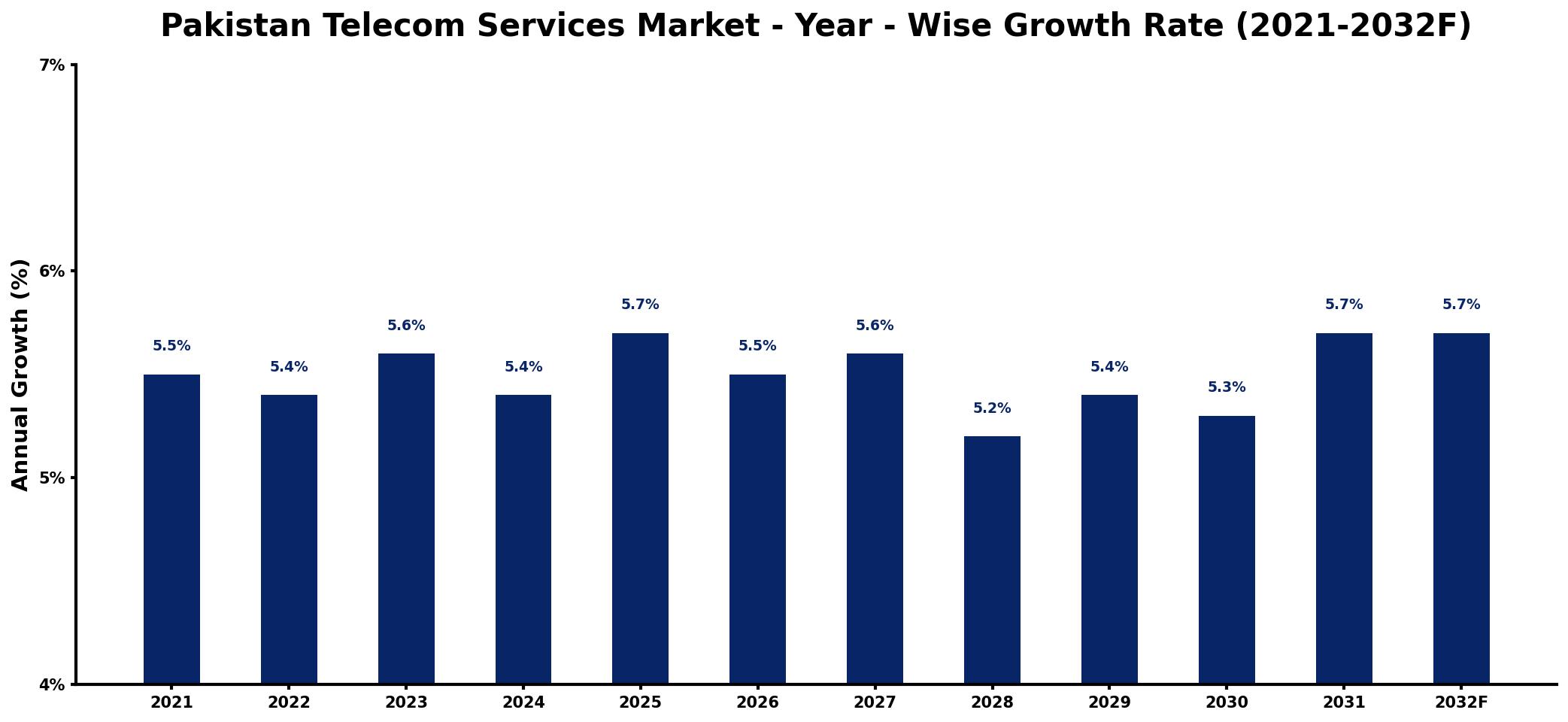
The table below presents the year‑wise growth rates along with the key drivers influencing the market
| Year | Growth Rate | Major Drivers |
| 2021 | 5.5% | Increased smartphone penetration rates |
| 2022 | 5.4% | improved processing technologies adoption |
| 2023 | 5.6% | Expansion of fiber optic networks |
| 2024 | 5.4% | Growth in mobile payment solutions |
| 2025 | 5.7% | Investment in 5G infrastructure |
| 2026 | 5.5% | Surge in digital content consumption |
| 2027 | 5.6% | Emergence of IoT applications |
| 2028 | 5.2% | Boost in remote working trends |
| 2029 | 5.4% | Adoption of smart home technologies |
| 2030 | 5.3% | Increase in e-commerce activities |
| 2031 | 5.7% | Development of fintech innovations |
| 2032 | 5.7% | rising demand from electronics |
Note: Market size estimations and growth projections presented in this report are based on 6Wresearch's proprietary forecasting methodology, utilizing the latest available industry data, government publications, and primary research inputs.
Pakistan Telecom Services Market Synopsis
The strongest force currently shaping the Pakistan Telecom Services Market is the rapid shift towards digitalization, which has catalyzed an uptick in demand for both mobile data and internet connectivity. This transformation is not only altering consumer behavior but is also prompting telecom operators to diversify their service offerings to remain competitive.
Moreover, government initiatives aimed at enhancing connectivity in rural areas are reinforcing this digital push. These efforts are vital in bridging the urban-rural divide, ensuring that telecommunications services become increasingly inclusive and accessible for all segments of the population.
Pakistan Telecom Services Market Key Takeaways
- The market is witnessing significant growth propelled by rising smartphone usage and high-speed internet demand.
- Digital payment and mobile banking partnerships are emerging as key revenue drivers for telecom operators.
- Government policies are fostering a favorable environment for infrastructure investment and digital innovation.
- Operators are focusing on expanding network coverage to underserved areas, promoting digital inclusion.
- The shift toward personalized services such as streaming and IoT solutions is shaping competitive strategies.
Evaluation of Restraints in Pakistan Telecom Services Market
Despite its potential, the Pakistan Telecom Services Market faces several constraints that challenge its growth. Intense competition among existing players creates significant pricing pressure, compelling companies to innovate continually. Additionally, infrastructure inadequacies, particularly in rural regions, lead to inconsistent service quality and connectivity issues. Regulatory hurdles further complicate the market dynamics, often resulting in uncertainties that can impede strategic planning and investment. Lastly, the escalating demand for data services requires substantial financial commitments for network upgrades and technological advancements, posing a considerable challenge for operators.
Pakistan Telecom Services Market Trends
Several trends are currently shaping the Pakistan Telecom Services Market, notably the growing consumer appetite for high-speed internet and mobile data. The transition to 4G networks, coupled with the upcoming rollout of 5G technology, is set to revolutionize the market. Furthermore, the rise of digital financial services is creating new revenue streams, with telecom operators actively collaborating with financial institutions to provide innovative solutions.
Additionally, the focus on personalized and value-added services has intensified as companies seek differentiation in a crowded landscape. This includes the launch of content streaming platforms and Internet of Things (IoT) applications, enhancing user experience and engagement.
Pakistan Telecom Services Market Opportunities
The Pakistan Telecom Services Market presents numerous investment opportunities, particularly in the expansion of 4G and upcoming 5G networks. As digital infrastructure continues to develop, there is significant potential for innovative value-added services, especially in the realms of digital payments and e-commerce. The governments commitment to enhancing connectivity, particularly in rural areas, offers avenues for partnerships and investment. Additionally, strategic acquisitions and collaborations with local operators are poised to drive growth and profitability within this evolving market landscape.
Government Initiatives in the Pakistan Telecom Services Market
The regulation of the Pakistan Telecom Services Market is primarily overseen by the Pakistan Telecommunication Authority (PTA), which establishes guidelines to promote competition and protect consumers. Key government initiatives include policies aimed at expanding infrastructure to improve access to telecommunications services nationwide. There is also a strong emphasis on fostering innovation in the digital sector, with support for the adoption of 5G technology and the cultivation of a conducive environment for startups. These measures aim to ensure a vibrant, competitive market that benefits consumers and enterprises alike.
Future Insights of the Pakistan Telecom Services Market
The outlook for the Pakistan Telecom Services Market between 2026 and 2032 is optimistic, fueled by increasing smartphone penetration and a burgeoning demand for digital services. With a predominantly young population driving this trend, the need for high-speed internet and mobile data is expected to surge. The imminent rollout of 5G will further enhance connectivity and open new avenues for service providers. Moreover, as various sectors embrace digital transformation, telecom operators will have the opportunity to diversify and innovate their offerings, positioning themselves for sustained growth in the years to come.
Pakistan Telecom Services Market Latest Developments (2025 - 2026)
Recent developments within the Pakistan Telecom Services Market indicate a heightened focus on expanding infrastructure and enhancing service quality. There is an increased effort to roll out 5G networks, with several operators conducting trial runs and pilot projects across urban and semi-urban regions. Additionally, collaborations between telecom companies and fintech firms are gaining traction, facilitating the provision of seamless digital payment solutions. As a result, this dynamic landscape is evolving rapidly, with significant advancements expected to shape the future of telecommunications in Pakistan.
Pakistan Telecom Services Market - Key Attractiveness of the Report
- 10 Years of Market Numbers
- Historical Data Starting from 2022 to 2025
- Base Year: 2025
- Forecast Data until 2032
- Key Performance Indicators Impacting the Market
- Major Upcoming Developments and Projects
Key Highlights of the Report:
- Pakistan Telecom Services Market Outlook
- Market Size of Pakistan Telecom Services Market, 2025
- Forecast of Pakistan Telecom Services Market, 2032
- Historical Data and Forecast of Pakistan Telecom Services Revenues & Volume for the Period 2022-2032F
- Pakistan Telecom Services Market Trend Evolution
- Pakistan Telecom Services Market Drivers and Challenges
- Pakistan Telecom Services Price Trends
- Pakistan Telecom Services Porter's Five Forces
- Pakistan Telecom Services Industry Life Cycle
- Historical Data and Forecast of Pakistan Telecom Services Market Revenues & Volume By Service Type for the Period 2022-2032F
- Historical Data and Forecast of Pakistan Telecom Services Market Revenues & Volume By Fixed Voice Services for the Period 2022-2032F
- Historical Data and Forecast of Pakistan Telecom Services Market Revenues & Volume By Fixed Internet Access Services for the Period 2022-2032F
- Historical Data and Forecast of Pakistan Telecom Services Market Revenues & Volume By Mobile Voice Services for the Period 2022-2032F
- Historical Data and Forecast of Pakistan Telecom Services Market Revenues & Volume By Mobile Data Services for the Period 2022-2032F
- Historical Data and Forecast of Pakistan Telecom Services Market Revenues & Volume By Pay-TV Services for the Period 2022-2032F
- Historical Data and Forecast of Pakistan Telecom Services Market Revenues & Volume By Machine-to-Machine (Mobile IoT) Services for the Period 2022-2032F
- Historical Data and Forecast of Pakistan Telecom Services Market Revenues & Volume By Transmission for the Period 2022-2032F
- Historical Data and Forecast of Pakistan Telecom Services Market Revenues & Volume By Wireline for the Period 2022-2032F
- Historical Data and Forecast of Pakistan Telecom Services Market Revenues & Volume By Wireless for the Period 2022-2032F
- Historical Data and Forecast of Pakistan Telecom Services Market Revenues & Volume By End-use for the Period 2022-2032F
- Historical Data and Forecast of Pakistan Telecom Services Market Revenues & Volume By Consumer/Residential for the Period 2022-2032F
- Historical Data and Forecast of Pakistan Telecom Services Market Revenues & Volume By Business for the Period 2022-2032F
- Pakistan Telecom Services Import Export Trade Statistics
- Market Opportunity Assessment By Service Type
- Market Opportunity Assessment By Transmission
- Market Opportunity Assessment By End-use
- Pakistan Telecom Services Top Companies Market Share
- Pakistan Telecom Services Competitive Benchmarking By Technical and Operational Parameters
- Pakistan Telecom Services Company Profiles
- Pakistan Telecom Services Key Strategic Recommendations






































