Paraguay Decorative Glass Market Growth Rate Analysis (2025 - 2031)
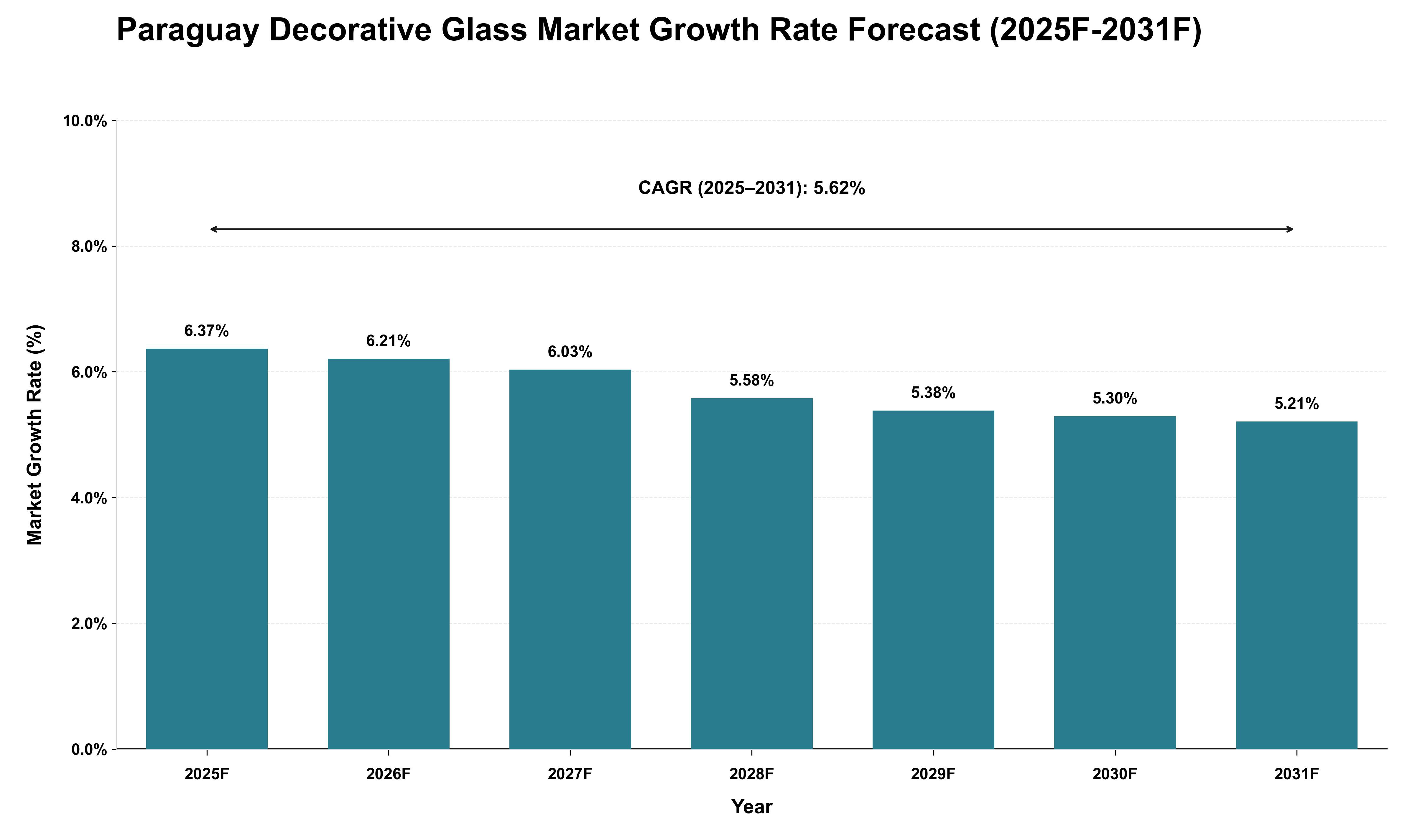
The Paraguay decorative glass market is projected to experience a compound annual growth rate of 5.62% from 2025 to 2031, reflecting a robust demand driven by evolving consumer preferences and technological advancements in glass production. As the forecasted annual growth rates gradually decline from 6.37% in 2025 to 5.21% by 2031, this trend indicates a potential shift towards product substitution, where consumers may increasingly favor innovative materials or designs that enhance aesthetic appeal and functionality. The anticipated growth will likely be influenced by import dependencies, as Paraguay continues to rely on external suppliers for high-quality glass products, which could affect pricing dynamics and availability. Additionally, cyclical trends in construction and interior design sectors will play a crucial role in shaping market demand, as economic fluctuations may lead to varying investment levels in decorative applications over the forecast period.
Key Highlights of the Report:
- Paraguay Decorative Glass Market Outlook
- Market Size of Paraguay Decorative Glass Market, 2024
- Forecast of Paraguay Decorative Glass Market, 2031
- Historical Data and Forecast of Paraguay Decorative Glass Revenues & Volume for the Period 2021-2031
- Paraguay Decorative Glass Market Trend Evolution
- Paraguay Decorative Glass Market Drivers and Challenges
- Paraguay Decorative Glass Price Trends
- Paraguay Decorative Glass Porter`s Five Forces
- Paraguay Decorative Glass Industry Life Cycle
- Historical Data and Forecast of Paraguay Decorative Glass Market Revenues & Volume By Product for the Period 2021-2031
- Historical Data and Forecast of Paraguay Decorative Glass Market Revenues & Volume By Low-e for the Period 2021-2031
- Historical Data and Forecast of Paraguay Decorative Glass Market Revenues & Volume By Special for the Period 2021-2031
- Historical Data and Forecast of Paraguay Decorative Glass Market Revenues & Volume By Other for the Period 2021-2031
- Historical Data and Forecast of Paraguay Decorative Glass Market Revenues & Volume By Application for the Period 2021-2031
- Historical Data and Forecast of Paraguay Decorative Glass Market Revenues & Volume By Commercial Building for the Period 2021-2031
- Historical Data and Forecast of Paraguay Decorative Glass Market Revenues & Volume By Residential Building for the Period 2021-2031
- Historical Data and Forecast of Paraguay Decorative Glass Market Revenues & Volume By Public Building for the Period 2021-2031
- Paraguay Decorative Glass Import Export Trade Statistics
- Market Opportunity Assessment By Product
- Market Opportunity Assessment By Application
- Paraguay Decorative Glass Top Companies Market Share
- Paraguay Decorative Glass Competitive Benchmarking By Technical and Operational Parameters
- Paraguay Decorative Glass Company Profiles
- Paraguay Decorative Glass Key Strategic Recommendations






































