Peru Asphalt Market Summary
The peru asphalt market was estimated at USD 208 Million in 2025 and is projected to reach USD 272 Million by 2032, growing at a CAGR of 4.6% from 2026 to 2032.
Peru Asphalt Market Year-wise Growth Rate and Key Drivers
This graph highlights how the Peru Asphalt Market has steadily grown over the past five years, supported by major growth factors.
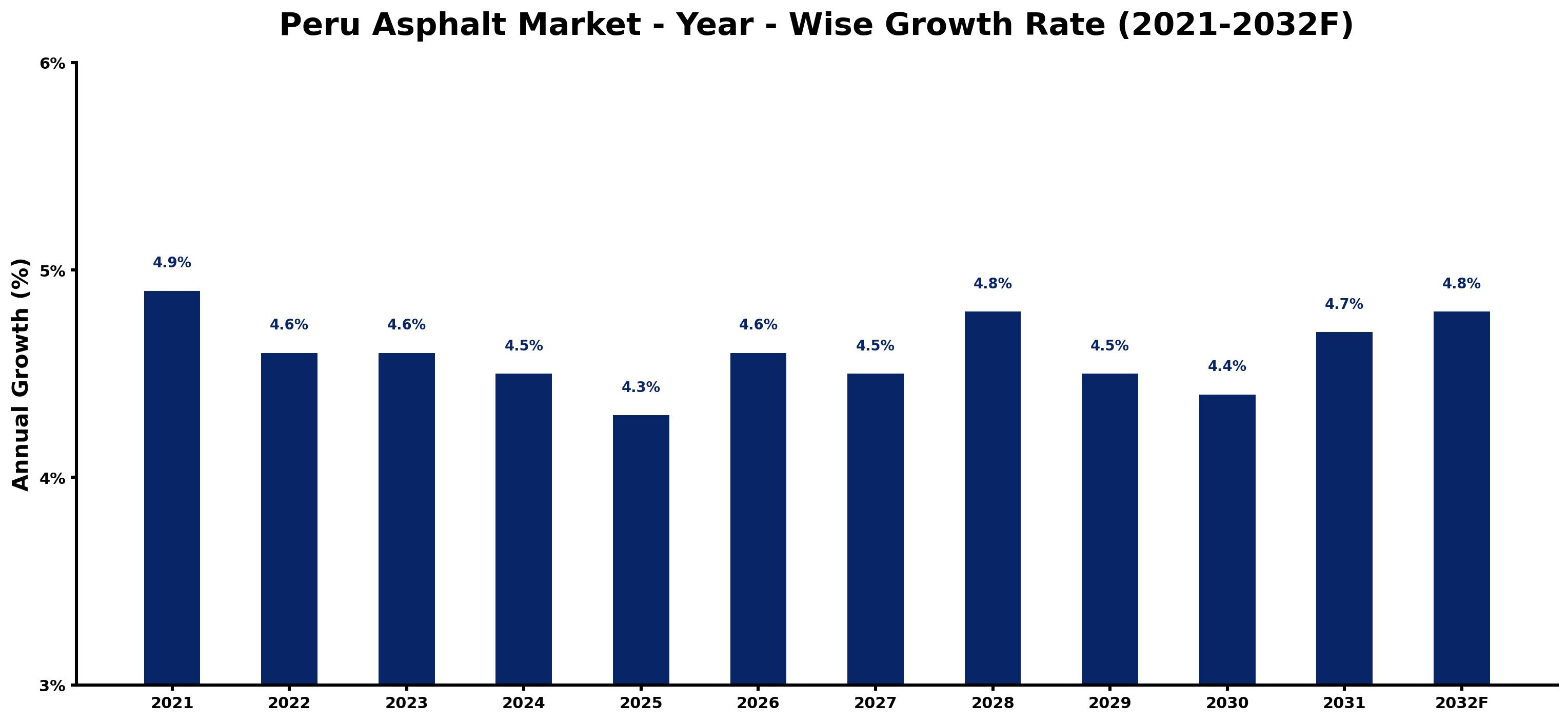
The table below presents the year wise growth rates along with the key drivers influencing the market
| Year | Growth Rate | Major Drivers |
| 2021 | 4.9% | Economic recovery efforts sparked renewed interest in infrastructure and public works projects. |
| 2022 | 4.6% | Investment in transportation networks highlighted the importance of reliable, high-quality asphalt materials. |
| 2023 | 4.6% | Local manufacturers began prioritizing sustainable asphalt alternatives to enhance environmental compliance. |
| 2024 | 4.5% | Urbanization trends increased demand for durable road surfaces in growing metropolitan areas. |
| 2025 | 4.3% | Innovative materials and techniques emerged to address climate resilience in road construction. |
| 2026 | 4.6% | Increased competition among suppliers led to improved pricing and product quality in the market. |
| 2027 | 4.5% | Rising construction costs necessitated efficient material usage and lifecycle management strategies. |
| 2028 | 4.8% | Collaborations between public and private sectors fueled large-scale infrastructure development initiatives. |
| 2029 | 4.5% | Technological advancements in asphalt production enhanced performance while reducing environmental impact. |
| 2030 | 4.4% | Focus on road safety and durability became paramount during infrastructure project planning phases. |
| 2031 | 4.7% | Emerging smart city projects demanded advanced materials for intelligent transportation systems. |
| 2032 | 4.8% | Market expansion into rural areas emphasized the importance of accessibility and regional connectivity. |
Note - Market size estimations and growth projections presented in this report are based on 6Wresearch's advanced forecasting approach, validated with industry datasets as of June 2026.
Peru Asphalt Market Synopsis
The Peru Asphalt Market is projected to reach 4.6% and witness significant growth during the forecast period (2026-2032). This growth is primarily attributed to the country's extensive infrastructure development initiatives. The demand for asphalt in Peru is closely linked to government-supported projects in transportation and urban enhancement, indicative of an evolving landscape that prioritizes improved connectivity and urbanization.
Peru Asphalt Market Growth Drivers
The standout factors driving the Peru Asphalt Market include:
- The continuous investment in road construction, maintenance, and expansion undertaken by the government, which is critical for improving national transportation networks.
- A heightened emphasis on sustainable construction materials and practices, resulting in increased adoption of innovative asphalt formulations that are both eco-friendly and efficient.
- Urban development initiatives accelerating demand for asphalt in residential and commercial construction projects as cities expand and modernize.
- The integration of polymer-modified asphalt to enhance performance in various environmental conditions, catering to the need for durable road surfaces.
- The rising trend of leveraging recycled asphalt materials to reduce costs and promote sustainability in construction practices.
Peru Asphalt Market Trends and Opportunities
The Peru Asphalt Market is currently witnessing several notable trends that provide opportunities for growth:
- There is a marked transition towards warm mix asphalt technologies, which minimize energy consumption during production and lower greenhouse gas emissions.
- Innovative approaches, such as the use of high-performance asphalt designed to address specific climatic challenges, are gaining traction within the market.
- The government's push for smarter cities is enhancing the prospects for modern asphalt solutions that can support advanced infrastructure.
- Investment in public-private partnerships is on the rise, enabling more efficient deployment of asphalt production and distribution initiatives.
- With urbanization on the rise, there is an increasing need for asphalt in diverse applications, fostering a competitive landscape ripe for investment opportunities.
Peru Asphalt Market Challenges and Restraints
Despite the promising outlook, the Peru Asphalt Market faces several challenges:
- Fluctuations in oil prices can significantly impact the cost of raw materials, presenting a financial challenge in pricing asphalt products competitively.
- Infrastructure inadequacies may lead to logistical challenges, affecting the timely delivery of asphalt to construction sites.
- Regulatory hurdles, including stringent environmental regulations, may delay project timelines and increase compliance costs for manufacturers.
- Competition from alternative paving materials such as concrete could hinder growth prospects for asphalt products in certain applications.
- Environmental concerns surrounding asphalt production and application may lead to increased scrutiny and demand for sustainable practices.
Peru Asphalt Market Government Investment and Initiatives
The Peruvian government plays a pivotal role in shaping the dynamics of the asphalt market through targeted investments and initiatives:
- Ongoing government initiatives focus on enhancing the transportation infrastructure, with significant funding allocated for road rehabilitation and new projects.
- Policies aimed at promoting sustainable construction practices encourage the adoption of eco-friendly asphalt technologies across various construction projects.
- Public spending on infrastructure development has increased, resulting in heightened demand for asphalt as a core material in public works.
- The establishment of public-private partnerships facilitates greater investment opportunities and resource sharing within the asphalt sector.
- Efforts to streamline regulatory frameworks are underway, which are expected to improve market conditions and enhance operational efficiencies for asphalt producers.
Peru Asphalt Market Latest Developments (May 2025 - June 2026)
Recent developments within the Peru Asphalt Market highlight its adaptability and growth potential:
- There has been a significant rise in projects focusing on the use of advanced asphalt technologies, reflecting a global industry trend towards performance-based solutions.
- The government has initiated several large-scale infrastructure projects, which have led to a renewed focus on quality and sustainability in asphalt production.
- Industry stakeholders are increasingly prioritizing R&D activities aimed at improving the performance and sustainability of asphalt products.
- Collaborations and partnerships between public and private sectors have been on the rise, fostering innovation and resource sharing in asphalt-related projects.
- Moreover, the integration of digital technologies into asphalt production processes is expected to enhance operational efficiencies and reduce environmental impacts.
Peru Asphalt Market - Key Attractiveness of the Report
- 10 Years of Market Numbers
- Historical Data Starting from 2022 to 2025
- Base Year: 2025
- Forecast Data until 2032
- Key Performance Indicators Impacting the Market
- Major Upcoming Developments and Projects
Key Highlights of the Report:
- Peru Asphalt Market Outlook
- Market Size of Peru Asphalt Market, 2025
- Forecast of Peru Asphalt Market, 2032F
- Historical Data and Forecast of Peru Asphalt Revenues & Volume for the Period 2022-2032F
- Peru Asphalt Market Trend Evolution
- Peru Asphalt Market Drivers and Challenges
- Peru Asphalt Price Trends
- Peru Asphalt Porter's Five Forces
- Peru Asphalt Industry Life Cycle
- Historical Data and Forecast of Peru Asphalt Market Revenues & Volume By Type for the Period 2022-2032F
- Historical Data and Forecast of Peru Asphalt Market Revenues & Volume By Paving Petroleum Asphalt for the Period 2022-2032F
- Historical Data and Forecast of Peru Asphalt Market Revenues & Volume By Industrial Petroleum Asphalt for the Period 2022-2032F
- Historical Data and Forecast of Peru Asphalt Market Revenues & Volume By Others for the Period 2022-2032F
- Historical Data and Forecast of Peru Asphalt Market Revenues & Volume By Application for the Period 2022-2032F
- Historical Data and Forecast of Peru Asphalt Market Revenues & Volume By Paving for the Period 2022-2032F
- Historical Data and Forecast of Peru Asphalt Market Revenues & Volume By Roofing for the Period 2022-2032F
- Historical Data and Forecast of Peru Asphalt Market Revenues & Volume By Others for the Period 2022-2032F
- Peru Asphalt Import Export Trade Statistics
- Market Opportunity Assessment By Type
- Market Opportunity Assessment By Application
- Peru Asphalt Top Companies Market Share
- Peru Asphalt Competitive Benchmarking By Technical and Operational Parameters
- Peru Asphalt Company Profiles
- Peru Asphalt Key Strategic Recommendations






































