Peru Cellulose Acetate Fiber Market Top 5 Importing Countries and Market Competition (HHI) Analysis
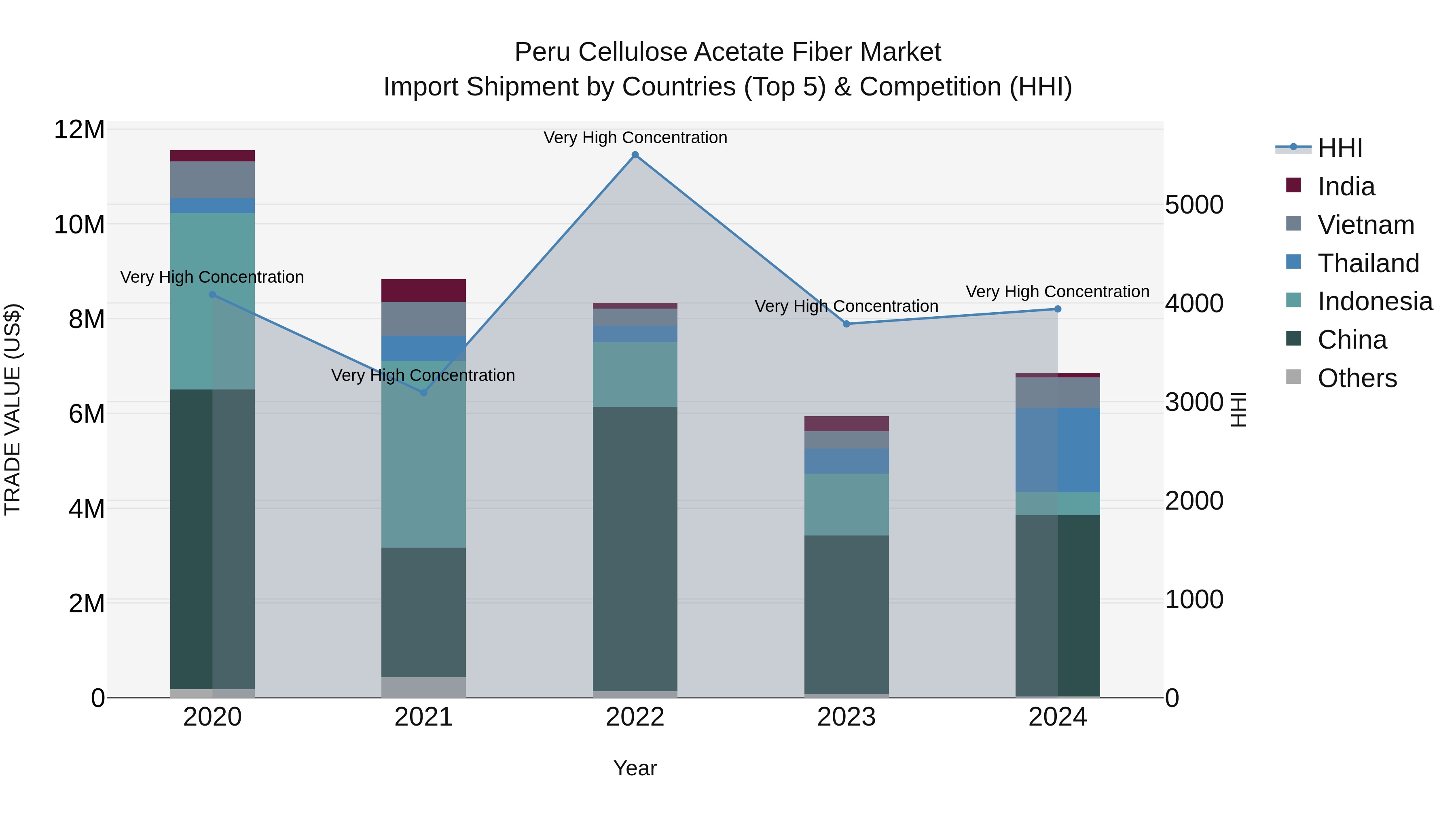
Peru continues to be a key destination for cellulose acetate fiber imports, with China, Thailand, Vietnam, Indonesia, and India leading the way in 2024. The high Herfindahl-Hirschman Index (HHI) indicates a concentrated market, while the negative Compound Annual Growth Rate (CAGR) from 2020 to 2024 suggests challenges in the industry. However, the impressive growth rate of 15.22% from 2023 to 2024 hints at a potential turnaround or increased demand for cellulose acetate fiber in Peru. Monitoring market dynamics and emerging trends will be crucial for stakeholders in this sector.
Peru Cellulose Acetate Fiber Market Overview
The Peru Cellulose Acetate Fiber market is experiencing steady growth driven by the increasing demand for sustainable and eco-friendly textiles in the country. Cellulose acetate fibers are derived from natural sources and offer properties such as high absorbency, softness, and biodegradability, making them popular among environmentally conscious consumers. The textile industry in Peru is embracing these fibers for the production of apparel, home textiles, and industrial fabrics. Additionally, the growing awareness about the harmful effects of synthetic fibers on the environment is further fueling the adoption of cellulose acetate fibers. Key players in the Peru market include manufacturers such as Eastman Chemical Company and Celanese Corporation, who are investing in research and development to introduce innovative products and cater to the evolving needs of the consumers.
Peru Cellulose Acetate Fiber Market Trends
The Peru Cellulose Acetate Fiber market is experiencing steady growth due to increasing demand from various industries such as textiles, automotive, and packaging. The market is witnessing a shift towards eco-friendly and sustainable fibers, driving the adoption of cellulose acetate fibers which are biodegradable and derived from natural sources. Manufacturers are focusing on developing innovative products with improved properties such as enhanced strength, durability, and moisture-wicking capabilities to cater to the evolving consumer preferences. Additionally, the rising awareness about the environmental impact of synthetic fibers is further fueling the demand for cellulose acetate fibers in Peru. Overall, the market is expected to continue its growth trajectory in the coming years driven by sustainability concerns and changing consumer preferences.
Peru Cellulose Acetate Fiber Market Challenges
In the Peru Cellulose Acetate Fiber Market, some of the key challenges faced include competition from alternative synthetic fibers, fluctuating raw material prices, and limited awareness among consumers about the benefits of cellulose acetate fibers. Additionally, issues related to sustainability and environmental concerns are becoming increasingly important for consumers, putting pressure on companies to adopt more eco-friendly production processes. Furthermore, the industry faces challenges in terms of technological advancements and innovation to meet evolving market demands. Overcoming these challenges will require companies to invest in research and development, focus on sustainability initiatives, and educate consumers on the unique qualities and benefits of cellulose acetate fibers to remain competitive in the market.
Peru Cellulose Acetate Fiber Market Investment Opportunities
The Peru Cellulose Acetate Fiber Market presents promising investment opportunities due to the increasing demand for sustainable and eco-friendly textile materials. With the growing awareness of environmental issues, there is a rising preference for cellulose acetate fibers, which are derived from natural sources such as wood pulp. This presents an attractive opportunity for investors looking to capitalize on the shift towards sustainable fashion and textiles. Additionally, the textile industry in Peru is a significant contributor to the country`s economy, further bolstering the potential for growth and investment in cellulose acetate fiber production. Investing in this market can provide long-term returns and align with the global trend towards sustainable and environmentally conscious consumer choices.
Peru Cellulose Acetate Fiber Market Government Policy
Government policies related to the Peru Cellulose Acetate Fiber Market include regulations on environmental protection, labor practices, and trade agreements. The Peruvian government has implemented measures to promote sustainable production practices and ensure compliance with environmental standards to protect the country`s natural resources. Additionally, policies are in place to regulate labor conditions in the cellulose acetate fiber industry to safeguard workers` rights and promote fair employment practices. Peru`s participation in trade agreements also plays a significant role in shaping the market landscape by influencing tariffs, quotas, and market access for cellulose acetate fiber products. Overall, government policies in Peru aim to create a conducive regulatory environment for the cellulose acetate fiber market that balances economic growth with social and environmental sustainability.
Peru Cellulose Acetate Fiber Market Future Outlook
The future outlook for the Peru Cellulose Acetate Fiber Market appears promising, driven by the increasing demand for sustainable and eco-friendly textile materials in the region. With a growing awareness of environmental issues, consumers are increasingly opting for cellulose acetate fibers as a renewable alternative to traditional synthetic fibers. The market is also expected to benefit from the textile industry`s shift towards more sustainable practices and the rising popularity of eco-conscious fashion trends. Additionally, technological advancements in the production of cellulose acetate fibers are likely to improve the quality and performance of these materials, further boosting market growth. Overall, the Peru Cellulose Acetate Fiber Market is poised for expansion in the coming years, supported by sustainability initiatives and changing consumer preferences.
Key Highlights of the Report:
- Peru Cellulose Acetate Fiber Market Outlook
- Market Size of Peru Cellulose Acetate Fiber Market, 2024
- Forecast of Peru Cellulose Acetate Fiber Market, 2031
- Historical Data and Forecast of Peru Cellulose Acetate Fiber Revenues & Volume for the Period 2021 - 2031
- Peru Cellulose Acetate Fiber Market Trend Evolution
- Peru Cellulose Acetate Fiber Market Drivers and Challenges
- Peru Cellulose Acetate Fiber Price Trends
- Peru Cellulose Acetate Fiber Porter's Five Forces
- Peru Cellulose Acetate Fiber Industry Life Cycle
- Historical Data and Forecast of Peru Cellulose Acetate Fiber Market Revenues & Volume By Type for the Period 2021 - 2031
- Historical Data and Forecast of Peru Cellulose Acetate Fiber Market Revenues & Volume By Plastic for the Period 2021 - 2031
- Historical Data and Forecast of Peru Cellulose Acetate Fiber Market Revenues & Volume By Fiber for the Period 2021 - 2031
- Historical Data and Forecast of Peru Cellulose Acetate Fiber Market Revenues & Volume By Application for the Period 2021 - 2031
- Historical Data and Forecast of Peru Cellulose Acetate Fiber Market Revenues & Volume By Photographic Films for the Period 2021 - 2031
- Historical Data and Forecast of Peru Cellulose Acetate Fiber Market Revenues & Volume By Cigarette Filters for the Period 2021 - 2031
- Historical Data and Forecast of Peru Cellulose Acetate Fiber Market Revenues & Volume By Tapes & Labels for the Period 2021 - 2031
- Historical Data and Forecast of Peru Cellulose Acetate Fiber Market Revenues & Volume By Textiles & Apparel for the Period 2021 - 2031
- Peru Cellulose Acetate Fiber Import Export Trade Statistics
- Market Opportunity Assessment By Type
- Market Opportunity Assessment By Application
- Peru Cellulose Acetate Fiber Top Companies Market Share
- Peru Cellulose Acetate Fiber Competitive Benchmarking By Technical and Operational Parameters
- Peru Cellulose Acetate Fiber Company Profiles
- Peru Cellulose Acetate Fiber Key Strategic Recommendations






































