Peru Container Security Market Size & Growth Rate (2026-2032)
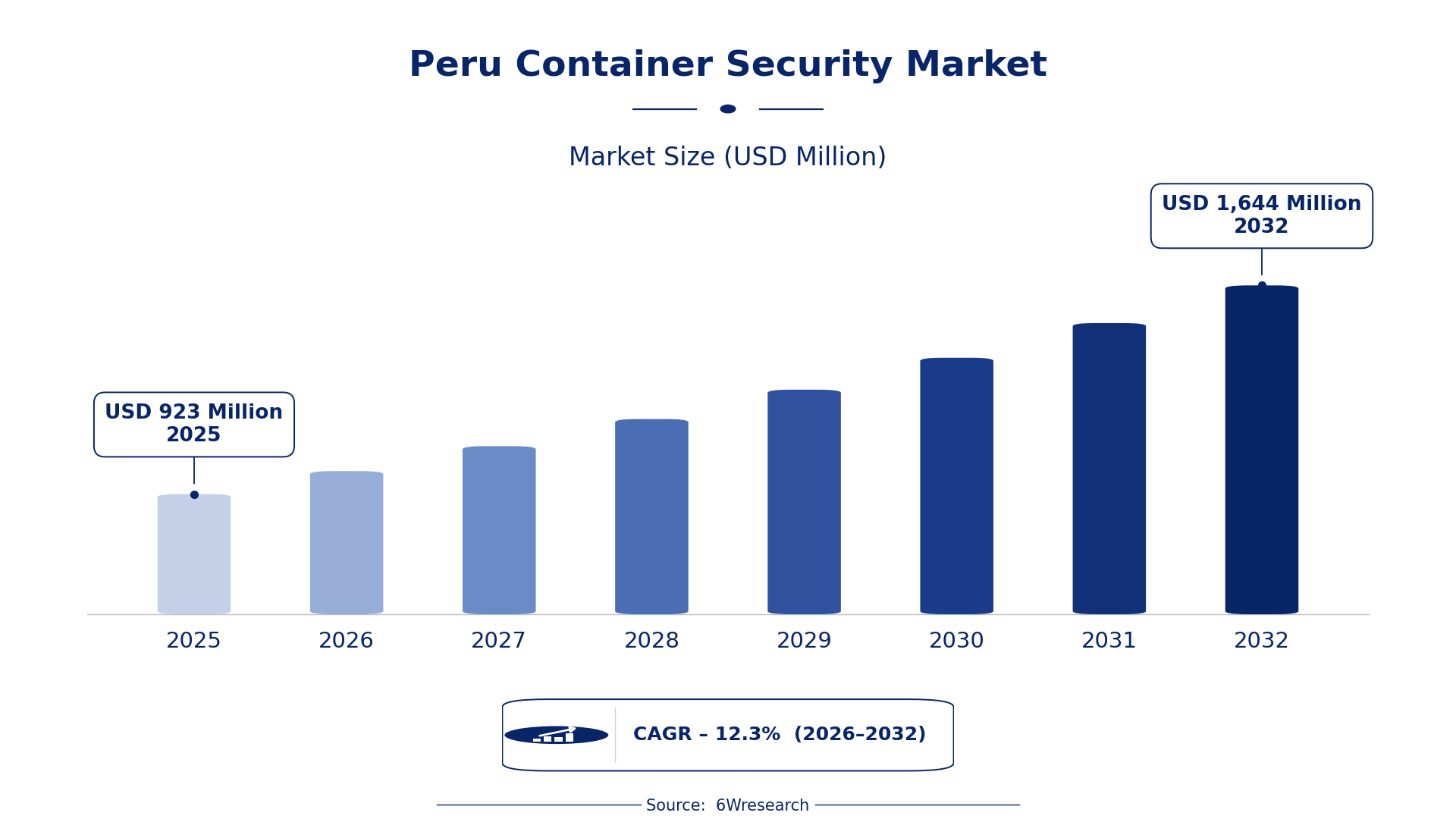
The Peru Container Security Market was estimated at USD 923 Million in 2025 and is projected to reach USD 1644 Million by 2032, growing at a CAGR of 12.3% from 2026 to 2032.
Peru Container Security Market Synopsis
The Peru Container Security Market has recently gained momentum as companies focus on securing their shipments against theft and tampering. The rising global trade volume amplifies the urgency for enhanced security measures, positioning the market for substantial growth.
As organizations increasingly adopt advanced technologies like IoT tracking and RFID solutions, the future of container security looks promising. This proactive approach not only safeguards cargo but also aligns with government initiatives aimed at fortifying port security and regulatory compliance.
Peru Container Security Market Year-wise Growth Rate and Key Drivers
This graph illustrates the annual growth rates of the Peru Container Security Market from 2021 to 2032, highlighting a steady upward trajectory and projected expansion over the forecast period.
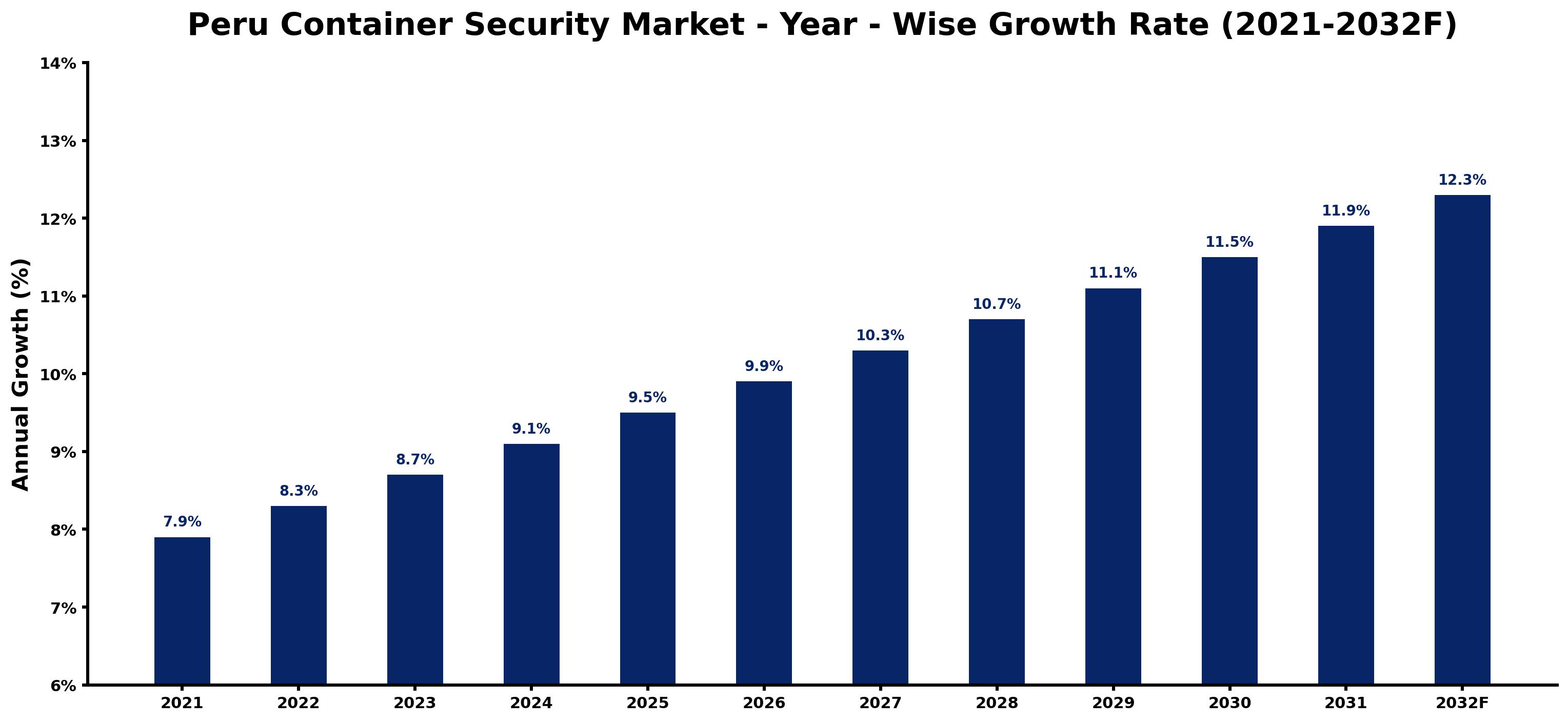
The table below presents the year‑wise growth rates along with the key drivers influencing the market
| Year | Growth Rate | Major Drivers |
| 2021 | 7.9% | Government investment in port security infrastructure upgrades. |
| 2022 | 8.3% | Increased trade volume drives demand for enhanced security. |
| 2023 | 8.7% | Adoption of blockchain for secure supply chain tracking. |
| 2024 | 9.1% | New customs regulations requiring stricter container inspections. |
| 2025 | 9.5% | Rising awareness of cybersecurity in logistics operations. |
| 2026 | 9.9% | Enhanced collaboration between ports and security agencies. |
| 2027 | 10.3% | Introduction of IoT for real-time container monitoring. |
| 2028 | 10.7% | Growth in e-commerce boosting demand for secure transport. |
| 2029 | 11.1% | Peru's economic recovery spurring international shipping activities. |
| 2030 | 11.5% | Investment in training programs for security personnel. |
| 2031 | 11.9% | Regulatory incentives for companies implementing advanced technologies. |
| 2032 | 12.3% | Emergence of local firms specializing in container security solutions. |
Note: Market size estimations and growth projections presented in this report are based on 6Wresearch's proprietary forecasting methodology, utilizing the latest available industry data, government publications, and primary research inputs.
Peru Container Security Market Key Takeaways
Below are some of the specific key takeaways from the market, including:
- The growing emphasis on compliance with international security standards is driving investments in container security technologies.
- Recent advancements in IoT and blockchain are enhancing the visibility and integrity of container shipments.
- The market is becoming increasingly reliant on integrated security solutions that offer real-time monitoring capabilities.
- Government policies are facilitating improvements in port security through advanced screening technologies and strict customs regulations.
- Investment opportunities are expanding, particularly in container tracking and tamper-evident sealing technologies.
Evaluation of Restraints in Peru Container Security Market
While the market presents considerable growth potential, it faces constraints that can impede progress. A primary challenge is the need for significant investment in technology and infrastructure. Many organizations encounter resource limitations that make implementing comprehensive security measures difficult. This is particularly pronounced in regions with varying security needs, as diverse cargo types complicate the standardization of security protocols. Compliance with international security regulations, coupled with the risk of cyber threats, adds another layer of complexity that businesses must address to secure their supply chains effectively.
Peru Container Security Market Trends
Emerging trends in the Peru Container Security Market are primarily centered around technological advancements. The integration of IoT-enabled devices is increasingly becoming a standard for tracking shipments in real-time. Additionally, businesses are leaning toward blockchain technology to ensure data integrity and visibility throughout the supply chain. Compliance with international security standards is another trend, compelling organizations to invest heavily in robust security measures. The shift towards cloud-based solutions reflects a growing need for scalable security that can adapt to the dynamic nature of trade operations.
Peru Container Security Market Opportunities
The Peru Container Security Market is ripe with investment opportunities as demand for secure logistics solutions grows. Organizations are seeking cutting-edge container tracking technologies like GPS, RFID, and IoT sensors to mitigate risks associated with theft and tampering. Additionally, security services, including tamper-evident seals and enhanced storage facilities, are gaining traction among logistics providers aiming to bolster cargo safety. As trade volumes rise, these opportunities present a lucrative avenue for investors looking to tap into the evolving security landscape.
Government Initiatives in the Peru Container Security Market
The Peruvian government is actively shaping the container security market through a range of initiatives focused on enhancing trade safety and regulatory compliance. These measures reflect a commitment to protecting supply chains and ensuring adherence to international standards, crucial for facilitating smoother trade operations.
- A recently completed initiative involved upgrading port screening technologies, including the installation of advanced X-ray scanners and radiation detectors.
- Currently underway is a comprehensive review of customs regulations to bolster compliance with international security standards established by the World Customs Organization.
- Planned initiatives include the expansion of a national cybersecurity program aimed at safeguarding the digital infrastructure used in container logistics.
- Ongoing collaboration with international organizations has resulted in enhanced intelligence sharing on threats to container security.
- A program designed to improve training for customs officials in recognizing security vulnerabilities is set to launch by mid-2026.
Future Insights of the Peru Container Security Market
Looking ahead to 2026-2032, the Peru Container Security Market is positioned for remarkable growth. Continued advancements in technology will be pivotal in redefining the security protocols within the logistics sector. The expected increase in trade activities will further heighten the demand for sophisticated security solutions. Additionally, as international regulations tighten, companies will need to adopt more rigorous security measures to remain compliant. This convergence of factors suggests an accelerating trajectory for innovation and investment in the container security space.
Peru Container Security Market Latest Developments
Recent activity in the Peru Container Security Market reveals a strong focus on technological integration and security upgrades. Over the past year, organizations have prioritized measures that enhance supply chain visibility and ensure cargo integrity.
- A leading technology vendor announced the rollout of an IoT-enabled tracking solution aimed at increasing real-time monitoring capabilities, initiated in Q1 2025 and currently ongoing.
- An initiative to implement tamper-evident seals in major shipping lines was completed by the end of 2025, significantly enhancing cargo protection.
- Plans for a public-private partnership to develop a cybersecurity framework specifically for logistics operations are expected to commence in late 2026.
- A regional operator has begun testing blockchain technology in container monitoring systems, with expected outcomes to be assessed by mid-2026.
- Current efforts include upgrading data transmission security protocols to address vulnerabilities identified in earlier evaluations.
Peru Container Security Market - Key Attractiveness of the Report
- 10 Years of Market Numbers
- Historical Data Starting from 2022 to 2025
- Base Year: 2025
- Forecast Data until 2032
- Key Performance Indicators Impacting the Market
- Major Upcoming Developments and Projects
Key Highlights of the Report:
- Peru Container Security Market Outlook
- Market Size of Peru Container Security Market, 2025
- Forecast of Peru Container Security Market, 2032
- Historical Data and Forecast of Peru Container Security Revenues & Volume for the Period 2022-2032F
- Peru Container Security Market Trend Evolution
- Peru Container Security Market Drivers and Challenges
- Peru Container Security Price Trends
- Peru Container Security Porter's Five Forces
- Peru Container Security Industry Life Cycle
- Historical Data and Forecast of Peru Container Security Market Revenues & Volume By Component for the Period 2022-2032F
- Historical Data and Forecast of Peru Container Security Market Revenues & Volume By Container Security Products for the Period 2022-2032F
- Historical Data and Forecast of Peru Container Security Market Revenues & Volume By Services (Professional, Managed) for the Period 2022-2032F
- Historical Data and Forecast of Peru Container Security Market Revenues & Volume By Deployment Type for the Period 2022-2032F
- Historical Data and Forecast of Peru Container Security Market Revenues & Volume By Cloud for the Period 2022-2032F
- Historical Data and Forecast of Peru Container Security Market Revenues & Volume By On-premises for the Period 2022-2032F
- Historical Data and Forecast of Peru Container Security Market Revenues & Volume By Vertical for the Period 2022-2032F
- Historical Data and Forecast of Peru Container Security Market Revenues & Volume By BFSI for the Period 2022-2032F
- Historical Data and Forecast of Peru Container Security Market Revenues & Volume By Retail for the Period 2022-2032F
- Historical Data and Forecast of Peru Container Security Market Revenues & Volume By Government for the Period 2022-2032F
- Historical Data and Forecast of Peru Container Security Market Revenues & Volume By Healthcare for the Period 2022-2032F
- Peru Container Security Import Export Trade Statistics
- Market Opportunity Assessment By Component
- Market Opportunity Assessment By Deployment Type
- Market Opportunity Assessment By Vertical
- Peru Container Security Top Companies Market Share
- Peru Container Security Competitive Benchmarking By Technical and Operational Parameters
- Peru Container Security Company Profiles
- Peru Container Security Key Strategic Recommendations






































