Peru Deli Meat Market Size, Share & Growth Rate
The Peru Deli Meat Market was estimated at USD 458 Million in 2025 and is projected to reach USD 626 Million by 2032, growing at a CAGR of 4.6% from 2026 to 2032. This growth trajectory is fueled by an expanding urban population seeking convenient food options, coupled with a marked shift towards healthier, premium deli meats. As consumers increasingly prioritize quality and authenticity, the market is poised for substantial expansion.
Peru Deli Meat Market Year-wise Growth Rate and Key Drivers
This graph highlights how the Peru Deli Meat Market has steadily grown over the years, supported by major growth factors.
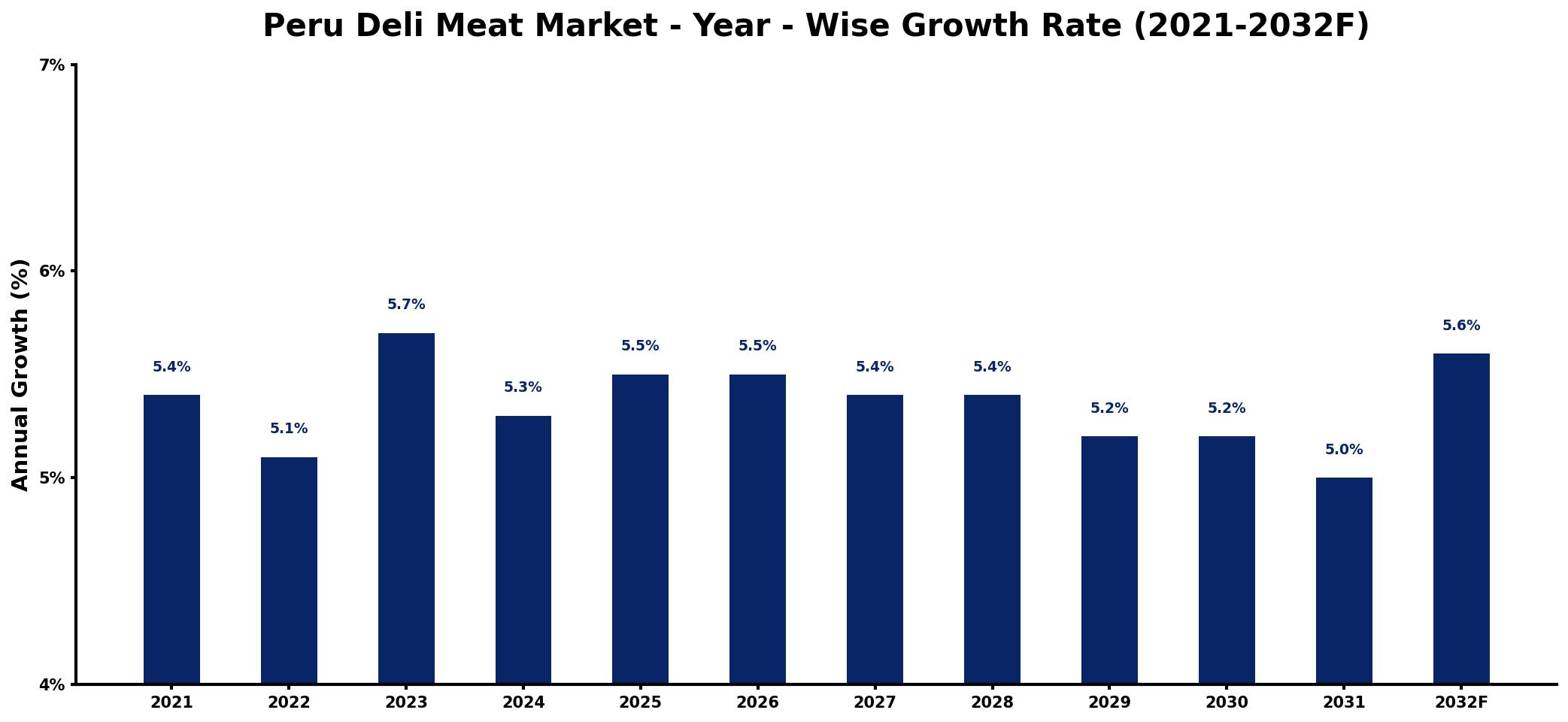
The table below presents the year‑wise growth rates along with the key drivers influencing the market
| Year | Growth Rate | Major Drivers |
| 2021 | 5.4% | Rising consumer health consciousness |
| 2022 | 5.1% | Increased retail distribution channels |
| 2023 | 5.7% | Growing demand for convenience foods |
| 2024 | 5.3% | Expansion of local production facilities |
| 2025 | 5.5% | Surge in online grocery shopping |
| 2026 | 5.5% | Innovations in packaging technology |
| 2027 | 5.4% | Strengthening of export markets |
| 2028 | 5.4% | Investment in sustainable sourcing |
| 2029 | 5.2% | Enhanced food safety regulations |
| 2030 | 5.2% | Emergence of plant-based alternatives |
| 2031 | 5.0% | Diversification of product offerings |
| 2032 | 5.6% | Rising popularity of premium products |
Note: Market size estimations and growth projections presented in this report are based on 6Wresearch's proprietary forecasting methodology, utilizing the latest available industry data, government publications, and primary research inputs.
Peru Deli Meat Market Synopsis
The Peru deli meat market is currently experiencing a robust evolution, driven by the growing demand for quick and convenient meal solutions. Urbanization and changing lifestyles have led to a surge in popularity for products such as ham, salami, and turkey, commonly used in sandwiches, salads, and appetizers.
Furthermore, there is a noticeable shift towards healthier options, with consumers gravitating towards organic and antibiotic-free varieties. This trend reflects an increasing awareness about nutrition and food quality, presenting an evolving landscape for both domestic and international deli meat producers.
Peru Deli Meat Market Key Takeaways
- The demand for premium and health-conscious deli meat products is steadily rising among Peruvian consumers.
- Convenience and time-saving options are paramount in driving consumer choices within the deli meat sector.
- Challenges posed by food safety regulations and fluctuating raw material prices require strategic planning from manufacturers.
- The COVID-19 pandemic has accelerated trends towards at-home dining, enhancing the popularity of deli meats for DIY charcuterie boards.
- Government policies are focused on ensuring food safety and transparency in labeling, impacting the deli meat landscape.
Evaluation of Restraints in Peru Deli Meat Market
The Peru deli meat market faces several restraints that may hinder its growth trajectory. Heightened competition from both local and international producers is contributing to a crowded market space. Additionally, fluctuating raw material costs complicate pricing strategies, making it difficult for manufacturers to maintain margins while meeting consumer demands for high-quality products. Regulatory requirements concerning food safety and quality standards further complicate market dynamics, necessitating strict compliance from manufacturers. Moreover, logistical challenges, including the need for efficient distribution networks to ensure freshness, add another layer of complexity.
Peru Deli Meat Market Trends
The Peru deli meat market is currently witnessing several notable trends. A growing consumer inclination towards gourmet and artisanal products has led to increased interest in unique deli meat varieties, such as charcuterie. As health-conscious eating becomes more prevalent, there is a significant demand for meats that are free from additives and artificial ingredients. Additionally, the COVID-19 pandemic has prompted a greater focus on at-home dining experiences, resulting in higher deli meat purchases for home-prepared meals and gatherings.
Peru Deli Meat Market Opportunities
Opportunities abound in the Peru deli meat market for investors and producers alike. The growing trend towards health-oriented products suggests a lucrative avenue for introducing organic, ethically sourced deli meats. Moreover, innovative packaging and distribution strategies can enhance accessibility and appeal to a broader consumer base. Collaborations with local producers to create unique product lines could also cater to the increasing demand for premium offerings. Focused investment in product development that aligns with consumer preferences for convenience and quality is likely to yield favorable returns.
Government Initiatives in the Peru Deli Meat Market
Government initiatives play a crucial role in shaping the Peru deli meat market. Regulatory bodies, such as the National Sanitary Authority (DIGESA), focus on ensuring food safety and quality through rigorous inspections and certifications. The Ministry of Agriculture oversees import and export requirements, emphasizing compliance with international standards to promote fair trade. Labeling regulations require transparency in ingredient listings and nutritional information, empowering consumers to make informed choices about their deli meat purchases. Overall, these policies aim to enhance food safety while fostering a competitive market environment.
Future Insights of the Peru Deli Meat Market
Looking ahead to 2026-2032, the Peru deli meat market is expected to maintain a steady growth trajectory. Urbanization and disposable income growth will continue to fuel demand for convenient food products. As Western food trends infiltrate local diets, consumers may increasingly seek diverse and innovative deli meat offerings. However, the market must navigate health concerns associated with processed meats and heightened competition from plant-based alternatives. Overall, focusing on innovation, quality, and health-conscious offerings will be pivotal in meeting evolving consumer demands.
Peru Deli Meat Market Latest Developments (2025 - 2026)
Recent developments in the Peru deli meat market suggest a heightened emphasis on health and sustainability. Many producers are exploring the use of locally sourced ingredients and sustainable practices to align with consumer preferences for ethical products. Innovations in packaging technology are also gaining traction, aimed at enhancing product shelf life and convenience. As consumer interest in gourmet offerings rises, there is a notable increase in artisanal production methods being adopted across the industry.
Peru Deli Meat Market - Key Attractiveness of the Report
- 10 Years of Market Numbers
- Historical Data Starting from 2022 to 2025
- Base Year: 2025
- Forecast Data until 2032
- Key Performance Indicators Impacting the Market
- Major Upcoming Developments and Projects
Key Highlights of the Report:
- Peru Deli Meat Market Outlook
- Market Size of Peru Deli Meat Market, 2025
- Forecast of Peru Deli Meat Market, 2032
- Historical Data and Forecast of Peru Deli Meat Revenues & Volume for the Period 2022-2032F
- Peru Deli Meat Market Trend Evolution
- Peru Deli Meat Market Drivers and Challenges
- Peru Deli Meat Price Trends
- Peru Deli Meat Porter's Five Forces
- Peru Deli Meat Industry Life Cycle
- Historical Data and Forecast of Peru Deli Meat Market Revenues & Volume By Source for the Period 2022-2032F
- Historical Data and Forecast of Peru Deli Meat Market Revenues & Volume By Beef for the Period 2022-2032F
- Historical Data and Forecast of Peru Deli Meat Market Revenues & Volume By Pork for the Period 2022-2032F
- Historical Data and Forecast of Peru Deli Meat Market Revenues & Volume By Chicken for the Period 2022-2032F
- Historical Data and Forecast of Peru Deli Meat Market Revenues & Volume By Others for the Period 2022-2032F
- Historical Data and Forecast of Peru Deli Meat Market Revenues & Volume By Product Type for the Period 2022-2032F
- Historical Data and Forecast of Peru Deli Meat Market Revenues & Volume By Cured Meat for the Period 2022-2032F
- Historical Data and Forecast of Peru Deli Meat Market Revenues & Volume By Uncured Meat for the Period 2022-2032F
- Historical Data and Forecast of Peru Deli Meat Market Revenues & Volume By Sales Channel for the Period 2022-2032F
- Historical Data and Forecast of Peru Deli Meat Market Revenues & Volume By Hypermarkets/Supermarkets for the Period 2022-2032F
- Historical Data and Forecast of Peru Deli Meat Market Revenues & Volume By Specialty Stores for the Period 2022-2032F
- Historical Data and Forecast of Peru Deli Meat Market Revenues & Volume By Convenience Stores for the Period 2022-2032F
- Historical Data and Forecast of Peru Deli Meat Market Revenues & Volume By Online Channels for the Period 2022-2032F
- Historical Data and Forecast of Peru Deli Meat Market Revenues & Volume By Others for the Period 2022-2032F
- Peru Deli Meat Import Export Trade Statistics
- Market Opportunity Assessment By Source
- Market Opportunity Assessment By Product Type
- Market Opportunity Assessment By Sales Channel
- Peru Deli Meat Top Companies Market Share
- Peru Deli Meat Competitive Benchmarking By Technical and Operational Parameters
- Peru Deli Meat Company Profiles
- Peru Deli Meat Key Strategic Recommendations






































