Peru Security Analytics Market Size & Growth Rate (2026-2032)
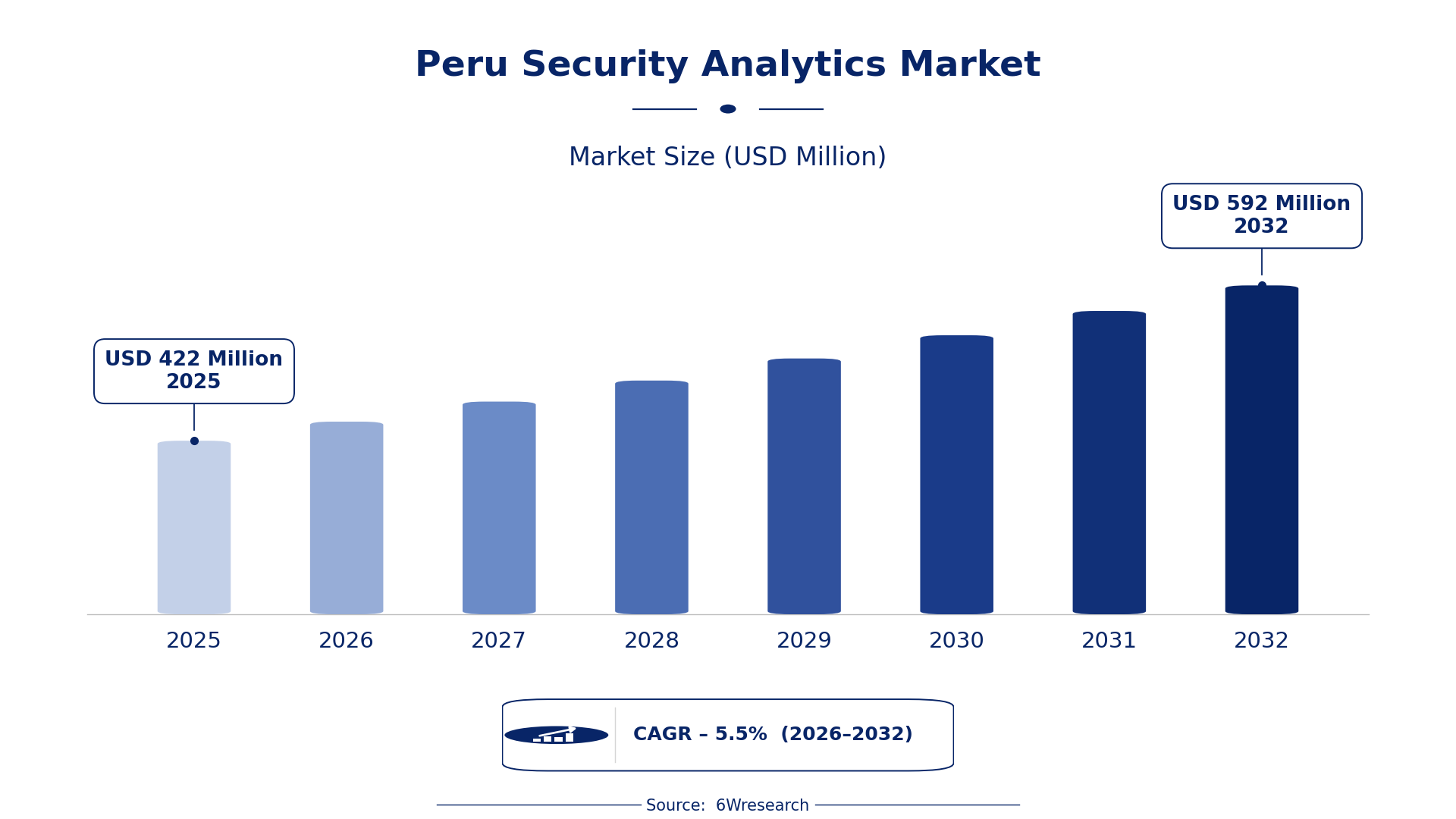
The Peru Security Analytics Market was estimated at USD 422 Million in 2025 and is projected to reach USD 592 Million by 2032, growing at a CAGR of 5.5% from 2026 to 2032.
Peru Security Analytics Market Synopsis
The Peru Security Analytics Market is witnessing an essential evolution, fueled by rising cybersecurity threats and a heightened focus on data protection across sectors. Businesses are increasingly turning to security analytics solutions not just as a precaution, but as a vital component of their operational infrastructure, particularly in industries like banking, healthcare, and government.
As organizations grapple with complex security challenges, they are adopting advanced tools such as threat intelligence and security information and event management (SIEM) systems. The regulatory landscape further intensifies this demand, as companies strive to meet compliance requirements while safeguarding sensitive information.
Peru Security Analytics Market Year-wise Growth Rate and Key Drivers
This graph illustrates the annual growth rates of the Peru Security Analytics Market from 2021 to 2032, highlighting a steady upward trajectory and projected expansion over the forecast period.
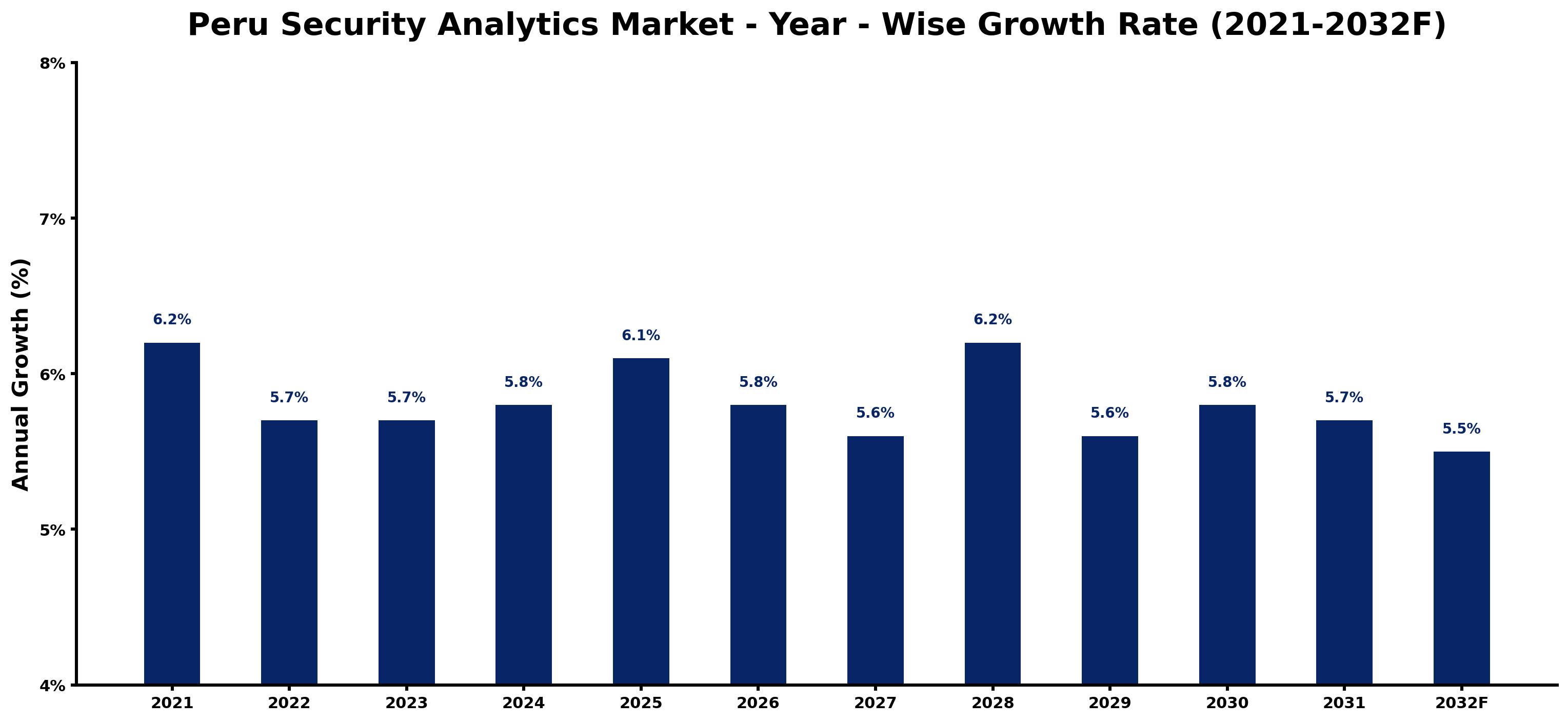
The table below presents the year‑wise growth rates along with the key drivers influencing the market
| Year | Growth Rate | Major Drivers |
| 2021 | 6.2% | Increase in cybercrime incidents reported by government. |
| 2022 | 5.7% | New data protection law enforced by OSIPTEL. |
| 2023 | 5.7% | Adoption of AI algorithms in local security firms. |
| 2024 | 5.8% | Rise in demand for fraud detection solutions. |
| 2025 | 6.1% | Government initiatives for urban security improvements. |
| 2026 | 5.8% | Increased global investment in local cybersecurity startups. |
| 2027 | 5.6% | Growing infrastructure modernization requires advanced analytics. |
| 2028 | 6.2% | Awareness of data breach risks among enterprises rising. |
| 2029 | 5.6% | Growth in e-commerce spurring analytics demand. |
| 2030 | 5.8% | Shift towards cloud-based security solutions by businesses. |
| 2031 | 5.7% | Public-private partnerships enhancing security analytics capabilities. |
| 2032 | 5.5% | Increased regulatory scrutiny driving analytical tool adoption. |
Note: Market size estimations and growth projections presented in this report are based on 6Wresearch's proprietary forecasting methodology, utilizing the latest available industry data, government publications, and primary research inputs.
Peru Security Analytics Market Key Takeaways
Below are some of the specific key takeaways from the market, including:
- Growing awareness of cyber threats is driving demand for advanced security analytics solutions.
- The healthcare and finance sectors are leading adopters of security analytics technologies.
- Regulatory pressures are increasing the necessity for compliance-related security analytics tools.
- Cloud-based solutions are becoming a preferred choice for scalability and efficiency.
- The shift toward AI-driven analytics is enhancing threat detection and response capabilities.
Evaluation of Restraints in Peru Security Analytics Market
Despite its growth trajectory, the Peru Security Analytics Market is held back by several key restraints. A noticeable lack of awareness regarding the benefits of security analytics persists among many organizations, often leading to underinvestment in necessary tools. Coupled with a shortage of skilled professionals in cybersecurity, these factors hinder effective implementation and utilization of security measures. The costs associated with deploying these solutions also pose significant barriers, particularly for small and medium enterprises. As cybersecurity threats evolve rapidly, the complexity of IT environments further complicates the landscape, making it imperative for organizations to prioritize investment in robust analytics frameworks.
Peru Security Analytics Market Trends
Several key trends are shaping the Peru Security Analytics Market. Firstly, there is a marked shift towards integrating AI and machine learning capabilities into security solutions, enabling organizations to preemptively identify and neutralize threats. Additionally, the increasing prevalence of remote work has escalated the need for effective security monitoring solutions, prompting businesses to adopt cloud-based analytics tools that offer flexibility and scalability. Enhanced threat intelligence capabilities are also becoming essential, allowing organizations to stay ahead of sophisticated cyber threats.
Peru Security Analytics Market Opportunities
Opportunities in the Peru Security Analytics Market are robust, driven by an increasing recognition of cybersecurity as a priority. Areas ripe for growth include threat intelligence services, SIEM solutions, and behavioral analytics. As companies seek tailored security solutions to meet specific challenges, the demand for innovative offerings will surge. on top of that, public sector investments in cybersecurity initiatives provide a fertile ground for vendors to introduce advanced analytics capabilities tailored to governmental needs.
Government Initiatives in the Peru Security Analytics Market
Government policy plays a significant role in shaping the Peru Security Analytics Market, reflecting a clear commitment to enhancing the nation’s cybersecurity framework. Recent initiatives highlight a focus on advancing security analytics capabilities, ensuring compliance with data protection regulations, and fostering collaboration between public and private sectors. These developments are crucial for building a secure digital environment that supports both businesses and citizens.
- A recently launched National Cybersecurity Strategy focuses on improving the use of advanced analytics tools for threat detection and response.
- Ongoing partnerships with private sector entities are promoting collaborative efforts in cybersecurity information sharing.
- A regulatory framework established in 2025 mandates secure data handling practices, directly impacting how organizations approach security analytics.
- Current initiatives include enhancing training programs aimed at developing a skilled cybersecurity workforce.
- Upcoming public-private initiatives are expected to invest in infrastructure upgrades to bolster national cybersecurity capabilities.
Future Insights of the Peru Security Analytics Market
Looking ahead to 2026-2032, the Peru Security Analytics Market is set to expand significantly as organizations continue to prioritize cybersecurity. The increasing sophistication of cyber threats necessitates continual advancements in security analytics solutions, with a focus on integrating cutting-edge technologies such as artificial intelligence. The demand for compliance with stringent data protection laws will also play a vital role in driving growth, as companies must ensure they are equipped to handle sensitive information securely.
Peru Security Analytics Market Latest Developments
Recent months have seen substantial activity in the Peru Security Analytics Market, reflecting a collective push towards enhanced cybersecurity measures. Organizations are actively seeking to fortify their defenses against evolving threats, leading to a flurry of product launches and service upgrades tailored to meet these needs.
- A leading technology vendor launched an innovative SIEM solution in Q1 2025, designed to enhance real-time threat detection for financial institutions.
- A government initiative focused on cybersecurity awareness training began in mid-2025 and remains underway, aiming to equip organizations with critical knowledge.
- Plans are in place for an upcoming digital security framework expected to roll out in 2026, which will mandate updated compliance protocols for all sectors.
- A partnership established between government and tech firms in early 2025 focuses on developing a national cybersecurity incident response strategy that is currently in the implementation phase.
Peru Security Analytics Market - Key Attractiveness of the Report
- 10 Years of Market Numbers
- Historical Data Starting from 2022 to 2025
- Base Year: 2025
- Forecast Data until 2032
- Key Performance Indicators Impacting the Market
- Major Upcoming Developments and Projects
Key Highlights of the Report:
- Peru Security Analytics Market Outlook
- Market Size of Peru Security Analytics Market, 2025
- Forecast of Peru Security Analytics Market, 2032
- Historical Data and Forecast of Peru Security Analytics Revenues & Volume for the Period 2022-2032F
- Peru Security Analytics Market Trend Evolution
- Peru Security Analytics Market Drivers and Challenges
- Peru Security Analytics Price Trends
- Peru Security Analytics Porter's Five Forces
- Peru Security Analytics Industry Life Cycle
- Historical Data and Forecast of Peru Security Analytics Market Revenues & Volume By Application for the Period 2022-2032F
- Historical Data and Forecast of Peru Security Analytics Market Revenues & Volume By Web Security Analytics for the Period 2022-2032F
- Historical Data and Forecast of Peru Security Analytics Market Revenues & Volume By Network Security Analytics for the Period 2022-2032F
- Historical Data and Forecast of Peru Security Analytics Market Revenues & Volume By Endpoint SecurityAnalytics for the Period 2022-2032F
- Historical Data and Forecast of Peru Security Analytics Market Revenues & Volume By Application Security Analytics for the Period 2022-2032F
- Historical Data and Forecast of Peru Security Analytics Market Revenues & Volume By Others(Content Security, ICS Security, Database Security, Cloud Security) for the Period 2022-2032F
- Historical Data and Forecast of Peru Security Analytics Market Revenues & Volume By Vertical for the Period 2022-2032F
- Historical Data and Forecast of Peru Security Analytics Market Revenues & Volume By BFSI for the Period 2022-2032F
- Historical Data and Forecast of Peru Security Analytics Market Revenues & Volume By Retail and eCommerce for the Period 2022-2032F
- Historical Data and Forecast of Peru Security Analytics Market Revenues & Volume By Media and Entertainment for the Period 2022-2032F
- Historical Data and Forecast of Peru Security Analytics Market Revenues & Volume By Travel and Hospitality for the Period 2022-2032F
- Historical Data and Forecast of Peru Security Analytics Market Revenues & Volume By Telecom and IT for the Period 2022-2032F
- Historical Data and Forecast of Peru Security Analytics Market Revenues & Volume By Healthcare for the Period 2022-2032F
- Historical Data and Forecast of Peru Security Analytics Market Revenues & Volume By Others(automobile, government, and education) for the Period 2022-2032F
- Historical Data and Forecast of Peru Security Analytics Market Revenues & Volume By Component for the Period 2022-2032F
- Historical Data and Forecast of Peru Security Analytics Market Revenues & Volume By Platform for the Period 2022-2032F
- Historical Data and Forecast of Peru Security Analytics Market Revenues & Volume By Services for the Period 2022-2032F
- Historical Data and Forecast of Peru Security Analytics Market Revenues & Volume By Professional Services for the Period 2022-2032F
- Historical Data and Forecast of Peru Security Analytics Market Revenues & Volume By Deployment Mode for the Period 2022-2032F
- Historical Data and Forecast of Peru Security Analytics Market Revenues & Volume By Cloud for the Period 2022-2032F
- Historical Data and Forecast of Peru Security Analytics Market Revenues & Volume By On-premises for the Period 2022-2032F
- Historical Data and Forecast of Peru Security Analytics Market Revenues & Volume By Organization Size for the Period 2022-2032F
- Historical Data and Forecast of Peru Security Analytics Market Revenues & Volume By Large enterprises for the Period 2022-2032F
- Historical Data and Forecast of Peru Security Analytics Market Revenues & Volume By Small and medium-sized enterprises (SMEs) for the Period 2022-2032F
- Peru Security Analytics Import Export Trade Statistics
- Market Opportunity Assessment By Application
- Market Opportunity Assessment By Vertical
- Market Opportunity Assessment By Component
- Market Opportunity Assessment By Deployment Mode
- Market Opportunity Assessment By Organization Size
- Peru Security Analytics Top Companies Market Share
- Peru Security Analytics Competitive Benchmarking By Technical and Operational Parameters
- Peru Security Analytics Company Profiles
- Peru Security Analytics Key Strategic Recommendations






































