Philippines Anesthesia Monitoring Devices Market Top 5 Importing Countries and Market Competition (HHI) Analysis
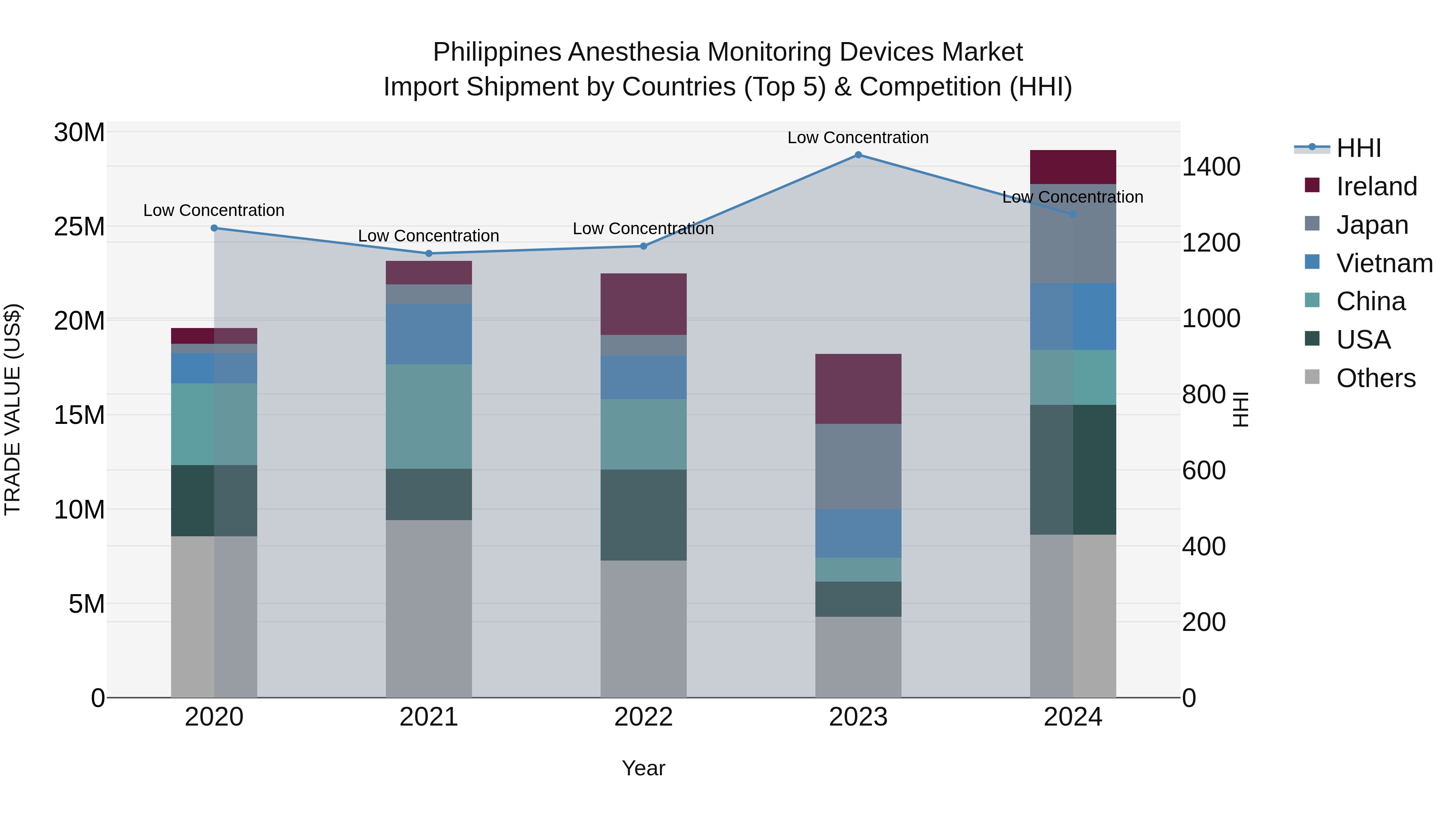
The Philippines saw a significant increase in anesthesia monitoring devices import shipments in 2024, with top exporters being the USA, Japan, Vietnam, China, and Singapore. The market remained competitive with low concentration as indicated by the Herfindahl-Hirschman Index (HHI). The compound annual growth rate (CAGR) from 2020 to 2024 stood at an impressive 10.31%, showcasing a strong upward trajectory. Furthermore, the growth rate from 2023 to 2024 spiked by 59.27%, indicating a rapid expansion in the market for anesthesia monitoring devices in the Philippines.
Philippines Anesthesia Monitoring Devices Market Overview
Monitoring devices are critical for real-time assessment of patient vitals during anesthesia. The market in the Philippines is growing due to a focus on surgical safety and quality care standards. Anesthesia depth monitors, pulse oximeters, and capnography systems are particularly sought after, especially in multispecialty hospitals.
Trends of the market
Monitoring devices used during anesthesia are seeing increased adoption due to heightened focus on patient safety and real-time data availability. Portable and wireless monitoring technologies are gaining popularity. Demand is strongest in tertiary care centers and surgical hospitals.
Challenges of the market
Monitoring devices encounter challenges related to the need for highly accurate and real-time data, which demands advanced sensor technologies that are costly. Budget constraints limit the procurement of modern devices in public hospitals. Furthermore, lack of continuous staff training results in underutilization of the full capabilities of monitoring systems.
Investment opportunities in the Market
Anesthesia monitoring is crucial for ensuring patient safety during procedures. The growing adoption of multi-parameter monitoring systems opens investment opportunities for both international device makers and local distributors. Partnerships with surgical centers and anesthesiology departments are key to gaining market share.
Government Policy of the market
Anesthesia monitoring devices are subject to stringent government regulation to ensure patient safety during surgical procedures. The FDA mandates rigorous testing and certification, while the DOH promotes clinical guidelines emphasizing continuous patient monitoring. Public hospitals receive government funding support to upgrade monitoring equipment, aligning with the national objective to improve surgical outcomes and reduce anesthesia-related complications.
Key Highlights of the Report:
- Philippines Anesthesia Monitoring Devices Market Outlook
- Market Size of Philippines Anesthesia Monitoring Devices Market, 2024
- Forecast of Philippines Anesthesia Monitoring Devices Market, 2031
- Historical Data and Forecast of Philippines Anesthesia Monitoring Devices Revenues & Volume for the Period 2021- 2031
- Philippines Anesthesia Monitoring Devices Market Trend Evolution
- Philippines Anesthesia Monitoring Devices Market Drivers and Challenges
- Philippines Anesthesia Monitoring Devices Price Trends
- Philippines Anesthesia Monitoring Devices Porter's Five Forces
- Philippines Anesthesia Monitoring Devices Industry Life Cycle
- Historical Data and Forecast of Philippines Anesthesia Monitoring Devices Market Revenues & Volume By Product for the Period 2021- 2031
- Historical Data and Forecast of Philippines Anesthesia Monitoring Devices Market Revenues & Volume By Basic Anesthesia Monitors for the Period 2021- 2031
- Historical Data and Forecast of Philippines Anesthesia Monitoring Devices Market Revenues & Volume By Advanced Anesthesia Monitors for the Period 2021- 2031
- Historical Data and Forecast of Philippines Anesthesia Monitoring Devices Market Revenues & Volume By Integrated Anesthesia Workstations for the Period 2021- 2031
- Historical Data and Forecast of Philippines Anesthesia Monitoring Devices Market Revenues & Volume By End User for the Period 2021- 2031
- Historical Data and Forecast of Philippines Anesthesia Monitoring Devices Market Revenues & Volume By Hospital for the Period 2021- 2031
- Historical Data and Forecast of Philippines Anesthesia Monitoring Devices Market Revenues & Volume By Ambulatory Surgery Centers for the Period 2021- 2031
- Philippines Anesthesia Monitoring Devices Import Export Trade Statistics
- Market Opportunity Assessment By Product
- Market Opportunity Assessment By End User
- Philippines Anesthesia Monitoring Devices Top Companies Market Share
- Philippines Anesthesia Monitoring Devices Competitive Benchmarking By Technical and Operational Parameters
- Philippines Anesthesia Monitoring Devices Company Profiles
- Philippines Anesthesia Monitoring Devices Key Strategic Recommendations






































