Philippines Cigarette Market Size, Share & Growth Rate
The Philippines Cigarette Market was estimated at USD 302 Million in 2025 and is projected to reach USD 381 Million by 2032, growing at a CAGR of 3.4% from 2026 to 2032. This growth trajectory is largely driven by increasing disposable incomes, which empower consumers to spend more on tobacco products. Additionally, urbanization is influencing consumption patterns as more Filipinos migrate to cities where smoking continues to be prevalent despite regulatory efforts.
Philippines Cigarette Market Year-wise Growth Rate and Key Drivers
This graph highlights how the Philippines Cigarette Market has steadily grown over the years, supported by major growth factors.
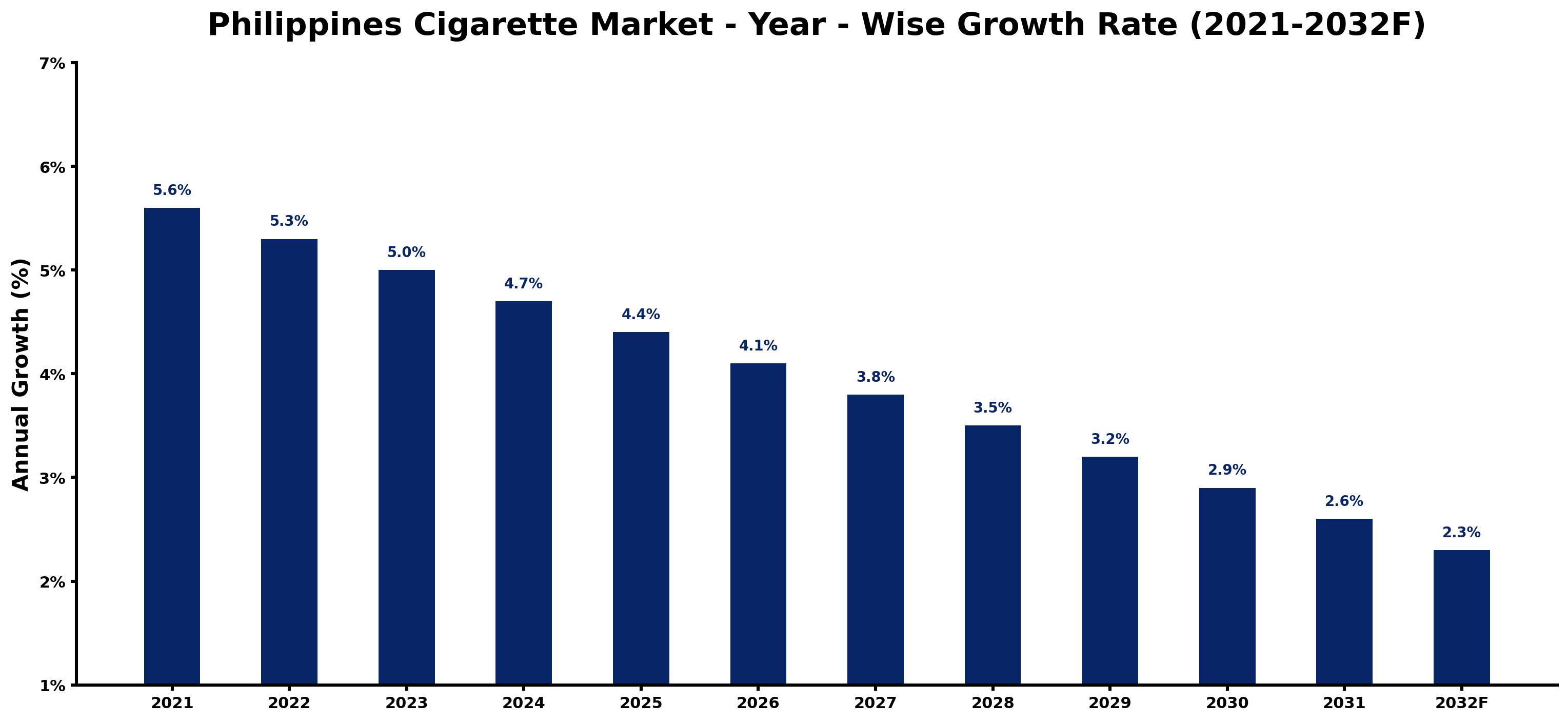
The table below presents the year‑wise growth rates along with the key drivers influencing the market
| Year | Growth Rate | Major Drivers |
| 2021 | 5.6% | Expansion of commercial construction activities |
| 2022 | 5.3% | Increasing industrial infrastructure investments |
| 2023 | 5.0% | Rapid growth in telecom and data center sectors |
| 2024 | 4.7% | Growing renewable energy integration projects |
| 2025 | 4.4% | Growing renewable energy integration projects |
| 2026 | 4.1% | Increasing shift toward cleaner alternatives |
| 2027 | 3.8% | Declining investments in legacy infrastructure |
| 2028 | 3.5% | Technology transition toward sustainable alternatives |
| 2029 | 3.2% | Growing adoption of energy efficient systems |
| 2030 | 2.9% | Growing adoption of energy efficient systems |
| 2031 | 2.6% | Increasing shift toward cleaner alternatives |
| 2032 | 2.3% | Growing adoption of energy efficient systems |
Note - Market size estimations and growth projections presented in this report are based on 6Wresearch’s advanced forecasting approach, validated with industry datasets as of June 2026.
Philippines Cigarette Market Synopsis
The demand for cigarettes in the Philippines is significantly impacted by the availability of cheaper options in the market. This price sensitivity is crucial, as many consumers prioritize affordability in their purchasing decisions. Furthermore, the influence of cultural norms, where smoking remains a socially accepted behavior in many communities, sustains a steady demand for tobacco products.
However, the rise of health awareness campaigns and smoking cessation programs continues to challenge the market. Government initiatives aimed at reducing smoking rates, especially among youth, are prompting a shift in consumer preferences, pushing some smokers to seek alternatives such as e-cigarettes. This evolving landscape creates both challenges and opportunities for tobacco manufacturers in the country.
Philippines Cigarette Market Key Takeaways
- Projected market size of USD 381 Million by 2032 indicates stable growth despite regulatory challenges.
- Increasing disposable incomes and urbanization are key factors driving consumption trends.
- Government anti-smoking campaigns are reshaping consumer behaviors and preferences.
- Price-sensitive consumers are gravitating towards more affordable cigarette brands.
- Emerging alternatives like e-cigarettes represent potential shifts in market dynamics.
Evaluation of Restraints in Philippines Cigarette Market
The Philippines cigarette market is constrained by stringent government regulations designed to combat tobacco use. Increased taxation on tobacco products has raised prices, dissuading lower-income consumers from purchasing traditional cigarettes. Moreover, health campaigns continue to gain traction, leading to heightened awareness about the risks associated with smoking. These factors cumulatively contribute to a declining growth rate in traditional cigarette consumption as consumers turn to alternatives or reduce usage.
Philippines Cigarette Market Trends
Current trends in the Philippines cigarette market reflect a growing preference for more diverse product offerings, including flavored cigarettes and reduced-harm products. Additionally, there is a notable shift towards premium brands as certain segments of the population seek higher-quality smoking experiences. Digital marketing and social media are increasingly being utilized by tobacco companies to reach younger demographics, despite regulatory restrictions.
Philippines Cigarette Market Opportunities
Amid the regulatory landscape, opportunities lie in developing innovative products that appeal to health-conscious consumers. Expansion into untapped rural markets could also present significant growth prospects, particularly where access to premium brands is limited. Furthermore, as the trend towards e-cigarettes continues, traditional manufacturers have the chance to diversify their portfolios to capture this growing segment.
Government Initiatives in the Philippines Cigarette Market
The Philippine government has implemented several initiatives aimed at curbing tobacco use. These include increased taxation on tobacco products and strict advertising regulations. Public health campaigns focused on educating citizens about the dangers of smoking have also been ramped up. While these measures are designed to protect public health, they also shape the market dynamics significantly, challenging companies to adapt to the evolving regulatory framework.
Future Insights of the Philippines Cigarette Market
Looking ahead to 2026-2032, the Philippines cigarette market is poised for continued evolution. The projected increase in market size suggests resilience despite regulatory challenges. As consumer preferences shift, manufacturers will need to innovate and diversify their offerings. A combination of strategic marketing, compliance with government regulations, and an increased focus on product differentiation will be critical for long-term success in this dynamic market.
Philippines Cigarette Market Latest Developments (May 2025 - June 2026)
Recent developments in the Philippines cigarette market show a noticeable increase in competition as local brands strive to maintain market share amidst tightening regulations. Additionally, there is a rising interest in digital marketing strategies that target younger consumers. Companies are also exploring partnerships with health organizations to promote less harmful alternatives, aligning with global trends towards healthier lifestyle choices.
Philippines Cigarette Market - Key Attractiveness of the Report
- 10 Years of Market Numbers
- Historical Data Starting from 2022 to 2025
- Base Year: 2025
- Forecast Data until 2032
- Key Performance Indicators Impacting the Market
- Major Upcoming Developments and Projects
Key Highlights of the Report:
- Philippines Cigarette? Market Outlook
- Market Size of Philippines Cigarette? Market, 2025
- Forecast of Philippines Cigarette? Market, 2032F
- Historical Data and Forecast of Philippines Cigarette? Revenues & Volume for the Period 2022-2032F
- Philippines Cigarette? Market Trend Evolution
- Philippines Cigarette? Market Drivers and Challenges
- Philippines Cigarette? Price Trends
- Philippines Cigarette? Porter's Five Forces
- Philippines Cigarette? Industry Life Cycle
- Historical Data and Forecast of Philippines Cigarette? Market Revenues & Volume By Type for the Period 2022-2032F
- Historical Data and Forecast of Philippines Cigarette? Market Revenues & Volume By Light for the Period 2022-2032F
- Historical Data and Forecast of Philippines Cigarette? Market Revenues & Volume By Medium for the Period 2022-2032F
- Historical Data and Forecast of Philippines Cigarette? Market Revenues & Volume By Others for the Period 2022-2032F
- Historical Data and Forecast of Philippines Cigarette? Market Revenues & Volume By Distribution Channel for the Period 2022-2032F
- Historical Data and Forecast of Philippines Cigarette? Market Revenues & Volume By Tobacco Shops for the Period 2022-2032F
- Historical Data and Forecast of Philippines Cigarette? Market Revenues & Volume By Supermarket and Hypermarkets for the Period 2022-2032F
- Historical Data and Forecast of Philippines Cigarette? Market Revenues & Volume By Convenience Stores for the Period 2022-2032F
- Historical Data and Forecast of Philippines Cigarette? Market Revenues & Volume By Online Stores for the Period 2022-2032F
- Historical Data and Forecast of Philippines Cigarette? Market Revenues & Volume By Others for the Period 2022-2032F
- Philippines Cigarette? Import Export Trade Statistics
- Market Opportunity Assessment By Type
- Market Opportunity Assessment By Distribution Channel
- Philippines Cigarette? Top Companies Market Share
- Philippines Cigarette? Competitive Benchmarking By Technical and Operational Parameters
- Philippines Cigarette? Company Profiles
- Philippines Cigarette? Key Strategic Recommendations






































