Philippines Coal Based Activated Carbon Market Size, Share & Growth Rate
The Philippines Coal Based Activated Carbon Market was estimated at USD 394 Million in 2025 and is projected to reach USD 497 Million by 2032, growing at a CAGR of 3.4% from 2026 to 2032. This growth trajectory is fueled by the increasing industrial applications of activated carbon in air and water purification, coupled with a rising demand for eco-friendly materials in the face of environmental regulations. Furthermore, the thriving mining and agricultural sectors in the Philippines are creating heightened opportunities for the utilization of coal-based activated carbon in various applications, ranging from food processing to waste management.
Philippines Coal Based Activated Carbon Market Year-wise Growth Rate and Key Drivers
This graph highlights how the Philippines Coal Based Activated Carbon Market has steadily grown over the years, supported by major growth factors.
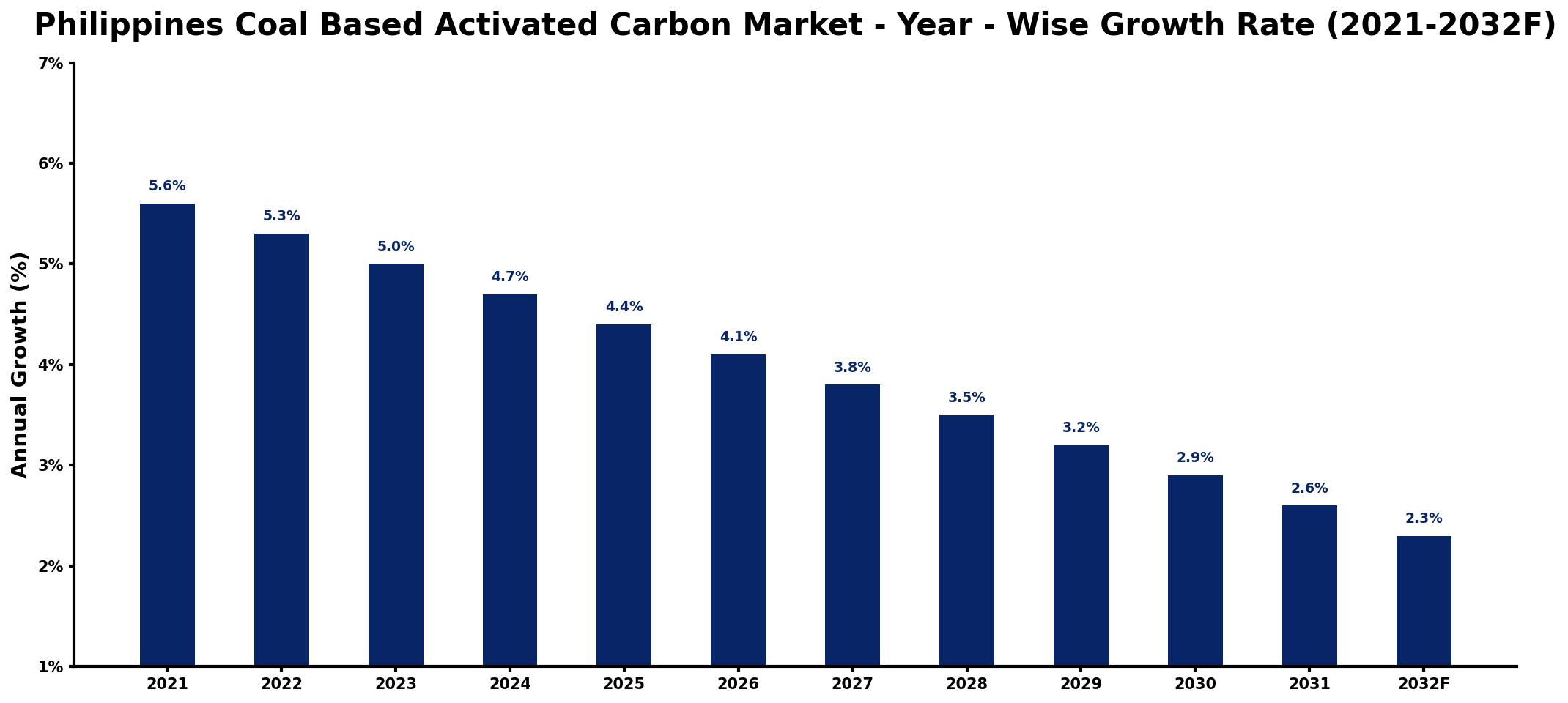
The table below presents the year‑wise growth rates along with the key drivers influencing the market
| Year | Growth Rate | Major Drivers |
| 2021 | 5.6% | Rising environmental regulations boosting demand |
| 2022 | 5.3% | Increased investments in filtration technologies |
| 2023 | 5.0% | Growing industrial applications in manufacturing |
| 2024 | 4.7% | Expansion of water treatment facilities |
| 2025 | 4.4% | Surge in air purification systems |
| 2026 | 4.1% | Demand from pharmaceuticals and healthcare |
| 2027 | 3.8% | Emerging markets seeking sustainable solutions |
| 2028 | 3.5% | Growth in renewable energy initiatives |
| 2029 | 3.2% | Increased government infrastructure spending |
| 2030 | 2.9% | rising procurement volume requirements |
| 2031 | 2.6% | Rising awareness of environmental sustainability |
| 2032 | 2.3% | Technological advancements enhancing efficiency |
Note: Market size estimations and growth projections presented in this report are based on 6Wresearch's proprietary forecasting methodology, utilizing the latest available industry data, government publications, and primary research inputs.
Philippines Coal Based Activated Carbon Market Synopsis
The Philippines is witnessing an upsurge in demand for coal-based activated carbon as industries increasingly recognize its efficacy in removing impurities from air and water. With growing industrial activity, sectors such as food and beverage, pharmaceuticals, and wastewater treatment are driving the market towards a robust growth phase.
The country's ongoing focus on environmental sustainability and adherence to stricter air quality regulations further propels this market. As local manufacturers strive to enhance their product offerings to meet international quality standards, innovation in activated carbon technologies is expected to play a crucial role in market expansion.
Philippines Coal Based Activated Carbon Market Key Takeaways
- Steady growth driven by industrial applications and environmental regulations.
- Increased investment in water and air purification technologies bolstering demand.
- Innovation and product quality improvements are pivotal for competitive advantage.
- High potential in waste management applications across various industries.
- Growing awareness of sustainable practices influencing market dynamics.
Evaluation of Restraints in Philippines Coal Based Activated Carbon Market
Despite the positive outlook, the Philippines Coal Based Activated Carbon Market is facing several restraints that could hinder its growth. The fluctuating prices of raw materials for activated carbon production pose a significant challenge, impacting profitability. Furthermore, there is a lack of standardized regulations in the market which can lead to inconsistent product quality, undermining consumer confidence. The limited availability of advanced manufacturing technologies may also restrict local producers from scaling operations effectively, thereby affecting their market share and competitiveness.
Philippines Coal Based Activated Carbon Market Trends
Current trends indicate a strong shift towards the adoption of sustainable production practices in the activated carbon sector. Local manufacturers are exploring innovative processes that minimize waste and energy consumption. Additionally, the rise in eco-conscious consumer behavior is prompting businesses to focus on green certifications for their products. Digitalization and automation are also beginning to influence manufacturing processes, enhancing efficiency and enabling real-time quality control, which is crucial in maintaining product integrity.
Philippines Coal Based Activated Carbon Market Opportunities
There exists a multitude of growth opportunities within the Philippines Coal Based Activated Carbon Market. As the country grapples with challenges related to air and water pollution, the demand for effective filtration and purification solutions is set to soar. Additionally, expanding sectors such as agriculture present avenues for the use of activated carbon in soil enhancement and pest management. Collaboration with government initiatives aimed at environmental sustainability can also create favorable conditions for market players, paving the way for innovative product development and broader market access.
Government Initiatives in the Philippines Coal Based Activated Carbon Market
The Philippine government has begun to implement policies that focus on improving environmental quality, which is beneficial for the coal-based activated carbon market. Investments in infrastructure projects that prioritize clean technology and the enactment of stricter emissions regulations highlight a commitment to fostering sustainable practices across various industries. These initiatives not only increase awareness but also incentivize companies to adopt activated carbon solutions as part of their operational strategies.
Future Insights of the Philippines Coal Based Activated Carbon Market
Looking ahead to 2026-2032, the Philippines Coal Based Activated Carbon Market is anticipated to navigate a path of steady growth. The ongoing expansion of industrial sectors coupled with increased governmental focus on sustainability will likely drive innovation and product diversification. As consumer preferences continue to shift towards eco-friendly solutions, companies that invest in advanced technologies and emphasize quality will be well-positioned to capitalize on emerging opportunities.
Philippines Coal Based Activated Carbon Market Latest Developments (2025 - 2026)
Recent developments in the Philippines Coal Based Activated Carbon Market reflect a growing inclination towards research and development. Manufacturers are increasingly collaborating with academic institutions to enhance the efficacy of activated carbon for specialized applications. Moreover, there's a noticeable trend towards eco-certification, as companies seek to align with global standards, making their products more attractive to environmentally-conscious consumers.
Philippines Coal Based Activated Carbon Market - Key Attractiveness of the Report
- 10 Years of Market Numbers
- Historical Data Starting from 2022 to 2025
- Base Year: 2025
- Forecast Data until 2032
- Key Performance Indicators Impacting the Market
- Major Upcoming Developments and Projects
Key Highlights of the Report:
- Philippines Coal Based Activated Carbon Market Outlook
- Market Size of Philippines Coal Based Activated Carbon Market, 2025
- Forecast of Philippines Coal Based Activated Carbon Market, 2032
- Historical Data and Forecast of Philippines Coal Based Activated Carbon Revenues & Volume for the Period 2022-2032F
- Philippines Coal Based Activated Carbon Market Trend Evolution
- Philippines Coal Based Activated Carbon Market Drivers and Challenges
- Philippines Coal Based Activated Carbon Price Trends
- Philippines Coal Based Activated Carbon Porter's Five Forces
- Philippines Coal Based Activated Carbon Industry Life Cycle
- Historical Data and Forecast of Philippines Coal Based Activated Carbon Market Revenues & Volume By Product for the Period 2022-2032F
- Historical Data and Forecast of Philippines Coal Based Activated Carbon Market Revenues & Volume By Granular for the Period 2022-2032F
- Historical Data and Forecast of Philippines Coal Based Activated Carbon Market Revenues & Volume By Powdered for the Period 2022-2032F
- Historical Data and Forecast of Philippines Coal Based Activated Carbon Market Revenues & Volume By Others for the Period 2022-2032F
- Historical Data and Forecast of Philippines Coal Based Activated Carbon Market Revenues & Volume By End-Use for the Period 2022-2032F
- Historical Data and Forecast of Philippines Coal Based Activated Carbon Market Revenues & Volume By Water Treatment for the Period 2022-2032F
- Historical Data and Forecast of Philippines Coal Based Activated Carbon Market Revenues & Volume By Food & Beverage Processing for the Period 2022-2032F
- Historical Data and Forecast of Philippines Coal Based Activated Carbon Market Revenues & Volume By Pharmaceutical & Medical for the Period 2022-2032F
- Historical Data and Forecast of Philippines Coal Based Activated Carbon Market Revenues & Volume By Automotive for the Period 2022-2032F
- Historical Data and Forecast of Philippines Coal Based Activated Carbon Market Revenues & Volume By Air Purification for the Period 2022-2032F
- Historical Data and Forecast of Philippines Coal Based Activated Carbon Market Revenues & Volume By Others for the Period 2022-2032F
- Philippines Coal Based Activated Carbon Import Export Trade Statistics
- Market Opportunity Assessment By Product
- Market Opportunity Assessment By End-Use
- Philippines Coal Based Activated Carbon Top Companies Market Share
- Philippines Coal Based Activated Carbon Competitive Benchmarking By Technical and Operational Parameters
- Philippines Coal Based Activated Carbon Company Profiles
- Philippines Coal Based Activated Carbon Key Strategic Recommendations






































