Philippines Construction and Mining Machinery Market Summary
The philippines construction and mining machinery market was estimated at USD 486 Million in 2025 and is projected to reach USD 650 Million by 2032, growing at a CAGR of 4.8% from 2026 to 2032.
Philippines Construction and Mining Machinery Market Year-wise Growth Rate and Key Drivers
This graph highlights how the Philippines Construction and Mining Machinery Market has steadily grown over the past five years, supported by major growth factors.
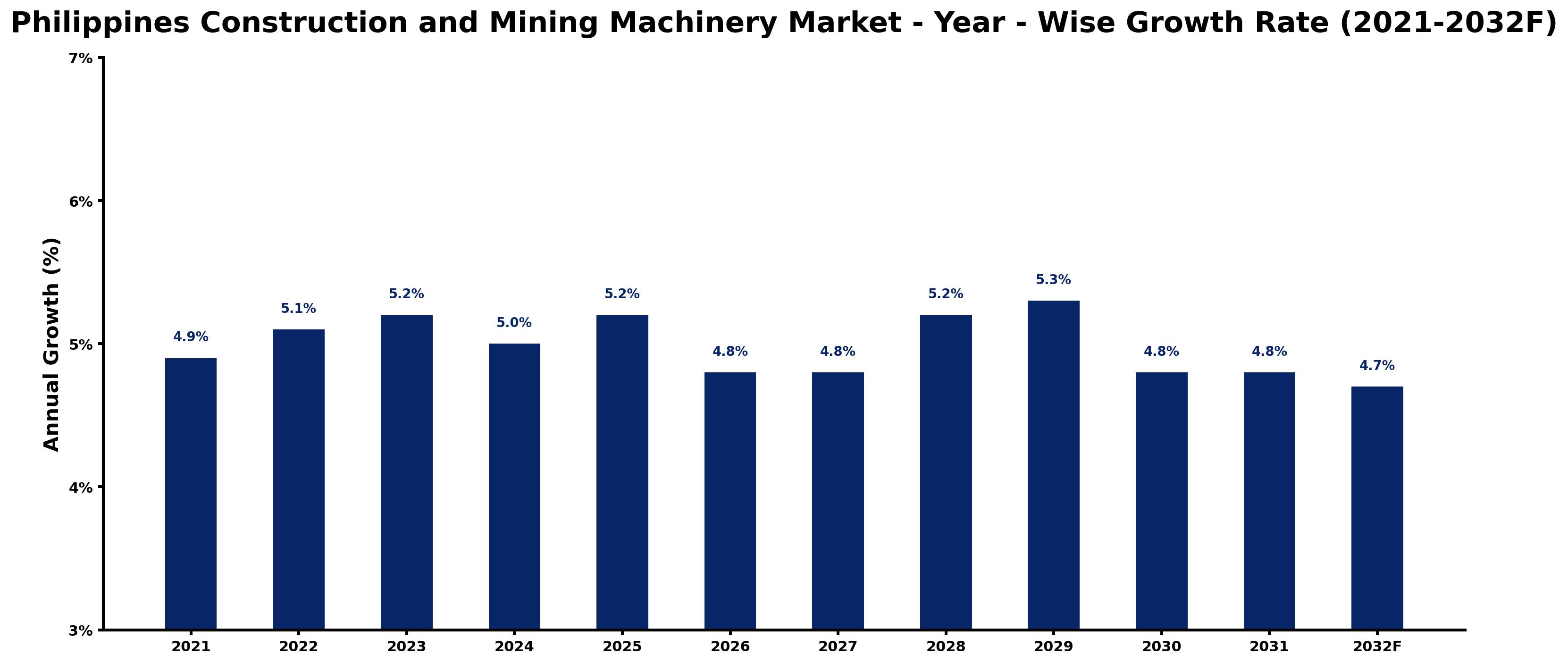
The table below presents the year wise growth rates along with the key drivers influencing the market
| Year | Growth Rate | Major Drivers |
| 2021 | 4.9% | Post-pandemic recovery stimulated infrastructure investments across urban and rural sectors. |
| 2022 | 5.1% | Increased private sector participation enhances construction projects and machinery procurement. |
| 2023 | 5.2% | Major infrastructure spending aligns with the government's Build, Build, Build program objectives. |
| 2024 | 5.0% | Emerging technologies in machinery improve efficiency and reduce operational costs significantly. |
| 2025 | 5.2% | Continued urbanization trends create persistent demand for earthmoving and construction equipment. |
| 2026 | 4.8% | Mining operations expand as global mineral demand benefits local operators and suppliers. |
| 2027 | 4.8% | Sustainability initiatives lead to increased investment in energy-efficient machinery solutions. |
| 2028 | 5.2% | Foreign investments in Philippine construction promote competitive machinery market growth. |
| 2029 | 5.3% | Digital transformation in operations streamlines procurement and operational frameworks for companies. |
| 2030 | 4.8% | Skill development initiatives enhance workforce capabilities within the construction machinery sector. |
| 2031 | 4.8% | Regional trade agreements facilitate easier importation of advanced mining and construction machinery. |
| 2032 | 4.7% | Market consolidation among key players enhances overall efficiency and service delivery. |
Note - Market size estimations and growth projections presented in this report are based on 6Wresearch's advanced forecasting approach, validated with industry datasets as of June 2026.
Philippines Construction and Mining Machinery Market Synopsis
The Philippines Construction and Mining Machinery Market is projected to reach 4.8% and witness significant growth during the forecast period (2026-2032). This upward trajectory is primarily driven by the government's infrastructure initiatives, such as the Build, Build, Build Program and various Public-Private Partnership (PPP) projects aimed at enhancing the country's infrastructure framework. The local manufacturing sector is responding with increased demand for advanced construction and mining equipment, which is crucial for maintaining momentum in infrastructure development.
Philippines Construction and Mining Machinery Market Growth Drivers
The growth of the Philippines Construction and Mining Machinery Market is underpinned by several key factors:
- The Philippine government is implementing major infrastructure projects that necessitate significant investment in construction and mining machinery.
- Public-Private Partnerships have emerged as a viable solution for funding large-scale infrastructure, thus fueling demand for specialized machinery.
- Technological advancements, including AI and cloud computing, are enhancing operational efficiency, making modern machinery more appealing to local manufacturers.
- With heightened awareness about environmental sustainability, there is a marked shift towards electric machinery that promises to reduce emissions significantly compared to traditional fossil fuel options.
- Increased investments in renewable energy projects are further driving the requirement for heavy machinery, particularly in the installation of solar photovoltaic and wind turbine systems.
Philippines Construction and Mining Machinery Market Trends and Opportunities
The Philippines Construction and Mining Machinery Market is witnessing several trends that present significant opportunities for growth:
- Manufacturers are developing specialized equipment tailored for specific applications, such as underground drilling solutions, enhancing the operational capabilities of local companies.
- The integration of smart technologies into machinery operations is facilitating better data management and predictive maintenance, further enhancing productivity.
- There is a burgeoning demand for low-noise machinery suited for residential areas, catering to urban development needs without compromising on living conditions.
- As environmental regulations tighten globally, the introduction of electric and hybrid machinery serves as a strategic response to meet compliance while appealing to eco-conscious customers.
- Investment in transportation infrastructure remains a priority, with ongoing projects likely to sustain machinery demand throughout the forecast period.
Philippines Construction and Mining Machinery Market Challenges and Restraints
While there are promising growth prospects, the Philippines Construction and Mining Machinery Market faces several challenges:
- The prevalence of counterfeit parts poses a significant risk, undermining genuine spare part sales and complicating maintenance for OEMs.
- A shortage of skilled labor remains a challenge, despite ongoing training initiatives, which may slow machinery operation and efficiency improvements.
- The high upfront costs associated with new machinery purchases might deter end-users, leading to subdued sales volumes during the forecast period.
- Economic fluctuations and uncertainties may affect government spending on infrastructure, contributing to volatility in machinery demand.
- The potential for regulatory hurdles can delay project timelines, which may adversely impact the procurement of construction and mining machinery.
Philippines Construction and Mining Machinery Market Government Investment and Initiatives
The Philippine government is actively initiating programs to bolster infrastructure development, significantly impacting the Construction and Mining Machinery Market. Key initiatives include:
- The Build, Build, Build Program, which underscores a commitment to infrastructure expansion across the country, thereby enhancing demand for construction-related machinery.
- Public-Private Partnerships (PPP) that facilitate collaboration between the government and private sector entities, attract investments, and ensure timely project execution.
- Strategic investment plans aimed at boosting regional connectivity, which will necessitate robust machinery for road, bridge, and airport construction projects.
- Incentives for eco-friendly machinery align with global sustainability goals, encouraging manufacturers to focus on innovative solutions that reduce environmental impact.
- Training programs aimed at enhancing the skill set of the workforce associated with the construction and mining sectors, thereby addressing labor shortages.
Philippines Construction and Mining Machinery Market Latest Developments (May 2025 - June 2026)
Recent developments in the Philippines Construction and Mining Machinery Market reveal a trend towards innovation and recovery from pandemic impacts:
- Investment in technological advancements has seen manufacturers adopting AI and data analytics to optimize machinery performance and operational efficiency.
- The government has announced several new infrastructure projects post-COVID-19, leading to a revitalization of demand for construction and mining equipment.
- Efforts to enhance local manufacturing capabilities have been prioritized, encouraging companies to invest in advanced machinery that meets international standards.
- Increased collaboration between government and private sector entities is evident, facilitating the swift execution of infrastructure projects while ensuring compliance with environmental standards.
- Market players are increasingly focusing on diversifying their product lines to include electric and hybrid machinery options, catering to evolving market preferences.
Philippines Construction and Mining Machinery Market - Key Attractiveness of the Report
- 10 Years of Market Numbers
- Historical Data Starting from 2022 to 2025
- Base Year: 2025
- Forecast Data until 2032
- Key Performance Indicators Impacting the Market
- Major Upcoming Developments and Projects
Key Highlights of the Report:
- Philippines Construction and Mining Machinery Market Outlook
- Market Size of Philippines Construction and Mining Machinery Market, 2025
- Forecast of Philippines Construction and Mining Machinery Market, 2032
- Historical Data and Forecast of Philippines Construction and Mining Machinery Revenues & Volume for the Period 2022-2032F
- Philippines Construction and Mining Machinery Market Trend Evolution
- Philippines Construction and Mining Machinery Market Drivers and Challenges
- Philippines Construction and Mining Machinery Price Trends
- Philippines Construction and Mining Machinery Porter's Five Forces
- Philippines Construction and Mining Machinery Industry Life Cycle
- Historical Data and Forecast of Philippines Construction and Mining Machinery Market Revenues & Volume By Product Types for the Period 2022-2032F
- Historical Data and Forecast of Philippines Construction and Mining Machinery Market Revenues & Volume By Loaders for the Period 2022-2032F
- Historical Data and Forecast of Philippines Construction and Mining Machinery Market Revenues & Volume By Dozers for the Period 2022-2032F
- Historical Data and Forecast of Philippines Construction and Mining Machinery Market Revenues & Volume By Excavators for the Period 2022-2032F
- Historical Data and Forecast of Philippines Construction and Mining Machinery Market Revenues & Volume By Crushing for the Period 2022-2032F
- Historical Data and Forecast of Philippines Construction and Mining Machinery Market Revenues & Volume By Pulverizing & Screening Equipment for the Period 2022-2032F
- Historical Data and Forecast of Philippines Construction and Mining Machinery Market Revenues & Volume By Others for the Period 2022-2032F
- Historical Data and Forecast of Philippines Construction and Mining Machinery Market Revenues & Volume By Applications for the Period 2022-2032F
- Historical Data and Forecast of Philippines Construction and Mining Machinery Market Revenues & Volume By Infrastructure for the Period 2022-2032F
- Historical Data and Forecast of Philippines Construction and Mining Machinery Market Revenues & Volume By Mineral Mining for the Period 2022-2032F
- Historical Data and Forecast of Philippines Construction and Mining Machinery Market Revenues & Volume By Residential Building for the Period 2022-2032F
- Historical Data and Forecast of Philippines Construction and Mining Machinery Market Revenues & Volume By Metal Mining for the Period 2022-2032F
- Historical Data and Forecast of Philippines Construction and Mining Machinery Market Revenues & Volume By Others for the Period 2022-2032F
- Philippines Construction and Mining Machinery Import Export Trade Statistics
- Market Opportunity Assessment By Product Types
- Market Opportunity Assessment By Applications
- Philippines Construction and Mining Machinery Top Companies Market Share
- Philippines Construction and Mining Machinery Competitive Benchmarking By Technical and Operational Parameters
- Philippines Construction and Mining Machinery Company Profiles
- Philippines Construction and Mining Machinery Key Strategic Recommendations






































