Philippines Infrastructure as Code (IaC) Market Size & Growth Rate (2026-2032)
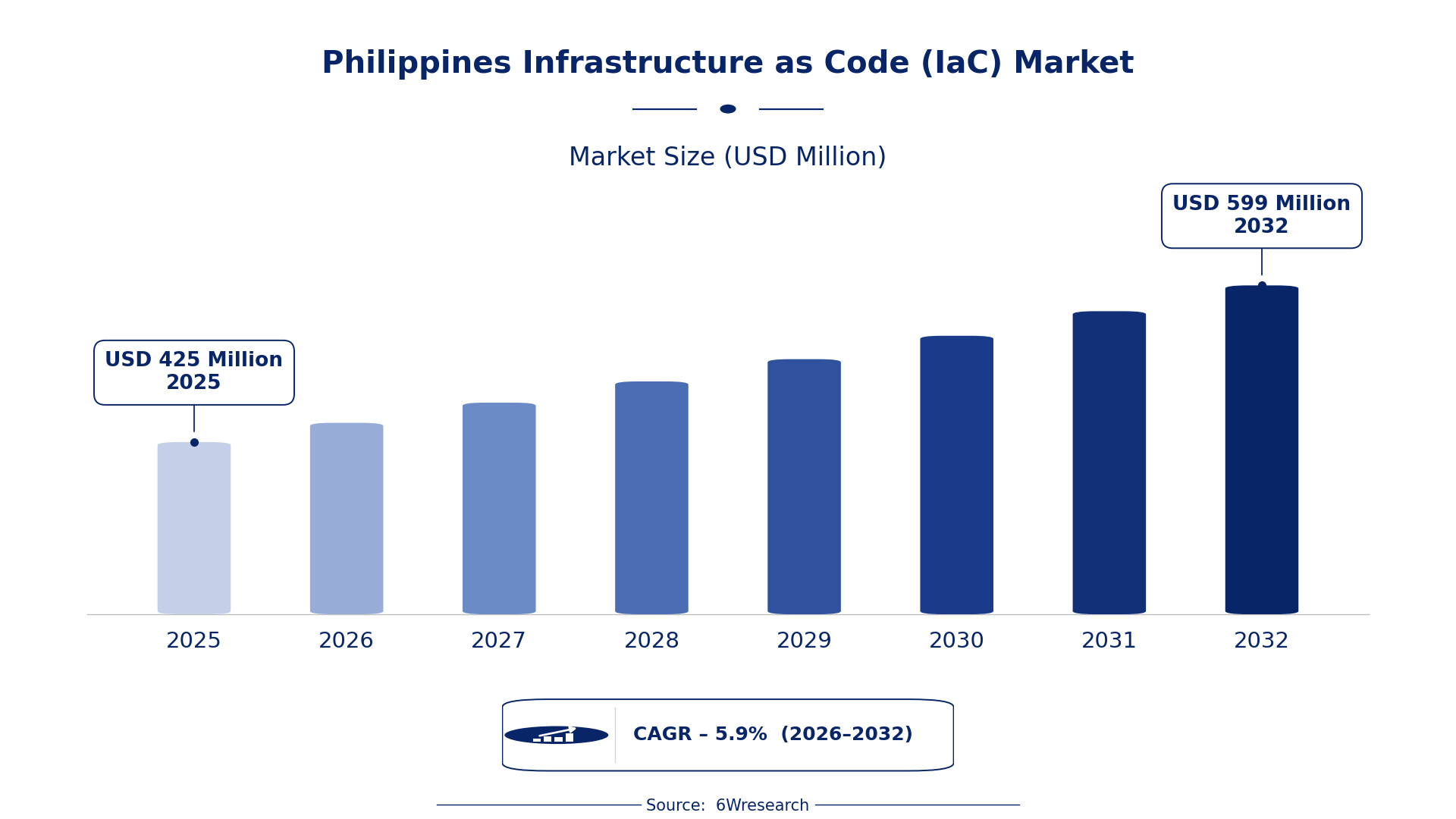
The Philippines Infrastructure as Code (IaC) Market was estimated at USD 425 Million in 2025 and is projected to reach USD 599 Million by 2032, growing at a CAGR of 5.9% from 2026 to 2032.
Philippines Infrastructure as Code (IaC) Market Synopsis
In recent years, the Philippines has witnessed a surge in the adoption of Infrastructure as Code (IaC) as organizations recognize its ability to enhance operational efficiency. With digital transformation efforts accelerating, particularly post-pandemic, the market is now on a trajectory toward more widespread integration of IaC practices.
Looking ahead, the Philippines Infrastructure as Code (IaC) Market is expected to evolve significantly. As more enterprises adopt cloud technologies and automation, the demand for IaC solutions is set to rise, driven by the need for faster deployment, improved scalability, and reduced operational costs.
Philippines Infrastructure as Code (IaC) Market Year-wise Growth Rate and Key Drivers
This graph illustrates the annual growth rates of the Philippines Infrastructure as Code (IaC) Market from 2021 to 2032, highlighting a steady upward trajectory and projected expansion over the forecast period.
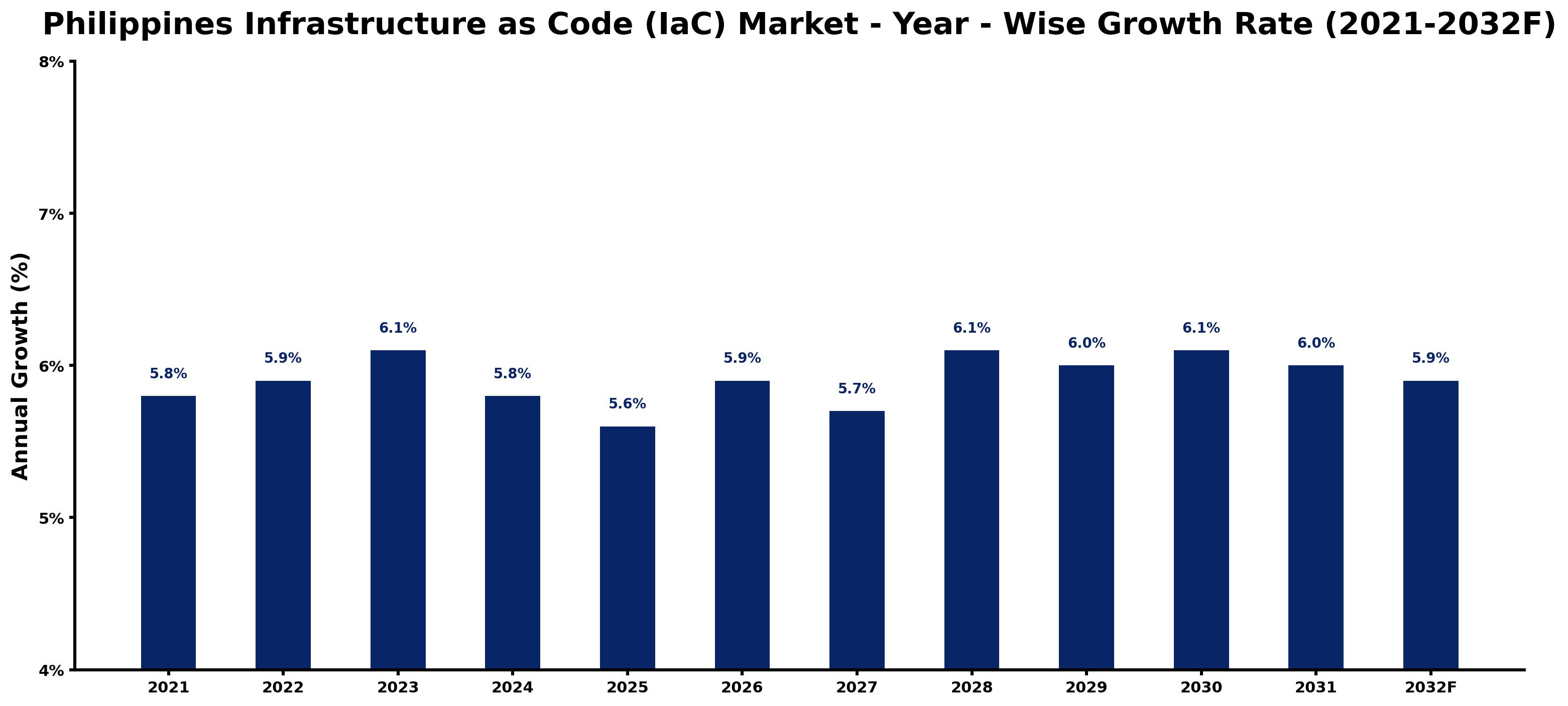
The table below presents the year‑wise growth rates along with the key drivers influencing the market
| Year | Growth Rate | Major Drivers |
| 2021 | 5.8% | Philippine Digital Transformation Roadmap initiatives boosting cloud adoption. |
| 2022 | 5.9% | Growing local developer talent in cloud-native technologies. |
| 2023 | 6.1% | Increased demand for agile development from local businesses. |
| 2024 | 5.8% | Government support for tech startups through innovation grants. |
| 2025 | 5.6% | Rising awareness of DevOps practices among enterprises. |
| 2026 | 5.9% | Local firms adopting IaC for better resource management. |
| 2027 | 5.7% | Increased investments in fintech driving IaC adoption. |
| 2028 | 6.1% | Telecommunications expansion requiring improved infrastructure automation. |
| 2029 | 6.0% | Emerging e-commerce sector demanding scalable solution deployment. |
| 2030 | 6.1% | Regulatory focus on cybersecurity enhancing IaC solutions need. |
| 2031 | 6.0% | Growing interest in microservices architecture within local startups. |
| 2032 | 5.9% | Improvements in internet connectivity fostering software development growth. |
Note: Market size estimations and growth projections presented in this report are based on 6Wresearch's proprietary forecasting methodology, utilizing the latest available industry data, government publications, and primary research inputs.
Philippines Infrastructure as Code (IaC) Market Key Takeaways
Below are some of the specific key takeaways from the market, including:
- The market is experiencing a notable shift toward automation in IT infrastructure management.
- Cloud adoption is a primary driver for IaC solutions among Philippine organizations.
- Challenges remain, particularly in changing traditional IT cultures within established enterprises.
- The impact of COVID-19 has accelerated the need for efficient infrastructure management solutions.
- Government initiatives are increasingly supportive of digital infrastructure development.
Evaluation of Restraints in Philippines Infrastructure as Code (IaC) Market
Despite the promising growth of the Infrastructure as Code (IaC) market, significant restraints impede its expansion. A prevalent challenge is the resistance to change within established enterprises that are accustomed to traditional IT management methods. Many organizations continue to rely on manual processes, which can hinder the adoption of IaC practices. Additionally, a shortage of skilled professionals familiar with IaC tools and methodologies presents a barrier to widespread implementation.
Philippines Infrastructure as Code (IaC) Market Trends
Several trends are currently shaping the Philippines Infrastructure as Code (IaC) Market. The rise of hybrid cloud environments is driving the need for IaC solutions that can seamlessly manage resources across multiple platforms. on top of that, organizations are increasingly prioritizing security in their IaC practices, leading to the integration of security measures into the deployment pipeline. This trend towards "DevSecOps" is gaining traction, reflecting a broader commitment to secure infrastructure management.
Philippines Infrastructure as Code (IaC) Market Opportunities
Opportunities in the Infrastructure as Code (IaC) market are plentiful, especially for technology providers. The demand for specialized training programs aimed at upskilling IT professionals is on the rise, creating a niche for educational platforms. Additionally, businesses are seeking tailored IaC solutions that cater to specific industry needs, such as finance and healthcare, where regulatory compliance is paramount. As digital transformation continues to accelerate, the potential for innovative IaC applications will expand, particularly in sectors undergoing significant technological upgrades.
Government Initiatives in the Philippines Infrastructure as Code (IaC) Market
Government policy is playing a crucial role in shaping the Philippines Infrastructure as Code (IaC) Market. With a focus on enhancing the nation’s digital capabilities, the government is prioritizing initiatives that promote automation and cloud technology adoption across various sectors. These policies are vital in driving public and private sector collaboration, ensuring that the infrastructure needed for effective IaC implementation is in place.
- A national digital infrastructure upgrade programme now in its rollout phase aims to enhance connectivity and support cloud adoption.
- A regulatory framework introduced in 2025 mandates transparency in billing for cloud services, facilitating trust in IaC solutions.
- A public-private initiative expected to expand telecom infrastructure access by 2028 is underway, further enabling cloud-based services.
- Recently launched training programs aim to equip IT professionals with the necessary skills to implement IaC practices effectively.
- Current discussions regarding tax incentives for companies adopting automation technologies are ongoing, aimed at stimulating further investment.
Future Insights of the Philippines Infrastructure as Code (IaC) Market
From 2026 to 2032, the Philippines Infrastructure as Code (IaC) Market is set to expand rapidly. Organizations will increasingly prioritize agility and cost-efficiency, pushing IaC solutions to the forefront of their IT strategies. As cloud technologies continue to evolve, integration of artificial intelligence and machine learning within IaC frameworks will likely emerge, allowing for smarter resource management and predictive maintenance capabilities. The collaboration between technology providers and government initiatives will further catalyze growth, paving the way for a more digitally mature economy.
Philippines Infrastructure as Code (IaC) Market Latest Developments
In the last year, the Philippines Infrastructure as Code (IaC) Market has witnessed a series of developments reflecting the growing interest in automation and cloud solutions. Organizations are increasingly recognizing the importance of adopting IaC methodologies to stay competitive and efficient.
- A major technology vendor launched an IaC solution tailored for small to medium enterprises in early 2025, enhancing accessibility to advanced infrastructure management tools.
- An initiative that began in mid-2025 and remains underway focuses on integrating IaC into the national IT curriculum, fostering a new generation of skilled professionals.
- A partnership between leading cloud service providers was established in Q1 2025, aiming to develop joint IaC solutions that cater to specific industry challenges.
- Ongoing trials for a new IaC automation tool are expected to be completed by late 2025, promising improved deployment efficiency.
- Upcoming regulatory changes anticipated by mid-2026 will introduce new compliance requirements for IaC practices, prompting organizations to adapt their strategies accordingly.
Philippines Infrastructure as Code (IaC) Market - Key Attractiveness of the Report
- 10 Years of Market Numbers
- Historical Data Starting from 2022 to 2025
- Base Year: 2025
- Forecast Data until 2032
- Key Performance Indicators Impacting the Market
- Major Upcoming Developments and Projects
Key Highlights of the Report:
- Philippines Infrastructure as Code (IaC) Market Outlook
- Market Size of Philippines Infrastructure as Code (IaC) Market, 2025
- Forecast of Philippines Infrastructure as Code (IaC) Market, 2032
- Historical Data and Forecast of Philippines Infrastructure as Code (IaC) Revenues & Volume for the Period 2022-2032F
- Philippines Infrastructure as Code (IaC) Market Trend Evolution
- Philippines Infrastructure as Code (IaC) Market Drivers and Challenges
- Philippines Infrastructure as Code (IaC) Price Trends
- Philippines Infrastructure as Code (IaC) Porter's Five Forces
- Philippines Infrastructure as Code (IaC) Industry Life Cycle
- Historical Data and Forecast of Philippines Infrastructure as Code (IaC) Market Revenues & Volume By Component for the Period 2022-2032F
- Historical Data and Forecast of Philippines Infrastructure as Code (IaC) Market Revenues & Volume By Tools for the Period 2022-2032F
- Historical Data and Forecast of Philippines Infrastructure as Code (IaC) Market Revenues & Volume By Services for the Period 2022-2032F
- Historical Data and Forecast of Philippines Infrastructure as Code (IaC) Market Revenues & Volume By Type for the Period 2022-2032F
- Historical Data and Forecast of Philippines Infrastructure as Code (IaC) Market Revenues & Volume By Declarative for the Period 2022-2032F
- Historical Data and Forecast of Philippines Infrastructure as Code (IaC) Market Revenues & Volume By Imperative for the Period 2022-2032F
- Historical Data and Forecast of Philippines Infrastructure as Code (IaC) Market Revenues & Volume By Infrastructure Type for the Period 2022-2032F
- Historical Data and Forecast of Philippines Infrastructure as Code (IaC) Market Revenues & Volume By Mutable for the Period 2022-2032F
- Historical Data and Forecast of Philippines Infrastructure as Code (IaC) Market Revenues & Volume By Immutable for the Period 2022-2032F
- Historical Data and Forecast of Philippines Infrastructure as Code (IaC) Market Revenues & Volume By Organization Size for the Period 2022-2032F
- Historical Data and Forecast of Philippines Infrastructure as Code (IaC) Market Revenues & Volume By Large Enterprises for the Period 2022-2032F
- Historical Data and Forecast of Philippines Infrastructure as Code (IaC) Market Revenues & Volume By SMEs for the Period 2022-2032F
- Historical Data and Forecast of Philippines Infrastructure as Code (IaC) Market Revenues & Volume By Deployment Type for the Period 2022-2032F
- Historical Data and Forecast of Philippines Infrastructure as Code (IaC) Market Revenues & Volume By On-premises for the Period 2022-2032F
- Historical Data and Forecast of Philippines Infrastructure as Code (IaC) Market Revenues & Volume By Cloud for the Period 2022-2032F
- Historical Data and Forecast of Philippines Infrastructure as Code (IaC) Market Revenues & Volume By Verticals for the Period 2022-2032F
- Historical Data and Forecast of Philippines Infrastructure as Code (IaC) Market Revenues & Volume By BFSI for the Period 2022-2032F
- Historical Data and Forecast of Philippines Infrastructure as Code (IaC) Market Revenues & Volume By IT & ITES for the Period 2022-2032F
- Historical Data and Forecast of Philippines Infrastructure as Code (IaC) Market Revenues & Volume By Telecom for the Period 2022-2032F
- Historical Data and Forecast of Philippines Infrastructure as Code (IaC) Market Revenues & Volume By Government for the Period 2022-2032F
- Historical Data and Forecast of Philippines Infrastructure as Code (IaC) Market Revenues & Volume By Manufacturing for the Period 2022-2032F
- Historical Data and Forecast of Philippines Infrastructure as Code (IaC) Market Revenues & Volume By Healthcare for the Period 2022-2032F
- Historical Data and Forecast of Philippines Infrastructure as Code (IaC) Market Revenues & Volume By Retail for the Period 2022-2032F
- Historical Data and Forecast of Philippines Infrastructure as Code (IaC) Market Revenues & Volume By Transportation & Logistics for the Period 2022-2032F
- Philippines Infrastructure as Code (IaC) Import Export Trade Statistics
- Market Opportunity Assessment By Component
- Market Opportunity Assessment By Type
- Market Opportunity Assessment By Infrastructure Type
- Market Opportunity Assessment By Organization Size
- Market Opportunity Assessment By Deployment Type
- Market Opportunity Assessment By Verticals
- Philippines Infrastructure as Code (IaC) Top Companies Market Share
- Philippines Infrastructure as Code (IaC) Competitive Benchmarking By Technical and Operational Parameters
- Philippines Infrastructure as Code (IaC) Company Profiles
- Philippines Infrastructure as Code (IaC) Key Strategic Recommendations






































