Philippines Plastics Products Market Summary
The philippines plastics products market was estimated at USD 949 Million in 2025 and is projected to reach USD 1374 Million by 2032, growing at a CAGR of 6.1% from 2026 to 2032.
Philippines Plastics Products Market Year-wise Growth Rate and Key Drivers
This graph highlights how the Philippines Plastics Products Market has steadily grown over the past five years, supported by major growth factors.
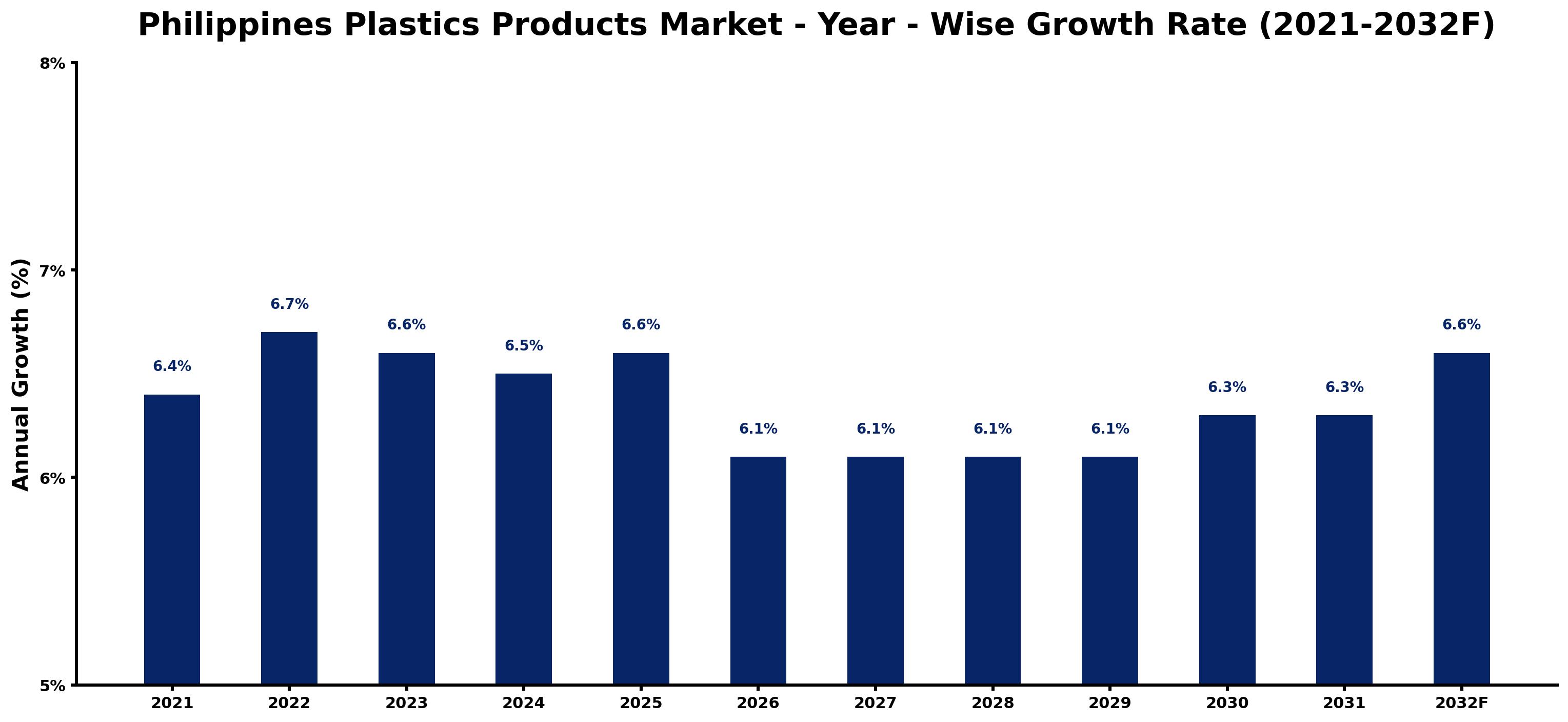
The table below presents the year wise growth rates along with the key drivers influencing the market
| Year | Growth Rate | Major Drivers |
| 2021 | 6.4% | Post-lockdown retail projects began to prioritize sustainable packaging solutions. |
| 2022 | 6.7% | Manufacturers focused on enhancing production efficiency amidst global supply chain disruptions. |
| 2023 | 6.6% | Local businesses increasingly adopted eco-friendly materials to meet consumer preferences. |
| 2024 | 6.5% | Technological innovations in recycling processes attracted investments in plastic alternatives. |
| 2025 | 6.6% | Collaborations between firms boosted the development of biodegradable plastic products. |
| 2026 | 6.1% | Export opportunities expanded as global markets sought Philippine plastic manufacturing. |
| 2027 | 6.1% | Urbanization trends increased demand for durable plastic products in construction sectors. |
| 2028 | 6.1% | Awareness of plastic waste issues prompted consumer shifts towards sustainable options. |
| 2029 | 6.1% | Corporate social responsibility initiatives led to significant investments in green technologies. |
| 2030 | 6.3% | Economic recovery efforts post-pandemic emphasized resilient supply chains for plastics. |
| 2031 | 6.3% | Increased competition spurred innovation in product design and material usage. |
| 2032 | 6.6% | Regulatory frameworks began supporting circular economy practices in the plastics industry. |
Note - Market size estimations and growth projections presented in this report are based on 6Wresearch's advanced forecasting approach, validated with industry datasets as of June 2026.
Philippines Plastics Products Market Synopsis
The Philippines Plastics Products Market is projected to reach 6.1% and witness significant growth during the forecast period (2026-2032). This growth trajectory is primarily fueled by several key factors including a rising demand for packaging in food and beverages, an increase in personal disposable income, and a growing consumer preference for convenience. Furthermore, the influx of investments in infrastructure projects has stimulated growth in the construction and automotive sectors, thereby further elevating the demand for various plastic products. Nevertheless, the market faces challenges, particularly due to stringent government regulations concerning plastic waste management, which may impede growth over the forecast period.
Philippines Plastics Products Market Growth Drivers
The expansion of the Philippines Plastics Products Market is significantly influenced by several growth drivers:
- Increasing demand for food and beverage packaging is a primary driver, as businesses and consumers alike focus on convenience and preservation of product quality.
- Rising disposable income among the Filipino population is enabling greater consumer spending on plastic products, thereby boosting market demand.
- The infrastructure development boom, fueled by government initiatives and public-private partnerships, is elevating the demand for construction materials such as PVC.
- Growing urbanization is resulting in increased residential and commercial construction activities, further amplifying the consumption of plastic products.
- Shifting consumer preferences towards convenience and lightweight products are augmenting the use of plastics in various applications, including automotive and electronics.
Philippines Plastics Products Market Trends and Opportunities
One notable trend in the Philippines Plastics Products Market is the rising traction of biodegradable plastics. These materials are gaining popularity due to their environmental sustainability, as they decompose relatively quickly compared to traditional plastics, which can take centuries to break down. This eco-friendly attribute is crucial for reducing carbon emissions and combating pollution. Governments are actively promoting the use of bioplastics through various incentives, including financial assistance and tax deductions, thus fostering their adoption among manufacturers. Additionally, the trend towards sustainable practices is expected to drive innovation and investment in bioplastics throughout the forecast period from 2026 to 2032.
Philippines Plastics Products Market Challenges and Restraints
Despite the growth potential, the Philippines Plastics Products Market faces significant challenges:
- Stringent government regulations related to plastic waste management are increasingly being implemented, creating legal hurdles for manufacturers.
- Public awareness campaigns addressing the environmental impact of plastics may lead to reduced consumer demand for traditional plastic products.
- Competition from alternative materials, including biodegradable and plant-based options, could restrict the market's traditional plastic products segment.
- Fluctuations in the prices of raw materials used in plastic production may affect profitability and pricing strategies of manufacturers.
- Global movements towards sustainability and environmental responsibility may compel companies to invest heavily in R&D to meet consumer and regulatory expectations.
Philippines Plastics Products Market Government Investment and Initiatives
The Philippine government is taking proactive measures to foster growth in the plastics products market through various initiatives and investments. Public funding has been allocated to support infrastructure development projects that necessitate the usage of plastic materials, particularly in construction and transportation. Moreover, initiatives aimed at improving waste management and promoting recycling are gaining ground, as policymakers strive to tackle pollution and promote sustainability. Financial incentives for companies investing in biodegradable plastics and plastic alternatives are also being introduced to enhance the market's environmental footprint. These efforts are indicative of a coordinated strategy to balance economic growth with environmental stewardship.
Philippines Plastics Products Market Latest Developments (May 2025 - June 2026)
During the period from May 2025 to June 2026, the Philippines Plastics Products Market has witnessed several noteworthy developments. A shift towards eco-friendly materials has been observed as manufacturers explore bioplastics and sustainable alternatives in response to regulatory pressures. Additionally, collaborations between government agencies and private sector stakeholders have been instrumental in launching awareness campaigns regarding responsible plastic usage and waste disposal. Investment in infrastructure projects continues to surge, driving the demand for plastic materials in construction applications. The automotive industry is also making strides towards using lighter and more efficient plastic components, reflecting broader trends towards innovation and sustainability in manufacturing practices.
Philippines Plastics Products Market - Key Attractiveness of the Report
- 10 Years of Market Numbers
- Historical Data Starting from 2022 to 2025
- Base Year: 2025
- Forecast Data until 2032
- Key Performance Indicators Impacting the Market
- Major Upcoming Developments and Projects
Key Highlights of the Report:
- Philippines Plastics Products Market Outlook
- Market Size of Philippines Plastics Products Market, 2025
- Forecast of Philippines Plastics Products Market, 2032
- Historical Data and Forecast of Philippines Plastics Products Revenues & Volume for the Period 2022-2032F
- Philippines Plastics Products Market Trend Evolution
- Philippines Plastics Products Market Drivers and Challenges
- Philippines Plastics Products Price Trends
- Philippines Plastics Products Porter's Five Forces
- Philippines Plastics Products Industry Life Cycle
- Historical Data and Forecast of Philippines Plastics Products Market Revenues & Volume By Types for the Period 2022-2032F
- Historical Data and Forecast of Philippines Plastics Products Market Revenues & Volume By Plastics Packaging Materials And Unlaminated Film And Sheet for the Period 2022-2032F
- Historical Data and Forecast of Philippines Plastics Products Market Revenues & Volume By Plastic Pipes And Shapes for the Period 2022-2032F
- Historical Data and Forecast of Philippines Plastics Products Market Revenues & Volume By Laminated Plastics Plate, Sheet, And Shape for the Period 2022-2032F
- Historical Data and Forecast of Philippines Plastics Products Market Revenues & Volume By Plastics Bottle for the Period 2022-2032F
- Historical Data and Forecast of Philippines Plastics Products Market Revenues & Volume By Urethane And Other Foam Product for the Period 2022-2032F
- Historical Data and Forecast of Philippines Plastics Products Market Revenues & Volume By Polystyrene Foam Product for the Period 2022-2032F
- Historical Data and Forecast of Philippines Plastics Products Market Revenues & Volume By Other Plastics Product ? ? for the Period 2022-2032F
- Historical Data and Forecast of Philippines Plastics Products Market Revenues & Volume By End-users for the Period 2022-2032F
- Historical Data and Forecast of Philippines Plastics Products Market Revenues & Volume By Automotive & Transportation for the Period 2022-2032F
- Historical Data and Forecast of Philippines Plastics Products Market Revenues & Volume By Electrical & Electronics for the Period 2022-2032F
- Historical Data and Forecast of Philippines Plastics Products Market Revenues & Volume By Medical for the Period 2022-2032F
- Historical Data and Forecast of Philippines Plastics Products Market Revenues & Volume By Construction for the Period 2022-2032F
- Historical Data and Forecast of Philippines Plastics Products Market Revenues & Volume By Others for the Period 2022-2032F
- Philippines Plastics Products Import Export Trade Statistics
- Market Opportunity Assessment By Types
- Market Opportunity Assessment By End-users
- Philippines Plastics Products Top Companies Market Share
- Philippines Plastics Products Competitive Benchmarking By Technical and Operational Parameters
- Philippines Plastics Products Company Profiles
- Philippines Plastics Products Key Strategic Recommendations






































