Philippines Power Convertor Market Summary
The philippines power convertor market was estimated at USD 172 Million in 2025 and is projected to reach USD 243 Million by 2032, growing at a CAGR of 6.1% from 2026 to 2032.
Philippines Power Convertor Market Year-wise Growth Rate and Key Drivers
This graph highlights how the Philippines Power Convertor Market has steadily grown over the past five years, supported by major growth factors.
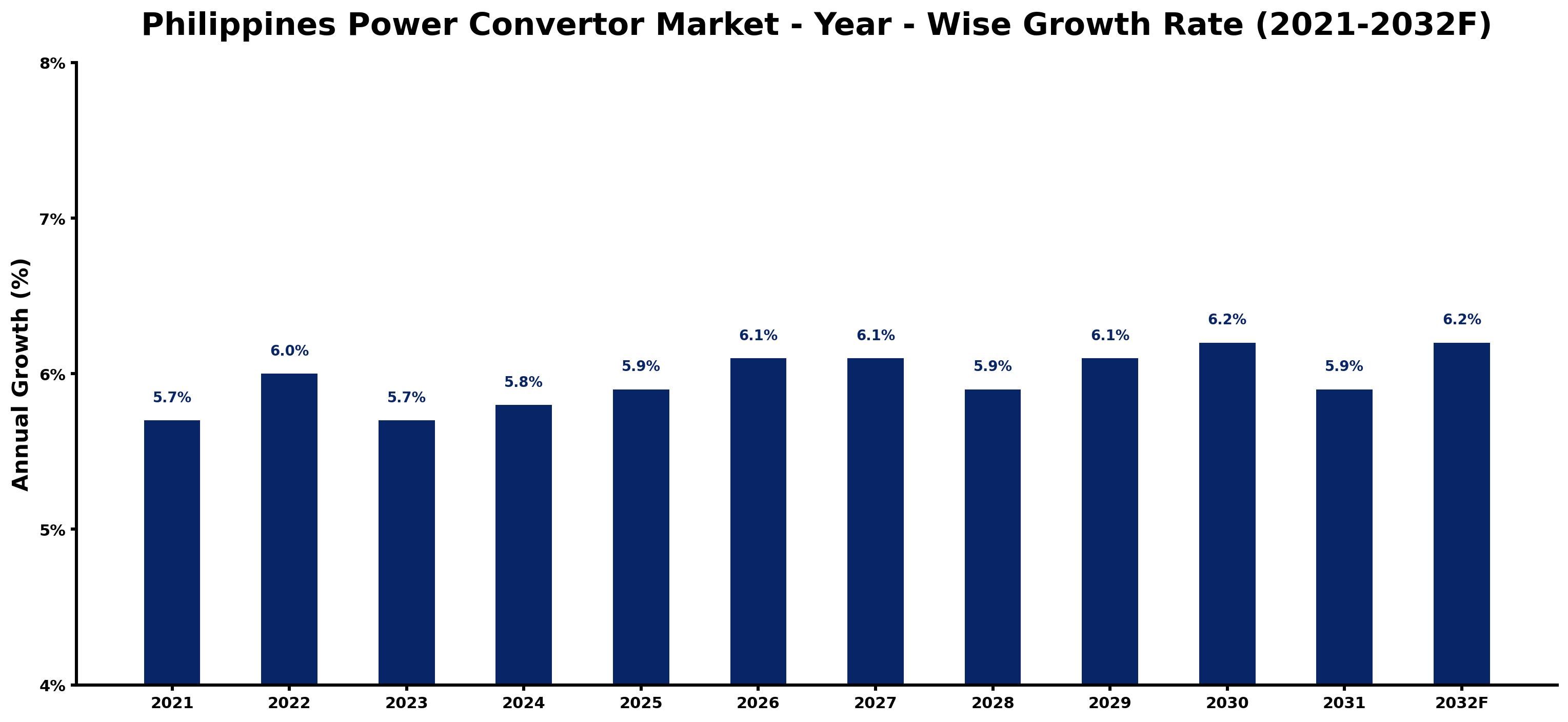
The table below presents the year wise growth rates along with the key drivers influencing the market
| Year | Growth Rate | Major Drivers |
| 2021 | 5.7% | Post-lockdown retail projects sparked interest in reliable power solutions across industries. |
| 2022 | 6.0% | Legacy copper grid failures prompted businesses to seek modern power convertor systems. |
| 2023 | 5.7% | Enterprise budgets prioritizing energy efficiency led to increased converter investments throughout sectors. |
| 2024 | 5.8% | Local manufacturing of electronics facilitated easier access to power conversion technologies. |
| 2025 | 5.9% | Renewable energy projects intensified demand for advanced power conversion technologies and solutions. |
| 2026 | 6.1% | Infrastructure development in urban areas underscored the need for reliable power systems. |
| 2027 | 6.1% | Rural electrification efforts compelled businesses to invest in robust power converter options. |
| 2028 | 5.9% | Increased awareness of energy loss encouraged users to upgrade outdated converter equipment. |
| 2029 | 6.1% | Strong economic recovery post-pandemic shifted focus towards energy resilience in businesses. |
| 2030 | 6.2% | Digital transformation initiatives required more sophisticated power solutions for operational efficiency. |
| 2031 | 5.9% | Emerging tech startups sought innovative power conversion solutions to support their growth. |
| 2032 | 6.2% | The push for sustainability in businesses influenced investments in energy-efficient convertors. |
Note - Market size estimations and growth projections presented in this report are based on 6Wresearch's advanced forecasting approach, validated with industry datasets as of June 2026.
Philippines Power Convertor Market Synopsis
The Philippines Power Convertor Market is projected to reach 6.1% and witness significant growth during the forecast period (2026-2032). This anticipated growth is largely driven by the increasing demand for reliable and efficient energy solutions, spurred by government initiatives aimed at enhancing the country's electricity infrastructure. Furthermore, rising investments in renewable energy initiatives and ongoing technological advancements are expected to further energize the market. With urbanization continuing to increase, so does the demand for a reliable electric supply, providing a robust foundation for market expansion.
Philippines Power Convertor Market Growth Drivers
Key growth drivers of the Philippines Power Convertor Market include:
- The global push towards renewable energy sources, particularly solar and wind power, has resulted in increased government and private sector investments in power conversion systems. This trend is expected to significantly impact the Philippines, as research and development activities in green technologies gain momentum.
- Growing environmental awareness among consumers and businesses has prompted a shift towards energy-efficient solutions. Companies are actively seeking power conversion technologies that not only meet their operational needs but also align with corporate sustainability goals.
- The advancements in smart grid technologies present numerous opportunities for innovation within the power converter sector. Smart grids can optimize electricity distribution to minimize waste and enhance efficiency, making them critical for future developments.
- The rising urban population in the Philippines is contributing to a heightened demand for uninterrupted power supply. This demographic shift necessitates the adoption of more efficient power conversion systems to support the growing energy demands.
- Government policies focused on enhancing electrical infrastructure play a crucial role in market growth. By providing incentives and support for renewable energy projects, the government is generating a conducive environment for investment in power converter technologies.
Philippines Power Convertor Market Trends and Opportunities
Several trends are emerging within the Philippines Power Convertor Market that offer ample opportunities for growth, such as:
- The trend towards hybrid systems integrating renewable energy sources with traditional power grids is gaining traction. This integration requires advanced power conversion technologies to ensure seamless operation, presenting a market opportunity.
- As energy efficiency becomes a priority for both consumers and businesses, there is a growing demand for innovative power conversion solutions that offer improved performance without significant cost increases.
- The rise in electric vehicles (EVs) is influencing the need for efficient power converters, particularly charging stations. The shift towards EVs entails an overhaul of electrical infrastructure to accommodate new power needs.
- Government-funded projects aimed at modernizing the electrical grid are generating opportunities for power converter technology providers to engage in large-scale installations and upgrades.
- The emphasis on reducing carbon footprints across industries is driving a shift towards eco-friendly power conversion solutions, which opens avenues for companies dedicated to advancing sustainable technologies.
Philippines Power Convertor Market Challenges and Restraints
Despite the positive outlook for the Philippines Power Convertor Market, certain challenges may inhibit the realization of its full potential:
- The availability of skilled labor familiar with modern power conversion technologies remains a significant barrier. The lack of adequately trained professionals can hinder the adoption and deployment of innovative systems.
- High installation and maintenance costs associated with advanced power converters may deter businesses from making necessary investments, potentially leading to lower returns on investment.
- Regulatory hurdles and bureaucratic challenges in obtaining necessary permits and approvals can create delays in project timelines, affecting overall market growth.
- The economic impacts resulting from global events, such as the COVID-19 pandemic, have caused fluctuations in consumer spending and manufacturing capabilities, affecting demand in the power converter sector.
- The competitive landscape is characterized by rapid technological advancements, which may leave established companies struggling to keep pace with new entrants offering innovative solutions at lower prices.
Philippines Power Convertor Market Government Investment and Initiatives
The Philippine government is actively investing in the power sector to enhance the performance and reliability of the electricity grid. This includes funding for renewable energy projects that require advanced power conversion technologies. Through various initiatives and public-private partnerships, the government aims to modernize the electrical infrastructure and improve accessibility and efficiency.
Additionally, specific policies encourage private investments in green technologies, providing incentives for companies to adopt innovative power solutions. The government's commitment to increasing renewable energy share in the energy mix is further illustrated by its aim for a more sustainable future, which is pivotal for the growth of the power converter market.
Philippines Power Convertor Market Latest Developments (May 2025 - June 2026)
Recent developments in the Philippines Power Convertor Market highlight a shift towards more sustainable and efficient technologies. Companies are increasingly focused on incorporating digital technologies into power conversion systems to enhance functionality and efficiency. The growing interest in energy storage solutions is also resulting in innovation within the sector, as firms explore ways to integrate battery technologies with power converters effectively.
Moreover, collaborative efforts between the government and private sectors are becoming more prevalent, aiming to streamline the adoption of renewable energy sources. Research and development activities are being intensified, reflecting a collective recognition of the importance of advancing power conversion technologies to meet future energy demands.
Philippines Power Convertor Market - Key Attractiveness of the Report
- 10 Years of Market Numbers
- Historical Data Starting from 2022 to 2025
- Base Year: 2025
- Forecast Data until 2032
- Key Performance Indicators Impacting the Market
- Major Upcoming Developments and Projects
Key Highlights of the Report:
- Philippines Power Convertor Market Outlook
- Market Size of Philippines Power Convertor Market, 2025
- Forecast of Philippines Power Convertor Market, 2032
- Historical Data and Forecast of Philippines Power Convertor Revenues & Volume for the Period 2022-2032F
- Philippines Power Convertor Market Trend Evolution
- Philippines Power Convertor Market Drivers and Challenges
- Philippines Power Convertor Price Trends
- Philippines Power Convertor Porter's Five Forces
- Philippines Power Convertor Industry Life Cycle
- Historical Data and Forecast of Philippines Power Convertor Market Revenues & Volume By Product Types for the Period 2022-2032F
- Historical Data and Forecast of Philippines Power Convertor Market Revenues & Volume By Low Voltage Power Converter for the Period 2022-2032F
- Historical Data and Forecast of Philippines Power Convertor Market Revenues & Volume By High Voltage Power Converter for the Period 2022-2032F
- Historical Data and Forecast of Philippines Power Convertor Market Revenues & Volume By Applications for the Period 2022-2032F
- Historical Data and Forecast of Philippines Power Convertor Market Revenues & Volume By Electronics for the Period 2022-2032F
- Historical Data and Forecast of Philippines Power Convertor Market Revenues & Volume By Industrial for the Period 2022-2032F
- Historical Data and Forecast of Philippines Power Convertor Market Revenues & Volume By Infrastructure & Transportation for the Period 2022-2032F
- Historical Data and Forecast of Philippines Power Convertor Market Revenues & Volume By Power Utilities for the Period 2022-2032F
- Historical Data and Forecast of Philippines Power Convertor Market Revenues & Volume By Others for the Period 2022-2032F
- Philippines Power Convertor Import Export Trade Statistics
- Market Opportunity Assessment By Product Types
- Market Opportunity Assessment By Applications
- Philippines Power Convertor Top Companies Market Share
- Philippines Power Convertor Competitive Benchmarking By Technical and Operational Parameters
- Philippines Power Convertor Company Profiles
- Philippines Power Convertor Key Strategic Recommendations






































