Philippines Pure Wool Market Size, Share & Growth Rate
The Philippines Pure Wool Market was estimated at USD 477 Million in 2025 and is projected to reach USD 663 Million by 2032, growing at a CAGR of 4.8% from 2026 to 2032. This growth trajectory is primarily driven by a unique blend of niche demand from fashion enthusiasts and artisans, along with an increasing appreciation for high-quality imported wool products. The resilience of the market reflects the enduring allure of luxury textiles, even in a climate that poses challenges for local production.
Philippines Pure Wool Market Year-wise Growth Rate and Key Drivers
This graph highlights how the Philippines Pure Wool Market has steadily grown over the years, supported by major growth factors.
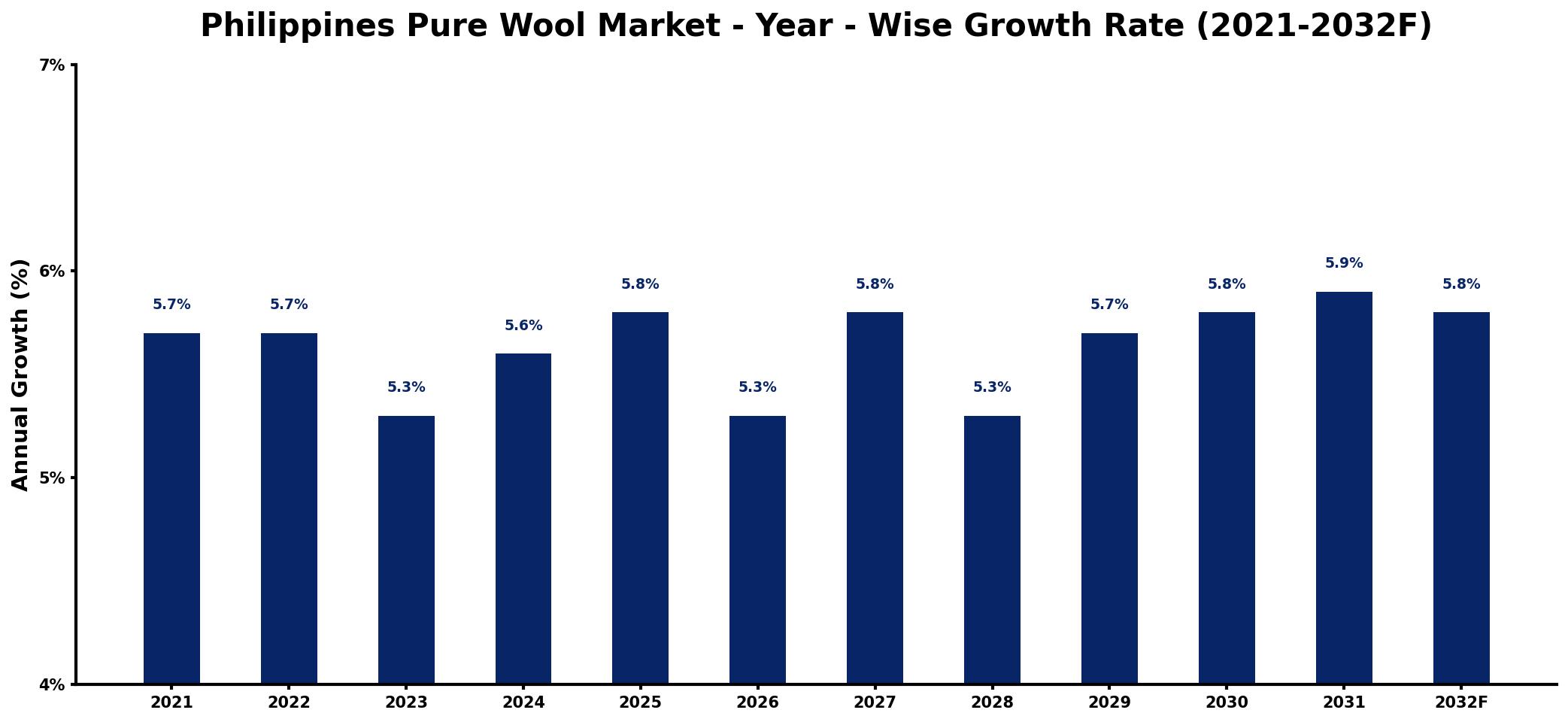
The table below presents the year‑wise growth rates along with the key drivers influencing the market
| Year | Growth Rate | Major Drivers |
| 2021 | 5.7% | Rising demand for sustainable textiles |
| 2022 | 5.7% | Increased investment in local manufacturing |
| 2023 | 5.3% | Growth in eco-friendly fashion trends |
| 2024 | 5.6% | Expansion of export markets |
| 2025 | 5.8% | Higher consumer awareness on quality |
| 2026 | 5.3% | Boost in online retail channels |
| 2027 | 5.8% | Strengthening of artisan craftsmanship |
| 2028 | 5.3% | Enhanced marketing strategies adopted |
| 2029 | 5.7% | Greater collaboration with designers |
| 2030 | 5.8% | Emergence of niche market segments |
| 2031 | 5.9% | strengthening international trade flows |
| 2032 | 5.8% | Increased focus on product innovation |
Note: Market size estimations and growth projections presented in this report are based on 6Wresearch's proprietary forecasting methodology, utilizing the latest available industry data, government publications, and primary research inputs.
Philippines Pure Wool Market Synopsis
Despite the Philippines' tropical climate hindering local sheep farming, the pure wool market has carved out a distinct niche. Driven largely by craft enthusiasts and a small but devoted consumer base, the demand for premium wool products continues to flourish, showcasing the countrys unique relationship with luxury textiles.
Import dependence characterizes the market, with local artisans and fashion designers turning to high-quality wool sourced from colder regions. This reliance not only highlights the challenges of local production but also underscores the dedication of local players to maintain standards amidst environmental constraints.
Philippines Pure Wool Market Key Takeaways
- The market is niche, fueled by a dedicated clientele seeking quality over quantity.
- High import reliance raises concerns about sustainability and logistics.
- Fashion trends increasingly favor artisanal and premium wool products.
- The economic environment influences consumer spending on luxury wool goods.
- COVID-19 recovery efforts focus on revitalizing trade channels and supply chains.
Evaluation of Restraints in Philippines Pure Wool Market
The primary restraint facing the Philippines pure wool market is the tropical climate, which inherently limits sheep farming and wool production. The absence of suitable environmental conditions complicates any attempts to establish a robust local wool industry. Additionally, the reliance on imports introduces economic pressures, such as high transportation costs and potential delays in supply, making it difficult to maintain a consistent supply chain. These factors not only challenge market stability but also raise important questions about the environmental impact associated with long-distance wool sourcing.
Philippines Pure Wool Market Trends
Current trends within the Philippines pure wool market reflect a growing interest in sustainable and artisanal products. Consumers are increasingly drawn to the craftsmanship behind handmade wool items, which adds unique value to their purchases. Moreover, the influence of international fashion trends encourages local designers to experiment with high-quality wool, further enhancing its status within the luxury textile segment. As sustainability becomes a priority for consumers, there is a noticeable shift towards eco-friendly sourcing practices in the importing process.
Philippines Pure Wool Market Opportunities
Opportunities abound in the Philippines pure wool market, particularly in the realm of artisanal and customized products. The rising trend of local craftsmanship presents an avenue for creators to differentiate themselves in a competitive landscape. By tapping into the growing global demand for sustainably sourced materials, local businesses can explore new partnerships and enhance their brand's appeal. Additionally, with the increasing interest in fashion and lifestyle products that embrace luxury, there exists potential for targeted marketing campaigns that educate consumers on the benefits of pure wool.
Government Initiatives in the Philippines Pure Wool Market
The Philippine government has initiated various programs aimed at supporting the local textile industry, including those that promote artisan crafts and sustainable practices. Efforts to encourage eco-friendly production methods and reduce import dependency are part of a broader strategy to enhance the nation's competitive edge in luxury goods. Public spending in related sectors, along with collaborations with fashion institutions, aim to elevate local capabilities and foster innovation in textile production.
Future Insights of the Philippines Pure Wool Market
Looking ahead to 2026-2032, the Philippines pure wool market is poised for gradual yet steady growth. The anticipated increase in demand for premium wool products, combined with rising consumer awareness about sustainability, suggests a positive outlook. As local artisans continue to gain recognition both domestically and internationally, the market may witness a diversification of products that align with global trends while still honoring traditional craftsmanship. Strategic partnerships could also emerge to streamline supply chains, enhancing the market's resilience and sustainability.
Philippines Pure Wool Market Latest Developments (2025 - 2026)
Recent developments in the Philippines pure wool market indicate a shift towards more sustainable practices in sourcing and production. Local designers are increasingly collaborating with international suppliers to ensure high-quality materials while minimizing environmental impact. There is also a notable uptick in the participation of local craft fairs and exhibitions, promoting artisan-made wool products. Trade associations are advocating for improved logistical frameworks to enhance the efficiency of wool imports, responding to both consumer demand and the challenges posed by pandemic disruptions.
Philippines Pure Wool Market - Key Attractiveness of the Report
- 10 Years of Market Numbers
- Historical Data Starting from 2022 to 2025
- Base Year: 2025
- Forecast Data until 2032
- Key Performance Indicators Impacting the Market
- Major Upcoming Developments and Projects
Key Highlights of the Report:
- Philippines Pure Wool Market Outlook
- Market Size of Philippines Pure Wool Market, 2025
- Forecast of Philippines Pure Wool Market, 2032
- Historical Data and Forecast of Philippines Pure Wool Revenues & Volume for the Period 2022-2032F
- Philippines Pure Wool Market Trend Evolution
- Philippines Pure Wool Market Drivers and Challenges
- Philippines Pure Wool Price Trends
- Philippines Pure Wool Porter's Five Forces
- Philippines Pure Wool Industry Life Cycle
- Historical Data and Forecast of Philippines Pure Wool Market Revenues & Volume By Type for the Period 2022-2032F
- Historical Data and Forecast of Philippines Pure Wool Market Revenues & Volume By Sheep Wool for the Period 2022-2032F
- Historical Data and Forecast of Philippines Pure Wool Market Revenues & Volume By Alpaca Wool for the Period 2022-2032F
- Historical Data and Forecast of Philippines Pure Wool Market Revenues & Volume By Merino Wool for the Period 2022-2032F
- Historical Data and Forecast of Philippines Pure Wool Market Revenues & Volume By Cashmere Wool for the Period 2022-2032F
- Historical Data and Forecast of Philippines Pure Wool Market Revenues & Volume By Mohair Wool for the Period 2022-2032F
- Historical Data and Forecast of Philippines Pure Wool Market Revenues & Volume By Angora Wool for the Period 2022-2032F
- Historical Data and Forecast of Philippines Pure Wool Market Revenues & Volume By Form for the Period 2022-2032F
- Historical Data and Forecast of Philippines Pure Wool Market Revenues & Volume By Woven for the Period 2022-2032F
- Historical Data and Forecast of Philippines Pure Wool Market Revenues & Volume By Non-Woven for the Period 2022-2032F
- Historical Data and Forecast of Philippines Pure Wool Market Revenues & Volume By Others for the Period 2022-2032F
- Historical Data and Forecast of Philippines Pure Wool Market Revenues & Volume By Application for the Period 2022-2032F
- Historical Data and Forecast of Philippines Pure Wool Market Revenues & Volume By Textiles and Apparels for the Period 2022-2032F
- Historical Data and Forecast of Philippines Pure Wool Market Revenues & Volume By Footwear for the Period 2022-2032F
- Historical Data and Forecast of Philippines Pure Wool Market Revenues & Volume By Mattress & Quilts for the Period 2022-2032F
- Historical Data and Forecast of Philippines Pure Wool Market Revenues & Volume By Others for the Period 2022-2032F
- Philippines Pure Wool Import Export Trade Statistics
- Market Opportunity Assessment By Type
- Market Opportunity Assessment By Form
- Market Opportunity Assessment By Application
- Philippines Pure Wool Top Companies Market Share
- Philippines Pure Wool Competitive Benchmarking By Technical and Operational Parameters
- Philippines Pure Wool Company Profiles
- Philippines Pure Wool Key Strategic Recommendations






































