Philippines Shrimp Feed Market Top 5 Importing Countries and Market Competition (HHI) Analysis
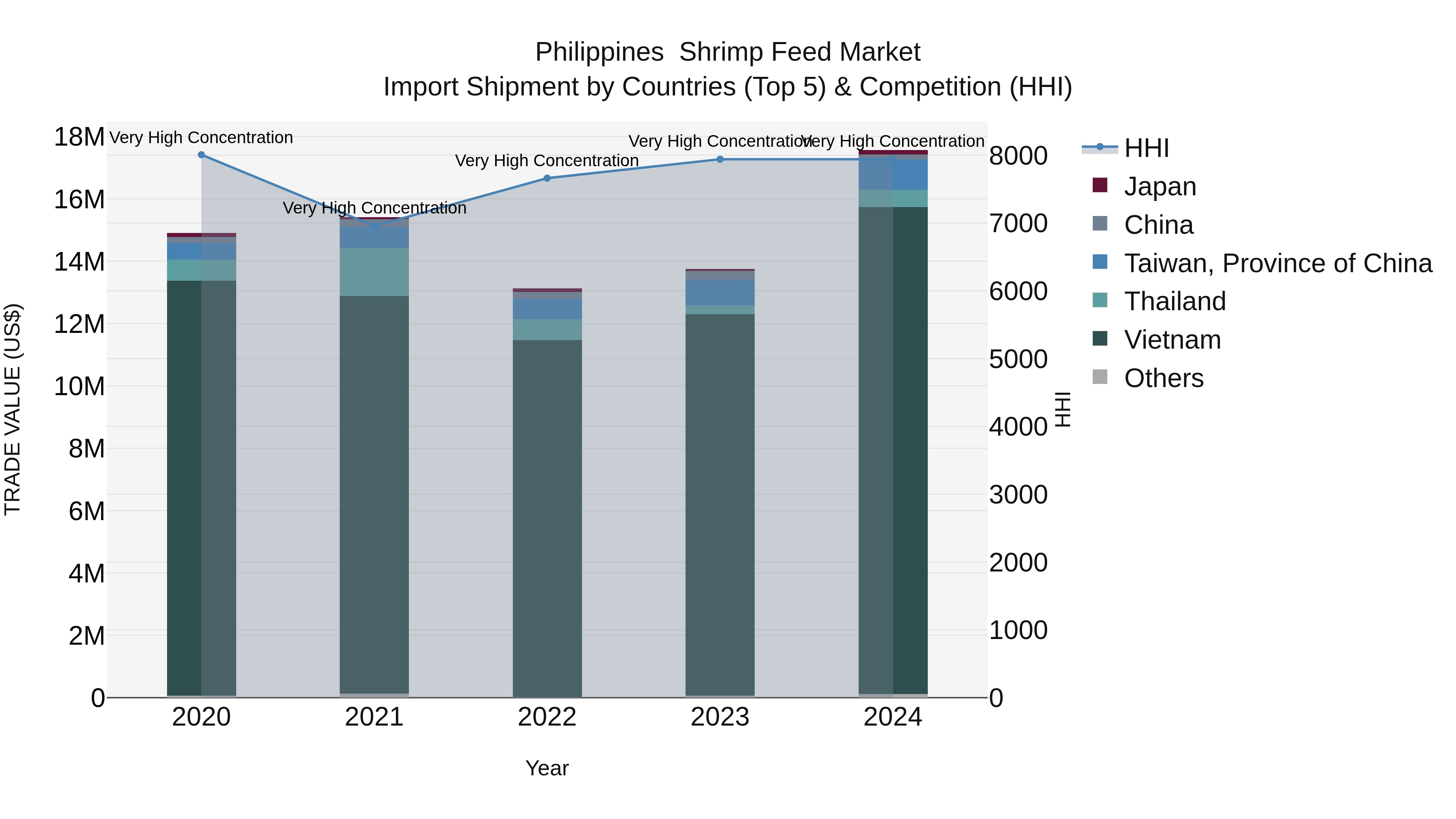
In 2024, the Philippines saw a significant increase in shrimp feed import shipments, with top exporting countries being Vietnam, Taiwan, Thailand, China, and Japan. The Herfindahl-Hirschman Index (HHI) remained at a high concentration level, indicating a competitive market. With a compound annual growth rate (CAGR) of 4.18% from 2020 to 2024 and a growth rate of 27.69% from 2023 to 2024, the Philippines` demand for shrimp feed continues to show robust expansion, driven by the thriving aquaculture industry in the region.
Philippines Shrimp Feed Market Growth Rate
According to 6Wresearch internal database and industry insights, the Philippines Shrimp Feed Market is projected to grow at a compound annual growth rate (CAGR) of 9.2% during the forecast period from 2026 to 2032.
Five-Year Growth Trajectory of the Philippines Shrimp Feed Market with Core Drivers
Below mentioned are the evaluation of year-wise growth rate along with key drivers:
| Years | Est. Annual Growth in % | Growth Drivers |
| 2021 | 7.9% | Rising demand for shrimp products in domestic and international markets. |
| 2022 | 8.1% | The shrimp farming industry is expanding due to the existing aquaculture regulations. |
| 2023 | 8.4% | Advanced shrimp farming methods are being adopted by more farmers. |
| 2024 | 8.6% | The industry now focuses its resources on developing better feed products while enhancing shrimp health. |
| 2025 | 8.9% | Advancements in shrimp feed formulation and nutritional efficiency. |
Topics Covered in the Philippines Shrimp Feed Market Report
The Philippines Shrimp Feed Market report thoroughly covers the market by type, ingredients, and additives, providing an unbiased and detailed analysis of ongoing market trends, opportunities, challenges, and market drivers, helping stakeholders align their strategies with current and future market dynamics.
Philippines Shrimp Feed Market Highlights
| Report Name | Philippines Shrimp Feed Market |
| Forecast period | 2026-2032 |
| CAGR | 9.2% |
| Growing Sector | Shrimp Feed |
Philippines Shrimp Feed Market Synopsis
The growth of the Philippines Shrimp Feed Market is being driven by increased shrimp product demand, advances in aquaculture practices, and government support for the aquaculture industry. Due to the increased sophistication of shrimp farming, new specialty feed types have emerged to assist in improving the growth and health of shrimp. The demand for good-quality shrimp feed continues to expand, driven by improved feed formulations, nutritional efficiency, and the increasing size of the shrimp farming industry.
Evaluation of Growth Drivers in the Philippines Shrimp Feed Market
Below mentioned are some prominent drivers and their impact on the market dynamics:
| Drivers | Primary Segments Affected | Why It Matters (Evidence) |
| Rising Demand for Shrimp Products | All Segments | Increasing domestic and export demand for shrimp is driving the need for quality feed. |
| Advancements in Aquaculture | All Segments | The demand for specialized shrimp feed has increased due to the enhanced shrimp farming methods. |
| Government Support for Aquaculture | All Segments | Policies promoting aquaculture sustainability and growth are encouraging feed production. |
| Nutritional Efficiency of Feeds | Grower, Finisher, Starter | The market is growing as feed formulations have been developed to enhance both shrimp growth and health. |
| Focus on Shrimp Health | All Segments | Growing awareness about shrimp health is leading to more investments in advanced feed solutions. |
The Philippines Shrimp Feed Market Size is projected to grow at a CAGR of 9.2% from 2026 to 2032. The Philippines Shrimp Feed Market is driven by significant increase in demand for shrimp products, improvements in feed formulation, and expansion of the overall aquaculture industry are all contributing to the strong growth rate of the market. As a result of this increase in demand, there will be an improved quality of nutrition for shrimp and a subsequent increase in production efficiency through the adoption of a wide variety of high-quality specialized feed options. In addition, government support for shrimp farming is creating additional opportunities for high-quality specialized feed development within the Philippine Shrimp Feed Market.
Evaluation of Restraints in the Philippines Shrimp Feed Market
Below mentioned are some major restraints and their influence on the market dynamics:
| Restraints | Primary Segments Affected | What This Means (Evidence) |
| High Feed Costs | All Segments | Rising costs of raw materials and feed production may make shrimp farming less profitable. |
| Limited Access to Quality Feed | Grower, Finisher, Starter | Smaller farms may struggle to access high-quality feed, limiting shrimp farming growth. |
| Regulatory Challenges | All Segments | Strict regulations on feed production and safety standards can increase operational costs. |
| Environmental Concerns | All Segments | Environmental impacts from feed production, such as overfishing of fishmeal, may limit feed sustainability. |
| Dependency on Imported Ingredients | All Segments | High dependency on imported raw materials for feed production can affect market stability. |
Philippines Shrimp Feed Market Challenges
The Philippines Shrimp Feed Industry faces multiple challenges that include expensive feed costs, limited feed quality access for small-scale farmers and understanding rules and regulations. The market expansion will be restricted due to environmental issues which are associated with feed production and the requirement for imported components. The solution to existing problems needs 3 innovations which include 3 new feed production methods and better feed distribution systems for small-scale farmers and 3 sustainable extraction methods which protect environmental resources.
Philippines Shrimp Feed Market Trends
Here are some major trends changing the Philippines Shrimp Feed Market Growth dynamics:
- Technological Advancements in Feed Formulation - Innovations in shrimp feed formulations, such as the development of nutritionally optimized feeds, are improving shrimp growth rates and health.
- Shift Towards Sustainable Feed Ingredients - The growing focus on sustainability is encouraging the use of alternative feed ingredients, such as plant-based protein and insect meal.
- Rising Demand for High-Quality Shrimp Feed - The need for better shrimp feed has increased as aquaculture methods have progressed. The need for better shrimp feed which supports growth and health throughout the grower and finisher periods has increased due to the advancements in aquaculture methods.
Investment Opportunities in the Philippines Shrimp Feed Market
The Philippines Shrimp Feed Market presents several investment opportunities, including:
- Development in Feed Ingredients - Investment in R&D for developing alternative and sustainable feed ingredients can offer cost-effective and eco-friendly solutions that will help the market expansion.
- Aquaculture Technology Innovation - Companies that focus on developing feed production technologies will gain a market advantage as their products will cost less and their product quality will improve.
- Sustainability and Eco-friendly Practices - The implementation of sustainable practices through the use of plant-based protein and insect meal will enable us to achieve our target of producing environmentally friendly shrimp feed.
Top 5 Leading Players in the Philippines Shrimp Feed Market
Below is the list of prominent companies leading the Philippines Shrimp Feed Market Share:
Tateh Aqua Feeds (Santeh Feeds Corp.)
| Company Name | Tateh Aqua Feeds (Santeh Feeds Corp.) |
| Established Year | 1990 |
| Headquarters | Philippines |
| Official Website | Click Here |
Santeh Feeds is a domestic leader in aquaculture nutrition, recognized for its specialized "Tateh" brand. They offer high-performance shrimp feeds designed for various cultivation stages, focusing on optimal growth and water stability for the Philippine shrimp industry.
Charoen Pokphand Foods (CPF) Philippines
| Company Name | Charoen Pokphand Foods (CPF) Philippines |
| Established Year | 1921 (Philippines operations since 1997) |
| Headquarters | Thailand (Significant Philippines Operations) |
| Official Website | Click Here |
CPF Philippines is a dominant integrated player that provides advanced shrimp feed solutions. They leverage global R&D to offer functional feeds that enhance the survival and immunity of Black Tiger and Vannamei shrimp in local farms.
Cargill Philippines
| Company Name | Cargill Philippines |
| Established Year | 1865 (Philippines operations since 1947) |
| Headquarters | USA (Significant Philippines Operations) |
| Official Website | Click Here |
Cargill provides a diverse range of shrimp nutrition products under brands like "Aquaxcel." Their focus in the Philippines is on high-density nursery and grow-out feeds that utilize advanced extrusion technology to maximize feed conversion ratios.
Skretting (Nutreco)
| Company Name | Skretting (Nutreco) |
| Established Year | 1899 |
| Headquarters | Norway (Significant Philippines Presence) |
| Official Website | Click Here |
Skretting is a leading international provider of innovative shrimp feed. Their presence in the Philippines focuses on sustainable nutrition and health-oriented feed additives, helping farmers manage disease challenges and improve harvest quality.
ADM Animal Nutrition (Philippines)
| Company Name | ADM Animal Nutrition (Philippines) |
| Established Year | 1902 |
| Headquarters | USA (Significant Philippines Operations) |
| Official Website | Click Here |
ADM is a key supplier of shrimp feed in the Philippines, offering specialized brands like "Bernaqua" and "O-Line." They specialize in premium larval and post-larval feeds, providing critical nutritional support during the early stages of the shrimp life cycle.
Government Regulations Introduced in the Philippines Shrimp Feed Market
According to the Filipino government data, through the Bureau of Fisheries and Aquatic Resources and the Department of Agriculture, there are regulations in place regulating the safety and quality of shrimp feed. These regulations focus on the quality and composition of the feed ingredients, production practices, and labelling, to promote transparency and provide safety in the sale and distribution of shrimp feed. The Philippine Feed Regulatory Agency monitors all businesses to ensure that they are compliant with the regulations.
Future Insights of the Philippines Shrimp Feed Market
The Philippines Shrimp Feed Market has a good outlook, as the demand for shrimp continues to increase, with the increased adoption of advancement aquaculture technique and new feed formulations being introduced. The government plays a major role in promoting sustainable shrimp farming by establishing equitable aquatic food production through developing policies which favour sustainable shrimp farm operations and by establishing the following technology since feed production processes are expected to improve in the coming years.
Market Segmentation Analysis
The report offers a comprehensive study of the following market segments and their leading categories:
By Type – Grower to Dominate the Market
According to Ritika Kalra, Senior Research Analyst, 6Wresearch, the market will be controlled by Grower as it provides essential nutritional needs which shrimp require during their developmental stage. Most shrimp feed manufacturers concentrate on this segment as it serves as the main component which they need to achieve maximum growth performance and maintain healthy shrimp development.
By Ingredients – Fish Meal to Dominate the Market
The Philippines Shrimp Feed Market will be dominated by Fish Meal as it serves as a major ingredient in shrimp feed which contains high protein levels and various nutritional advantages. Fish meal functions as a vital component in most shrimp feed compositions as it supports the proper development of shrimp.
By Additives – Vitamin and Protein to Dominate the Market
The Philippines Shrimp Feed Market will be dominated by Vitamin and Protein additives according to market predictions. The additives function as essential components which improve the nutritional value of shrimp feed to promote their health and growth while helping them fight off diseases. The segment experiences growth as producers focus on developing shrimp feed products which contain essential vitamins and proteins.
Key Attractiveness of the Report
- 10 Years of Market Numbers
- Historical Data Starting from 2022 to 2025
- Base Year: 2025
- Forecast Data until 2032
- Key Performance Indicators Impacting the Market
- Major Upcoming Developments and Projects
Key Highlights of the Report:
- Philippines Shrimp Feed Market Outlook
- Market Size of Philippines Shrimp Feed Market, 2025
- Forecast of Philippines Shrimp Feed Market, 2032
- Historical Data and Forecast of Philippines Shrimp Feed Revenues & Volume for the Period 2022 - 2032
- Philippines Shrimp Feed Market Trend Evolution
- Philippines Shrimp Feed Market Drivers and Challenges
- Philippines Shrimp Feed Price Trends
- Philippines Shrimp Feed Porter's Five Forces
- Philippines Shrimp Feed Industry Life Cycle
- Historical Data and Forecast of Philippines Shrimp Feed Market Revenues & Volume By Type for the Period 2022 - 2032
- Historical Data and Forecast of Philippines Shrimp Feed Market Revenues & Volume By Grower for the Period 2022 - 2032
- Historical Data and Forecast of Philippines Shrimp Feed Market Revenues & Volume By Finisher for the Period 2022 - 2032
- Historical Data and Forecast of Philippines Shrimp Feed Market Revenues & Volume By Starter for the Period 2022 - 2032
- Historical Data and Forecast of Philippines Shrimp Feed Market Revenues & Volume By Ingredients for the Period 2022 - 2032
- Historical Data and Forecast of Philippines Shrimp Feed Market Revenues & Volume By Soybean Meal for the Period 2022 - 2032
- Historical Data and Forecast of Philippines Shrimp Feed Market Revenues & Volume By Fish Meal for the Period 2022 - 2032
- Historical Data and Forecast of Philippines Shrimp Feed Market Revenues & Volume By Wheat Flour for the Period 2022 - 2032
- Historical Data and Forecast of Philippines Shrimp Feed Market Revenues & Volume By Fish Oil for the Period 2022 - 2032
- Historical Data and Forecast of Philippines Shrimp Feed Market Revenues & Volume By Additives for the Period 2022 - 2032
- Historical Data and Forecast of Philippines Shrimp Feed Market Revenues & Volume By Vitamin and Protein for the Period 2022 - 2032
- Historical Data and Forecast of Philippines Shrimp Feed Market Revenues & Volume By Fatty Acid for the Period 2022 - 2032
- Historical Data and Forecast of Philippines Shrimp Feed Market Revenues & Volume By Antioxidant for the Period 2022 - 2032
- Historical Data and Forecast of Philippines Shrimp Feed Market Revenues & Volume By Feed Enzyme for the Period 2022 - 2032
- Historical Data and Forecast of Philippines Shrimp Feed Market Revenues & Volume By Antibiotics for the Period 2022 - 2032
- Philippines Shrimp Feed Import Export Trade Statistics
- Market Opportunity Assessment By Type
- Market Opportunity Assessment By Ingredients
- Market Opportunity Assessment By Additives
- Philippines Shrimp Feed Top Companies Market Share
- Philippines Shrimp Feed Competitive Benchmarking By Technical and Operational Parameters
- Philippines Shrimp Feed Company Profiles
- Philippines Shrimp Feed Key Strategic Recommendations
Market Covered
The report offers a comprehensive study of the subsequent market segments:
By Type
- Grower
- Finisher
- Starter
By Ingredients
- Soybean Meal
- Fish Meal
- Wheat Flour
- Fish Oil
By Additives
- Vitamin and Protein
- Fatty Acid
- Antioxidant
- Feed Enzyme
- Antibiotics






































