Philippines Stackers Market Size, Share & Growth Rate
The Philippines Stackers Market was estimated at USD 322 Million in 2025 and is projected to reach USD 446 Million by 2032, growing at a CAGR of 4.8% from 2026 to 2032. This growth trajectory is predominantly driven by rising industrial activities and the burgeoning e-commerce sector, which creates a robust demand for efficient material handling solutions. As businesses seek to optimize their operations in warehouses and distribution centers, stackers have become integral to maintaining productivity and ensuring safety.
Philippines Stackers Market Year-wise Growth Rate and Key Drivers
This graph highlights how the Philippines Stackers Market has steadily grown over the years, supported by major growth factors.
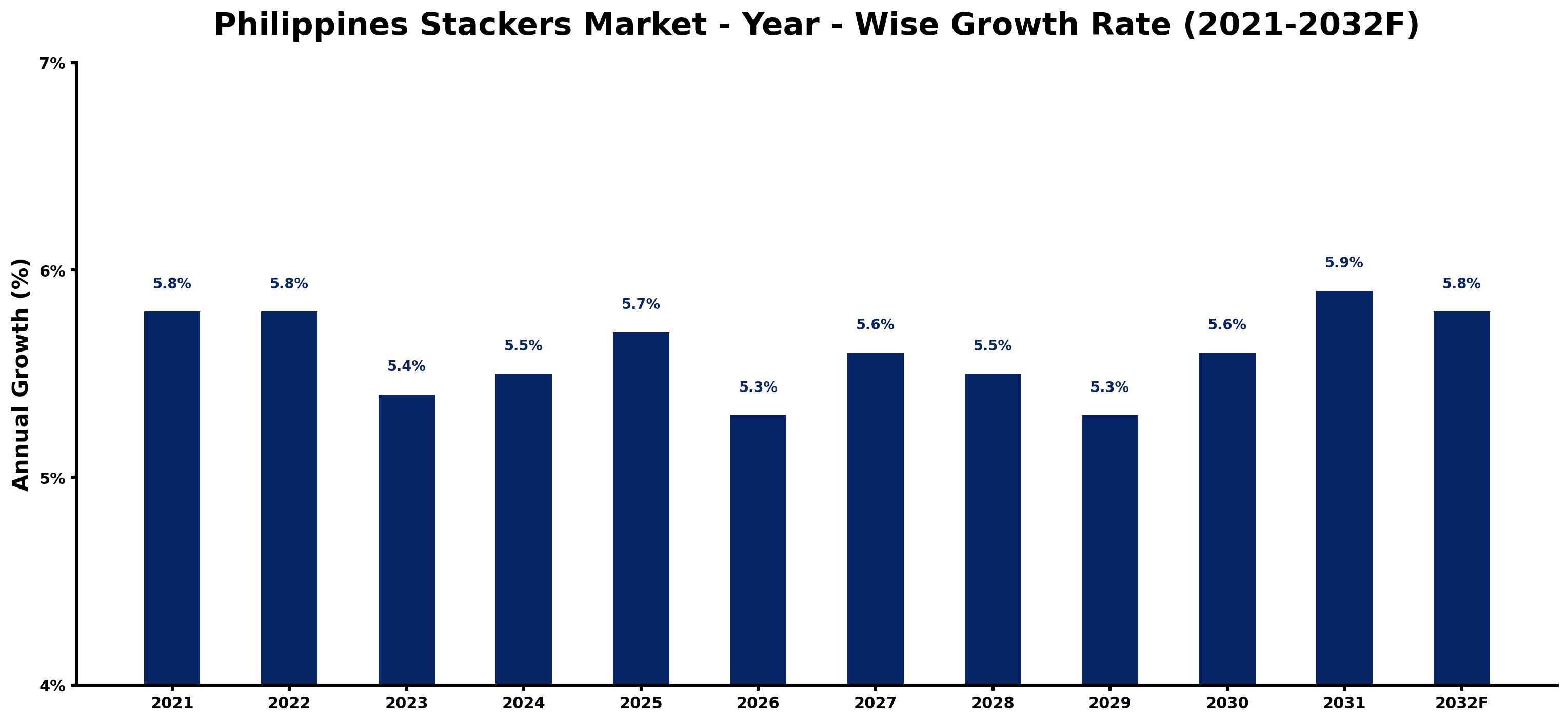
The table below presents the year‑wise growth rates along with the key drivers influencing the market
| Year | Growth Rate | Major Drivers |
| 2021 | 5.8% | Increasing adoption of advanced technologies |
| 2022 | 5.8% | Increasing industrial infrastructure investments |
| 2023 | 5.4% | Increasing industrial automation investments |
| 2024 | 5.5% | Expansion of transportation and logistics networks |
| 2025 | 5.7% | Rising electricity demand across industries |
| 2026 | 5.3% | Expansion of manufacturing activities |
| 2027 | 5.6% | Growing urbanization and commercial development |
| 2028 | 5.5% | Rising electricity demand across industries |
| 2029 | 5.3% | Expansion of transportation and logistics networks |
| 2030 | 5.6% | Expansion of manufacturing activities |
| 2031 | 5.9% | Expansion of transportation and logistics networks |
| 2032 | 5.8% | Government infrastructure modernization initiatives |
Note - Market size estimations and growth projections presented in this report are based on 6Wresearch’s advanced forecasting approach, validated with industry datasets as of June 2026.
Philippines Stackers Market Synopsis
Technological advancement is the most influential force shaping the Philippines Stackers Market today. The introduction of automated stackers has revolutionized how companies approach material handling, significantly enhancing efficiency while lowering operational costs. As a result, end-users are increasingly adopting these technologies to meet their logistical demands.
Furthermore, the shift toward electric-powered stackers is notable within the industry, driven by sustainability concerns and the desire for cost-effective solutions. These stackers not only boast zero emissions but also offer reduced noise pollution, making them suitable for indoor and space-restricted environments, thereby reinforcing their growing acceptance across various sectors.
Philippines Stackers Market Key Takeaways
- Projected market growth driven by increased demand for efficient material handling solutions.
- Automated stackers are gaining traction for their operational efficiencies.
- Electric stackers are becoming a preferred choice due to sustainability benefits.
- Investment in workplace safety is fueling demand for stacker-type machinery.
- Small businesses face challenges in affordability, impacting their purchasing decisions.
Evaluation of Restraints in Philippines Stackers Market
One of the most pressing restraints within the Philippines Stackers Market is the high upfront cost of purchasing stackers, which can be a significant barrier for small-scale operators. Despite the clear advantages that stackers offer, many potential buyers lack the necessary financial resources to invest in such equipment. This affordability issue is exacerbated by limited access to financing options, which can hinder growth for small businesses keen to enhance their operational efficiencies. The result is a slower adoption rate compared to larger enterprises that can more easily absorb these costs.
Philippines Stackers Market Trends
The Philippines Stackers Market is currently experiencing a significant shift towards automation. Many manufacturers are investing in developing automated stackers that promise not only higher efficiency but also reduced labor costs. Simultaneously, the adoption of smart technologies in stackers, such as IoT connectivity, is expected to enhance real-time data management, further optimizing operations. Additionally, sustainability remains a key trend, with electric stackers being preferred for their environmental benefits, as companies aim to reduce their carbon footprints and adhere to evolving regulations.
Philippines Stackers Market Opportunities
Growth opportunities in the Philippines Stackers Market lie within the expanding e-commerce sector, which is rapidly reshaping logistics and warehousing needs. Companies can leverage these changes by offering tailored solutions that address the specific demands of online retailers. Furthermore, as consumers become more environmentally conscious, manufacturers can capitalize on the trend toward electric stackers, positioning themselves as leaders in sustainable material handling solutions. Investment in training and safety technologies will also create additional avenues for market growth as businesses strive to meet stringent workplace safety standards.
Government Initiatives in the Philippines Stackers Market
The Philippine government is actively promoting investment in infrastructure development, which indirectly benefits the stackers market. Policies aimed at enhancing logistics capabilities through improved transport networks and ports are essential in facilitating smoother supply chain operations. Additionally, public safety regulations that emphasize workplace safety standards encourage businesses to invest in advanced material handling equipment. These initiatives create a favorable environment for the stackers market to flourish, ensuring compliance while enhancing operational efficiency.
Future Insights of the Philippines Stackers Market
From 2026 to 2032, the Philippines Stackers Market is expected to witness robust growth, fueled by continual investments in automation and a shift toward eco-friendly solutions. As more businesses recognize the long-term benefits of electric stackers and automated systems, the demand for such equipment will likely surge. This period will also see increased focus on digital transformation within warehouses and distribution centers, with data-driven insights becoming critical in decision-making processes. Ultimately, these trends indicate a dynamic market poised for substantial development, driven by both technological innovation and sustainability.
Philippines Stackers Market Latest Developments (May 2025 - June 2026)
In recent months, the Philippines Stackers Market has seen significant advancements in technology and application. New automated stacker models equipped with enhanced safety features have been introduced, catering specifically to the growing demand from sectors like e-commerce and food processing. Moreover, electric stackers are becoming increasingly popular as businesses seek to reduce their environmental impact. The market is also witnessing increased collaboration among manufacturers and tech companies to develop smarter, more efficient material handling solutions that meet the evolving needs of various industries.
Philippines Stackers Market - Key Attractiveness of the Report
- 10 Years of Market Numbers
- Historical Data Starting from 2022 to 2025
- Base Year: 2025
- Forecast Data until 2032
- Key Performance Indicators Impacting the Market
- Major Upcoming Developments and Projects
Key Highlights of the Report:
- Philippines Stackers Market Outlook
- Market Size of Philippines Stackers Market, 2025
- Forecast of Philippines Stackers Market, 2032
- Historical Data and Forecast of Philippines Stackers Revenues & Volume for the Period 2022-2032F
- Philippines Stackers Market Trend Evolution
- Philippines Stackers Market Drivers and Challenges
- Philippines Stackers Price Trends
- Philippines Stackers Porter's Five Forces
- Philippines Stackers Industry Life Cycle
- Historical Data and Forecast of Philippines Stackers Market Revenues & Volume By Type for the Period 2022-2032F
- Historical Data and Forecast of Philippines Stackers Market Revenues & Volume By Electric for the Period 2022-2032F
- Historical Data and Forecast of Philippines Stackers Market Revenues & Volume By Manual/Hydraulic for the Period 2022-2032F
- Historical Data and Forecast of Philippines Stackers Market Revenues & Volume By Semi-Electric for the Period 2022-2032F
- Historical Data and Forecast of Philippines Stackers Market Revenues & Volume By End-User for the Period 2022-2032F
- Historical Data and Forecast of Philippines Stackers Market Revenues & Volume By Retail & Wholesale for the Period 2022-2032F
- Historical Data and Forecast of Philippines Stackers Market Revenues & Volume By Logistics for the Period 2022-2032F
- Historical Data and Forecast of Philippines Stackers Market Revenues & Volume By Automobile for the Period 2022-2032F
- Historical Data and Forecast of Philippines Stackers Market Revenues & Volume By Food & Beverages for the Period 2022-2032F
- Historical Data and Forecast of Philippines Stackers Market Revenues & Volume By Others for the Period 2022-2032F
- Philippines Stackers Import Export Trade Statistics
- Market Opportunity Assessment By Type
- Market Opportunity Assessment By End-User
- Philippines Stackers Top Companies Market Share
- Philippines Stackers Competitive Benchmarking By Technical and Operational Parameters
- Philippines Stackers Company Profiles
- Philippines Stackers Key Strategic Recommendations






































