Philippines Stethoscope Market Top 5 Importing Countries and Market Competition (HHI) Analysis
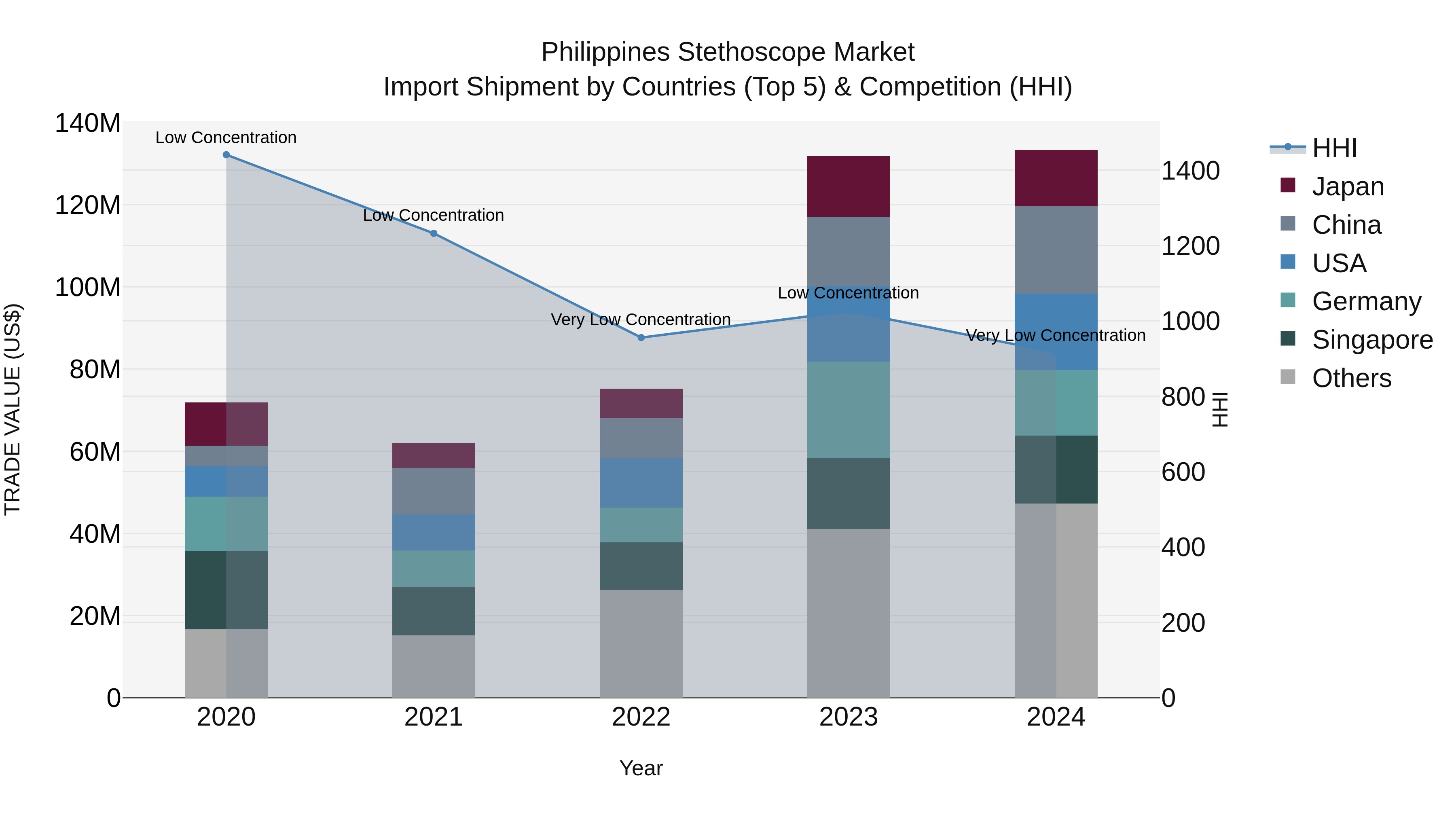
The stethoscope import market in the Philippines saw a significant increase in diversity in 2024, with top exporting countries including China, USA, Singapore, Germany, and Japan. The market concentration, as measured by the Herfindahl-Hirschman Index (HHI), decreased from low to very low in 2024, indicating a more competitive landscape. The compound annual growth rate (CAGR) for the period 2020-2024 was a robust 16.7%, with a steady growth rate of 1.13% from 2023 to 2024, reflecting a stable and expanding market for stethoscope imports in the Philippines.
Philippines Stethoscope Market Synopsis
The stethoscope market in the Philippines is supported by ongoing investments in the healthcare sector and the rising demand for diagnostic tools. With growing medical professional populations and training institutions, the demand for both basic and advanced digital stethoscopes continues to grow.
Trends of the market
The stethoscope market is poised for steady growth as healthcare providers increasingly adopt high-quality diagnostic tools. Newer technologies in stethoscopes, such as electronic and digital models, are gaining popularity, especially among medical professionals looking for enhanced sound clarity and diagnostic accuracy.
Challenges of the market
The Stethoscope market in the Philippines faces challenges related to product quality and affordability. While stethoscopes are essential diagnostic tools for healthcare professionals, there is a disparity between high-quality stethoscopes and more affordable alternatives. Many healthcare facilities, particularly in rural areas, struggle with budget constraints that prevent them from purchasing premium stethoscopes, which can affect the quality of diagnoses. Additionally, counterfeit or low-quality stethoscopes are prevalent in the market, further complicating matters for healthcare providers seeking reliable tools.
Investment opportunities in the Market
The stethoscope market in the Philippines is expanding as healthcare services continue to improve and the demand for medical instruments increases. Stethoscopes are essential diagnostic tools in hospitals, clinics, and private practices. Investment opportunities in this market include the development of high-quality, durable, and affordable stethoscopes with advanced features, such as digital stethoscopes with sound amplification and noise reduction capabilities. Companies can also explore partnerships with healthcare institutions to enhance product adoption and distribution.
Government Policy of the market
The Philippine government regulates the importation and manufacturing of stethoscopes to ensure they meet the necessary safety and quality standards for use in healthcare settings. Policies focus on ensuring that these essential diagnostic tools are accessible and affordable for healthcare professionals across the country.
Key Highlights of the Report:
- Philippines Stethoscope Market Outlook
- Market Size of Philippines Stethoscope Market, 2024
- Forecast of Philippines Stethoscope Market, 2031
- Historical Data and Forecast of Philippines Stethoscope Revenues & Volume for the Period 2021- 2031
- Philippines Stethoscope Market Trend Evolution
- Philippines Stethoscope Market Drivers and Challenges
- Philippines Stethoscope Price Trends
- Philippines Stethoscope Porter's Five Forces
- Philippines Stethoscope Industry Life Cycle
- Historical Data and Forecast of Philippines Stethoscope Market Revenues & Volume By Technology for the Period 2021- 2031
- Historical Data and Forecast of Philippines Stethoscope Market Revenues & Volume By Electronic/Digital Stethoscope for the Period 2021- 2031
- Historical Data and Forecast of Philippines Stethoscope Market Revenues & Volume By Smart Stethoscope for the Period 2021- 2031
- Historical Data and Forecast of Philippines Stethoscope Market Revenues & Volume By Traditional Acoustic Stethoscope for the Period 2021- 2031
- Historical Data and Forecast of Philippines Stethoscope Market Revenues & Volume By Sales Channel for the Period 2021- 2031
- Historical Data and Forecast of Philippines Stethoscope Market Revenues & Volume By Distributors for the Period 2021- 2031
- Historical Data and Forecast of Philippines Stethoscope Market Revenues & Volume By E-Commerce for the Period 2021- 2031
- Historical Data and Forecast of Philippines Stethoscope Market Revenues & Volume By Direct Purchase for the Period 2021- 2031
- Historical Data and Forecast of Philippines Stethoscope Market Revenues & Volume By End Use for the Period 2021- 2031
- Historical Data and Forecast of Philippines Stethoscope Market Revenues & Volume By Home Healthcare for the Period 2021- 2031
- Historical Data and Forecast of Philippines Stethoscope Market Revenues & Volume By Hospitals for the Period 2021- 2031
- Historical Data and Forecast of Philippines Stethoscope Market Revenues & Volume By Clinics for the Period 2021- 2031
- Historical Data and Forecast of Philippines Stethoscope Market Revenues & Volume By Nurse Practitioners for the Period 2021- 2031
- Historical Data and Forecast of Philippines Stethoscope Market Revenues & Volume By EMT/ First Responders for the Period 2021- 2031
- Historical Data and Forecast of Philippines Stethoscope Market Revenues & Volume By Veterinary for the Period 2021- 2031
- Philippines Stethoscope Import Export Trade Statistics
- Market Opportunity Assessment By Technology
- Market Opportunity Assessment By Sales Channel
- Market Opportunity Assessment By End Use
- Philippines Stethoscope Top Companies Market Share
- Philippines Stethoscope Competitive Benchmarking By Technical and Operational Parameters
- Philippines Stethoscope Company Profiles
- Philippines Stethoscope Key Strategic Recommendations






































