Philippines Tensile Testing Equipment Market Size, Share & Growth Rate
The Philippines Tensile Testing Equipment Market was estimated at USD 1416 Million in 2025 and is projected to reach USD 2056 Million by 2032, growing at a CAGR of 5.5% from 2026 to 2032. This significant growth trajectory is driven by the increasing demand for high-quality materials across multiple sectors, including automotive and aerospace, where stringent quality standards are paramount. The ongoing shift toward automation in manufacturing processes further amplifies this demand, as companies strive to enhance product reliability and operational efficiency.
Philippines Tensile Testing Equipment Market Year-wise Growth Rate and Key Drivers
This graph highlights how the Philippines Tensile Testing Equipment Market has steadily grown over the years, supported by major growth factors.
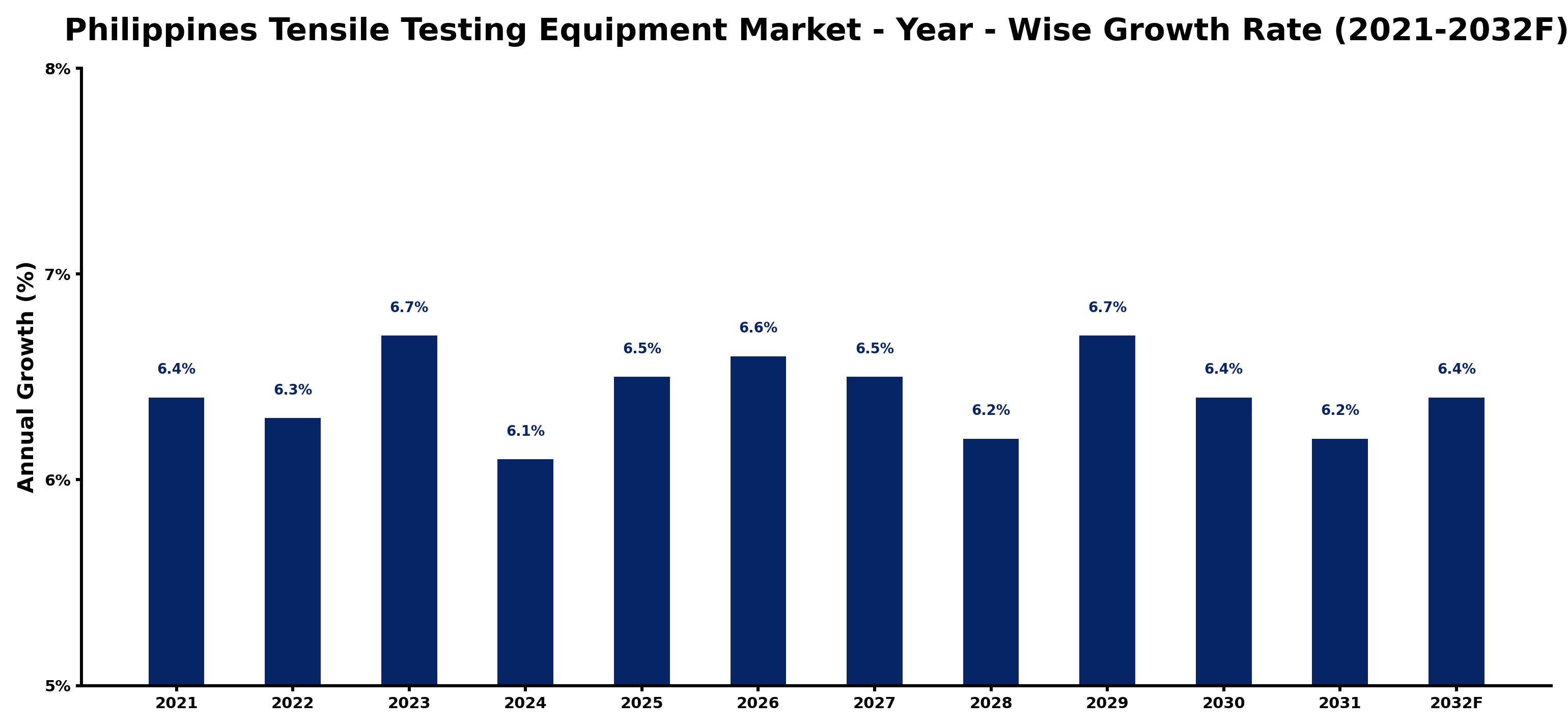
The table below presents the year‑wise growth rates along with the key drivers influencing the market
| Year | Growth Rate | Major Drivers |
| 2021 | 6.4% | Expansion of manufacturing activities |
| 2022 | 6.3% | Increasing adoption of advanced technologies |
| 2023 | 6.7% | Growing renewable energy integration projects |
| 2024 | 6.1% | Increasing industrial infrastructure investments |
| 2025 | 6.5% | Expansion of manufacturing activities |
| 2026 | 6.6% | Increasing adoption of advanced technologies |
| 2027 | 6.5% | Growing renewable energy integration projects |
| 2028 | 6.2% | Growing urbanization and commercial development |
| 2029 | 6.7% | Government infrastructure modernization initiatives |
| 2030 | 6.4% | Government infrastructure modernization initiatives |
| 2031 | 6.2% | Increasing industrial automation investments |
| 2032 | 6.4% | Government infrastructure modernization initiatives |
Note - Market size estimations and growth projections presented in this report are based on 6Wresearch’s advanced forecasting approach, validated with industry datasets as of June 2026.
Philippines Tensile Testing Equipment Market Synopsis
The tensile testing equipment market in the Philippines has displayed a dynamic recovery in recent years, bouncing back from pandemic-induced challenges. With industries rebounding, the future appears bright as companies prioritize quality assurance and safety in their production processes.
As manufacturers increasingly integrate advanced technologies, the sector is set for an evolution. Innovations like AI-enabled analytics are transforming data interpretation, driving smarter testing solutions that cater to complex material specifications.
Philippines Tensile Testing Equipment Market Key Takeaways
- Robust growth is anticipated in response to heightened quality assurance demands across key sectors.
- The rise of automation and AI technologies is reshaping testing methodologies and enhancing efficiency.
- Stringent regulatory requirements are pushing manufacturers to invest in advanced tensile testing solutions.
- Increased safety awareness among consumers and regulators is driving market expansion.
- The ongoing post-pandemic recovery is fueling renewed interest in quality testing equipment.
Evaluation of Restraints in Philippines Tensile Testing Equipment Market
Despite its promising growth outlook, the Philippines tensile testing equipment market faces notable restraints. The complexity of newer testing machines necessitates skilled personnel for installation and operation, which can pose challenges for mid-sized and smaller companies unable to afford specialized labor. Additionally, the financial strain from pandemic repercussions has led many businesses to adopt cost-containment measures, potentially stunting investments in advanced testing solutions. This imbalance may hinder optimal growth unless addressed strategically by industry stakeholders.
Philippines Tensile Testing Equipment Market Trends
Currently, the market is witnessing a transition towards more integrated and automated testing solutions. As industries lean into Industry 4.0 principles, the convergence of data analytics with tensile testing equipment is becoming more prevalent, allowing for real-time insights and enhanced material performance evaluations. Moreover, sustainable practices are gaining traction, prompting the development of testing equipment that not only meets safety standards but is also environmentally friendly.
Philippines Tensile Testing Equipment Market Opportunities
Genuine growth opportunities lie in the expansion of the renewable energy sector, where robust material testing is critical for ensuring the reliability and safety of components. Furthermore, government initiatives aimed at bolstering local manufacturing capabilities are creating avenues for increased investment in high-quality testing solutions. As industries evolve, the need for tailored, innovative equipment that meets specific performance criteria will continue to expand, paving the way for niche market players to thrive.
Government Initiatives in the Philippines Tensile Testing Equipment Market
The Philippine government has been proactive in promoting manufacturing resilience through various initiatives. By supporting investment in advanced technology and enforcing stricter safety regulations, authorities aim to elevate local industry standards. Programs focused on quality assurance and material safety compliance are encouraging manufacturers to adopt cutting-edge testing methodologies, fostering an environment conducive to the growth of the tensile testing equipment sector.
Future Insights of the Philippines Tensile Testing Equipment Market
Looking ahead to 2026-2032, the Philippines tensile testing equipment market is poised for substantial advancements. The integration of smart technologies and real-time data processing will redefine testing protocols, enhancing accuracy and efficiency. As market players adapt to evolving safety standards and technological demands, the focus on high-performance materials will drive innovation, reinforcing the sector's competitive edge within the regional and global markets.
Philippines Tensile Testing Equipment Market Latest Developments (May 2025 - June 2026)
Recent industry developments indicate a notable shift towards digital integration in tensile testing. Several manufacturers are exploring collaborations with tech firms to embed AI and machine learning capabilities into their testing frameworks. This strategy not only addresses operational efficiency but also aligns with the market's increasing emphasis on predictive maintenance and data-driven decision-making. Additionally, there is a growing focus on sustainability, with initiatives being taken to produce eco-friendly testing equipment.
Philippines Tensile Testing Equipment Market - Key Attractiveness of the Report
- 10 Years of Market Numbers
- Historical Data Starting from 2022 to 2025
- Base Year: 2025
- Forecast Data until 2032
- Key Performance Indicators Impacting the Market
- Major Upcoming Developments and Projects
Key Highlights of the Report:
- Philippines Tensile Testing Equipment Market Outlook
- Market Size of Philippines Tensile Testing Equipment Market, 2025
- Forecast of Philippines Tensile Testing Equipment Market, 2032
- Historical Data and Forecast of Philippines Tensile Testing Equipment Revenues & Volume for the Period 2022-2032F
- Philippines Tensile Testing Equipment Market Trend Evolution
- Philippines Tensile Testing Equipment Market Drivers and Challenges
- Philippines Tensile Testing Equipment Price Trends
- Philippines Tensile Testing Equipment Porter's Five Forces
- Philippines Tensile Testing Equipment Industry Life Cycle
- Historical Data and Forecast of Philippines Tensile Testing Equipment Market Revenues & Volume By Equipment Type for the Period 2022-2032F
- Historical Data and Forecast of Philippines Tensile Testing Equipment Market Revenues & Volume By Universal Testing Machine for the Period 2022-2032F
- Historical Data and Forecast of Philippines Tensile Testing Equipment Market Revenues & Volume By Hydraulic for the Period 2022-2032F
- Historical Data and Forecast of Philippines Tensile Testing Equipment Market Revenues & Volume By Electromechanical for the Period 2022-2032F
- Historical Data and Forecast of Philippines Tensile Testing Equipment Market Revenues & Volume By Others for the Period 2022-2032F
- Historical Data and Forecast of Philippines Tensile Testing Equipment Market Revenues & Volume By End-User Industry for the Period 2022-2032F
- Historical Data and Forecast of Philippines Tensile Testing Equipment Market Revenues & Volume By Industrial Manufacturing for the Period 2022-2032F
- Historical Data and Forecast of Philippines Tensile Testing Equipment Market Revenues & Volume By Automotive for the Period 2022-2032F
- Historical Data and Forecast of Philippines Tensile Testing Equipment Market Revenues & Volume By Construction for the Period 2022-2032F
- Historical Data and Forecast of Philippines Tensile Testing Equipment Market Revenues & Volume By Others for the Period 2022-2032F
- Philippines Tensile Testing Equipment Import Export Trade Statistics
- Market Opportunity Assessment By Equipment Type
- Market Opportunity Assessment By End-User Industry
- Philippines Tensile Testing Equipment Top Companies Market Share
- Philippines Tensile Testing Equipment Competitive Benchmarking By Technical and Operational Parameters
- Philippines Tensile Testing Equipment Company Profiles
- Philippines Tensile Testing Equipment Key Strategic Recommendations






































