Poland Groceries Market Summary
The poland groceries market was estimated at USD 294 Million in 2025 and is projected to reach USD 382 Million by 2032, growing at a CAGR of 4.4% from 2026 to 2032.
Poland Groceries Market Year-wise Growth Rate and Key Drivers
This graph highlights how the Poland Groceries Market has steadily grown over the past five years, supported by major growth factors.
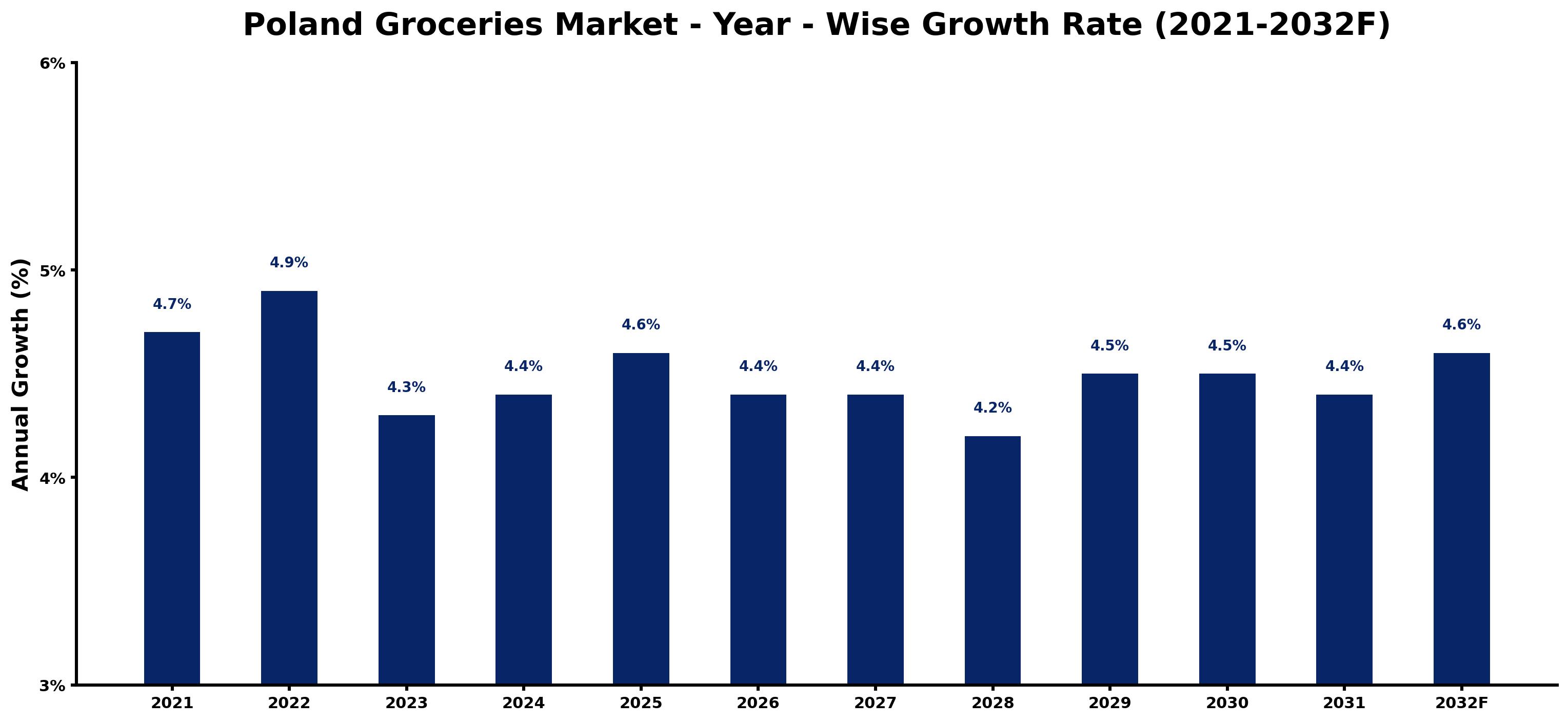
The table below presents the year wise growth rates along with the key drivers influencing the market
| Year | Growth Rate | Major Drivers |
| 2021 | 4.7% | Post-lockdown retail projects emphasize local sourcing, enhancing community ties and trust. |
| 2022 | 4.9% | Health-conscious consumers increasingly favor organic and locally produced grocery options. |
| 2023 | 4.3% | Digital transformation in retail introduces advanced e-commerce platforms for grocery shopping. |
| 2024 | 4.4% | Sustainable packaging trends gain traction, influencing consumer purchase decisions significantly. |
| 2025 | 4.6% | Urbanization leads to higher demand for convenience foods in metropolitan areas. |
| 2026 | 4.4% | Increased competition among retailers drives innovation in product offerings and services. |
| 2027 | 4.4% | Consumer preferences shift towards plant-based diets, impacting traditional grocery sales. |
| 2028 | 4.2% | Technological integration in supply chains enhances operational efficiency and cost management. |
| 2029 | 4.5% | Rising disposable incomes enable consumers to explore premium grocery products extensively. |
| 2030 | 4.5% | E-commerce platforms expand, creating new delivery services catering to busy lifestyles. |
| 2031 | 4.4% | Focus on food sustainability influences manufacturing processes across the grocery sector. |
| 2032 | 4.6% | Consumer awareness of health trends continues to reshape product development and marketing. |
Note - Market size estimations and growth projections presented in this report are based on 6Wresearch's advanced forecasting approach, validated with industry datasets as of June 2026.
Poland Groceries Market Synopsis
The Poland Groceries Market is projected to reach 4.4% and witness significant growth during the forecast period (2026-2032). This growth trajectory is underpinned by various factors, including the transformation of consumer lifestyles, a notable increase in the number of working women, and a heightened awareness of health and nutrition among shoppers. Furthermore, the growing preference for organic food products and the proliferation of convenience stores are expected to provide added impetus to market expansion. With a substantial population base, particularly concentrated in key urban areas such as Warsaw, Krakow, and Wroclaw, the Poland groceries market presents a wealth of opportunities for retailers.
Poland Groceries Market Growth Drivers
The growth of the Poland groceries market can be attributed to several interrelated factors:
- Shifts in Lifestyle: As lifestyles evolve, consumers are increasingly looking for convenience, which has led to a rise in demand for quick and accessible grocery shopping options.
- Rising Employment Rates: The increase in the number of working women has contributed to greater disposable income and an inclination towards purchasing ready-to-eat and convenient meal options.
- Health Consciousness: A growing focus on health and wellness among Polish consumers is driving demand for organic and natural food products, reflecting a shift towards healthier eating habits.
- Urbanisation: Urban areas are experiencing population growth, leading to a higher concentration of consumers seeking grocery products, thereby stimulating market expansion.
- Technological Advancements: The integration of technology in retail, such as e-commerce platforms and mobile applications, enhances consumer shopping experiences and facilitates greater market accessibility.
Poland Groceries Market Trends and Opportunities
Several key trends are shaping the Poland groceries market and presenting new opportunities for growth:
- Organic Products Demand: The soaring demand for organic food is prompting retailers to diversify their offerings, providing consumers with healthier and environmentally sustainable options.
- Convenience Stores Expansion: The proliferation of convenience stores is catering to the busy lifestyles of modern consumers, offering a wide range of grocery products in easily accessible locations.
- Online Shopping Growth: The surge in online grocery shopping, accelerated by the recent pandemic, is likely to continue, reshaping the retail landscape and expanding consumer reach.
- Focus on Sustainability: Increasing environmental awareness is encouraging brands to adopt sustainable practices, such as reducing packaging waste and sourcing locally produced goods.
- Health-Focused Innovations: Innovations in food technology, such as plant-based products and functional foods, are providing consumers with more options that align with their health goals.
Poland Groceries Market Challenges and Restraints
While the Poland groceries market is poised for growth, there are challenges and restraints that could impact its trajectory:
- Price Sensitivity: Economic fluctuations and inflation can lead to increased prices, making consumers more price-sensitive and potentially affecting their purchasing decisions.
- Competition: The market's attractiveness has led to intensified competition among retailers, necessitating differentiation strategies to maintain market share.
- Supply Chain Issues: Global supply chain disruptions can impact the availability of products, leading to potential stock shortages and affecting customer satisfaction.
- Regulatory Changes: Compliance with food safety regulations and changing government policies can pose challenges for grocery retailers in terms of operational costs and logistics.
- Consumer Preferences: Rapidly changing consumer preferences can make it difficult for retailers to stay ahead of trends and meet evolving demands.
Poland Groceries Market Government Investment and Initiatives
The Polish government has been actively investing in various initiatives to support the growth of the groceries market. These initiatives focus on enhancing food quality, sustainability, and accessibility. Government policies promote local food production and support organic farming through subsidies and grants, catering to the increasing consumer demand for organic products. Additionally, investments in infrastructure improvements, such as transport and logistics, aim to streamline supply chains and enhance distribution networks. Collaborative efforts with the private sector to boost innovation in food technology further underpin the government's commitment to advancing the groceries market.
Poland Groceries Market Latest Developments (May 2025 - June 2026)
Recent developments in the Poland groceries market highlight a continued shift towards online shopping, with many retailers investing significantly in their e-commerce capabilities. There is a marked increase in partnerships between grocery chains and local producers to enhance supply chain efficiency and meet consumer demand for fresh products. Additionally, promotional campaigns focusing on health and sustainability have gained traction, resonating with the consumer base. The government has also rolled out initiatives to support innovation in food technology, fostering advancements in product offerings and marketing strategies within the sector.
Poland Groceries Market - Key Attractiveness of the Report
- 10 Years of Market Numbers
- Historical Data Starting from 2022 to 2025
- Base Year: 2025
- Forecast Data until 2032
- Key Performance Indicators Impacting the Market
- Major Upcoming Developments and Projects
Key Highlights of the Report:
- Poland Groceries Market Outlook
- Market Size of Poland Groceries Market, 2025
- Forecast of Poland Groceries Market, 2032F
- Historical Data and Forecast of Poland Groceries Revenues & Volume for the Period 2022-2032F
- Poland Groceries Market Trend Evolution
- Poland Groceries Market Drivers and Challenges
- Poland Groceries Price Trends
- Poland Groceries Porter's Five Forces
- Poland Groceries Industry Life Cycle
- Historical Data and Forecast of Poland Groceries Market Revenues & Volume By Product Types for the Period 2022-2032F
- Historical Data and Forecast of Poland Groceries Market Revenues & Volume By Packaged Food for the Period 2022-2032F
- Historical Data and Forecast of Poland Groceries Market Revenues & Volume By Unpackaged Food for the Period 2022-2032F
- Historical Data and Forecast of Poland Groceries Market Revenues & Volume By Drinks for the Period 2022-2032F
- Historical Data and Forecast of Poland Groceries Market Revenues & Volume By Tobacco for the Period 2022-2032F
- Historical Data and Forecast of Poland Groceries Market Revenues & Volume By Household Products for the Period 2022-2032F
- Historical Data and Forecast of Poland Groceries Market Revenues & Volume By Others for the Period 2022-2032F
- Historical Data and Forecast of Poland Groceries Market Revenues & Volume By Distribution Channel for the Period 2022-2032F
- Historical Data and Forecast of Poland Groceries Market Revenues & Volume By Supermarkets & Hypermarkets for the Period 2022-2032F
- Historical Data and Forecast of Poland Groceries Market Revenues & Volume By Convenience Store for the Period 2022-2032F
- Historical Data and Forecast of Poland Groceries Market Revenues & Volume By Online for the Period 2022-2032F
- Poland Groceries Import Export Trade Statistics
- Market Opportunity Assessment By Product Types
- Market Opportunity Assessment By Distribution Channel
- Poland Groceries Top Companies Market Share
- Poland Groceries Competitive Benchmarking By Technical and Operational Parameters
- Poland Groceries Company Profiles
- Poland Groceries Key Strategic Recommendations






































