Portugal Polymerase Chain Reaction Market (2026-2032) | Share, Segmentation, Companies, Trends, Analysis, Value, Growth, Forecast, Outlook, Competitive Landscape, Size & Revenue, Industry
Market Forecast By Type (Conventional PCR, Others), By Product (Consumables & Reagents, Instruments, Software & Services) And Competitive Landscape
| Product Code: ETC8892516 | Publication Date: Sep 2024 | Updated Date: May 2026 | Product Type: Market Research Report | |
| Publisher: 6Wresearch | Author: Bhawna Singh | No. of Pages: 75 | No. of Figures: 35 | No. of Tables: 20 |
Portugal Polymerase Chain Reaction Market Growth Rate
According to 6Wresearch internal database and industry insights, the Portugal Polymerase Chain Reaction Market is growing at a compound annual growth rate (CAGR) of 7.50% during the forecast period (2026-2032).
Portugal Polymerase Chain Reaction Market Year-wise Growth Rate and Key Drivers
This graph highlights how the Portugal Polymerase Chain Reaction Market has steadily grown over the past five years, supported by major growth factors.
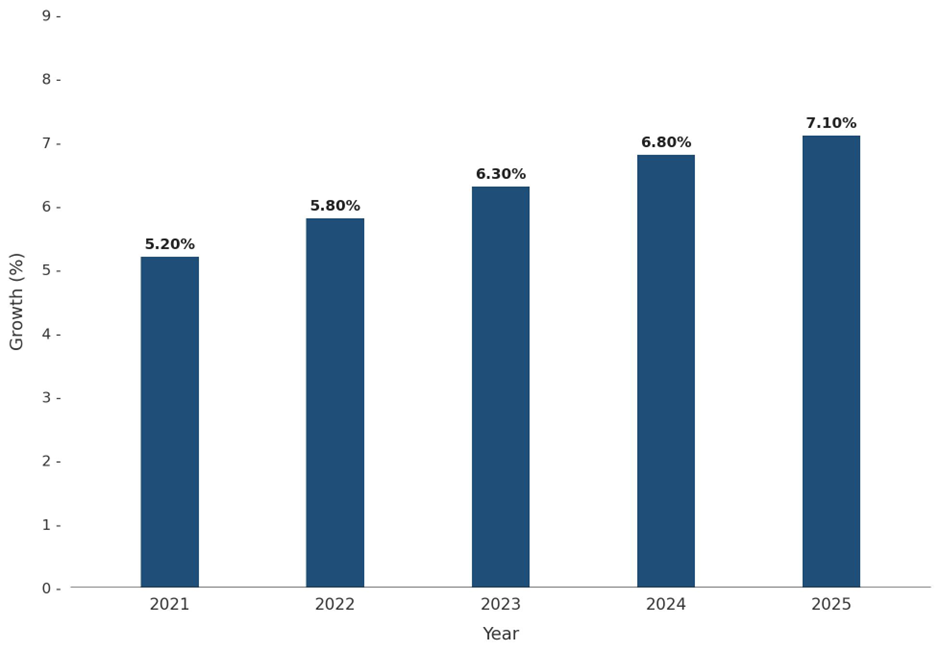
The table below presents the year‑wise growth rates along with the key drivers influencing the market
| Years | Est. Annual Growth in % | Growth Drivers |
| 2021 | 5.2% | Rising adoption of PCR for clinical diagnostics and research purposes. |
| 2022 | 5.8% | Increasing demand for personalized medicine and genomic testing. |
| 2023 | 6.3% | Expanding healthcare infrastructure and government initiatives in biotechnology. |
| 2024 | 6.8% | Integration of digital PCR and automation technologies to improve accuracy. |
| 2025 | 7.1% | Growing emphasis on real-time PCR and advancements in genetic research. |
Topics Covered in the Portugal Polymerase Chain Reaction Market Report
Portugal Polymerase Chain Reaction Market report thoroughly covers the market by type and product. The market report provides an unbiased and detailed analysis of ongoing market trends, opportunities/high growth areas, and market drivers, which would help stakeholders devise and align their market strategies according to the current and future market dynamics.
Portugal Polymerase Chain Reaction Market Highlights
| Report Name |
Portugal Polymerase Chain Reaction Market |
| Forecast period | 2026-2032 |
| CAGR | 7.50% |
| Market Size |
Diagnostics & Research |
Portugal Polymerase Chain Reaction Market Synopsis
The Portugal Polymerase Chain Reaction Market is set to be experiencing a substantial growth led by the rising adoption of PCR technologies in clinical diagnostics, genetic testing, and research applications. Government support for biotechnology innovation, along with key investments in healthcare infrastructure, is empowering the market’s foundation. Innovations in real-time PCR, digital PCR, and automation technologies are improving the sensitivity and efficiency of PCR systems, thereby it contributes to the demand growth. Additionally, Portugal’s strategic position within Europe is fueling the extension of its PCR market spurring both domestic consumption and exports.
Evaluation of Growth Drivers in the Portugal Polymerase Chain Reaction Market (2026-2032)
Below mentioned are some growth drivers and their impact on market dynamics:
| Drivers | Primary Segments Affected | Why It Matters |
| Government Support for Biotechnology | Instruments, Software & Services | Promotes innovation and development in PCR technologies, improving market growth. |
| Rising Demand for Molecular Diagnostics | Consumables & Reagents | Expanding the need for PCR reagents and consumables for disease detection. |
| Growth in Genomics & Personalized Medicine | Conventional PCR, Others | Increase the application of PCR in genetic studies and personalized healthcare. |
| Technological Advancements in PCR | Instruments, Software & Services | Improves the accuracy, sensitivity, and effectiveness of PCR testing. |
| Expansion of Healthcare Infrastructure | All Segments | Refines access to PCR testing and advances the adoption of developed technologies |
The Portugal Polymerase Chain Reaction Market is projected to grow significantly, with a CAGR of 7.50% during the forecast period of 2026-2032. The market expansion is led by rising demand for PCR-based testing, especially in clinical diagnostics, personalized medicine, and genomic research. Also, government support that combines with investments in healthcare infrastructure and technological advancements in PCR, is expected to be further fuel market growth. Innovations like real-time PCR and digital PCR are improving diagnostic capabilities, while the integration of automation technologies will continue to improve the productivity and accuracy of testing. The growing need for point-of-care testing, coupled with an increasing focus on early disease detection would influence beyond adoption of these advanced PCR technologies.
Evaluation of Restraints in the Portugal Polymerase Chain Reaction Market
Below mentioned are some major restraints and their influence on market dynamics:
| Restraints | Primary Segments Affected | What This Means |
| High Cost of PCR Systems | Instruments | Limited adoption in smaller laboratories and minimizes market access. |
| Shortage of Skilled Labor | Software & Services | Hinders the effective use of advanced PCR systems, which then reduces operational efficiency. |
| Regulatory Barriers | All Segments | Increasing the complexity and time required for product approvals. |
| Dependence on Imported Reagents | Consumables & Reagents | Creates vulnerability to supply chain disruptions and price fluctuations. |
| Data Management Challenges | Software & Services | Restricts efficient data analysis and slows down the overall workflow. |
Portugal Polymerase Chain Reaction Market Challenges
Portugal's Polymerase Chain Reaction Industry is grappling with several hurdles. One significant obstacle is the low price of the necessary equipment, a factor that limits widespread international use, especially in smaller labs. Furthermore, the requirement for specialized personnel to manage refined PCR systems presents another challenge to expansion. Altogether, governance hurdles and slowdown in product approvals can restrict the market’s development. Moreover, the details built-in data management can compromise the accuracy and interpretation of PCR results.
Portugal Polymerase Chain Reaction Market Trends
Some major trends contributing to the Portugal Polymerase Chain Reaction Market Growth are:
- Integration of AI & Automation in PCR: To improve accuracy, easy usage and speed, artificial intelligence and automation technology are being included into PCR systems.
- Personalized Medicine: As the need for personalized healthcare grows, so does the need for genetic testing, a key application of PCR technology.
- Real-time PCR and Digital PCR Growth: The demand for more spot-on, faster PCR technologies such as real-time PCR and digital PCR continues to rise in both clinical and research settings.
Investment Opportunities in the Portugal Polymerase Chain Reaction Market
Here are some investment opportunities in the Portugal Polymerase Chain Reaction Industry:
- Development of Advanced PCR Platforms: Investing in next-generation PCR technologies that includes real-time and digital PCR system would capture the growing demand for precise diagnostics.
- E-commerce and Online PCR Services: The launch of online services for at-home PCR testing can meet the increasing demand for convenient and quick testing solutions.
- Biotechnology Innovation: By investing in biotech R&D creates a new PCR-based solutions for emerging health challenges will be a key growth driver.
Top 5 Leading Players in the Portugal Polymerase Chain Reaction Market
Here are some top companies contributing to Portugal Polymerase Chain Reaction Market Share:
1. Thermo Fisher Scientific Portugal
| Company Name | Thermo Fisher Scientific Portugal |
|---|---|
| Established Year | 2006 |
| Headquarters | Porto Salvo, Portugal |
| Official Website | Click Here |
Thermo Fisher Scientific is a global leader in PCR technologies, offering a wide range of instruments, reagents, and software solutions for diagnostics, research, and life sciences applications. The company’s focus on innovation in molecular diagnostics and biotechnology supports its strong market presence in Portugal.
2. Roche Farmaceutica Quimica Lda
| Company Name | Roche Farmaceutica Quimica, Lda. |
|---|---|
| Established Year | 1973 |
| Headquarters | Amadora, Portugal |
| Official Website | Click Here |
Roche provides comprehensive PCR solutions for clinical diagnostics, including real-time PCR systems and reagents. Its commitment to quality and technological advancement has made it a prominent player in the Portuguese PCR market.
3. QIAGEN NV
| Company Name | QIAGEN N.V. |
|---|---|
| Established Year | 1984 |
| Headquarters | Venlo, Netherlands |
| Official Website | Click Here |
QIAGEN N.V. is a global leader in "Sample to Insight" solutions, headquartered in Venlo, Netherlands. The company specializes in technologies that allow scientists and clinicians to extract and analyse molecular information from biological samples (DNA, RNA, and proteins).
4. Danaher Corporation
| Company Name | Danaher Corporation (Cepheid) |
|---|---|
| Established Year | 2011 |
| Headquarters | California, USA |
| Official Website | Click Here |
Cepheid, a wholly owned subsidiary of Danaher Corporation, is a leading molecular diagnostics company focused on improving healthcare through rapid, accurate molecular systems. Cepheid provides diagnostic solutions for TB (including drug-resistant strains), respiratory infections, and healthcare-associated infections.
5. Bio Rad Laboratories Inc
| Company Name | Bio-Rad Laboratories, Inc. |
|---|---|
| Established Year | 1966 |
| Headquarters | Algés, Portugal |
| Official Website | Click Here |
Bio-Rad Laboratories, is a part of the global leader in life science research and clinical diagnostics, providing innovative instruments, software, and consumables to healthcare, industrial, and academic labs. It focuses on developing, manufacturing, and marketing products for life science research and clinical diagnostics.
Government Regulations Introduced in the Portugal Polymerase Chain Reaction Market
According to Portuguese government data, the development of the PCR market is mainly influenced by strict regulatory infrastructures and robust encouragement for biotechnology innovation. The Portuguese National Institute of Health (INSA) plays a vital role by making sure that PCR systems adhere to the essential safety, quality, and legal criteria, thus assuring the reliable and correct results. Moreover, the government programs, like the Biotechnology and Life Sciences Innovation Program, are influential in promoting research and development (R&D) within the PCR sector.
Future Insights of the Portugal Polymerase Chain Reaction Market
The Portugal Polymerase Chain Reaction (PCR) market's future seems optimistic, on account of some major factors, such as the rising advancements in diagnostics, biotechnology, and healthcare sectors, coupled with a rise in the demand for precise and rapid disease detection, especially in genetic testing and infectious disease monitoring. Government investments in healthcare infrastructure and growing awareness of PCR’s applications in research and medical diagnostics will further enhance the market's future prospects in Portugal.
Market Segmentation Analysis
The report offers a comprehensive study of the subsequent market segments and their leading categories.
Conventional PCR to Dominate the Market – By Type
According to Mansi Ahuja, Senior Research Analyst at 6Wresearch, conventional PCR remains the primary technology in the Portugal Polymerase Chain Reaction Market due to its reliability, affordability, and global use in routine diagnostics and research. It is widely used for genetic amplification and detection, especially in the academics and clinical laboratories. While more advanced technologies like digital PCR are gaining progress, conventional PCR continues to be important for many applications.
Consumables and Reagents to Dominate the Market – By Product
Consumables and Reagents dominate the Portugal Polymerase Chain Reaction Market due to their necessity in every PCR test conducted. The increasing volume of molecular testing, particularly in clinical diagnostics and research, continues to promote demand for reagents, kits, and consumables. As the adoption of PCR technologies increases, so does the consumption of these essential products, making them the largest segment in the market.
Key attractiveness of the report
- 10 Years Market Numbers.
- Historical Data Starting from 2022 to 2025.
- Base Year: 2025
- Forecast Data until 2032.
- Key Performance Indicators Impacting the Market.
- Major Upcoming Developments and Projects.
Key Highlights of the Report:
- Portugal Polymerase Chain Reaction Market Outlook
- Market Size of Portugal Polymerase Chain Reaction Market, 2025
- Forecast of Portugal Polymerase Chain Reaction Market, 2032
- Historical Data and Forecast of Portugal Polymerase Chain Reaction Revenues & Volume for the Period 2022-2032
- Portugal Polymerase Chain Reaction Market Trend Evolution
- Portugal Polymerase Chain Reaction Market Drivers and Challenges
- Portugal Polymerase Chain Reaction Price Trends
- Portugal Polymerase Chain Reaction Porter's Five Forces
- Portugal Polymerase Chain Reaction Industry Life Cycle
- Historical Data and Forecast of Portugal Polymerase Chain Reaction Market Revenues & Volume By Type for the Period 2022-2032
- Historical Data and Forecast of Portugal Polymerase Chain Reaction Market Revenues & Volume By Conventional PCR for the Period 2022-2032
- Historical Data and Forecast of Portugal Polymerase Chain Reaction Market Revenues & Volume By Others for the Period 2022-2032
- Historical Data and Forecast of Portugal Polymerase Chain Reaction Market Revenues & Volume By Product for the Period 2022-2032
- Historical Data and Forecast of Portugal Polymerase Chain Reaction Market Revenues & Volume By Consumables & Reagents for the Period 2022-2032
- Historical Data and Forecast of Portugal Polymerase Chain Reaction Market Revenues & Volume By Instruments for the Period 2022-2032
- Historical Data and Forecast of Portugal Polymerase Chain Reaction Market Revenues & Volume By Software & Services for the Period 2022-2032
- Portugal Polymerase Chain Reaction Import Export Trade Statistics
- Market Opportunity Assessment By Type
- Market Opportunity Assessment By Product
- Portugal Polymerase Chain Reaction Top Companies Market Share
- Portugal Polymerase Chain Reaction Competitive Benchmarking By Technical and Operational Parameters
- Portugal Polymerase Chain Reaction Company Profiles
- Portugal Polymerase Chain Reaction Key Strategic Recommendations
Market covered
The report subsequently covers the market by following segments and subsegments.
By Type
- Conventional PCR
- Others
By Product
- Consumables & Reagents
- Instruments
- Software & Services
Portugal Polymerase Chain Reaction Market (2026-2032): FAQs
The Portugal Polymerase Chain Reaction Market is projected to grow at a CAGR of 7.50% during the forecast period (2026-2032).
Digital PCR, real-time PCR, and the use of artificial intelligence, along with automation, are technological advancements that improve both accuracy and speed.
The growth of the market is driven by the increasing need for molecular diagnostics, government support, and innovations in polymerase chain reaction technology.
The key challenges are high costs of PCR systems, shortage of skilled labour, regulatory compliance issues, and reliance on imported reagents.
6Wresearch actively monitors the Portugal Polymerase Chain Reaction Market and publishes its comprehensive annual report, highlighting emerging trends, growth drivers, revenue analysis, and forecast outlook. Our insights help businesses to make data-backed strategic decisions with ongoing market dynamics. Our analysts track relevent industries related to the Portugal Polymerase Chain Reaction Market, allowing our clients with actionable intelligence and reliable forecasts tailored to emerging regional needs.
Yes, we provide customisation as per your requirements. To learn more, feel free to contact us on sales@6wresearch.com
| 1 Executive Summary |
| 2 Introduction |
| 2.1 Key Highlights of the Report |
| 2.2 Report Description |
| 2.3 Market Scope & Segmentation |
| 2.4 Research Methodology |
| 2.5 Assumptions |
| 3 Portugal Polymerase Chain Reaction Market Overview |
| 3.1 Portugal Country Macro Economic Indicators |
| 3.2 Portugal Polymerase Chain Reaction Market Revenues & Volume, 2022 & 2032F |
| 3.3 Portugal Polymerase Chain Reaction Market - Industry Life Cycle |
| 3.4 Portugal Polymerase Chain Reaction Market - Porter's Five Forces |
| 3.5 Portugal Polymerase Chain Reaction Market Revenues & Volume Share, By Type, 2022 & 2032F |
| 3.6 Portugal Polymerase Chain Reaction Market Revenues & Volume Share, By Product, 2022 & 2032F |
| 4 Portugal Polymerase Chain Reaction Market Dynamics |
| 4.1 Impact Analysis |
| 4.2 Market Drivers |
| 4.2.1 Increasing demand for molecular diagnostics in healthcare applications |
| 4.2.2 Technological advancements in PCR techniques and equipment |
| 4.2.3 Growing research and development activities in life sciences and biotechnology sectors |
| 4.3 Market Restraints |
| 4.3.1 High initial investment and operational costs associated with PCR technology |
| 4.3.2 Lack of skilled professionals for operating and interpreting PCR results |
| 4.3.3 Stringent regulatory requirements for PCR testing in healthcare and research settings |
| 5 Portugal Polymerase Chain Reaction Market Trends |
| 6 Portugal Polymerase Chain Reaction Market, By Types |
| 6.1 Portugal Polymerase Chain Reaction Market, By Type |
| 6.1.1 Overview and Analysis |
| 6.1.2 Portugal Polymerase Chain Reaction Market Revenues & Volume, By Type, 2022- 2032F |
| 6.1.3 Portugal Polymerase Chain Reaction Market Revenues & Volume, By Conventional PCR, 2022- 2032F |
| 6.1.4 Portugal Polymerase Chain Reaction Market Revenues & Volume, By Others, 2022- 2032F |
| 6.2 Portugal Polymerase Chain Reaction Market, By Product |
| 6.2.1 Overview and Analysis |
| 6.2.2 Portugal Polymerase Chain Reaction Market Revenues & Volume, By Consumables & Reagents, 2022- 2032F |
| 6.2.3 Portugal Polymerase Chain Reaction Market Revenues & Volume, By Instruments, 2022- 2032F |
| 6.2.4 Portugal Polymerase Chain Reaction Market Revenues & Volume, By Software & Services, 2022- 2032F |
| 7 Portugal Polymerase Chain Reaction Market Import-Export Trade Statistics |
| 7.1 Portugal Polymerase Chain Reaction Market Export to Major Countries |
| 7.2 Portugal Polymerase Chain Reaction Market Imports from Major Countries |
| 8 Portugal Polymerase Chain Reaction Market Key Performance Indicators |
| 8.1 Rate of adoption of PCR technology in clinical diagnostics and research |
| 8.2 Number of partnerships and collaborations for PCR technology development |
| 8.3 Frequency of new product launches and innovations in the PCR market |
| 9 Portugal Polymerase Chain Reaction Market - Opportunity Assessment |
| 9.1 Portugal Polymerase Chain Reaction Market Opportunity Assessment, By Type, 2022 & 2032F |
| 9.2 Portugal Polymerase Chain Reaction Market Opportunity Assessment, By Product, 2022 & 2032F |
| 10 Portugal Polymerase Chain Reaction Market - Competitive Landscape |
| 10.1 Portugal Polymerase Chain Reaction Market Revenue Share, By Companies, 2025 |
| 10.2 Portugal Polymerase Chain Reaction Market Competitive Benchmarking, By Operating and Technical Parameters |
| 11 Company Profiles |
| 12 Recommendations |
| 13 Disclaimer |
Global Go To Market Strategy - 2030
Export potential enables firms to identify high-growth global markets with greater confidence by combining advanced trade intelligence with a structured quantitative methodology. The framework analyzes emerging demand trends and country-level import patterns while integrating macroeconomic and trade datasets such as GDP and population forecasts, bilateral import–export flows, tariff structures, elasticity differentials between developed and developing economies, geographic distance, and import demand projections. Using weighted trade values from 2020–2024 as the base period to project country-to-country export potential for 2030, these inputs are operationalized through calculated drivers such as gravity model parameters, tariff impact factors, and projected GDP per-capita growth. Through an analysis of hidden potentials, demand hotspots, and market conditions that are most favorable to success, this method enables firms to focus on target countries, maximize returns, and global expansion with data, backed by accuracy.
By factoring in the projected importer demand gap that is currently unmet and could be potential opportunity, it identifies the potential for the Exporter (Country) among 190 countries, against the general trade analysis, which identifies the biggest importer or exporter.
To discover high-growth global markets and optimize your business strategy:
Click Here
Pricing
- Single User License$ 1,995
- Department License$ 2,400
- Site License$ 3,120
- Global License$ 3,795

Leadership Perspectives from Industry Events
Search
Thought Leadership and Analyst Meet





Our Clients








6WResearch In News
- India Export Attractiveness Tracker 2026
- India Air Conditioner Market Set for Strong Rebound in 2026 After Weather-Led Correction and GST-Driven Recovery: 6Wresearch
- ADAS in India: How Automatic Emergency Braking, Blind Spot Detection & Driver Monitoring are Transforming Road Safety
- Doha a strategic location for EV manufacturing hub: IPA Qatar
- Demand for luxury TVs surging in the GCC, says Samsung
- Empowering Growth: The Thriving Journey of Bangladesh’s Cable Industry
Latest Reports
- Nicaragua RPG Gaming Market (2026-2032)
- New Zealand RPG Gaming Market (2026-2032)
- Netherlands RPG Gaming Market (2026-2032)
- Nauru RPG Gaming Market (2026-2032)
- Namibia RPG Gaming Market (2026-2032)
- Mozambique RPG Gaming Market (2026-2032)
- Montenegro RPG Gaming Market (2026-2032)
- Mongolia RPG Gaming Market (2026-2032)
- Monaco RPG Gaming Market (2026-2032)
- Micronesia RPG Gaming Market (2026-2032)
Industry Events and Analyst Meet

EV India Expo 2026

HIMTEX 2026

India Refining Summit 2026

India EV Show 2026

EV tech India Expo 2026
Whitepaper
- Middle East & Africa Commercial Security Market Click here to view more.
- Middle East & Africa Fire Safety Systems & Equipment Market Click here to view more.
- GCC Drone Market Click here to view more.
- Middle East Lighting Fixture Market Click here to view more.
- GCC Physical & Perimeter Security Market Click here to view more.


