Qatar 3D Animation Market Size & Growth Rate (2026-2032)
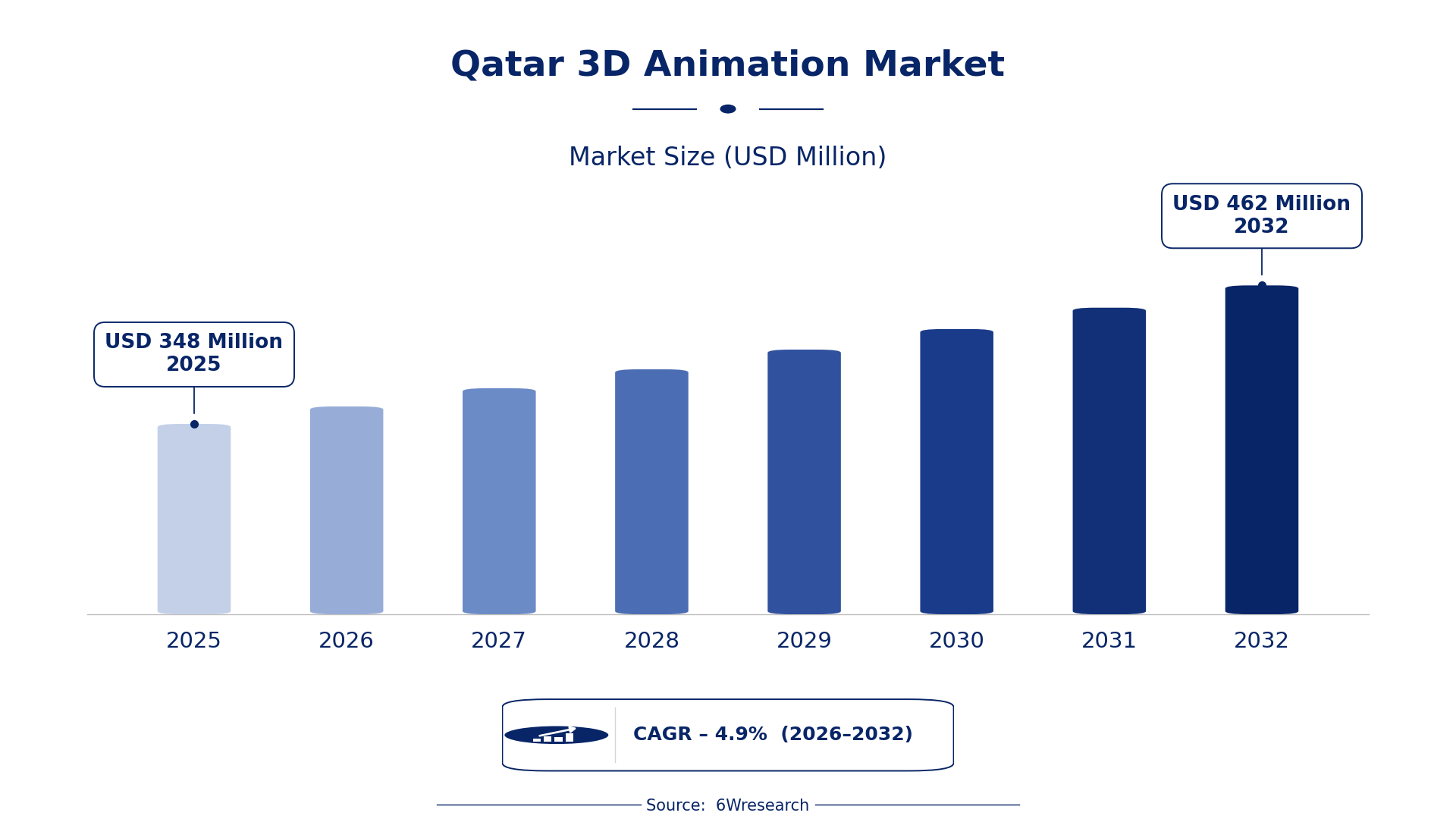
The Qatar 3D Animation Market was estimated at USD 348 Million in 2025 and is projected to reach USD 462 Million by 2032, growing at a CAGR of 4.9% from 2026 to 2032.
Qatar 3D Animation Market Synopsis
The Qatar 3D Animation Market has seen remarkable progress, fueled by the escalating demand for innovative visual content across multiple sectors. As the industry evolves, there is a clear trajectory towards more sophisticated applications, particularly in entertainment, education, and advertising.
Looking ahead, the market is set to embrace advancements in technology, such as virtual reality and augmented reality. The increasing appetite for immersive experiences will drive further growth, compelling businesses to refine their offerings and invest in cutting-edge animation solutions.
Qatar 3D Animation Market Year-wise Growth Rate and Key Drivers
This graph illustrates the annual growth rates of the Qatar 3D Animation Market from 2021 to 2032, highlighting a steady upward trajectory and projected expansion over the forecast period.
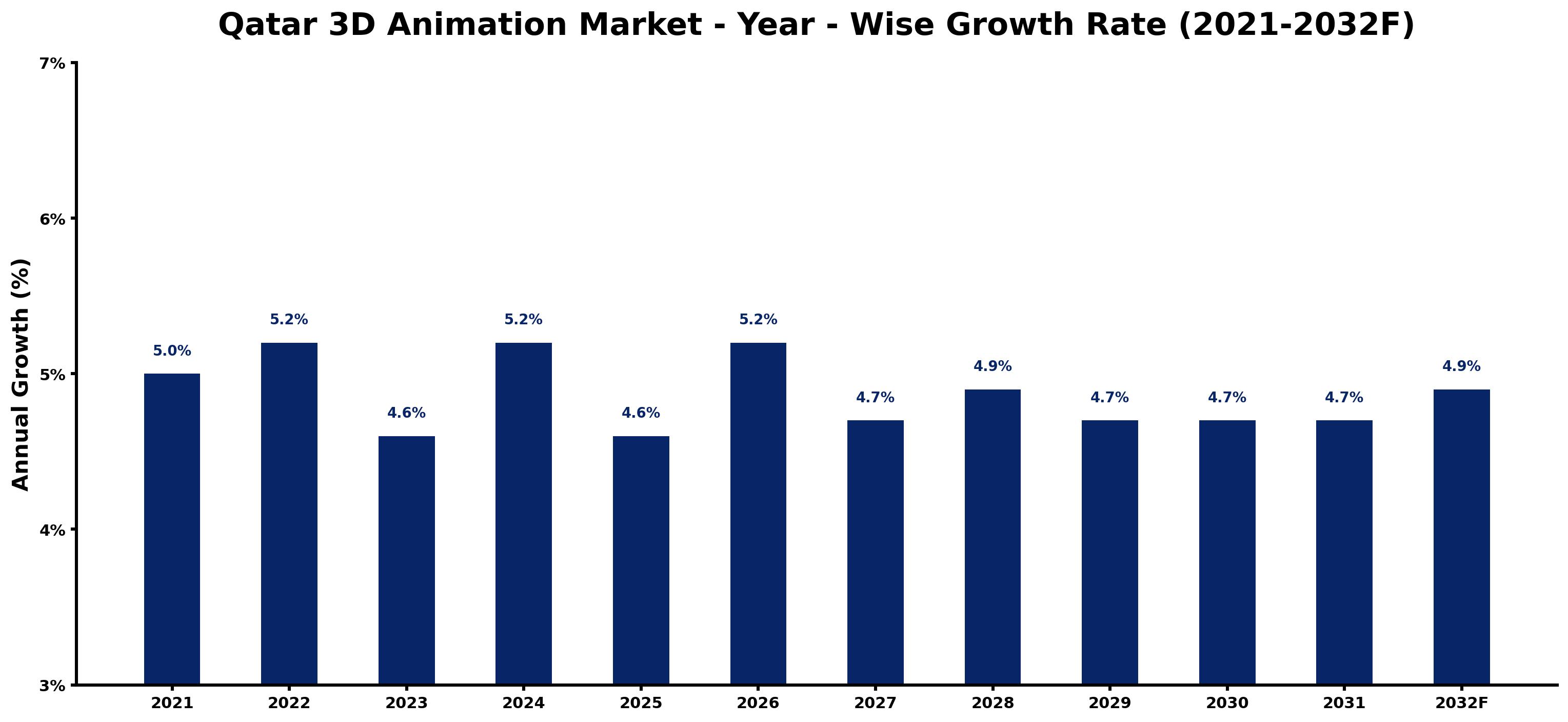
The table below presents the year‑wise growth rates along with the key drivers influencing the market
| Year | Growth Rate | Major Drivers |
| 2021 | 5.0% | Qatar National Vision 2030 supporting creative sector growth. |
| 2022 | 5.2% | Increased investment in digital content by Qatar Media Corporation. |
| 2023 | 4.6% | Growing popularity of animated cultural storytelling among youth. |
| 2024 | 5.2% | Qatar hosting international film festivals showcasing local animation. |
| 2025 | 4.6% | Educational institutions implementing animation programs for skill development. |
| 2026 | 5.2% | Local demand for animation in region's advertising campaigns. |
| 2027 | 4.7% | Rising partnerships with global animation studios in Qatar. |
| 2028 | 4.9% | Government funding for tech innovation boosting animation projects. |
| 2029 | 4.7% | Surge in production of animated series for television networks. |
| 2030 | 4.7% | Increased interest in virtual reality experiences utilizing animation. |
| 2031 | 4.7% | Adoption of animation technology in Qatar's tourism sector. |
| 2032 | 4.9% | Local collaborations enhancing quality of 3D animated films. |
Note: Market size estimations and growth projections presented in this report are based on 6Wresearch's proprietary forecasting methodology, utilizing the latest available industry data, government publications, and primary research inputs.
Qatar 3D Animation Market Key Takeaways
Below are some of the specific key takeaways from the market, including:
- The market is projected to grow from USD 348 Million in 2025 to USD 462 Million by 2032.
- Advancements in VR and AR technologies are reshaping the applications of 3D animation.
- Entertainment, particularly gaming and film, remains a dominant driver of market growth.
- There is a pressing need for skilled animators to meet the rising demand for quality content.
- Government initiatives are playing a crucial role in fostering the local animation industry.
Evaluation of Restraints in Qatar 3D Animation Market
Despite its growth, the Qatar 3D Animation Market faces several constraints. A shortage of skilled professionals hampers the ability to produce high-quality content that meets market expectations. on top of that, the technical demands for rendering realistic animations are increasing, creating barriers for companies that lack the necessary infrastructure and expertise. As the market matures, it will be imperative for stakeholders to address these challenges to maintain a competitive edge.
Qatar 3D Animation Market Trends
Several trends are shaping the Qatar 3D Animation Market. The integration of AI tools in animation workflows is streamlining production processes, allowing for faster turnaround times and enhanced creativity. Additionally, the rise of educational platforms leveraging 3D animation for interactive learning is creating new avenues for market expansion. The demand for personalized content is also gaining traction, pushing animators to develop tailored solutions that resonate with audiences.
Qatar 3D Animation Market Opportunities
The market is rife with opportunities, particularly for firms that can innovate within the realms of VR and AR. The application of 3D animation in sectors like healthcare for training simulations and in architecture for visualization is becoming increasingly valuable. on top of that, collaborations with educational institutions to create immersive learning experiences could yield substantial growth potential. Companies that position themselves strategically in these niches are likely to reap significant rewards.
Government Initiatives in the Qatar 3D Animation Market
The Qatari government is actively fostering the growth of the 3D animation sector through various initiatives. By prioritizing digital content creation and supporting innovation, the government aims to position Qatar as a hub for creativity and technology in the region. These efforts are crucial for establishing a favorable environment for local animators and attracting foreign investment.
- A recently completed initiative aimed at improving digital infrastructure to support creative industries.
- Current efforts are underway to establish a national animation festival that showcases local talent and innovations.
- A planned public-private partnership set to launch in 2026, focusing on developing training programs for aspiring animators.
- The introduction of grants for startups in the animation sector, encouraging new players to enter the market.
- A regulatory framework proposed to streamline licensing processes for animation studios, enhancing ease of doing business.
Future Insights of the Qatar 3D Animation Market
From 2026 to 2032, the Qatar 3D Animation Market is expected to evolve significantly. As consumer preferences shift towards more interactive and immersive experiences, businesses will need to adapt. The fusion of 3D animation with emerging technologies will likely create new products and services. Companies that embrace this change, invest in talent, and enhance their technological capabilities will be well-positioned to capitalize on the market’s growth.
Qatar 3D Animation Market Latest Developments
In the past year, the Qatar 3D Animation Market has experienced noteworthy activity, reflecting the industry's dynamic nature. The push for innovation has led to a series of collaborations and technological advancements that signal a promising future for local animators.
- A major technology vendor launched a new animation software suite aimed at streamlining production processes in early 2025.
- Ongoing partnerships between local universities and animation firms to develop specialized training programs for students.
- A leading regional operator is currently expanding its animation services, focusing on VR applications for educational content.
- Plans for an international animation conference scheduled for late 2026, designed to attract global talent and investors.
- A new initiative to support female animators in the industry, launched in Q1 2025, aims to increase diversity within the sector.
Qatar 3D Animation Market - Key Attractiveness of the Report
- 10 Years of Market Numbers
- Historical Data Starting from 2022 to 2025
- Base Year: 2025
- Forecast Data until 2032
- Key Performance Indicators Impacting the Market
- Major Upcoming Developments and Projects
Key Highlights of the Report:
- Qatar 3D Animation Market Outlook
- Market Size of Qatar 3D Animation Market, 2025
- Forecast of Qatar 3D Animation Market, 2032
- Historical Data and Forecast of Qatar 3D Animation Revenues & Volume for the Period 2022-2032F
- Qatar 3D Animation Market Trend Evolution
- Qatar 3D Animation Market Drivers and Challenges
- Qatar 3D Animation Price Trends
- Qatar 3D Animation Porter's Five Forces
- Qatar 3D Animation Industry Life Cycle
- Historical Data and Forecast of Qatar 3D Animation Market Revenues & Volume By Technology for the Period 2022-2032F
- Historical Data and Forecast of Qatar 3D Animation Market Revenues & Volume By 3D Modeling for the Period 2022-2032F
- Historical Data and Forecast of Qatar 3D Animation Market Revenues & Volume By Motion Graphics for the Period 2022-2032F
- Historical Data and Forecast of Qatar 3D Animation Market Revenues & Volume By 3D Rendering for the Period 2022-2032F
- Historical Data and Forecast of Qatar 3D Animation Market Revenues & Volume By Visual Effects for the Period 2022-2032F
- Historical Data and Forecast of Qatar 3D Animation Market Revenues & Volume By Service for the Period 2022-2032F
- Historical Data and Forecast of Qatar 3D Animation Market Revenues & Volume By Consulting for the Period 2022-2032F
- Historical Data and Forecast of Qatar 3D Animation Market Revenues & Volume By Support and Maintenance for the Period 2022-2032F
- Historical Data and Forecast of Qatar 3D Animation Market Revenues & Volume By Integration and Deployment for the Period 2022-2032F
- Historical Data and Forecast of Qatar 3D Animation Market Revenues & Volume By Education and Training for the Period 2022-2032F
- Historical Data and Forecast of Qatar 3D Animation Market Revenues & Volume By Vertical for the Period 2022-2032F
- Historical Data and Forecast of Qatar 3D Animation Market Revenues & Volume By Media and Entertainment for the Period 2022-2032F
- Historical Data and Forecast of Qatar 3D Animation Market Revenues & Volume By Construction and Architecture for the Period 2022-2032F
- Historical Data and Forecast of Qatar 3D Animation Market Revenues & Volume By Healthcare and Lifesciences for the Period 2022-2032F
- Historical Data and Forecast of Qatar 3D Animation Market Revenues & Volume By Manufacturing for the Period 2022-2032F
- Historical Data and Forecast of Qatar 3D Animation Market Revenues & Volume By Education and Academia for the Period 2022-2032F
- Historical Data and Forecast of Qatar 3D Animation Market Revenues & Volume By Others for the Period 2022-2032F
- Historical Data and Forecast of Qatar 3D Animation Market Revenues & Volume By Deployment for the Period 2022-2032F
- Historical Data and Forecast of Qatar 3D Animation Market Revenues & Volume By On-Premises for the Period 2022-2032F
- Historical Data and Forecast of Qatar 3D Animation Market Revenues & Volume By On-Demand for the Period 2022-2032F
- Qatar 3D Animation Import Export Trade Statistics
- Market Opportunity Assessment By Technology
- Market Opportunity Assessment By Service
- Market Opportunity Assessment By Vertical
- Market Opportunity Assessment By Deployment
- Qatar 3D Animation Top Companies Market Share
- Qatar 3D Animation Competitive Benchmarking By Technical and Operational Parameters
- Qatar 3D Animation Company Profiles
- Qatar 3D Animation Key Strategic Recommendations






































