Qatar 3D Printed Eyewear Market (2026-2032) | Revenue, Forecast, Investment Trends, Analysis, Pricing Analysis, Segments, Growth, Strategic Insights, Demand, Competitive, Trends, Share, Drivers, Restraints, Value, Opportunities, Size, Strategy, Competition, Outlook, Supply, Consumer Insights, Challenges, Segmentation, Companies, Industry
Market Forecast By Material Type (Nylon, Metal, Resins, Others), By Technology (SLS, SLA, Multi Jet Fusion, DLP, FDM), By Application (Sunglasses, Optical Glasses, Sports Glasses, Safety glasses) And Competitive Landscape
| Product Code: ETC11536995 | Publication Date: Apr 2025 | Updated Date: Jun 2026 | Product Type: Market Research Report | |
| Publisher: 6Wresearch | Author: Bhawna Singh | No. of Pages: 65 | No. of Figures: 34 | No. of Tables: 19 |
Qatar 3D Printed Eyewear Market Growth Rate
According to 6Wresearch internal database and industry insights, the Qatar 3D Printed Eyewear Market is projected to grow at a compound annual growth rate (CAGR) of 10.1% during the forecast period (2026–2032).
Qatar 3D Printed Eyewear Market Year-wise Growth Rate and Key Drivers
This graph highlights how the Qatar 3D Printed Eyewear Market has steadily grown over the past five years, supported by major growth factors.
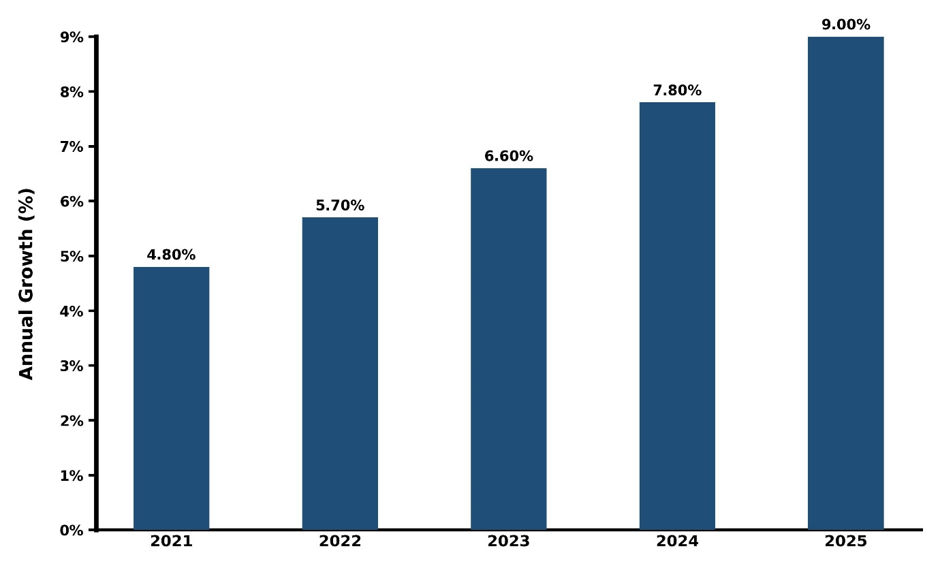
Below mentioned are the evaluation of year-wise growth rate along with key drivers:
| Year | Est. Annual Growth (%) | Growth Drivers |
| 2021 | 4.8% | Development of localized eyewear ecosystems where designers co-create frame designs through digital platforms that are collaborative. |
| 2022 | 5.7% | Fashion where eyewear is personalised for lifestyle-specific activities is gaining momentum. |
| 2023 | 6.6% | Incorporation of sensor-ready 3D printed frames for smart eyewear. |
| 2024 | 7.8% | Advancement of modular eyewear systems helping consumers to personalise not just colors and sizes, but optical features as well. |
| 2025 | 9% | Increase in number of micro-manufacturing hubs in Qatar. |
Topics Covered in the Qatar 3D Printed Eyewear Market Report
The report covers the market by material type, technology and application. It provides a detailed analysis of market trends, growth drivers, opportunities, and challenges influencing the eyewear ecosystem in Qatar.
Qatar 3D Printed Eyewear Market Highlights
| Report Name | Qatar 3D Printed Eyewear Market |
| Forecast period | 2026-2032 |
| CAGR | 10.1% |
| Growing Sector | Eyewear, Fashion Tech & Sports Equipment |
Qatar 3D Printed Eyewear Market Synopsis
The Qatar 3D Printed Eyewear Market is emerging into a dynamic consumer-driven ecosystem where eyewear is more than a functional accessory. It becomes a platform for lifestyle integration, wearable intelligence, and modular design innovation. For adapting to user activity, environmental conditions, and aesthetic preference, Local designers, micro-manufacturers, and collaborative studios are taking advantage of 3D printing to produce frames. Advanced materials and multi-layered printing techniques are helping in sensor-ready and adaptive eyewear, bridging fashion, health, and performance.
Evaluation of Growth Drivers in Qatar 3D Printed Eyewear Market (2026–2032)
Below are some major drivers and their influence on the Qatar 3D Printed Eyewear Market dynamics:
| Drivers | Primary Segment Affected | Why It Matters (Evidence) |
| Collaborative Design Ecosystems | Optical & Sunglasses | Platforms enabling designers and consumers to co-create eyewear are driving new product diversity and market engagement. |
| Adaptive Performance Frames | Sports Glasses | Eyewear that adjusts to environmental conditions, motion, or activity type enhances comfort, functionality, and sports performance. |
| Modular & Reconfigurable Systems | All Segments | Now, users can personalise through frames crafted with interchangeable components. |
| Integration of Wearable Technology | Sunglasses & Optical | Sensor-enabled eyewear provide new interactive experiences. |
| Localized On-Demand Manufacturing | Safety & Optical | Reliability on global supply chains owing to decreases micro-manufacturing hubs. |
The Qatar 3D Printed Eyewear Market is expected to experience robust growth at a CAGR of 10.1% during 2026–2032. It is accelerated not just through by technological adoption but also via fundamental transformation of how eyewear is designed, produced, and experienced. Modular and adaptive eyewear systems is also assisting the market to grow. This permit users to modulate optical features, frame components, or lens types to suit different activities. This is from sports and industrial applications to digital device usage.
Evaluation of Restraints in Qatar 3D Printed Eyewear Market (2026–2032)
Below are some major restraints and their influence on the Qatar 3D Printed Eyewear Market dynamics:
| Restraints | Primary Segment Affected | What This Means (Evidence) |
| Innovation Adoption Lag | Optical & Premium Eyewear | Traditional eyewear companies may hesitate to embrace modular, sensor-integrated, or adaptive frame designs, slowing market transformation and delaying new product introductions. |
| Fragmented Design Ecosystem | All Segments | Lack of cohesive collaboration platforms between designers, engineers, and consumers creates inefficiencies in co-creation workflows and limits the potential of hyper-personalized eyewear. |
| Regulatory & Certification Bottlenecks | Safety & Industrial Glasses | Complex compliance needs are faced by evolving multifunctional frames with AR. |
| Infrastructure & Resource Gaps | All Segments | In few hubs, high-end 3D printing equipment are highly concentrated. |
| Complexity of Multi-Material Production | Modular & Smart Frames | Advanced workflow coordination is required for producing frames. |
Qatar 3D Printed Eyewear Market Challenges
The Qatar 3D Printed Eyewear Industry is navigating a landscape of complex systemic and innovation-driven challenges. One of the leading complications is the integration of multifunctional, adaptive, and sensor-ready frames into existing manufacturing workflows. This needs a deep association between design innovation, materials science, and hardware capabilities and another challenge is the division of local design and production ecosystems. As startups and established brands must coordinate across micro-manufacturing hubs, software platforms, and consumer feedback channels to bring hyper-personalized eyewear to market.
Qatar 3D Printed Eyewear Market Trends
The following are key trends that influence the Qatar 3D Printed Eyewear Market:
- Co-Creation & Participatory Design Platforms: The market is transitioning to interactive ecosystem from a manufacturer-driven model.
- Adaptive & Smart Eyewear Integration: For urban and industrial applications, 3D printed frames are highly creating multifunctional products by catering as a platform for AR-enabled interfaces.
- Localized Micro-Manufacturing Hubs: On-demand production centres in Qatar are assisting in enabling hyper-localized, sustainable manufacturing.
- Modular & Reconfigurable Frame Systems: Lenses, temples, and other frame elements can be swapped or upgraded as eyewear is emerging into modular platforms.
Investment Opportunities in the Qatar 3D Printed Eyewear Market
Certain possible investment opportunities available in the Qatar 3D Printed Eyewear Market are listed below:
- Collaborative Design & Innovation Hubs: Experimentation with modular designs, smart features, and high-performance materials is necessary, hence, launching studios will help designers, engineers, and consumers to co-create frames which helps to necessitate this.
- Advanced Material & Functional R&D Labs: Adaptive and smart eyewear helps in providing to premium, sports, and industrial segments, hence, Money allocation in research for biocompatible, lightweight, hybrid composites and embedded electronics is highly necessary.
- Integrated Digital-to-Physical Platforms: Create end-to-end AR/AI retail platforms that permit consumers to virtually customize eyewear and simulate performance features.
Top 5 Leading Players in Qatar 3D Printed Eyewear Market
Below is a list of prominent companies dominating the Qatar 3D Printed Eyewear Market:
Materialise NV
| Company Name | Materialise NV |
| Established Year | 1990 |
| Headquarters | Belgium |
| Official Website | Click Here |
Materialise NV is a leading player providing 3D printing software and services to the eyewear industry, enabling the production of complex, customized, and lightweight frames for both premium and optical segments.
2. Monoqool ApS
| Company Name | Monoqool ApS |
| Established Year | 2004 |
| Headquarters | Denmark |
| Official Website | Click Here |
Monoqool ApS is known for minimalistic, ultra-lightweight 3D printed frames, offering high-tech, comfortable alternatives to conventional eyewear designs with a focus on innovation and wearer ergonomics.
3. MYKITA GmbH
| Company Name | MYKITA GmbH |
| Established Year | 2003 |
| Headquarters | Berlin, Germany |
| Official Website | Click Here |
MYKITA has an expertise in high-performance, luxury eyewear, leveraging proprietary 3D printing techniques to produce fully customized, premium designs for discerning consumers.
4. Safilo Group S.p.A.
| Company Name | Safilo Group S.p.A. |
| Established Year | 1934 |
| Headquarters | Italy |
| Official Website | Click Here |
Safilo Group incorporates 3D printing into its manufacturing processes, focusing on sustainable and innovative eyewear solutions that cater to modern fashion and functional requirements.
5. Hoet (Raytech)
| Company Name | Hoet (Raytech) |
| Established Year | 1998 |
| Headquarters | Netherlands |
| Official Website | Click Here |
Hoet (Raytech) specializes in metal 3D printing, producing high-end titanium frames that merge customized fits with unique, luxury designs for premium eyewear markets.
Government Initiatives Introduced in The Qatar 3D Printed Eyewear Market
According to Qatar’s government data, they are positioning the country as a regional innovation hub for additive manufacturing and next-generation eyewear design. They are concentrating on building integrated design-production ecosystems rather than just supporting isolated companies. The Qatar National Vision 2030 focusses on knowledge-driven industries. This helps in supporting modular, adaptive, and smart product development as the knowledge driven industries focusses on creating a regulatory and infrastructural environment. micro-manufacturing hubs are facilitated by programs under the Qatar Science & Technology Park and the Qatar Free Zones Authority.
Future Insights of the Qatar 3D Printed Eyewear Market
The Qatar 3D Printed Eyewear Market Growth is projected increase, and the industry will evolve into a dynamic, consumer-centric innovation ecosystem over the next decade. Beyond lightweight materials and hybrid manufacturing, the future growth trajectory is estimated to be propelled by modular and adaptive eyewear systems, smart and sensor-enabled frames, and fully personalized digital-to-physical experiences. Niche revenue streams are concentrating on lifestyle-specific and performance-driven eyewear will be created through growth in premium sports, industrial, and optical segments.
Market Segmentation Analysis
This report offers a comprehensive study of the following market segments and their leading categories:
By Material – Nylon Dominates the Market
According to Vasudha, Senior Research Analyst, 6Wresearch, by material, Nylon dominated with 42% share of the Qatar 3D Printed Eyewear Market in 2025, while Thermoplastic Polyurethane (TPU) is projected to expand at a 10.8% CAGR during 2026–2032, driven by lightweight, durable, and sustainable applications across optical and sports eyewear.
By Technology – Selective Laser Sintering (SLS) Leads the Market
By technology, SLS leads the Qatar 3D Printed Eyewear Market Share with 38% share in 2025, while Multi Jet Fusion (MJF) is projected to grow at an 11.2% CAGR during 2026–2032, supported by high precision, complex geometry capabilities, and efficient production for multi-material eyewear designs.
By Application – Sunglasses to Lead the Market
By application, Sunglasses dominated with 35% share in 2025, while Optical Glasses are projected to expand at a 10.5% CAGR during 2026–2032, fueled by growing demand for fashion-forward designs, customizable lenses, and premium lifestyle eyewear adoption.
Note: Market size and growth projections are calculated using 6Wresearch’s advanced research and forecasting methodology.
Key Attractiveness of the Report:
- 10 Years of Market Numbers
- Historical Data Starting from 2022 to 2025
- Base Year: 2025
- Forecast Data until 2032
- Key Performance Indicators Impacting the Market
- Major Upcoming Developments and Projects
Key Highlights of the Report:
- Qatar 3D Printed Eyewear Market Outlook
- Market Size of Qatar 3D Printed Eyewear Market, 2025
- Forecast of Qatar 3D Printed Eyewear Market, 2032
- Historical Data and Forecast of Qatar 3D Printed Eyewear Revenues & Volume for the Period 2022-2032
- Qatar 3D Printed Eyewear Market Trend Evolution
- Qatar 3D Printed Eyewear Market Drivers and Challenges
- Qatar 3D Printed Eyewear Price Trends
- Qatar 3D Printed Eyewear Porter's Five Forces
- Qatar 3D Printed Eyewear Industry Life Cycle
- Historical Data and Forecast of Qatar 3D Printed Eyewear Market Revenues & Volume By Material Type for the Period 2022-2032
- Historical Data and Forecast of Qatar 3D Printed Eyewear Market Revenues & Volume By Nylon for the Period 2022-2032
- Historical Data and Forecast of Qatar 3D Printed Eyewear Market Revenues & Volume By Metal for the Period 2022-2032
- Historical Data and Forecast of Qatar 3D Printed Eyewear Market Revenues & Volume By Resins for the Period 2022-2032
- Historical Data and Forecast of Qatar 3D Printed Eyewear Market Revenues & Volume By Others for the Period 2022-2032
- Historical Data and Forecast of Qatar 3D Printed Eyewear Market Revenues & Volume By Technology for the Period 2022-2032
- Historical Data and Forecast of Qatar 3D Printed Eyewear Market Revenues & Volume By SLS for the Period 2022-2032
- Historical Data and Forecast of Qatar 3D Printed Eyewear Market Revenues & Volume By SLA for the Period 2022-2032
- Historical Data and Forecast of Qatar 3D Printed Eyewear Market Revenues & Volume By Multi Jet Fusion for the Period 2022-2032
- Historical Data and Forecast of Qatar 3D Printed Eyewear Market Revenues & Volume By DLP for the Period 2022-2032
- Historical Data and Forecast of Qatar 3D Printed Eyewear Market Revenues & Volume By FDM for the Period 2021 - 2031
- Historical Data and Forecast of Qatar 3D Printed Eyewear Market Revenues & Volume By Application for the Period 2022-2032
- Historical Data and Forecast of Qatar 3D Printed Eyewear Market Revenues & Volume By Sunglasses for the Period 2022-2032
- Historical Data and Forecast of Qatar 3D Printed Eyewear Market Revenues & Volume By Optical Glasses for the Period 2022-2032
- Historical Data and Forecast of Qatar 3D Printed Eyewear Market Revenues & Volume By Sports Glasses for the Period 2022-2032
- Historical Data and Forecast of Qatar 3D Printed Eyewear Market Revenues & Volume By Safety glasses for the Period 2022-2032
- Qatar 3D Printed Eyewear Import Export Trade Statistics
- Market Opportunity Assessment By Material Type
- Market Opportunity Assessment By Technology
- Market Opportunity Assessment By Application
- Qatar 3D Printed Eyewear Top Companies Market Share
- Qatar 3D Printed Eyewear Competitive Benchmarking By Technical and Operational Parameters
- Qatar 3D Printed Eyewear Company Profiles
- Qatar 3D Printed Eyewear Key Strategic Recommendations
Market Covered
The report offers a comprehensive study of the following Qatar 3D Printed Electronics Market segments:
By Component Type
- Sensors
- Antennas
- Circuit Boards
- Others
By Application
- Aerospace
- Automotive
- Consumer Electronics
- Others
By Material
- Metals
- Conductive Inks
- Others
By End User
- Medical
- Consumer
- Industrial
Qatar 3D Printed Eyewear Market (2026-2032) : FAQs
The Qatar 3D Printed Eyewear Market is projected to grow at a CAGR of 10.1% during the forecast period.
Key drivers include personalization demand, adoption of lightweight and durable materials, integration of AR/VR technologies.
The Qatari government promotes additive manufacturing through the Qatar National Vision 2030, Qatar Science & Technology Park.
Investment opportunities include premium sunglasses, customized optical frames, sports eyewear, advanced material development and AR-enabled retail platforms.
6Wresearch actively monitors the Qatar 3D Printed Eyewear Market and publishes its comprehensive annual report, highlighting emerging trends, growth drivers, revenue analysis, and forecast outlook. Our insights help businesses to make data-backed strategic decisions with ongoing market dynamics. Our analysts track relevent industries related to the Qatar 3D Printed Eyewear Market, allowing our clients with actionable intelligence and reliable forecasts tailored to emerging regional needs.
Yes, we provide customisation as per your requirements. To learn more, feel free to contact us on sales@6wresearch.com
| 1 Executive Summary |
| 2 Introduction |
| 2.1 Key Highlights of the Report |
| 2.2 Report Description |
| 2.3 Market Scope & Segmentation |
| 2.4 Research Methodology |
| 2.5 Assumptions |
| 3 Qatar 3D Printed Eyewear Market Overview |
| 3.1 Qatar Country Macro Economic Indicators |
| 3.2 Qatar 3D Printed Eyewear Market Revenues & Volume, 2022 & 2032F |
| 3.3 Qatar 3D Printed Eyewear Market - Industry Life Cycle |
| 3.4 Qatar 3D Printed Eyewear Market - Porter's Five Forces |
| 3.5 Qatar 3D Printed Eyewear Market Revenues & Volume Share, By Material Type, 2022 & 2032F |
| 3.6 Qatar 3D Printed Eyewear Market Revenues & Volume Share, By Technology, 2022 & 2032F |
| 3.7 Qatar 3D Printed Eyewear Market Revenues & Volume Share, By Application, 2022 & 2032F |
| 4 Qatar 3D Printed Eyewear Market Dynamics |
| 4.1 Impact Analysis |
| 4.2 Market Drivers |
| 4.2.1 Technological advancements in 3D printing technology leading to more efficient and customizable eyewear production. |
| 4.2.2 Growing trend towards personalized and unique fashion accessories. |
| 4.2.3 Increasing awareness about sustainable and eco-friendly manufacturing processes in the eyewear industry. |
| 4.3 Market Restraints |
| 4.3.1 High initial investment costs associated with setting up 3D printing infrastructure. |
| 4.3.2 Limited availability of skilled professionals with expertise in both eyewear design and 3D printing technology. |
| 4.3.3 Concerns regarding the durability and quality of 3D printed eyewear compared to traditional manufacturing methods. |
| 5 Qatar 3D Printed Eyewear Market Trends |
| 6 Qatar 3D Printed Eyewear Market, By Types |
| 6.1 Qatar 3D Printed Eyewear Market, By Material Type |
| 6.1.1 Overview and Analysis |
| 6.1.2 Qatar 3D Printed Eyewear Market Revenues & Volume, By Material Type, 2022 - 2032F |
| 6.1.3 Qatar 3D Printed Eyewear Market Revenues & Volume, By Nylon, 2022 - 2032F |
| 6.1.4 Qatar 3D Printed Eyewear Market Revenues & Volume, By Metal, 2022 - 2032F |
| 6.1.5 Qatar 3D Printed Eyewear Market Revenues & Volume, By Resins, 2022 - 2032F |
| 6.1.6 Qatar 3D Printed Eyewear Market Revenues & Volume, By Others, 2022 - 2032F |
| 6.2 Qatar 3D Printed Eyewear Market, By Technology |
| 6.2.1 Overview and Analysis |
| 6.2.2 Qatar 3D Printed Eyewear Market Revenues & Volume, By SLS, 2022 - 2032F |
| 6.2.3 Qatar 3D Printed Eyewear Market Revenues & Volume, By SLA, 2022 - 2032F |
| 6.2.4 Qatar 3D Printed Eyewear Market Revenues & Volume, By Multi Jet Fusion, 2022 - 2032F |
| 6.2.5 Qatar 3D Printed Eyewear Market Revenues & Volume, By DLP, 2022 - 2032F |
| 6.2.6 Qatar 3D Printed Eyewear Market Revenues & Volume, By FDM, 2022 - 2032F |
| 6.3 Qatar 3D Printed Eyewear Market, By Application |
| 6.3.1 Overview and Analysis |
| 6.3.2 Qatar 3D Printed Eyewear Market Revenues & Volume, By Sunglasses, 2022 - 2032F |
| 6.3.3 Qatar 3D Printed Eyewear Market Revenues & Volume, By Optical Glasses, 2022 - 2032F |
| 6.3.4 Qatar 3D Printed Eyewear Market Revenues & Volume, By Sports Glasses, 2022 - 2032F |
| 6.3.5 Qatar 3D Printed Eyewear Market Revenues & Volume, By Safety glasses, 2022 - 2032F |
| 7 Qatar 3D Printed Eyewear Market Import-Export Trade Statistics |
| 7.1 Qatar 3D Printed Eyewear Market Export to Major Countries |
| 7.2 Qatar 3D Printed Eyewear Market Imports from Major Countries |
| 8 Qatar 3D Printed Eyewear Market Key Performance Indicators |
| 8.1 Number of new 3D printing technologies adopted in the Qatar eyewear market. |
| 8.2 Percentage of consumers opting for personalized 3D printed eyewear over traditional options. |
| 8.3 Rate of growth in the adoption of sustainable practices in the Qatar eyewear industry. |
| 9 Qatar 3D Printed Eyewear Market - Opportunity Assessment |
| 9.1 Qatar 3D Printed Eyewear Market Opportunity Assessment, By Material Type, 2022 & 2032F |
| 9.2 Qatar 3D Printed Eyewear Market Opportunity Assessment, By Technology, 2022 & 2032F |
| 9.3 Qatar 3D Printed Eyewear Market Opportunity Assessment, By Application, 2022 & 2032F |
| 10 Qatar 3D Printed Eyewear Market - Competitive Landscape |
| 10.1 Qatar 3D Printed Eyewear Market Revenue Share, By Companies, 2025 |
| 10.2 Qatar 3D Printed Eyewear Market Competitive Benchmarking, By Operating and Technical Parameters |
| 11 Company Profiles |
| 12 Recommendations |
| 13 Disclaimer |
Global Go To Market Strategy - 2030
Export potential enables firms to identify high-growth global markets with greater confidence by combining advanced trade intelligence with a structured quantitative methodology. The framework analyzes emerging demand trends and country-level import patterns while integrating macroeconomic and trade datasets such as GDP and population forecasts, bilateral import–export flows, tariff structures, elasticity differentials between developed and developing economies, geographic distance, and import demand projections. Using weighted trade values from 2020–2024 as the base period to project country-to-country export potential for 2030, these inputs are operationalized through calculated drivers such as gravity model parameters, tariff impact factors, and projected GDP per-capita growth. Through an analysis of hidden potentials, demand hotspots, and market conditions that are most favorable to success, this method enables firms to focus on target countries, maximize returns, and global expansion with data, backed by accuracy.
By factoring in the projected importer demand gap that is currently unmet and could be potential opportunity, it identifies the potential for the Exporter (Country) among 190 countries, against the general trade analysis, which identifies the biggest importer or exporter.
To discover high-growth global markets and optimize your business strategy:
Click Here
Pricing
- Single User License$ 1,995
- Department License$ 2,400
- Site License$ 3,120
- Global License$ 3,795

Leadership Perspectives from Industry Events
Search
Thought Leadership and Analyst Meet





Our Clients








6WResearch In News
- India Export Attractiveness Tracker 2026
- India Air Conditioner Market Set for Strong Rebound in 2026 After Weather-Led Correction and GST-Driven Recovery: 6Wresearch
- ADAS in India: How Automatic Emergency Braking, Blind Spot Detection & Driver Monitoring are Transforming Road Safety
- Doha a strategic location for EV manufacturing hub: IPA Qatar
- Demand for luxury TVs surging in the GCC, says Samsung
- Empowering Growth: The Thriving Journey of Bangladesh’s Cable Industry
Latest Reports
- Nicaragua RPG Gaming Market (2026-2032)
- New Zealand RPG Gaming Market (2026-2032)
- Netherlands RPG Gaming Market (2026-2032)
- Nauru RPG Gaming Market (2026-2032)
- Namibia RPG Gaming Market (2026-2032)
- Mozambique RPG Gaming Market (2026-2032)
- Montenegro RPG Gaming Market (2026-2032)
- Mongolia RPG Gaming Market (2026-2032)
- Monaco RPG Gaming Market (2026-2032)
- Micronesia RPG Gaming Market (2026-2032)
Industry Events and Analyst Meet

EV India Expo 2026

HIMTEX 2026

India Refining Summit 2026

India EV Show 2026

EV tech India Expo 2026
Whitepaper
- Middle East & Africa Commercial Security Market Click here to view more.
- Middle East & Africa Fire Safety Systems & Equipment Market Click here to view more.
- GCC Drone Market Click here to view more.
- Middle East Lighting Fixture Market Click here to view more.
- GCC Physical & Perimeter Security Market Click here to view more.


