Qatar Abscess Market Growth Rate
According to 6Wresearch internal databases and industry insights, the Qatar Abscess Market is projected to expand at a steady CAGR of 3.6% during the forecast period 2026–2032.
Qatar Abscess Market Year-wise Growth Rate and Key Drivers
The following table presents historical and forecasted growth trends of the Qatar Abscess Market from 2021 to 2032, reflecting gradual but stable expansion driven by healthcare infrastructure modernization and infection control initiatives.
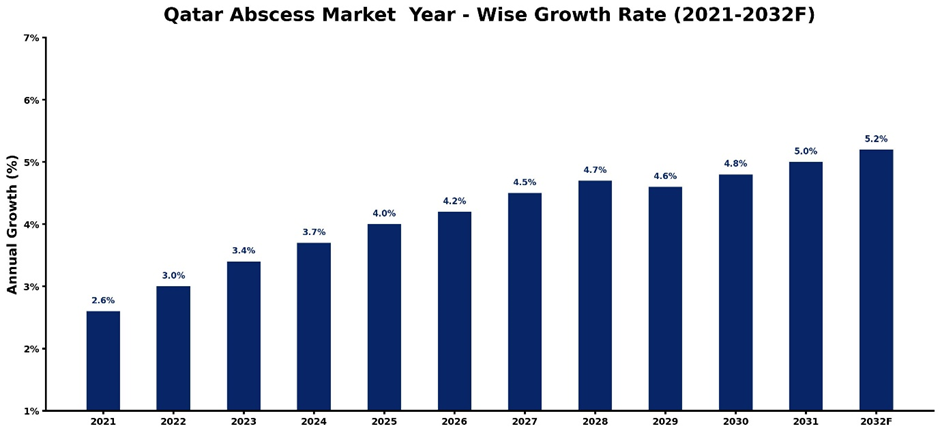
The following table summarizes the historical and forecasted growth rates of the
Qatar Abscess Market, along with the rationale behind each year’s performance.
| Year | Estimated Growth (%) | Market Rationale |
| 2021 | 2.6% | Post-pandemic stabilization in elective procedures |
| 2022 | 3% | Recovery in hospital admissions and surgical care |
| 2023 | 3.4% | Rising infectious complications in chronic patients |
| 2024 | 3.7% | Expansion of emergency and surgical units |
| 2025 | 4% | Increased imaging-based abscess detection |
| 2026 | 4.2% | Early adoption of minimally invasive drainage |
| 2027 | 4.5% | Growth in hospital infection surveillance systems |
| 2028 | 4.7% | Rising diabetes-linked soft tissue infections |
| 2029 | 4.6% | Improved outpatient antibiotic stewardship |
| 2030 | 4.8% | Expansion of tertiary care surgical centers |
| 2031 | 5% | Higher uptake of image-guided procedures |
| 2032 | 5.2% | Consolidation of advanced infection management protocols |
Topics Covered in the Qatar Abscess Market Report
The Qatar Abscess Industry report covers the market by infection type, treatment modality, and patient demographic segments. It provides detailed insights into evolving infectious disease patterns, hospital infection control practices, and advancements in minimally invasive drainage and antibiotic therapies shaping demand across the country.
Qatar Abscess Market Highlights
| Report Name | Qatar Abscess Market |
| Forecast period | 2026-2032 |
| CAGR | 3.6% |
| Growing Sector | Image-Guided Drainage Systems & Advanced Infectious Disease Management |
Qatar Abscess Market Synopsis
The Qatar Abscess Market describes to the ecosystem of diagnostic, therapeutic, and surgical solutions. It is used in the management of localized pus collections caused by bacterial infections in skin, internal organs, post-surgical sites, and oral cavities. Abscess formation is commonly associated with conditions such as diabetes, immunosuppression, trauma, and postoperative infections. In Qatar, advanced healthcare infrastructure, particularly tertiary hospitals, plays a major role in early diagnosis using ultrasound and CT imaging. They are followed by antibiotic therapy or drainage procedures and also, rising knowledge of infection control and swift access to emergency care is further solidifying the market landscape.
Evaluation of Growth Drivers in Qatar Abscess Market (2026–2032)
Below are some major drivers and their influence on the market dynamics:
| Drivers | Primary Segment Affected | Why It Matters (Evidence) |
| Rising diabetes prevalence | Skin & internal abscess | High glucose levels increase infection susceptibility |
| Expansion of tertiary hospitals | Hospitals/Clinics | Enhances surgical drainage and emergency care capacity |
| Increased imaging adoption | Internal abscess | CT/ultrasound improves early detection accuracy |
| Post-surgical infection rise | Surgical drainage segment | Growing surgical volumes increase complication risks |
| Antibiotic access improvement | Specialty pharmacies | Expands outpatient infection management |
The Qatar Abscess Market is projected to grow at a CAGR of 3.6% during 2026–2032, driven by increasing surgical procedures, higher incidence of metabolic disorders such as diabetes, and rapid expansion of hospital-based infectious disease management systems. This steady growth is further supported by rising adoption of advanced imaging techniques such as ultrasound and CT scans, which are improving early detection of deep-seated abscesses. In addition, the growing preference for minimally invasive drainage procedures is significantly reducing recovery time and hospital stay duration, thereby increasing overall treatment uptake.
Evaluation of Restraints in Qatar Abscess Market
Below are some major restraints and their influence on the market dynamics:
| Restraints | Primary Segment Affected | What This Means (Evidence) |
| Antibiotic resistance concerns | Antibiotic therapy | Reduced treatment effectiveness in recurrent cases |
| Delayed diagnosis in rural populations | Internal abscess | Late-stage complications increase treatment complexity |
| High procedural costs | Minimally invasive treatment | Limits adoption in cost-sensitive segments |
| Limited specialist availability | Pediatric/elderly care | Slower intervention in high-risk patients |
| Regulatory approval delays | New therapeutics | Slows introduction of advanced anti-infectives |
Qatar Abscess Market Challenges
The Qatar Abscess Industry faces challenges related to rising antimicrobial resistance, which complicates standard antibiotic therapy and increases dependency on surgical intervention. Additionally, early-stage abscess detection in deep tissue remains difficult without advanced imaging access. Workforce limitations in specialized infectious disease care and high treatment costs for minimally invasive procedures also restrict uniform market penetration across all patient groups. Limited access to advanced imaging modalities in certain care pathways can delay diagnosis, leading to disease progression and more invasive intervention requirements.
Qatar Abscess Market Trends
The following trends are pivotal in influencing the growth and evolution of the Qatar Abscess Market:
- Shift toward minimally invasive drainage techniques: Increasing preference for image-guided aspiration over open surgery is reducing recovery time and hospital stays.
- Rising adoption of point-of-care ultrasound: Enhances rapid diagnosis of soft tissue and internal abscesses in emergency settings, improving early intervention rates and reducing dependency on delayed radiology scheduling.
- Growing antibiotic stewardship programs: Hospitals are implementing controlled antibiotic usage to reduce resistance risks, ensuring more effective long-term treatment outcomes and preserving antibiotic efficacy.
- Expansion of outpatient infection management: Supports home-based antibiotic therapy and augments patient suitability while maintaining clinical monitoring standards.
Investment Opportunities in the Qatar Abscess Market
The following section captures the growing investment opportunities across the Qatar Abscess ecosystem:
- Expansion of image-guided drainage centers: Allocation of funds in radiology-assisted intervention units is rising owing to an increase in the number of diagnostic precision requirements.
- Development of advanced antibiotics: Prospects are present in novel anti-infective therapies targeting resistant bacterial strains.
- Specialty outpatient care clinics: Development in decentralized infection treatment facilities is producing new revenue channels.
Top 5 Leading Players in Qatar Abscess Market
The following section provides an overview of major companies active in the Qatar Abscess landscape:
1. Pfizer Inc.
| Company Name | Pfizer Inc. |
|---|---|
| Established Year | 1849 |
| Headquarters | New York, USA |
| Official Website | Click Here |
Pfizer Inc. is a worldwide pharmaceutical leader supplying a wide portfolio of broad-spectrum antibiotics and antimicrobial agents widely used in abscess treatment protocols.
2. Johnson & Johnson
| Company Name | Johnson & Johnson |
|---|---|
| Established Year | 1886 |
| Headquarters | New Jersey, USA |
| Official Website | Click Here |
Johnson & Johnson is a leading provider of advanced wound care solutions, surgical instruments, and abscess drainage kits.
3. Medtronic
| Company Name | Medtronic |
|---|---|
| Established Year | 1949 |
| Headquarters | Dublin, Ireland |
| Official Website | Click Here |
Medtronic is a prominent global supplier of surgical technologies and drainage systems used in abscess management.
4. Smith & Nephew
| Company Name | Smith & Nephew |
|---|---|
| Established Year | 1856 |
| Headquarters | London, United Kingdom |
| Official Website | Click Here |
Smith & Nephew specializes in advanced wound management and skin care solutions, catering dressings and infection-control products essential for abscess healing and post-surgical recovery in hospital and outpatient settings.
5. Abbott Laboratories
| Company Name | Abbott Laboratories |
|---|---|
| Established Year | 1888 |
| Headquarters | Illinois, USA |
| Official Website | Click Here |
Abbott Laboratories gives diagnostic tools, hospital supplies, and infection monitoring solutions that promote early detection and effective management of abscess-related complications, strengthening Qatar’s clinical diagnostic capabilities.
Government Initiatives in the Qatar Abscess Market
According to Qatar’s government data, they have implemented several healthcare strengthening initiatives to improve infection control and surgical care outcomes. Examples consist of the National Health Strategy 2024, which focuses on early infection detection, and hospital infection surveillance programs introduced in Hamad Medical facilities. Additionally, Qatar’s antimicrobial resistance containment program. It encourages rational antibiotic usage across public hospitals to reduce treatment failure rates in abscess cases and thus, these initiatives collectively encourage robust clinical governance, augmented patient safety, and standardized infection management practices nationwide.
Future Insights of the Qatar Abscess Market
The Qatar Abscess Market Growth is expected to improve. The market will progress toward highly technology-driven infection management systems, with increased reliance on AI-assisted diagnostics and minimally invasive interventions. Expansion of tertiary healthcare infrastructure and rising demand for outpatient care will further decentralize treatment delivery. Over the long term, precision medicine and targeted antibiotic therapies are expected to redefine clinical outcomes. Additionally, growing adoption of digital health platforms for infection tracking and post-treatment monitoring will enhance continuity of care and support earlier clinical decision-making.
Market Segmentation Analysis
The report offers a comprehensive study of the following market segments and their leading categories:
By Infection Type – Skin Abscess Leads Market, Internal Abscess Set for Steady Expansion
According to Sachin Kumar Rai, Senior Research Analyst, 6Wresearch, skin abscess dominated the Qatar Abscess Market with 38.6% share in 2025, driven by high prevalence of diabetic skin infections, trauma-related bacterial entry points, and faster diagnosis in outpatient settings. Conversely, internal abscess cases are projected to grow at a CAGR of 3.42% during 2026–2032, supported by rising imaging adoption and improved detection of deep-seated infections in abdominal and thoracic regions.
By Treatment Modality – Antibiotic Therapy Dominates, Minimally Invasive Approaches Accelerate
By treatment modality, antibiotic therapy accounted for 42.9% of the Qatar Abscess Market Share in 2025. It is owing to its broader usage as first-line management for early-stage and uncomplicated infections, and also minimally invasive drainage techniques are predicted to expand at a CAGR of 3.85% through 2032. It is proliferated by rising preference for image-guided procedures and reduced hospital stays.
By Patient Demographic – Adult Segment Leads, Elderly Population Shows Strong Growth
By patient demographic, the adult segment held a dominant 46.7% share of the Qatar Abscess Market in 2025. It is largely owing to higher exposure to post-surgical infections, and occupational injuries and the elderly population segment is projected to grow at a CAGR of 3.76% during 2026–2032. It is encouraged by higher immunosuppression risk and increased hospitalization rates.
Note: Market size estimations and growth projections presented in this report are based on 6Wresearch’s advanced forecasting approach, validated with industry datasets as of June 2026.
Key Attractiveness of the Report:
- 10 Years of Market Numbers
- Historical Data Starting from 2022 to 2025
- Base Year: 2025
- Forecast Data until 2032
- Key Performance Indicators Impacting the Market
- Major Upcoming Developments and Projects
Key Highlights of the Report:
- Qatar Abscess Market Outlook
- Market Size of Qatar Abscess Market, 2025
- Forecast of Qatar Abscess Market, 2032
- Historical Data and Forecast of Qatar Abscess Revenues & Volume for the Period 2022-2032
- Qatar Abscess Market Trend Evolution
- Qatar Abscess Market Drivers and Challenges
- Qatar Abscess Price Trends
- Qatar Abscess Porter's Five Forces
- Qatar Abscess Industry Life Cycle
- Historical Data and Forecast of Qatar Abscess Market Revenues & Volume By Infection Type for the Period 2022-2032
- Historical Data and Forecast of Qatar Abscess Market Revenues & Volume By Skin Abscess for the Period 2022-2032
- Historical Data and Forecast of Qatar Abscess Market Revenues & Volume By Internal Abscess for the Period 2022-2032
- Historical Data and Forecast of Qatar Abscess Market Revenues & Volume By Post-Surgical Abscess for the Period 2022-2032
- Historical Data and Forecast of Qatar Abscess Market Revenues & Volume By Dental Abscess for the Period 2022-2032
- Historical Data and Forecast of Qatar Abscess Market Revenues & Volume By Treatment Modality for the Period 2022-2032
- Historical Data and Forecast of Qatar Abscess Market Revenues & Volume By Antibiotic Therapy for the Period 2022-2032
- Historical Data and Forecast of Qatar Abscess Market Revenues & Volume By Surgical Drainage for the Period 2022-2032
- Historical Data and Forecast of Qatar Abscess Market Revenues & Volume By Minimally Invasive for the Period 2022-2032
- Historical Data and Forecast of Qatar Abscess Market Revenues & Volume By Combination Therapy for the Period 2022-2032
- Historical Data and Forecast of Qatar Abscess Market Revenues & Volume By Patient Demographic for the Period 2022-2032
- Historical Data and Forecast of Qatar Abscess Market Revenues & Volume By Pediatric/Adult for the Period 2022-2032
- Historical Data and Forecast of Qatar Abscess Market Revenues & Volume By Adult for the Period 2022-2032
- Historical Data and Forecast of Qatar Abscess Market Revenues & Volume By Elderly for the Period 2022-2032
- Historical Data and Forecast of Qatar Abscess Market Revenues & Volume By All Ages for the Period 2022-2032
- Qatar Abscess Import Export Trade Statistics
- Market Opportunity Assessment By Infection Type
- Market Opportunity Assessment By Treatment Modality
- Market Opportunity Assessment By Patient Demographic
- Qatar Abscess Top Companies Market Share
- Qatar Abscess Competitive Benchmarking By Technical and Operational Parameters
- Qatar Abscess Company Profiles
- Qatar Abscess Key Strategic Recommendations
Market Covered
The report offers an extensive study of the following market segments:
By Infection Type
- Skin Abscess
- Internal Abscess
- Post-Surgical Abscess
- Dental Abscess
By Treatment Modality
- Antibiotic Therapy
- Surgical Drainage
- Minimally Invasive Procedures
- Combination Therapy
By Patient Demographic
- Pediatric/Adult
- Adult
- Elderly
- All Ages






































