Qatar Acceleration And Yaw Rate Sensors Market (2026-2032) | Value, Companies, Growth, Share, Outlook, Forecast, Analysis, Industry, Competitive Landscape, Segmentation, Trends, Size & Revenue
Market Forecast By Application (Aerospace, Automotive (Passenger Cars, Light Commercial Vehicles, and Heavy Commercial Vehicles)), By Type (Piezoelectric, Micromechanical Type) And Competitive Landscape
| Product Code: ETC8898543 | Publication Date: Sep 2024 | Updated Date: Jul 2026 | Product Type: Market Research Report | |
| Publisher: 6Wresearch | Author: Sumit Sagar | No. of Pages: 70 | No. of Figures: 35 | No. of Tables: 5 |
Qatar Acceleration and Yaw Rate Sensors Market Growth Rate
According to 6Wresearch internal databases and industry insights, the Qatar Acceleration and Yaw Rate Sensors Market is projected to expand at a CAGR of 7.35% during 2026–2032.
Qatar Acceleration and Yaw Rate Sensors Market Year-wise Growth Rate and Key Drivers (2022-2032)
This graph illustrates the annual growth trajectory of the Qatar Acceleration and Yaw Rate Sensors Market from 2022 to 2032, highlighting a steady upward trajectory and projected market expansion over the forecast period.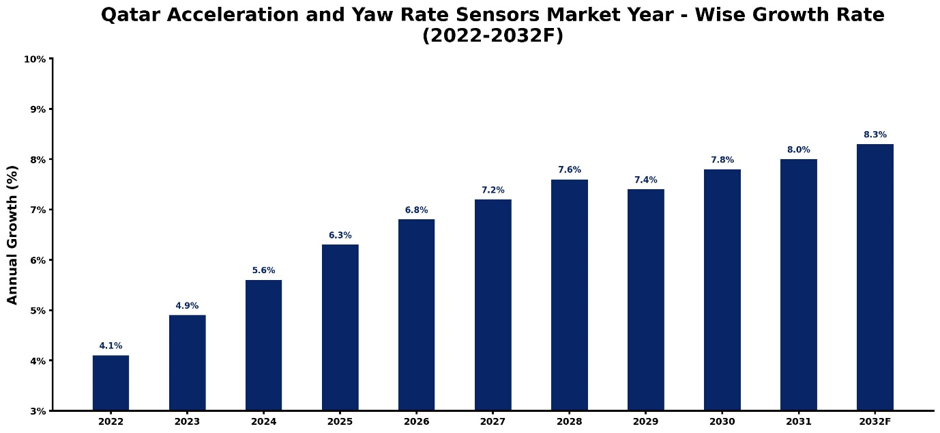 The following table summarizes the historical and forecasted growth rates of the Qatar Acceleration and Yaw Rate Sensors Market, along with the rationale behind each year’s performance.
| Year | Estimated Growth (%) | Market Rationale |
| 2022 | 4.1% | Rising integration of stability control systems |
| 2023 | 4.9% | Expansion of automotive safety regulations |
| 2024 | 5.6% | Growth in smart mobility infrastructure |
| 2025 | 6.3% | Increased MEMS sensor deployment in vehicles |
| 2026 | 6.8% | Strong automotive OEM demand and EV adoption |
| 2027 | 7.2% | Expansion of aerospace navigation upgrades |
| 2028 | 7.6% | Rising ADAS penetration in passenger cars |
| 2029 | 7.4% | Market stabilization with mature OEM integration |
| 2030 | 7.8% | Growth in autonomous driving pilot programs |
| 2031 | 8% | Higher sensor redundancy in safety-critical systems |
| 2032 | 8.3% | Mature smart mobility ecosystem |
Topics Covered in the Qatar Acceleration and Yaw Rate Sensors Market Report
The Qatar Acceleration and Yaw Rate Sensors Industry report covers the market by application and type. The report provides a detailed analysis of ongoing market trends, opportunities/high-growth areas, and market drivers that will help stakeholders align strategies based on current and future market dynamics.
Qatar Acceleration and Yaw Rate Sensors Market Highlights
| Report Name | Qatar Acceleration and Yaw Rate Sensors Market |
| Forecast Period | 2026–2032 |
| CAGR | 7.35% |
| Market Size by 2032 | USD 15.8 billion by 2032 |
| Growing Sector | Advanced Driver Assistance Systems (ADAS) & Aerospace Inertial Navigation Systems |
Qatar Acceleration and Yaw Rate Sensors Market Synopsis
The Qatar Acceleration and Yaw Rate Sensors Market comprise advanced motion detection components. They measure vehicle or aircraft linear acceleration and rotational movement around vertical axes, and these sensors are crucial for Electronic Stability Control (ESC), Anti-lock Braking Systems (ABS), Inertial Navigation Systems (INS), and ADAS platforms. Furthermore, persistent advancements in MEMS technology and the rising focus on vehicle safety regulations are supporting manufacturers to incorporate highly accurate, compact, and energy-efficient motion sensors across next-generation mobility solutions.
Evaluation of Growth Drivers in Qatar Acceleration and Yaw Rate Sensors Market (2026–2032)
Below are some major drivers and their influence on the market dynamics:
| Drivers | Primary Segment Affected | Why It Matters (Evidence) |
| Expansion of ADAS-enabled vehicles | Automotive (Passenger Cars) | Augments road safety |
| Aerospace modernization programs | Aerospace | For navigation accuracy, high-precision inertial sensors are needed. |
| EV adoption in GCC | Automotive (Passenger Cars, LCVs) | EV platforms depend largely on motion stability systems |
| Smart city transportation projects | Government & Infrastructure | Proliferates demand for real-time vehicle stability monitoring |
| Rising luxury vehicle imports | Passenger Cars | High-quality vehicles mandate yaw and acceleration sensors |
The Qatar Acceleration and Yaw Rate Sensors Market is projected to grow at a CAGR of 7.35% during 2026–2032. It is fortified by rising deployment of electronic stability systems, autonomous driving pilots, and aerospace-grade inertial navigation upgrades across the region. The rising prevalence of Advanced Driver Assistance Systems (ADAS) in passenger vehicles, along with increasing demand for premium automobiles equipped with advanced safety technologies, is expected to proliferate sensor adoption and the expansion of Qatar's aerospace sector is also expected to create sustained demand for high-performance inertial sensing solutions throughout the forecast period.
Evaluation of Restraints in Qatar Acceleration and Yaw Rate Sensors Market
Below are some major restraints and their influence on the market dynamics:
| Restraints | Primary Segment Affected | What This Means (Evidence) |
| High sensor replacement cost | Automotive Aftermarket | Limits adoption in low-cost vehicle segments |
| Dependence on imports | Industrial Supply Chain | Creates vulnerability in supply continuity |
| Harsh climate conditions | Automotive & Aerospace | Heat and dust reduce sensor lifespan reliability |
| Limited local manufacturing base | Government & Industry | Slows cost optimization and scaling |
| Calibration complexity | Aerospace Systems | Requires advanced technical expertise and increases operational cost |
Qatar Acceleration and Yaw Rate Sensors Market Challenges
The Qatar Acceleration and Yaw Rate Sensors Industry face challenges such as limited domestic semiconductor manufacturing capabilities, dependency on global suppliers, and calibration complexities in aerospace-grade applications. Additionally, extreme desert climatic conditions in Qatar can affect long-term sensor accuracy and durability, increasing maintenance requirements and total lifecycle costs for automotive and aviation systems. Fluctuations in global semiconductor supply chains and rising production costs can also impact the timely availability of advanced sensing components for local distributors and OEMs.
Qatar Acceleration and Yaw Rate Sensors Market Trends
Recent trends transforming the Acceleration and Yaw Rate Sensors Market in Qatar comprise the following:
- Rising MEMS integration in vehicles – Miniaturized sensors are becoming standard in modern automotive platforms for improved stability control.
- Growth of ADAS systems – Sensor deployment is propelling owing to rising requirement for lane-keeping, collision avoidance, and automated braking.
- Aerospace-grade inertial navigation upgrades – Airlines and defense aviation are allocating money to high-precision yaw rate sensing systems.
- AI-enabled sensor fusion – Predictive vehicle safety systems are getting augmented owing to the incorporation of yaw and acceleration data with AI algorithms.
Investment Opportunities in the Qatar Acceleration and Yaw Rate Sensors Market
A range of investment opportunities emerging in the Qatar Acceleration and Yaw Rate Sensors Market is summarized below:
- Smart mobility infrastructure development – Allocation of money in intelligent transport systems cater to strong sensor demand potential and is an essential investment prospect.
- Aerospace navigation systems expansion – Prospects for high-precision inertial sensor suppliers in aviation modernization programs are extremely crucial.
- EV platform sensor integration – Rising EV adoption makes an increasing requirement for next-generation MEMS sensors and is an important prospect for investors.
Top 5 Leading Players in Qatar Acceleration and Yaw Rate Sensors Market
The competitive structure of the Qatar Acceleration and Yaw Rate Sensors Market is defined by several major companies listed below:
1. Robert Bosch GmbH
| Company Name | Robert Bosch GmbH |
|---|---|
| Established Year | 1886 |
| Headquarters | Germany |
| Official Website | Click Here |
Robert Bosch GmbH is a worldwide leader in MEMS-based sensor technologies, widely supplying acceleration and yaw rate sensors used in Electronic Stability Control (ESC) and Advanced Driver Assistance Systems (ADAS).
2. Honeywell International Inc.
| Company Name | Honeywell International Inc. |
|---|---|
| Established Year | 1906 |
| Headquarters | United States |
| Official Website | Click Here |
Honeywell International Inc. is a leading provider of high-precision inertial measurement units (IMUs), specializing in aerospace and industrial-grade acceleration and yaw sensing solutions used in navigation, defense, and heavy-duty applications.
3. STMicroelectronics NV
| Company Name | STMicroelectronics NV |
|---|---|
| Established Year | 1987 |
| Headquarters | Switzerland / Italy |
| Official Website | Click Here |
STMicroelectronics NV is a major MEMS sensor manufacturer offering compact accelerometers and gyroscopes widely used in automotive safety systems, ADAS platforms, and motion-sensing applications.
4. Murata Manufacturing Co., Ltd.
| Company Name | Murata Manufacturing Co., Ltd. |
|---|---|
| Established Year | 1944 |
| Headquarters | Japan |
| Official Website | Click Here |
Murata Manufacturing Co., Ltd. is a renowned supplier of automotive-grade motion sensors, delivering high-precision acceleration and yaw rate sensors used in vehicle stability and dynamics control systems.
5. NXP Semiconductors NV
| Company Name | NXP Semiconductors NV |
|---|---|
| Established Year | 2006 |
| Headquarters | Netherlands |
| Official Website | Click Here |
NXP Semiconductors NV concentrates on automotive semiconductor innovation, consisting of sensor fusion and connected mobility solutions that encourage ADAS, autonomous driving, and intelligent vehicle systems.
Government Initiatives in the Qatar Acceleration and Yaw Rate Sensors Market
According to Qatar’s government data, the market is robustly influenced by national development programs such as Qatar National Vision 2030. It emphasizes the creation of advanced transport systems and smart mobility infrastructure. Therefore, it is indirectly propelling the deployment of vehicle stability and motion-sensing technologies and in parallel, the Smart Transportation Program is encouraging the adoption of intelligent traffic management systems that depend on sensor-enabled vehicle monitoring for augmented road safety and efficiency. Additionally, aerospace-focused modernization initiatives, consisting of Qatar Airways’ fleet upgrade strategies, are propelling the incorporation of advanced inertial navigation and yaw rate sensing systems in aircraft.
Future Insights of the Qatar Acceleration and Yaw Rate Sensors Market
The Qatar Acceleration and Yaw Rate Sensors Market Growth is expected to increase and will advance itself toward fully integrated sensor fusion systems combining acceleration, yaw, and gyroscopic data with AI-driven predictive analytics. Increasing penetration of autonomous vehicles, aerospace digitalization, and EV platform standardization will significantly enhance demand for high-precision MEMS-based motion sensors in Qatar.
Future developments will be highly accelerated by the increasing deployment of autonomous and semi-autonomous vehicles, which need highly accurate inertial data for navigation, stability control, and collision avoidance. In parallel, rising digitalization in the aerospace sector will push demand for aerospace-grade inertial navigation systems.
Market Segmentation Analysis
The report offers a comprehensive study of the following market segments and their leading categories:
By Application – Automotive Sector Dominates While Aerospace Grows Steadily
According to Sumit Sagar, Senior Research Analyst, 6Wresearch, automotive applications secured a dominant 69.20% of the Qatar Acceleration and Yaw Rate Sensors Market Share in 2025, driven by rapid integration of Electronic Stability Control (ESC), ADAS platforms, and luxury vehicle imports requiring advanced motion sensing systems. In contrast, aerospace applications are projected to expand at a strong CAGR of 8.05% during 2026–2032, supported by increasing adoption of high-precision inertial navigation systems in fleet modernization programs and rising demand for safety-critical flight control technologies.
By Type – MEMS Technology Leads Market, Piezoelectric Sensors Show Gradual Growth
By type, Micromechanical (MEMS) sensors accounted for 72.40% of the Qatar Acceleration and Yaw Rate Sensors Market revenue in 2025. It is attributed to their compact design, low power consumption, and also, piezoelectric sensors are anticipated to grow at a CAGR of 6.18% through 2026–2032. It is propelled by their reliability in high-vibration aerospace.
Note: Market size estimations and growth projections presented in this report are based on 6Wresearch’s advanced forecasting approach, validated with industry datasets as of June 2026.
Key Attractiveness of the Report:
- 10 Years of Market Numbers
- Historical Data Starting from 2022 to 2025
- Base Year: 2025
- Forecast Data until 2032
- Key Performance Indicators Impacting the Market
- Major Upcoming Developments and Projects
Key Highlights of the Report:
- Qatar Acceleration And Yaw Rate Sensors Market Outlook
- Market Size of Qatar Acceleration And Yaw Rate Sensors Market, 2025
- Forecast of Qatar Acceleration And Yaw Rate Sensors Market, 2032
- Historical Data and Forecast of Qatar Acceleration And Yaw Rate Sensors Revenues & Volume for the Period 2022-2032
- Qatar Acceleration And Yaw Rate Sensors Market Trend Evolution
- Qatar Acceleration And Yaw Rate Sensors Market Drivers and Challenges
- Qatar Acceleration And Yaw Rate Sensors Price Trends
- Qatar Acceleration And Yaw Rate Sensors Porter's Five Forces
- Qatar Acceleration And Yaw Rate Sensors Industry Life Cycle
- Historical Data and Forecast of Qatar Acceleration And Yaw Rate Sensors Market Revenues & Volume By Application for the Period 2022-2032
- Historical Data and Forecast of Qatar Acceleration And Yaw Rate Sensors Market Revenues & Volume By Aerospace for the Period 2022-2032
- Historical Data and Forecast of Qatar Acceleration And Yaw Rate Sensors Market Revenues & Volume By Automotive (Passenger Cars, Light Commercial Vehicles, and Heavy Commercial Vehicles) for the Period 2022-2032
- Historical Data and Forecast of Qatar Acceleration And Yaw Rate Sensors Market Revenues & Volume By Type for the Period 2022-2032
- Historical Data and Forecast of Qatar Acceleration And Yaw Rate Sensors Market Revenues & Volume By Piezoelectric for the Period 2022-2032
- Historical Data and Forecast of Qatar Acceleration And Yaw Rate Sensors Market Revenues & Volume By Micromechanical Type for the Period 2022-2032
- Qatar Acceleration And Yaw Rate Sensors Import Export Trade Statistics
- Market Opportunity Assessment By Application
- Market Opportunity Assessment By Type
- Qatar Acceleration And Yaw Rate Sensors Top Companies Market Share
- Qatar Acceleration And Yaw Rate Sensors Competitive Benchmarking By Technical and Operational Parameters
- Qatar Acceleration And Yaw Rate Sensors Company Profiles
Market Covered
The report offers a comprehensive study of the following Qatar Acceleration and Yaw Rate Sensors Market segments:
By Application
- Aerospace
- Automotive (Passenger Cars, Light Commercial Vehicles, Heavy Commercial Vehicles)
By Type
- Micromechanical (MEMS) Sensors
- Piezoelectric Sensors
Qatar Acceleration And Yaw Rate Sensors Market (2026-2032): FAQs
The Qatar Acceleration and Yaw Rate Sensors Market is projected to grow at a CAGR of 7.35% during 2026–2032.
ADAS expansion aerospace upgrades, and smart mobility infrastructure are major drivers.
Import dependency, harsh climate impact, and high calibration complexity are some of the hindrances.
6Wresearch actively monitors the Qatar Acceleration And Yaw Rate Sensors Market and publishes its comprehensive annual report, highlighting emerging trends, growth drivers, revenue analysis, and forecast outlook. Our insights help businesses to make data-backed strategic decisions with ongoing market dynamics. Our analysts track relevent industries related to the Qatar Acceleration And Yaw Rate Sensors Market, allowing our clients with actionable intelligence and reliable forecasts tailored to emerging regional needs.
Yes, we provide customisation as per your requirements. To learn more, feel free to contact us on sales@6wresearch.com
| 1 Executive Summary |
| 2 Introduction |
| 2.1 Key Highlights of the Report |
| 2.2 Report Description |
| 2.3 Market Scope & Segmentation |
| 2.4 Research Methodology |
| 2.5 Assumptions |
| 3 Qatar Acceleration And Yaw Rate Sensors Market Overview |
| 3.1 Qatar Country Macro Economic Indicators |
| 3.2 Qatar Acceleration And Yaw Rate Sensors Market Revenues & Volume, 2022 & 2032F |
| 3.3 Qatar Acceleration And Yaw Rate Sensors Market - Industry Life Cycle |
| 3.4 Qatar Acceleration And Yaw Rate Sensors Market - Porter's Five Forces |
| 3.5 Qatar Acceleration And Yaw Rate Sensors Market Revenues & Volume Share, By Application, 2022 & 2032F |
| 3.6 Qatar Acceleration And Yaw Rate Sensors Market Revenues & Volume Share, By Type, 2022 & 2032F |
| 4 Qatar Acceleration And Yaw Rate Sensors Market Dynamics |
| 4.1 Impact Analysis |
| 4.2 Market Drivers |
| 4.2.1 Technological advancements in sensor technology leading to improved performance and accuracy |
| 4.2.2 Increasing demand for automotive safety features in Qatar |
| 4.2.3 Growing adoption of electric vehicles in the region |
| 4.3 Market Restraints |
| 4.3.1 High initial investment required for the installation of advanced sensors |
| 4.3.2 Lack of standardization in sensor technology |
| 4.3.3 Potential cybersecurity risks associated with connected sensors |
| 5 Qatar Acceleration And Yaw Rate Sensors Market Trends |
| 6 Qatar Acceleration And Yaw Rate Sensors Market, By Types |
| 6.1 Qatar Acceleration And Yaw Rate Sensors Market, By Application |
| 6.1.1 Overview and Analysis |
| 6.1.2 Qatar Acceleration And Yaw Rate Sensors Market Revenues & Volume, By Application, 2022-2032F |
| 6.1.3 Qatar Acceleration And Yaw Rate Sensors Market Revenues & Volume, By Aerospace, 2022-2032F |
| 6.1.4 Qatar Acceleration And Yaw Rate Sensors Market Revenues & Volume, By Automotive (Passenger Cars, Light Commercial Vehicles, and Heavy Commercial Vehicles), 2022-2032F |
| 6.2 Qatar Acceleration And Yaw Rate Sensors Market, By Type |
| 6.2.1 Overview and Analysis |
| 6.2.2 Qatar Acceleration And Yaw Rate Sensors Market Revenues & Volume, By Piezoelectric, 2022-2032F |
| 6.2.3 Qatar Acceleration And Yaw Rate Sensors Market Revenues & Volume, By Micromechanical Type, 2022-2032F |
| 7 Qatar Acceleration And Yaw Rate Sensors Market Import-Export Trade Statistics |
| 7.1 Qatar Acceleration And Yaw Rate Sensors Market Export to Major Countries |
| 7.2 Qatar Acceleration And Yaw Rate Sensors Market Imports from Major Countries |
| 8 Qatar Acceleration And Yaw Rate Sensors Market Key Performance Indicators |
| 8.1 Average response time of acceleration and yaw rate sensors |
| 8.2 Number of automotive manufacturers in Qatar integrating advanced sensor technology |
| 8.3 Percentage increase in the adoption of electric vehicles equipped with acceleration and yaw rate sensors |
| 9 Qatar Acceleration And Yaw Rate Sensors Market - Opportunity Assessment |
| 9.1 Qatar Acceleration And Yaw Rate Sensors Market Opportunity Assessment, By Application, 2022 & 2032F |
| 9.2 Qatar Acceleration And Yaw Rate Sensors Market Opportunity Assessment, By Type, 2022 & 2032F |
| 10 Qatar Acceleration And Yaw Rate Sensors Market - Competitive Landscape |
| 10.1 Qatar Acceleration And Yaw Rate Sensors Market Revenue Share, By Companies, 2025 |
| 10.2 Qatar Acceleration And Yaw Rate Sensors Market Competitive Benchmarking, By Operating and Technical Parameters |
| 11 Company Profiles |
| 12 Recommendations |
| 13 Disclaimer |
Global Go To Market Strategy - 2030
Export potential enables firms to identify high-growth global markets with greater confidence by combining advanced trade intelligence with a structured quantitative methodology. The framework analyzes emerging demand trends and country-level import patterns while integrating macroeconomic and trade datasets such as GDP and population forecasts, bilateral import–export flows, tariff structures, elasticity differentials between developed and developing economies, geographic distance, and import demand projections. Using weighted trade values from 2020–2024 as the base period to project country-to-country export potential for 2030, these inputs are operationalized through calculated drivers such as gravity model parameters, tariff impact factors, and projected GDP per-capita growth. Through an analysis of hidden potentials, demand hotspots, and market conditions that are most favorable to success, this method enables firms to focus on target countries, maximize returns, and global expansion with data, backed by accuracy.
By factoring in the projected importer demand gap that is currently unmet and could be potential opportunity, it identifies the potential for the Exporter (Country) among 190 countries, against the general trade analysis, which identifies the biggest importer or exporter.
To discover high-growth global markets and optimize your business strategy:
Click Here
Pricing
- Single User License$ 1,995
- Department License$ 2,400
- Site License$ 3,120
- Global License$ 3,795

Leadership Perspectives from Industry Events
Search
Thought Leadership and Analyst Meet





Our Clients








6WResearch In News
- India Export Attractiveness Tracker 2026
- India Air Conditioner Market Set for Strong Rebound in 2026 After Weather-Led Correction and GST-Driven Recovery: 6Wresearch
- ADAS in India: How Automatic Emergency Braking, Blind Spot Detection & Driver Monitoring are Transforming Road Safety
- Doha a strategic location for EV manufacturing hub: IPA Qatar
- Demand for luxury TVs surging in the GCC, says Samsung
- Empowering Growth: The Thriving Journey of Bangladesh’s Cable Industry
Latest Reports
- Qatar Access and Home Network Market (2026-2032)
- Nicaragua RPG Gaming Market (2026-2032)
- New Zealand RPG Gaming Market (2026-2032)
- Netherlands RPG Gaming Market (2026-2032)
- Nauru RPG Gaming Market (2026-2032)
- Namibia RPG Gaming Market (2026-2032)
- Mozambique RPG Gaming Market (2026-2032)
- Montenegro RPG Gaming Market (2026-2032)
- Mongolia RPG Gaming Market (2026-2032)
- Monaco RPG Gaming Market (2026-2032)
Industry Events and Analyst Meet

EV India Expo 2026

HIMTEX 2026

India Refining Summit 2026

India EV Show 2026

EV tech India Expo 2026
Whitepaper
- Middle East & Africa Commercial Security Market Click here to view more.
- Middle East & Africa Fire Safety Systems & Equipment Market Click here to view more.
- GCC Drone Market Click here to view more.
- Middle East Lighting Fixture Market Click here to view more.
- GCC Physical & Perimeter Security Market Click here to view more.


