Qatar AI in Telecommunication Market Size & Growth Rate (2026-2032)
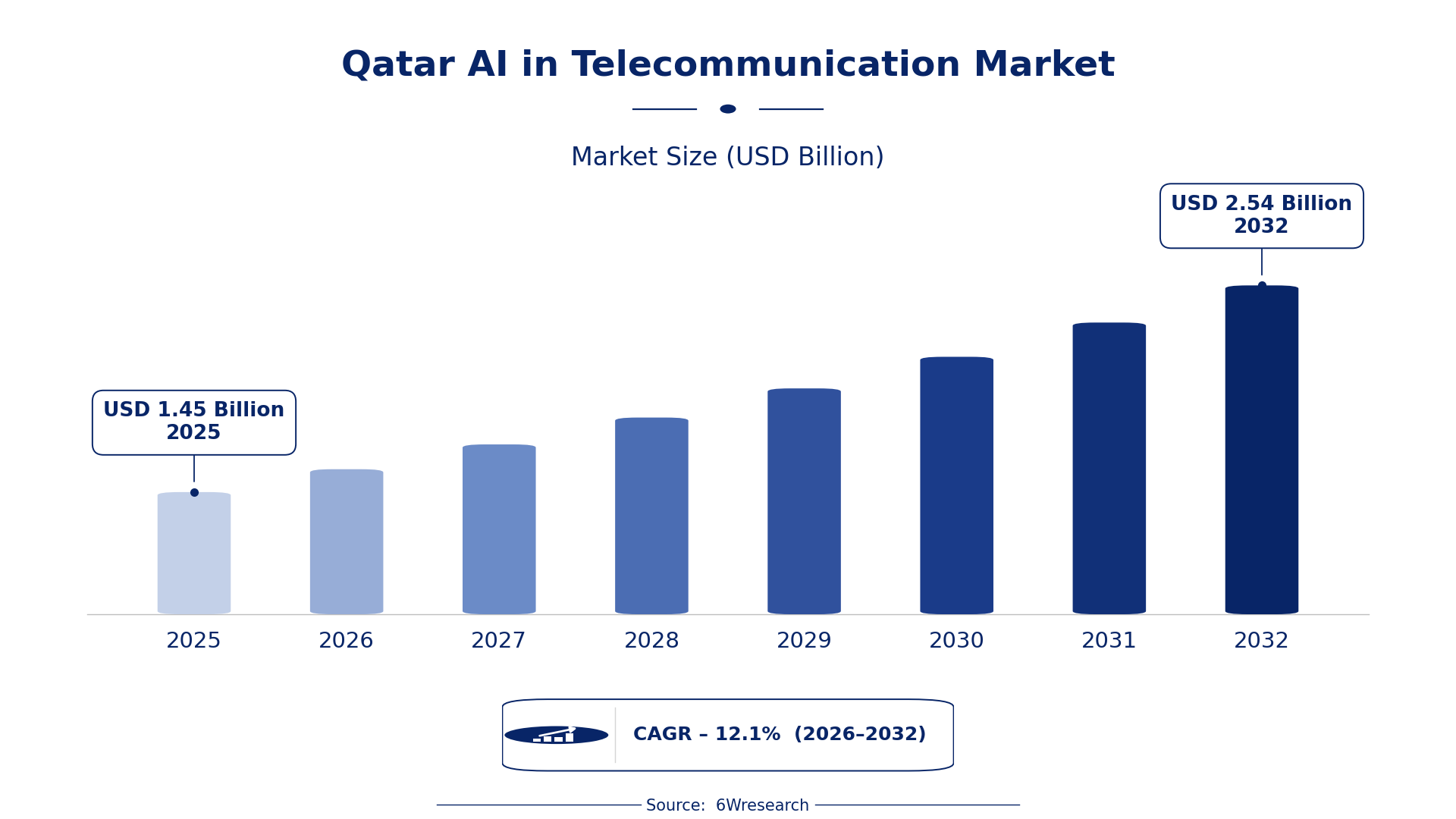
The Qatar AI in Telecommunication Market was estimated at USD 1445 Million in 2025 and is projected to reach USD 2545 Million by 2032, growing at a CAGR of 12.1% from 2026 to 2032.
Qatar AI in Telecommunication Market Synopsis
As Qatar's telecom operators push the boundaries of digital transformation, the integration of AI technologies is becoming critical. Innovative applications such as predictive analytics and chatbots are no longer optional; they are essential tools for enhancing both network performance and customer satisfaction.
The national emphasis on becoming a technology hub propels the AI in Telecommunication market forward. Operators are increasingly forming strategic partnerships with AI providers to stay competitive and meet evolving consumer expectations. This competitive environment fosters a cycle of constant innovation.
Qatar AI in Telecommunication Market Year-wise Growth Rate and Key Drivers
This graph illustrates the annual growth rates of the Qatar AI in Telecommunication Market from 2021 to 2032, highlighting a steady upward trajectory and projected expansion over the forecast period.
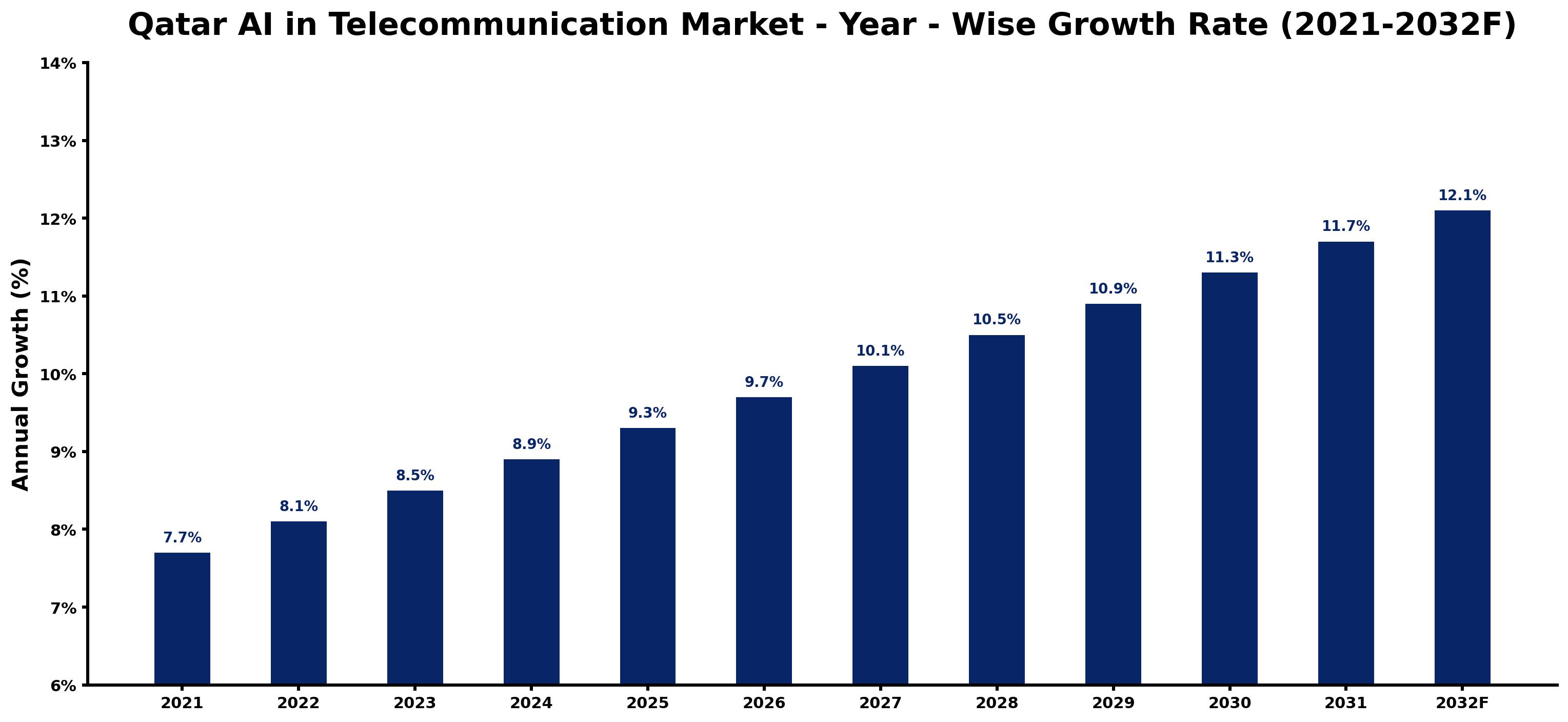
The table below presents the year‑wise growth rates along with the key drivers influencing the market
| Year | Growth Rate | Major Drivers |
| 2021 | 7.7% | Qatar National Vision 2030 emphasizes digital transformation. |
| 2022 | 8.1% | Qatel's AI-driven customer service solutions gaining traction. |
| 2023 | 8.5% | Regulatory support for 5G infrastructure accelerates AI adoption. |
| 2024 | 8.9% | Increased demand for smart city applications drives AI investment. |
| 2025 | 9.3% | Expanding youth population demanding innovative telecommunication services. |
| 2026 | 9.7% | Local telecoms partnering with tech firms for AI solutions. |
| 2027 | 10.1% | Government incentives for AI startups boost industry growth. |
| 2028 | 10.5% | Rising remote work leads to AI-enhanced communication tools. |
| 2029 | 10.9% | Qatar's focus on cybersecurity increases AI-driven security measures. |
| 2030 | 11.3% | Telecom operators deploying AI for network optimization. |
| 2031 | 11.7% | Growth of IoT devices drives demand for AI in telecom. |
| 2032 | 12.1% | Increased data consumption necessitates AI for traffic management. |
Note: Market size estimations and growth projections presented in this report are based on 6Wresearch's proprietary forecasting methodology, utilizing the latest available industry data, government publications, and primary research inputs.
Qatar AI in Telecommunication Market Key Takeaways
Below are some of the specific key takeaways from the market, including:
- The demand for AI solutions is largely driven by the rollout of 5G technologies.
- Operators are focusing on personalized customer experiences through AI applications.
- Data privacy remains a concern as telecoms utilize large datasets for AI analytics.
- Collaboration between telecoms and AI tech firms is intensifying, promoting rapid advancements.
- Government policies increasingly prioritize digital infrastructure development in telecommunications.
Evaluation of Restraints in Qatar AI in Telecommunication Market
Several factors are inhibiting the pace of growth in Qatar's AI in Telecommunication market. The complexity involved in integrating new AI technologies with existing telecom infrastructures creates substantial hurdles for operators. Additionally, concerns regarding data privacy and ethical implications are becoming more pronounced as telecoms deal with sensitive customer information. This dual focus on innovation and regulatory compliance demands careful navigation, which can delay project timelines and impact overall market growth.
Qatar AI in Telecommunication Market Trends
The telecommunications sector is increasingly witnessing a shift toward automation in customer service. AI-driven chatbots and virtual assistants are now commonplace, aimed at enhancing customer engagement and streamlining support operations. Furthermore, machine learning algorithms are being applied for predictive network maintenance, allowing operators to foresee and address potential issues before they escalate into problems.
Sustainability has also become a focal point, with companies seeking to reduce their carbon footprints through AI applications that optimize energy consumption within telecom networks. The focus on eco-friendly technologies is reshaping operational strategies across the sector.
Qatar AI in Telecommunication Market Opportunities
The future holds promising avenues for investment within the AI in Telecommunication space in Qatar. Opportunities lie particularly in leveraging AI for enhanced cybersecurity measures as the volume of data transmitted increases. Additionally, the demand for advanced analytics tools to provide deeper customer insights is on the rise, creating a robust market for AI solutions. The expanding 5G infrastructure also presents a fertile ground for innovative AI applications, from smart cities to IoT integrations.
Government Initiatives in the Qatar AI in Telecommunication Market
The Qatari government is actively fostering a policy environment conducive to the growth of AI in telecommunications. Recent initiatives reflect a commitment to enhancing digital infrastructure and ensuring regulatory frameworks that support technological innovation. By setting clear priorities in public policy, the government is paving the way for the telecommunications sector to thrive through AI integration.
- A national digital infrastructure upgrade programme recently launched to improve connectivity and access.
- Current initiatives focus on regulatory reforms to enhance billing transparency in telecom services.
- A planned public-private partnership aims to expand AI application in customer service operations expected by 2028.
- Recently completed policies emphasize data protection and customer privacy in AI deployments.
Future Insights of the Qatar AI in Telecommunication Market
Looking ahead to 2026-2032, the Qatar AI in Telecommunication market is expected to experience robust growth. The continued adoption of 5G technologies will necessitate advanced AI solutions for managing network complexities and consumer demands. A stronger focus on personalized customer experiences will drive investments in AI tools that enhance service delivery. As the market matures, operators will also prioritize responsible AI deployment, balancing innovation with ethical considerations.
Qatar AI in Telecommunication Market Latest Developments
In the past year, the Qatar AI in Telecommunication market has seen a surge in activities aimed at integrating advanced technologies into telecommunications infrastructure. Key developments reflect the industry's urgency to adapt to changing consumer needs and technological advancements, demonstrating a clear trajectory towards innovation.
- A major technology vendor rolled out a new AI-driven network management platform in Q3 2025, aimed at improving operational efficiency.
- A leading regional operator initiated a project to implement AI-based fraud detection systems, which remains underway since early 2025.
- An upcoming rollout planned for late 2026 will introduce AI-powered virtual assistants across customer service platforms.
- A collaboration between telecom providers and academic institutions to develop AI research hubs was announced in early 2025 and is currently in the planning phase.
Qatar AI in Telecommunication Market - Key Attractiveness of the Report
- 10 Years of Market Numbers
- Historical Data Starting from 2022 to 2025
- Base Year: 2025
- Forecast Data until 2032
- Key Performance Indicators Impacting the Market
- Major Upcoming Developments and Projects
Key Highlights of the Report:
- Qatar AI in Telecommunication Market Outlook
- Market Size of Qatar AI in Telecommunication Market, 2025
- Forecast of Qatar AI in Telecommunication Market, 2032
- Historical Data and Forecast of Qatar AI in Telecommunication Revenues & Volume for the Period 2022-2032F
- Qatar AI in Telecommunication Market Trend Evolution
- Qatar AI in Telecommunication Market Drivers and Challenges
- Qatar AI in Telecommunication Price Trends
- Qatar AI in Telecommunication Porter's Five Forces
- Qatar AI in Telecommunication Industry Life Cycle
- Historical Data and Forecast of Qatar AI in Telecommunication Market Revenues & Volume By Application for the Period 2022-2032F
- Historical Data and Forecast of Qatar AI in Telecommunication Market Revenues & Volume By Customer analytics for the Period 2022-2032F
- Historical Data and Forecast of Qatar AI in Telecommunication Market Revenues & Volume By Network security for the Period 2022-2032F
- Historical Data and Forecast of Qatar AI in Telecommunication Market Revenues & Volume By Network optimization for the Period 2022-2032F
- Historical Data and Forecast of Qatar AI in Telecommunication Market Revenues & Volume By Self-diagnostics for the Period 2022-2032F
- Historical Data and Forecast of Qatar AI in Telecommunication Market Revenues & Volume By Virtual assistance for the Period 2022-2032F
- Historical Data and Forecast of Qatar AI in Telecommunication Market Revenues & Volume By Others (contact center analytics and marketing campaign analytics) for the Period 2022-2032F
- Historical Data and Forecast of Qatar AI in Telecommunication Market Revenues & Volume By Component for the Period 2022-2032F
- Historical Data and Forecast of Qatar AI in Telecommunication Market Revenues & Volume By Solutions for the Period 2022-2032F
- Historical Data and Forecast of Qatar AI in Telecommunication Market Revenues & Volume By Services for the Period 2022-2032F
- Historical Data and Forecast of Qatar AI in Telecommunication Market Revenues & Volume By Deployment Mode for the Period 2022-2032F
- Historical Data and Forecast of Qatar AI in Telecommunication Market Revenues & Volume By Cloud for the Period 2022-2032F
- Historical Data and Forecast of Qatar AI in Telecommunication Market Revenues & Volume By On-premises for the Period 2022-2032F
- Historical Data and Forecast of Qatar AI in Telecommunication Market Revenues & Volume By Technology for the Period 2022-2032F
- Historical Data and Forecast of Qatar AI in Telecommunication Market Revenues & Volume By Machine learning and deep learning for the Period 2022-2032F
- Historical Data and Forecast of Qatar AI in Telecommunication Market Revenues & Volume By Natural Language Processing (NLP) for the Period 2022-2032F
- Qatar AI in Telecommunication Import Export Trade Statistics
- Market Opportunity Assessment By Application
- Market Opportunity Assessment By Component
- Market Opportunity Assessment By Deployment Mode
- Market Opportunity Assessment By Technology
- Qatar AI in Telecommunication Top Companies Market Share
- Qatar AI in Telecommunication Competitive Benchmarking By Technical and Operational Parameters
- Qatar AI in Telecommunication Company Profiles
- Qatar AI in Telecommunication Key Strategic Recommendations






































