Market Forecast By Type (Hay & Forage Feed (Alfalfa Grass/Hay, Rhodes Grass/Hay, Barley Grass/Hay, Green Forage and Silage, Other Hay & Roughage Feed,), Grain Feed (Barley Seeds (Bagged or Bulk), Other Grain Feed), Bran & By-product Feed, Compound & Specialty Feed And Competitive Landscape
| Product Code: ETC018481 | Publication Date: Oct 2020 | Updated Date: May 2026 | Product Type: Report | |
| Publisher: 6Wresearch | Author: Ravi Bhandari | No. of Pages: 43 | No. of Figures: 21 | No. of Tables: 8 |
Qatar Animal Feed Market Report thoroughly covers the market by type. Qatar Animal Feed Market Outlook report provides an unbiased and detailed analysis of the ongoing Qatar Animal Feed Market trends, opportunities/high growth areas, and market drivers. This would help stakeholders devise and align their market strategies according to the current and future market dynamics.
Qatar animal feed market witnessed sluggish growth during 2022–2025, shaped by evolving food security priorities, rising livestock production, and changing regional trade dynamics. During this period, Qatar expanded dairy and poultry farming activities significantly, achieving near-complete self-sufficiency in both sectors, supported by the rapid expansion of Baladna’s integrated dairy operations spanning an extensive production area. The country also recorded strong livestock numbers, including a high number of sheeps and goats, which sustained steady demand for compound feed, forage, and nutritional additives.
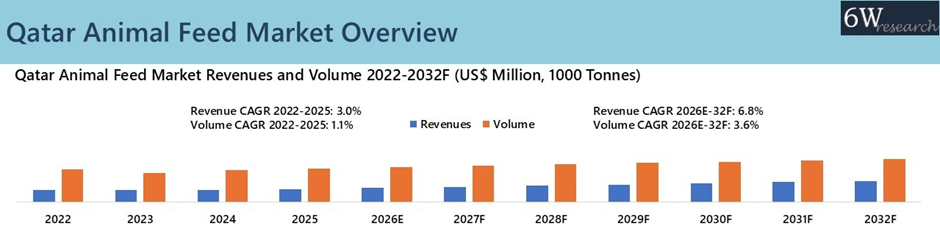
According to 6Wresearch, Qatar animal feed market revenue is projected to grow at a CAGR of 6.8% and market volume is projected at 3.6% growth during 2026–2032F, supported by ongoing food security initiatives, modernization of livestock farming, and increasing adoption of advanced feed technologies across the country. The implementation of Feed Subsidy Program and the National Food Security Strategy 2030 is expected to encourage hydroponic fodder cultivation, smart farming technologies, digital livestock registration systems, and greater utilization of nutritionally enhanced feed products.
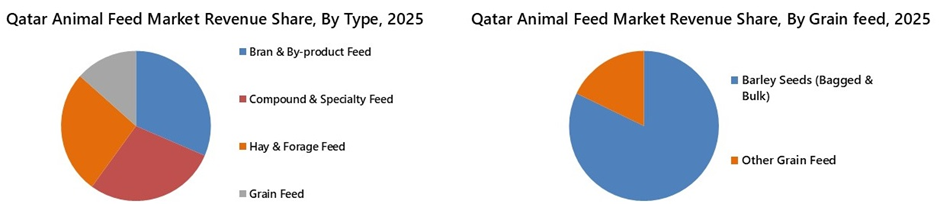
Government targets for achieving self-sufficiency in dairy and fresh poultry, table egg self-sufficiency, and red meat self-sufficiency, which are anticipated to maintain feed demand growth across dairy, poultry, sheep, goat, and aquaculture farming activities. Additionally, expansion of licensed livestock projects, aquaculture development programs, and barley availability initiatives are expected to support stable market development. Additionally, fluctuations in global grain pricing, elevated logistics costs, and climate-related agricultural limitations are expected to maintain a gradual pace of market growth during the forecast period.
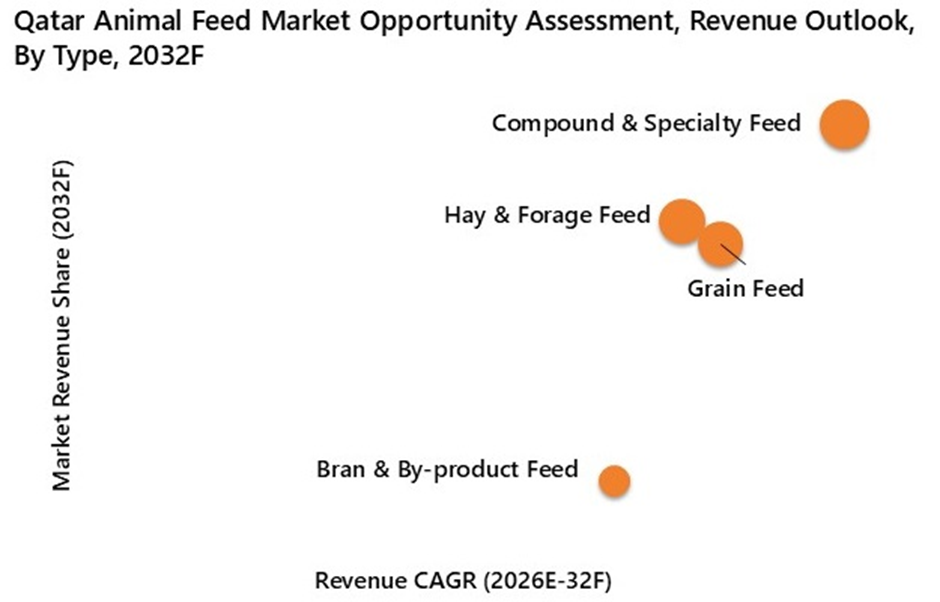
Compound & specialty feed is expected to growth fastest in Qatar Animal Feed market, driven by rising demand for balanced nutrition, protein-rich formulations, and feed additives across dairy, poultry, sheep, goat, and aquaculture farming. Its volume growth would also remain the highest, supported by commercial farms shifting from basic feed toward productivity-enhancing solutions that improve milk yield, herd health, feed conversion, and food self-sufficiency outcomes.
The report provides a detailed analysis of the following market segments:
By Type
| 1. Executive Summary |
| 2. Introduction |
| 2.1. Report Description |
| 2.2. Key Highlights of the Report |
| 2.3. Market Scope & Segmentation |
| 2.4. Research Methodology |
| 2.5. Assumptions |
| 3. Qatar Animal Feed Market Overview |
| 3.1. Qatar Animal Feed Market Revenues and Volume, 2022-2032F |
| 4. Qatar Animal Feed Market Dynamics |
| 4.1. Impact Analysis |
| 4.2. Market Drivers |
| 4.3. Market Restraints |
| 5. Qatar Animal Feed Market Overview, By Type |
| 5.1. Qatar Animal Feed Market Revenue and Volume Share, By Type, 2025 & 2032F |
| 5.2. Qatar Animal Feed Market Revenue and Volume, By Type, 2025 & 2032F |
| 5.2.1. Qatar Animal Feed Market Revenues and Volume, By Hay & Forage Feed, 2022-2032F |
| 5.2.2. Qatar Animal Feed Market Revenues and Volume, By Grain Feed, 2022-2032F |
| 5.2.3. Qatar Animal Feed Market Revenues and Volume, By Bran & By-product Feed, 2022-2032F |
| 5.2.4. Qatar Animal Feed Market Revenues and Volume, By Compound & Specialty Feed , 2022-2032F |

| 6. Qatar Animal Feed Market Overview, By Hay & Forage Feed |


| 6.1. Qatar Animal Feed Market Revenue and Volume Share, By Hay & Forage Feed, 2025 & 2032F |

| 6.2. Qatar Animal Feed Market Revenue and Volume, By Hay & Forage Feed, 2025 & 2032F |


| 6.2.1. Qatar Animal Feed Market Revenues and Volume, By Alfalfa Grass/Hay, 2022-2032F |
| 6.2.2. Qatar Animal Feed Market Revenues and Volume, By Rhodes Grass/Hay, 2022-2032F |
| 6.2.3. Qatar Animal Feed Market Revenues and Volume, By Barley Grass/Hay, 2022-2032F |
| 6.2.4. Qatar Animal Feed Market Revenues and Volume, By Green Forage and silage, 2022-2032F |
| 6.2.5. Qatar Animal Feed Market Revenues and Volume, By Other Hay & Roughage Feed , 2022-2032F |
| 7. Qatar Animal Feed Market Overview, By Grain Feed |
| 7.1. Qatar Animal Feed Market Revenue and Volume Share, By Grain Feed, 2025 & 2032F |
| 7.2. Qatar Animal Feed Market Revenue and Volume, By Grain Feed, 2025 & 2032F |
| 7.2.1. Qatar Animal Feed Market Revenues and Volume, By Barley Seeds (Bagged & Bulk), 2022-2032F |
| 7.2.2. Qatar Animal Feed Market Revenues and Volume, By Other Grain Feed, 2022-2032F |
| 8. Qatar Animal Feed Market Import Vs Local Production |
| 9. Qatar Animal Feed Market Opportunity Assessment |
| 9.1. Qatar Animal Feed Market Opportunity Assessment, By Type, 2032F |
| 9.2. Qatar Animal Feed Market Opportunity Assessment, By Hay & Forage Feed, 2032F |
| 9.3. Qatar Animal Feed Market Opportunity Assessment, By Grain Feed, 2032F |
| 10. Disclaimer |
| List of figures |
| 1. Qatar Animal Feed Market Revenues and Volume 2022-2032F (US$ Million, 1000 Tonnes) |
| 2. Local Production, Consumption, and Self-Sufficiency Rates of Key Livestock Products in Qatar, 2024(in tons & %) |
| 3. Qatar Livestock Population, 2024 |
| 4. Self-Sufficiency Rate Under Qatar National Food Security Strategy 2030 |
| 5. Qatar Animal Feed Market Revenue Share, By Type, 2025 & 2032F |
| 6. Qatar Animal Feed Market Volume Share, By Type, 2025 & 2032F |
| 7. Qatar Animal Feed Market Revenue Share, By Hay & Forage Feed, 2025 & 2032F |
| 8. Qatar Animal Feed Market Volume Share, By Hay & Forage Feed, 2025 & 2032F |
| 9. Qatar Animal Feed Market Revenue Share, By Grain Feed, 2025 & 2032F |
| 10. Qatar Animal Feed Market Volume Share, By Grain Feed, 2025 & 2032F |
| 11. Production Footprint of Animal Feeds Key Players in Qatar |
| 12. Qatar Animal Feed Import and Local Production Share(in %) and Import-to-Local Production Ratio, 2025 |
| 13. Qatar Imports of Animal Feed, 2021-2025*, (in $ Million) |
| 14. Qatar Imports of Animal Feed, by HS Code (in $ Million) |
| 15. Share of Top 5 Countries of Exporting Animal Feed to Qatar, 2025 |
| 16. Qatar Animal Feed Market Opportunity Assessment, Revenue Outlook, By Type, 2032F |
| 17. Qatar Animal Feed Market Opportunity Assessment, Volume Outlook, By Type, 2032F |
| 18. Qatar Animal Feed Market Opportunity Assessment, Revenue Outlook, By Hay & Forage Feed, 2032F |
| 19. Qatar Animal Feed Market Opportunity Assessment, Volume Outlook, By Hay & Forage Feed, 2032F |
| 20. Qatar Animal Feed Market Opportunity Assessment, Revenue Outlook, By Grain Feed, 2032F |
| 21. Qatar Animal Feed Market Opportunity Assessment, Volume Outlook, By Grain Feed, 2032F |
| List of table |
| 1. Key Government Policies and Strategic Initiatives Supporting Livestock and Feed Security |
| 2. Qatar Animal Feed Market Revenues, By Type, 2022-2032F (US$ Million) |
| 3. Qatar Animal Feed Market Volume, By Type, 2022-2032F (1000 Tons) |
| 4. Qatar Animal Feed Market Revenues, By Hay & Forage Feed, 2022-2032F (US$ Million) |
| 5. Qatar Animal Feed Market Volume, By Hay & Forage Feed, 2022-2032F (1000 Tons) |
| 6. Qatar Animal Feed Market Revenues, By Grain Feed, 2022-2032F (US$ Million) |
| 7. Qatar Animal Feed Market Volume, By Grain Feed, 2022-2032F (1000 Tons) |
| 8. Qatar Animal Feed Local Production Facilities, As of May 2026 |
Export potential enables firms to identify high-growth global markets with greater confidence by combining advanced trade intelligence with a structured quantitative methodology. The framework analyzes emerging demand trends and country-level import patterns while integrating macroeconomic and trade datasets such as GDP and population forecasts, bilateral import–export flows, tariff structures, elasticity differentials between developed and developing economies, geographic distance, and import demand projections. Using weighted trade values from 2020–2024 as the base period to project country-to-country export potential for 2030, these inputs are operationalized through calculated drivers such as gravity model parameters, tariff impact factors, and projected GDP per-capita growth. Through an analysis of hidden potentials, demand hotspots, and market conditions that are most favorable to success, this method enables firms to focus on target countries, maximize returns, and global expansion with data, backed by accuracy.
By factoring in the projected importer demand gap that is currently unmet and could be potential opportunity, it identifies the potential for the Exporter (Country) among 190 countries, against the general trade analysis, which identifies the biggest importer or exporter.
To discover high-growth global markets and optimize your business strategy:
Click Here




























