Qatar Anti-money Laundering Market Size & Growth Rate (2026-2032)
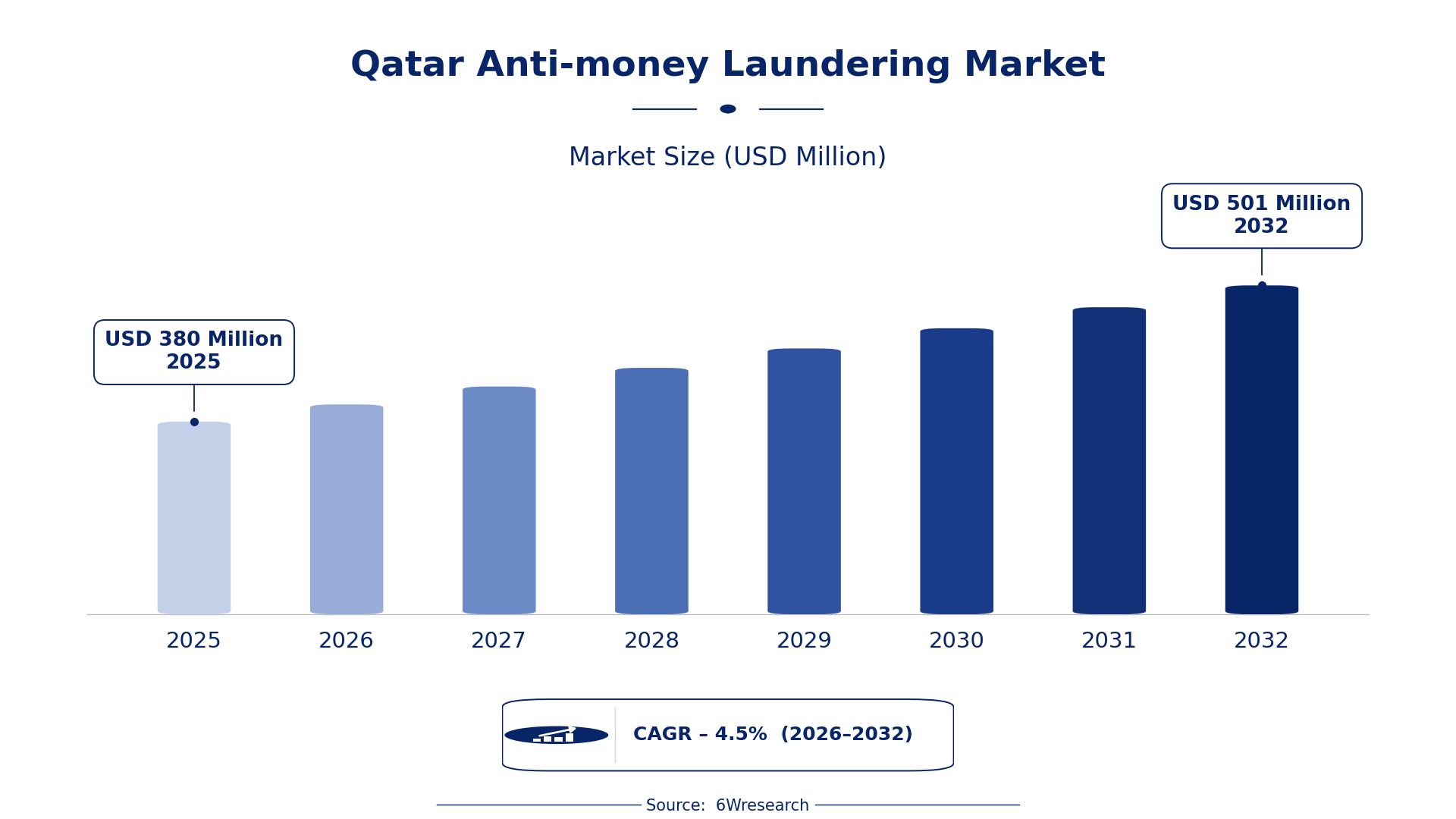
The Qatar Anti-money Laundering Market was estimated at USD 380 Million in 2025 and is projected to reach USD 501 Million by 2032, growing at a CAGR of 4.5% from 2026 to 2032.
Qatar Anti-money Laundering Market Synopsis
As one of the leading financial centers in the Middle East, Qatar's commitment to fortifying its financial integrity is evident. The Anti-money Laundering (AML) market in Qatar is becoming increasingly crucial as regulatory bodies and financial institutions tackle the growing complexities of financial crimes.
A blend of advanced technology and stringent regulatory measures is driving innovation in the AML sector. Financial institutions are now leveraging artificial intelligence and machine learning to strengthen their defenses against illicit financial activities, making compliance a top priority.
Qatar Anti-money Laundering Market Year-wise Growth Rate and Key Drivers
This graph illustrates the annual growth rates of the Qatar Anti-money Laundering Market from 2021 to 2032, highlighting a steady upward trajectory and projected expansion over the forecast period.
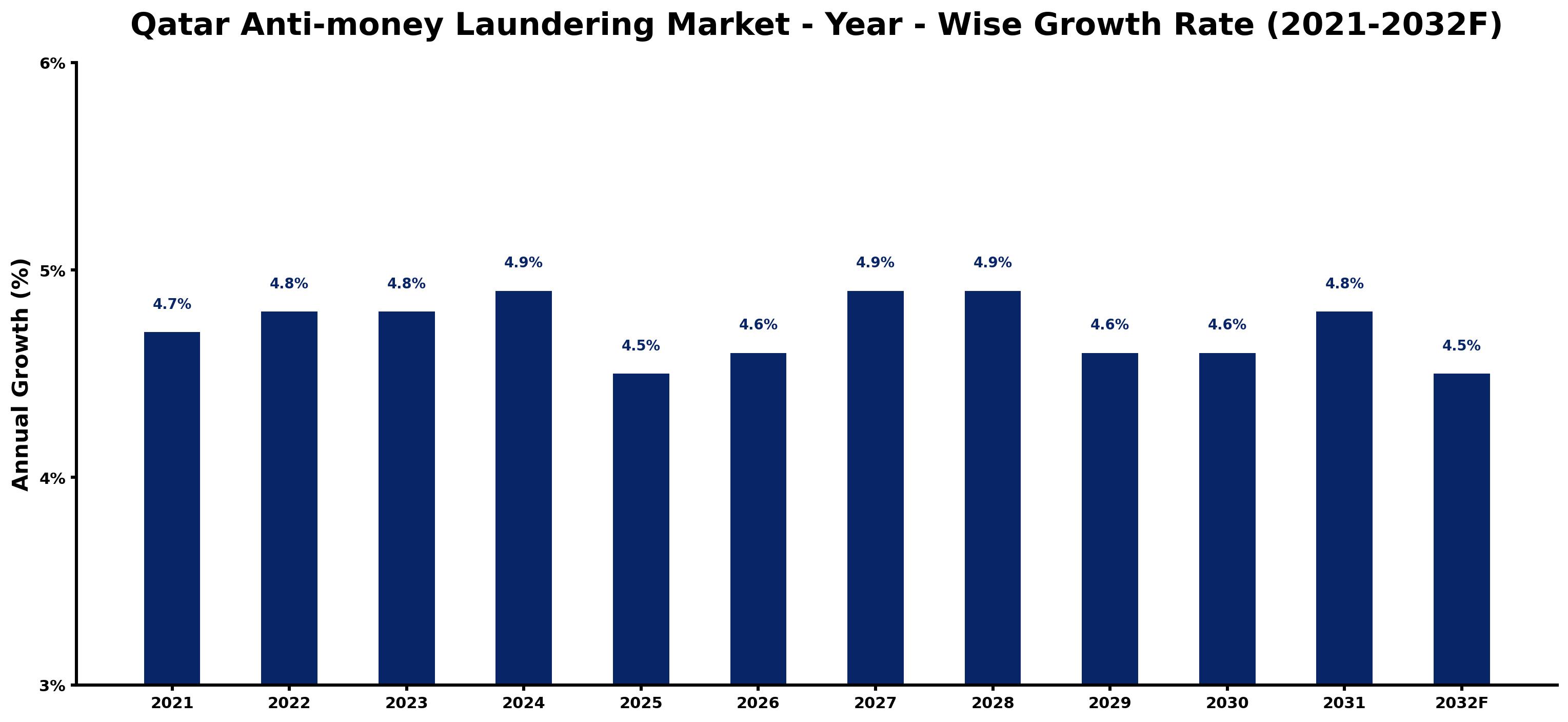
The table below presents the year‑wise growth rates along with the key drivers influencing the market
| Year | Growth Rate | Major Drivers |
| 2021 | 4.7% | Qatar Central Bank's enhanced AML regulatory framework implementation. |
| 2022 | 4.8% | Increasing foreign investment leading to stricter AML compliance. |
| 2023 | 4.8% | Growth in digital banking prompting stronger anti-money laundering measures. |
| 2024 | 4.9% | Qatar's FIFA World Cup spurring focused financial oversight demands. |
| 2025 | 4.5% | Emergence of fintech startups driving innovative AML solutions. |
| 2026 | 4.6% | International pressure for compliance with FATF directives. |
| 2027 | 4.9% | Government incentives for AML technology adoption programs. |
| 2028 | 4.9% | Rising concerns over cryptocurrency transactions prompting AML regulations. |
| 2029 | 4.6% | Strengthened partnerships with global financial crime agencies. |
| 2030 | 4.6% | Digitalization of financial services increasing AML surveillance needs. |
| 2031 | 4.8% | Implementation of national AML training programs for professionals. |
| 2032 | 4.5% | Continued efforts to enhance transparency in financial transactions. |
Note: Market size estimations and growth projections presented in this report are based on 6Wresearch's proprietary forecasting methodology, utilizing the latest available industry data, government publications, and primary research inputs.
Qatar Anti-money Laundering Market Key Takeaways
Below are some of the specific key takeaways from the market, including:
- Qatar's financial institutions are increasingly investing in AML solutions to enhance compliance and operational effectiveness.
- Technological advancements, particularly in AI, are reshaping how suspicious activities are detected and reported.
- International integration of Qatar’s financial sector heightens the demand for robust AML frameworks.
- Continuous government initiatives aimed at improving regulatory compliance are fostering market growth.
- Financial institutions are increasingly collaborating with technology providers to develop efficient AML strategies.
Evaluation of Restraints in Qatar Anti-money Laundering Market
Despite its growth, the Qatar Anti-money Laundering market faces several challenges. Chief among these is the sophistication of money laundering techniques, which continuously evolve alongside regulatory requirements. Financial institutions struggle with implementing systems that can accurately identify suspicious activity while minimizing false positives. The sheer volume of transactions also complicates compliance, requiring institutions to invest significantly in technology and training. Additionally, the need for international cooperation in information sharing presents another layer of difficulty, as cross-border financial operations often lack seamless integration.
Qatar Anti-money Laundering Market Trends
Several trends are shaping the Qatar Anti-money Laundering market today. A notable emphasis on real-time monitoring solutions is becoming standard, allowing institutions to detect suspicious transactions as they occur. The integration of blockchain technology in compliance measures is also on the rise, offering enhanced transparency and security. Furthermore, as cyber threats expand, organizations are prioritizing cybersecurity within their AML strategies, recognizing the link between technological vulnerabilities and financial crime.
Qatar Anti-money Laundering Market Opportunities
The market presents multiple avenues for growth and investment. With increasing regulatory scrutiny, there's a strong demand for specialized AML software that can effectively manage compliance across various financial sectors. Startups offering innovative solutions in transaction monitoring and risk assessment are likely to attract considerable interest. Additionally, the rise of digital banking in Qatar creates a fertile ground for AML solutions tailored specifically for online transactions, positioning technology providers as critical partners in the fight against financial crime.
Government Initiatives in the Qatar Anti-money Laundering Market
The Qatari government plays an integral role in shaping the AML market through various initiatives aimed at strengthening regulatory frameworks. With a focus on compliance, the government is actively enhancing its policies to prevent financial crimes and promote transparency within the financial sector.
- A national initiative launched in 2025 to upgrade AML compliance regulations, reinforcing stricter reporting requirements for financial institutions.
- Currently ongoing workshops and training sessions for financial professionals focused on the latest AML technologies and practices.
- Plans for a new inter-agency task force expected to launch in 2027 to bolster cooperation between financial institutions and regulatory bodies.
- Implementation of a digital reporting system set to begin in late 2026, aimed at streamlining the submission of suspicious transaction reports.
- A review of existing AML laws, anticipated to conclude by mid-2026, aiming to align Qatari regulations with international best practices.
Future Insights of the Qatar Anti-money Laundering Market
Looking ahead to 2026-2032, the Qatar Anti-money Laundering market is expected to continue its upward trajectory, driven by ongoing regulatory reforms and advancements in technology. The financial sector will likely adopt more sophisticated tools to combat emerging threats, particularly as global financial systems become increasingly interconnected. The collaboration between technology providers and financial institutions will be essential in developing effective strategies to detect and prevent money laundering activities, ensuring that Qatar maintains its reputation as a secure financial hub.
Qatar Anti-money Laundering Market Latest Developments
In the past year, the Qatar Anti-money Laundering market has witnessed several noteworthy developments as the financial sector adapts to growing regulatory demands. With an increasing focus on technology, financial institutions are re-evaluating their AML strategies to incorporate advanced solutions that enhance compliance and operational efficiency.
- A major technology vendor initiated a comprehensive AML software upgrade in early 2025, enhancing capabilities for detecting suspicious transactions.
- An ongoing public-private partnership aims to develop a new AML training curriculum for financial professionals, set to roll out in 2026.
- In Q3 2025, a leading regional operator began implementing a machine learning-driven system for real-time transaction analysis.
- A planned technology demonstration event in late 2026 will showcase innovative AML solutions developed by startups in Qatar.
- A recent collaboration between financial institutions and regulatory bodies aims to streamline AML reporting processes, expected to be completed by early 2026.
Qatar Anti-money Laundering Market - Key Attractiveness of the Report
- 10 Years of Market Numbers
- Historical Data Starting from 2022 to 2025
- Base Year: 2025
- Forecast Data until 2032
- Key Performance Indicators Impacting the Market
- Major Upcoming Developments and Projects
Key Highlights of the Report:
- Qatar Anti-money Laundering Market Outlook
- Market Size of Qatar Anti-money Laundering Market, 2025
- Forecast of Qatar Anti-money Laundering Market, 2032
- Historical Data and Forecast of Qatar Anti-money Laundering Revenues & Volume for the Period 2022-2032F
- Qatar Anti-money Laundering Market Trend Evolution
- Qatar Anti-money Laundering Market Drivers and Challenges
- Qatar Anti-money Laundering Price Trends
- Qatar Anti-money Laundering Porter's Five Forces
- Qatar Anti-money Laundering Industry Life Cycle
- Historical Data and Forecast of Qatar Anti-money Laundering Market Revenues & Volume By Component for the Period 2022-2032F
- Historical Data and Forecast of Qatar Anti-money Laundering Market Revenues & Volume By Services for the Period 2022-2032F
- Historical Data and Forecast of Qatar Anti-money Laundering Market Revenues & Volume By Solutions for the Period 2022-2032F
- Historical Data and Forecast of Qatar Anti-money Laundering Market Revenues & Volume By Deployment Mode for the Period 2022-2032F
- Historical Data and Forecast of Qatar Anti-money Laundering Market Revenues & Volume By On-Premises for the Period 2022-2032F
- Historical Data and Forecast of Qatar Anti-money Laundering Market Revenues & Volume By Cloud for the Period 2022-2032F
- Historical Data and Forecast of Qatar Anti-money Laundering Market Revenues & Volume By End User for the Period 2022-2032F
- Historical Data and Forecast of Qatar Anti-money Laundering Market Revenues & Volume By Banking & Financial Institutes for the Period 2022-2032F
- Historical Data and Forecast of Qatar Anti-money Laundering Market Revenues & Volume By Insurance for the Period 2022-2032F
- Historical Data and Forecast of Qatar Anti-money Laundering Market Revenues & Volume By Gaming & Gambling for the Period 2022-2032F
- Historical Data and Forecast of Qatar Anti-money Laundering Market Revenues & Volume By Organization Size for the Period 2022-2032F
- Historical Data and Forecast of Qatar Anti-money Laundering Market Revenues & Volume By Large Enterprises for the Period 2022-2032F
- Historical Data and Forecast of Qatar Anti-money Laundering Market Revenues & Volume By SMEs for the Period 2022-2032F
- Qatar Anti-money Laundering Import Export Trade Statistics
- Market Opportunity Assessment By Component
- Market Opportunity Assessment By Deployment Mode
- Market Opportunity Assessment By End User
- Market Opportunity Assessment By Organization Size
- Qatar Anti-money Laundering Top Companies Market Share
- Qatar Anti-money Laundering Competitive Benchmarking By Technical and Operational Parameters
- Qatar Anti-money Laundering Company Profiles
- Qatar Anti-money Laundering Key Strategic Recommendations






































