Qatar Anti Reflective Glass Market Size, Share & Growth Rate
The Qatar Anti Reflective Glass Market was estimated at USD 212 Million in 2025 and is projected to reach USD 289 Million by 2032, growing at a CAGR of 4.5% from 2026 to 2032. This growth trajectory is primarily driven by a surge in construction activities fueled by the nation's ongoing infrastructure development projects. Additionally, the automotive sector's expansion is set to further elevate the demand for anti-reflective glass, enhancing visibility and glare reduction in various applications.
Qatar Anti Reflective Glass Market Year-wise Growth Rate and Key Drivers
This graph highlights how the Qatar Anti Reflective Glass Market has steadily grown over the years, supported by major growth factors.
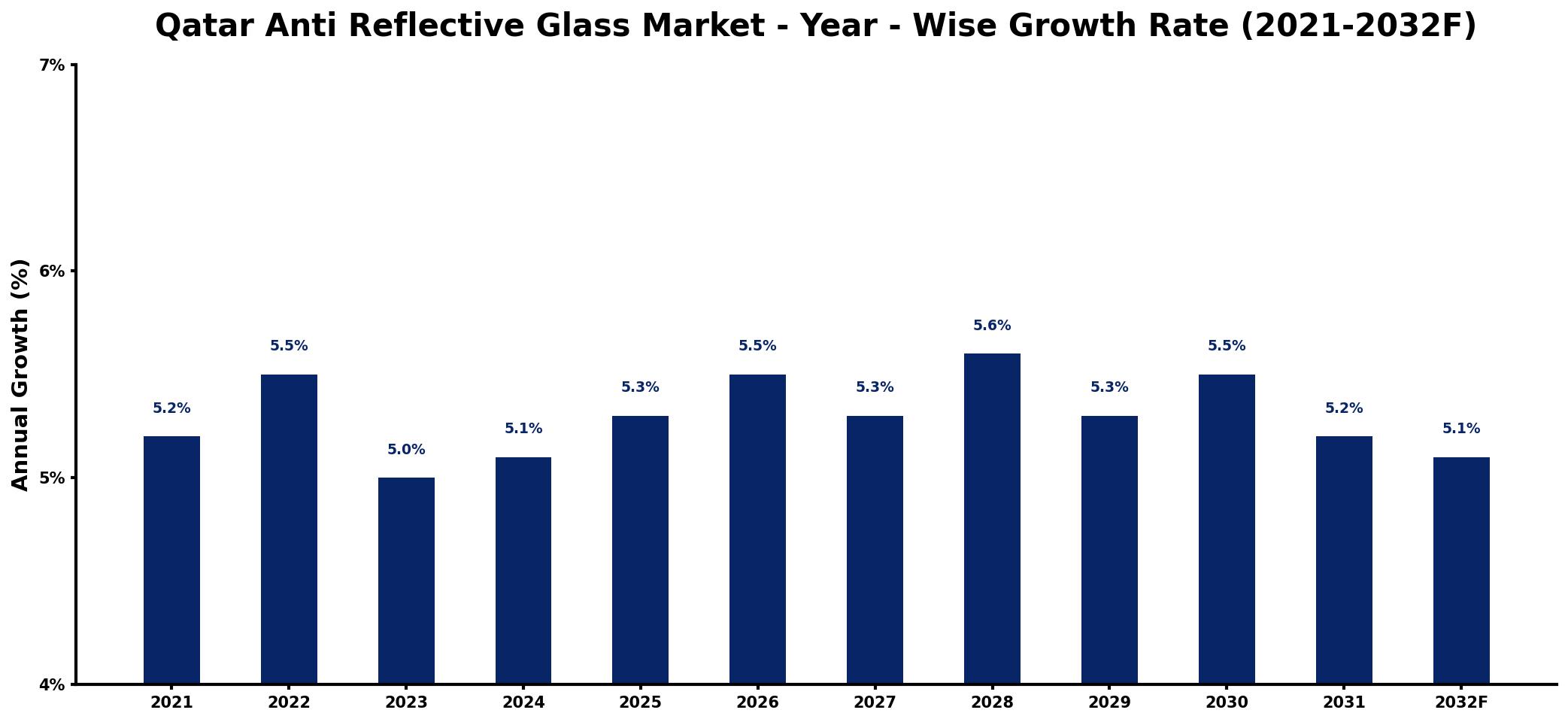
The table below presents the year‑wise growth rates along with the key drivers influencing the market
| Year | Growth Rate | Major Drivers |
| 2021 | 5.2% | Rising construction sector projects |
| 2022 | 5.5% | Increased focus on energy efficiency |
| 2023 | 5.0% | Growing architectural design trends |
| 2024 | 5.1% | Expansion of renewable energy initiatives |
| 2025 | 5.3% | Surge in luxury residential developments |
| 2026 | 5.5% | Investment in green building technologies |
| 2027 | 5.3% | Demand from automotive industry growth |
| 2028 | 5.6% | Technological advancements in coatings |
| 2029 | 5.3% | Growth in hospitality sector renovations |
| 2030 | 5.5% | Increased urbanization and population |
| 2031 | 5.2% | Strong government infrastructure investments |
| 2032 | 5.1% | Rising awareness of sustainability practices |
Note: Market size estimations and growth projections presented in this report are based on 6Wresearch's proprietary forecasting methodology, utilizing the latest available industry data, government publications, and primary research inputs.
Qatar Anti Reflective Glass Market Synopsis
The rising trend towards sustainability in construction is making anti-reflective glass a preferred choice for architects and builders across Qatar. This glass not only boosts energy efficiency but also enhances aesthetic appeal, making it an attractive option for modern designs.
Moreover, the electronic displays' increasing prevalence, particularly in consumer electronics and automotive industries, is contributing significantly to the demand for anti-reflective glass. As this technology becomes integral to everyday products, the necessity for glare reduction and improved visibility is increasingly evident.
Qatar Anti Reflective Glass Market Key Takeaways
- The market is projected to witness a steady increase, reaching USD 289 Million by 2032.
- Growth is driven by rising construction and infrastructure projects in Qatar.
- There is a notable demand from the automotive sector for enhanced visibility solutions.
- Consumer electronics trends are pushing the need for effective glare reduction technologies.
- Increased awareness of energy efficiency benefits is fostering market adoption.
Evaluation of Restraints in Qatar Anti Reflective Glass Market
A significant restraint impacting the Qatar anti-reflective glass market is the challenge of maintaining consistent quality standards across various applications. Ensuring that anti-reflective coatings adhere to strict optical and durability specifications necessitates rigorous quality control processes. Additionally, the industry faces obstacles related to consumer education on the advantages of anti-reflective glass, which may hinder widespread acceptance and integration into different sectors.
Qatar Anti Reflective Glass Market Trends
One notable trend is the increasing integration of anti-reflective glass into smart building solutions, enhancing energy efficiency and occupant comfort. Another emerging trend is the growing use of this glass in innovative automotive designs, where safety and aesthetics are paramount. As consumer demand for high-quality visuals in displays rises, anti-reflective coatings are also becoming more prevalent in electronics manufacturing.
Qatar Anti Reflective Glass Market Opportunities
The market offers substantial opportunities, particularly in architectural projects that prioritize energy efficiency. With Qatar's commitment to sustainable development, anti-reflective glass can play a crucial role in achieving environmental targets. Additionally, the continuous advancement of coating technologies presents avenues for innovation, enabling the development of products that cater to niche applications in both industrial and consumer markets.
Government Initiatives in the Qatar Anti Reflective Glass Market
The Qatari government is actively promoting initiatives aimed at enhancing sustainability in construction through various programs and public spending. These initiatives encourage the adoption of energy-efficient materials and technologies, including anti-reflective glass, to meet national goals for reducing carbon footprints and promoting eco-friendly construction practices. Such support is likely to create a more favorable environment for market growth.
Future Insights of the Qatar Anti Reflective Glass Market
Looking ahead to 2026-2032, the Qatar anti-reflective glass market is set for robust growth, driven by increasing investments in infrastructure and a heightened focus on sustainability. As construction projects ramp up, the demand for innovative solutions to enhance building aesthetics and energy efficiency will rise. Additionally, advancements in technology are expected to improve anti-reflective glass performance, solidifying its position as a key component across multiple sectors.
Qatar Anti Reflective Glass Market Latest Developments (2025 - 2026)
Recent developments indicate a shift towards more sophisticated anti-reflective glass solutions in both the architectural and automotive sectors. Companies are investing in research and development to improve the durability and effectiveness of anti-reflective coatings. Furthermore, partnerships between manufacturers and technology firms are emerging, focusing on creating customized solutions that address specific client needs in modern construction.
Qatar Anti Reflective Glass Market - Key Attractiveness of the Report
- 10 Years of Market Numbers
- Historical Data Starting from 2022 to 2025
- Base Year: 2025
- Forecast Data until 2032
- Key Performance Indicators Impacting the Market
- Major Upcoming Developments and Projects
Key Highlights of the Report:
- Qatar Anti Reflective Glass Market Outlook
- Market Size of Qatar Anti Reflective Glass Market, 2025
- Forecast of Qatar Anti Reflective Glass Market, 2032
- Historical Data and Forecast of Qatar Anti Reflective Glass Revenues & Volume for the Period 2022-2032F
- Qatar Anti Reflective Glass Market Trend Evolution
- Qatar Anti Reflective Glass Market Drivers and Challenges
- Qatar Anti Reflective Glass Price Trends
- Qatar Anti Reflective Glass Porter's Five Forces
- Qatar Anti Reflective Glass Industry Life Cycle
- Historical Data and Forecast of Qatar Anti Reflective Glass Market Revenues & Volume By Type for the Period 2022-2032F
- Historical Data and Forecast of Qatar Anti Reflective Glass Market Revenues & Volume By Double Layers for the Period 2022-2032F
- Historical Data and Forecast of Qatar Anti Reflective Glass Market Revenues & Volume By Four Layers for the Period 2022-2032F
- Historical Data and Forecast of Qatar Anti Reflective Glass Market Revenues & Volume By Others for the Period 2022-2032F
- Historical Data and Forecast of Qatar Anti Reflective Glass Market Revenues & Volume By Application for the Period 2022-2032F
- Historical Data and Forecast of Qatar Anti Reflective Glass Market Revenues & Volume By Architectural Windows for the Period 2022-2032F
- Historical Data and Forecast of Qatar Anti Reflective Glass Market Revenues & Volume By Instrumentation Windows for the Period 2022-2032F
- Historical Data and Forecast of Qatar Anti Reflective Glass Market Revenues & Volume By Electronic Displays for the Period 2022-2032F
- Historical Data and Forecast of Qatar Anti Reflective Glass Market Revenues & Volume By Picture Framing Glass for the Period 2022-2032F
- Historical Data and Forecast of Qatar Anti Reflective Glass Market Revenues & Volume By Showcase Glass for the Period 2022-2032F
- Historical Data and Forecast of Qatar Anti Reflective Glass Market Revenues & Volume By Cold Storage Displays for the Period 2022-2032F
- Historical Data and Forecast of Qatar Anti Reflective Glass Market Revenues & Volume By Lamps Glass for the Period 2022-2032F
- Historical Data and Forecast of Qatar Anti Reflective Glass Market Revenues & Volume By Others for the Period 2022-2032F
- Qatar Anti Reflective Glass Import Export Trade Statistics
- Market Opportunity Assessment By Type
- Market Opportunity Assessment By Application
- Qatar Anti Reflective Glass Top Companies Market Share
- Qatar Anti Reflective Glass Competitive Benchmarking By Technical and Operational Parameters
- Qatar Anti Reflective Glass Company Profiles
- Qatar Anti Reflective Glass Key Strategic Recommendations






































