Qatar Cameras Market Summary
The qatar cameras market was estimated at USD 356 Million in 2025 and is projected to reach USD 480 Million by 2032, growing at a CAGR of 5.0% from 2026 to 2032.
Qatar Cameras Market Year-wise Growth Rate and Key Drivers
This graph highlights how the Qatar Cameras Market has steadily grown over the past five years, supported by major growth factors.
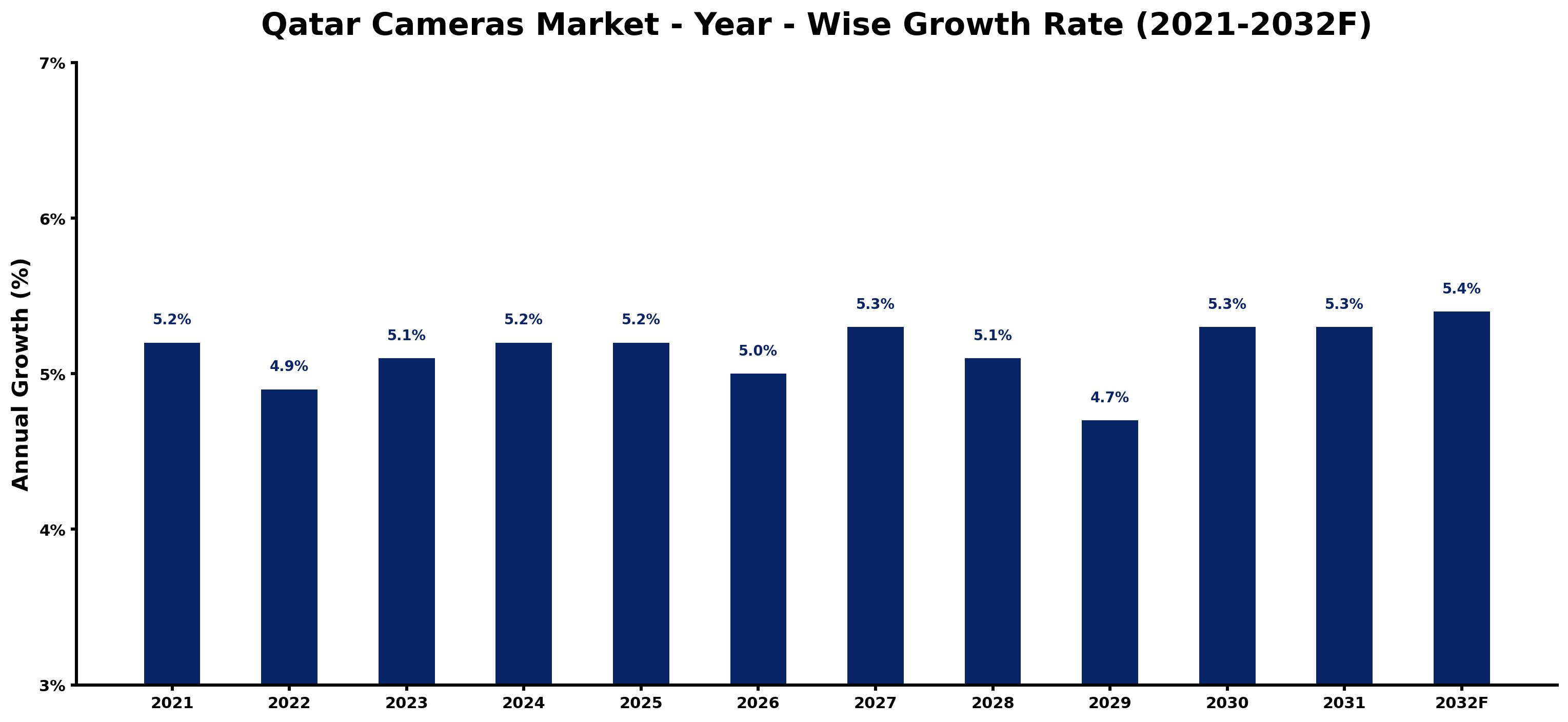
The table below presents the year wise growth rates along with the key drivers influencing the market
| Year | Growth Rate | Major Drivers |
| 2021 | 5.2% | The photography sector flourished as local tourism began to rebound post-COVID. |
| 2022 | 4.9% | E-commerce platforms increasingly showcased camera equipment, catering to tech-savvy consumers. |
| 2023 | 5.1% | High-profile international events bolstered interest in professional-grade cameras and accessories. |
| 2024 | 5.2% | Local influencers played a pivotal role in popularizing compact cameras among younger audiences. |
| 2025 | 5.2% | Enhanced smartphone camera capabilities shifted focus towards specialized photography tools. |
| 2026 | 5.0% | Expatriate communities drove niche market segments, emphasizing personalized camera solutions. |
| 2027 | 5.3% | The expansion of luxury retail spaces included dedicated camera stores, enhancing visibility. |
| 2028 | 5.1% | Partnerships with universities led to increased interest in photography education and tools. |
| 2029 | 4.7% | The emergence of drone photography created a new segment for aerial imaging enthusiasts. |
| 2030 | 5.3% | Sustainability trends prompted interest in eco-friendly camera materials and production methods. |
| 2031 | 5.3% | Local startups innovated in camera technologies, challenging established global brands effectively. |
| 2032 | 5.4% | Cultural events celebrating art and photography fueled consumer demand for high-end gear. |
Note - Market size estimations and growth projections presented in this report are based on 6Wresearch's advanced forecasting approach, validated with industry datasets as of June 2026.
Qatar Cameras Market Synopsis
The Qatar Cameras Market is projected to reach 5.0% and witness significant growth during the forecast period (2026-2032). This market encompasses a variety of camera types, including digital cameras, DSLRs, mirrorless cameras, action cameras, and professional video cameras. These devices are employed for a multitude of purposes, from personal photography and professional videography to recreational use.
Qatar Cameras Market Growth Drivers
Several key factors are propelling the growth of the Qatar Cameras Market. Continuous advancements in camera technology have drastically improved resolution and image quality. These technological innovations not only attract seasoned photographers but also entice newcomers looking for high-quality equipment.
- The rise of social media platforms has transformed the landscape of content creation, increasing the demand for high-quality cameras capable of capturing stunning visuals for platforms like Instagram and YouTube.
- A growing interest in hobbies such as photography and videography, particularly among millennials and Gen Z, has stimulated demand for cameras. This demographic is keen on documenting their experiences, leading to higher sales in the consumer segment.
- The travel and tourism sector remains a significant contributor to camera sales. Travelers increasingly seek reliable devices to document their journeys, driving demand for portable and versatile camera options.
- Innovations such as improved autofocus systems, stabilization features, and connectivity options are further fueling consumer interest, pushing individuals to upgrade their existing equipment.
- The growing popularity of vlogging as a career choice has expanded the market for high-quality video cameras, with consumers willing to invest in more advanced equipment to enhance their content creation capabilities.
Qatar Cameras Market Challenges and Restraints
Despite the positive growth trajectory, the Qatar Cameras Market faces several challenges. One of the most significant threats comes from smartphones equipped with advanced camera functionalities that increasingly compete with traditional cameras.
- The saturation of the camera market in mature regions can lead to stagnation in sales growth, as consumers may feel less compelled to upgrade their devices frequently.
- The high cost of professional cameras and related equipment can deter casual users and hobbyists, limiting market expansion to more affluent customers.
- The global disruptions caused by the Covid-19 pandemic had lasting effects on the cameras market, hindering production and causing delays in distribution which impacted overall sales.
- As consumer preferences shift towards multifunctional devices, dedicated camera brands must continuously innovate to maintain relevance and appeal in a competitive landscape.
- The relatively slow adoption of advanced functionalities in lower-priced segments may restrict overall market growth, creating a divide between premium and entry-level products.
Qatar Cameras Market Government Investment and Initiatives
The Qatar government has shown a commitment to fostering innovation and technology, which encompasses support for the cameras market. Various initiatives aimed at enhancing the digital landscape have been put in place, creating a conducive environment for market growth.
- Investments in public infrastructure encourage technology adoption, indirectly benefitting camera sales as more people become equipped with the necessary tools for content creation.
- Development plans aimed at promoting tourism have increased the number of events and activities, subsequently raising demand for cameras among both tourists and local residents.
- Government-led campaigns that emphasize cultural and artistic expression support the photography and videography sectors, encouraging local enthusiasts to invest in cameras.
- Policies that promote digital entrepreneurship provide incentives and resources for budding photographers and videographers, stimulating the local cameras market.
- Public investment in technology education and training provides a knowledge base for aspiring photographers, fostering a community that values quality imaging and video production.
Qatar Cameras Market Latest Developments (May 2025 - June 2026)
In recent months, the Qatar Cameras Market has seen several notable developments that reflect evolving consumer preferences and technological advancements. During this period, there has been a marked increase in the popularity of mirrorless cameras, which offer comparable or superior functionality to traditional DSLRs while being more compact.
- Enhanced features such as AI-driven autofocus systems and 4K video capabilities are becoming standard for new models, attracting both amateurs and professionals alike.
- The continued rise of influencer marketing has created a surge in demand for high-quality video recording equipment, particularly for vlogging and social media engagement.
- Sustainability initiatives within the market are gaining traction, with some manufacturers focusing on eco-friendly materials and production methods to appeal to environmentally conscious consumers.
- Technological integration, such as smartphone connectivity and cloud storage solutions, is becoming a focus area, allowing users to easily share and manage their media.
- The rise of online tutorials and professional workshops has bolstered skill development, leading to an increased interest in purchasing higher-end camera equipment.
Qatar Cameras Market - Key Attractiveness of the Report
- 10 Years of Market Numbers
- Historical Data Starting from 2022 to 2025
- Base Year: 2025
- Forecast Data until 2032
- Key Performance Indicators Impacting the Market
- Major Upcoming Developments and Projects
Key Highlights of the Report:
- Qatar Cameras Market Outlook
- Market Size of Qatar Cameras Market, 2025
- Forecast of Qatar Cameras Market, 2032
- Historical Data and Forecast of Qatar Cameras Revenues & Volume for the Period 2022-2032F
- Qatar Cameras Market Trend Evolution
- Qatar Cameras Market Drivers and Challenges
- Qatar Cameras Price Trends
- Qatar Cameras Porter's Five Forces
- Qatar Cameras Industry Life Cycle
- Historical Data and Forecast of Qatar Cameras Market Revenues & Volume By Product Type for the Period 2022-2032F
- Historical Data and Forecast of Qatar Cameras Market Revenues & Volume By Built-in Lens Camera for the Period 2022-2032F
- Historical Data and Forecast of Qatar Cameras Market Revenues & Volume By Interchangeable Lens Camera for the Period 2022-2032F
- Historical Data and Forecast of Qatar Cameras Market Revenues & Volume By DSLR for the Period 2022-2032F
- Historical Data and Forecast of Qatar Cameras Market Revenues & Volume By Non-reflex for the Period 2022-2032F
- Historical Data and Forecast of Qatar Cameras Market Revenues & Volume By Application for the Period 2022-2032F
- Historical Data and Forecast of Qatar Cameras Market Revenues & Volume By Commercial for the Period 2022-2032F
- Historical Data and Forecast of Qatar Cameras Market Revenues & Volume By Residential for the Period 2022-2032F
- Historical Data and Forecast of Qatar Cameras Market Revenues & Volume By Distribution Channel for the Period 2022-2032F
- Historical Data and Forecast of Qatar Cameras Market Revenues & Volume By Online for the Period 2022-2032F
- Historical Data and Forecast of Qatar Cameras Market Revenues & Volume By Offline for the Period 2022-2032F
- Qatar Cameras Import Export Trade Statistics
- Market Opportunity Assessment By Product Type
- Market Opportunity Assessment By Application
- Market Opportunity Assessment By Distribution Channel
- Qatar Cameras Top Companies Market Share
- Qatar Cameras Competitive Benchmarking By Technical and Operational Parameters
- Qatar Cameras Company Profiles
- Qatar Cameras Key Strategic Recommendations






































