Qatar Cigarette Market Size, Share & Growth Rate
The Qatar Cigarette Market was estimated at USD 167 Million in 2025 and is projected to reach USD 225 Million by 2032, growing at a CAGR of 4.4% from 2026 to 2032. This growth trajectory is propelled by a rising population of young adults increasingly influenced by Western lifestyle choices. Additionally, strategic marketing efforts by key market players further stimulate demand, despite the presence of significant regulatory challenges.
Qatar Cigarette Market Year-wise Growth Rate and Key Drivers
This graph highlights how the Qatar Cigarette Market has steadily grown over the years, supported by major growth factors.
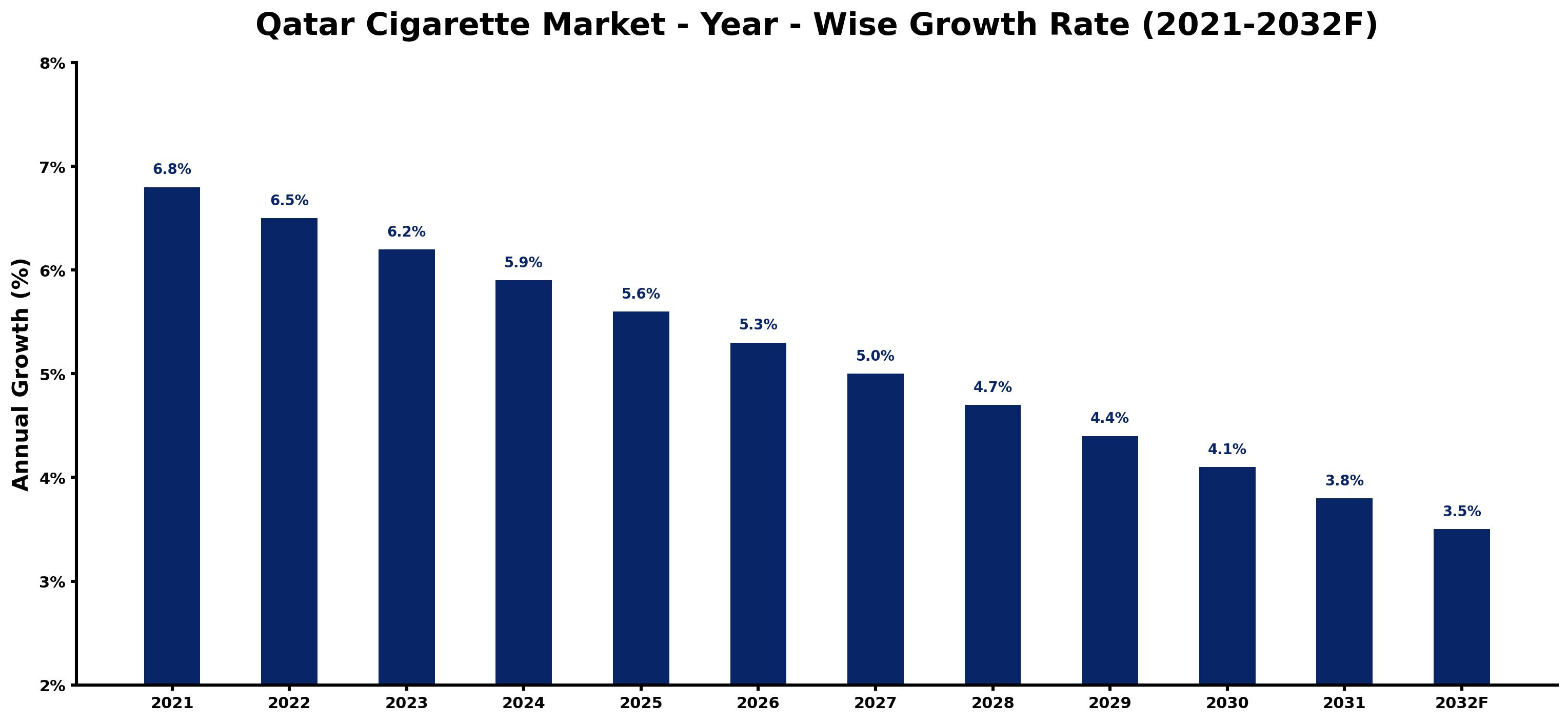
The table below presents the year‑wise growth rates along with the key drivers influencing the market
| Year | Growth Rate | Major Drivers |
| 2021 | 6.8% | Increasing adoption of advanced technologies |
| 2022 | 6.5% | Rapid growth in telecom and data center sectors |
| 2023 | 6.2% | Rapid growth in telecom and data center sectors |
| 2024 | 5.9% | Increasing industrial infrastructure investments |
| 2025 | 5.6% | Government infrastructure modernization initiatives |
| 2026 | 5.3% | Increasing shift toward cleaner alternatives |
| 2027 | 5.0% | Technology transition toward sustainable alternatives |
| 2028 | 4.7% | Declining investments in legacy infrastructure |
| 2029 | 4.4% | Technology transition toward sustainable alternatives |
| 2030 | 4.1% | Declining investments in legacy infrastructure |
| 2031 | 3.8% | Technology transition toward sustainable alternatives |
| 2032 | 3.5% | Increasing shift toward cleaner alternatives |
Note - Market size estimations and growth projections presented in this report are based on 6Wresearch’s advanced forecasting approach, validated with industry datasets as of June 2026.
Qatar Cigarette Market Synopsis
Recent years have seen the Qatar cigarette market undergo notable fluctuations, largely shaped by the dual forces of cultural influences and health consciousness. As the market evolves, emerging trends indicate a divergence towards alternative tobacco products, potentially altering the landscape of traditional cigarette consumption.
Despite ongoing challenges, such as stricter government regulations and shifting consumer preferences, the future outlook remains optimistic. The market is adapting to these pressures, indicating resilience amid changing societal norms surrounding smoking.
Qatar Cigarette Market Key Takeaways
- Fluctuations in consumption patterns reflect the complex interplay of cultural acceptance and health awareness.
- The young adult demographic serves as a key driver of market growth, influenced by global trends.
- Regulatory frameworks continue to shape the market dynamics, impacting sales strategies significantly.
- The Covid-19 pandemic has introduced both immediate and long-term changes to consumer behavior.
- Strategic marketing campaigns remain crucial for maintaining market share in a competitive environment.
Evaluation of Restraints in Qatar Cigarette Market
The Qatar cigarette market faces significant restraints primarily stemming from increased health awareness among consumers. As education on the health risks of smoking becomes more prevalent, a segment of the population is shifting towards healthier lifestyle choices, thereby reducing demand for traditional cigarettes. Furthermore, stringent government regulations, including advertising bans and higher taxation on tobacco products, impose additional pressures on market players, impacting profitability and growth. These factors necessitate a strategic reevaluation among manufacturers to adapt and innovate in a rapidly changing environment.
Qatar Cigarette Market Trends
Current trends in the Qatar cigarette market are heavily influenced by changing consumer preferences, particularly among younger demographics. There's a noticeable increase in the acceptance of alternative tobacco products, such as e-cigarettes and heated tobacco, as consumers seek less harmful options. Additionally, the role of social media and digital marketing is becoming increasingly prominent, allowing companies to engage with consumers in more personalized ways. As societal norms shift, manufacturers are compelled to pivot their strategies to align with these emerging preferences.
Qatar Cigarette Market Opportunities
The Qatar cigarette market presents several genuine growth opportunities, particularly in the realm of product diversification. As consumer interest in less harmful alternatives rises, there is a burgeoning market for innovative tobacco products that align with health-conscious trends. Furthermore, developing robust online sales channels could enhance market reach, especially among tech-savvy younger consumers. Strategic partnerships with lifestyle brands can also open new avenues for engagement and marketing, driving growth in an evolving landscape.
Government Initiatives in the Qatar Cigarette Market
The Qatari government has implemented a series of initiatives aimed at reducing smoking prevalence, reflecting a commitment to public health. These initiatives include stringent regulations on tobacco advertising and promotion, increased taxation on tobacco products, and comprehensive health campaigns to educate the public on the risks of smoking. Additionally, there are ongoing efforts to enforce laws that protect non-smokers and limit smoking in public spaces, thereby reshaping the consumption landscape of cigarettes within the country.
Future Insights of the Qatar Cigarette Market
Looking ahead to 2026-2032, the Qatar cigarette market is expected to navigate a complex landscape marked by regulatory challenges and shifting consumer preferences. The anticipated growth in the market will likely be driven by innovative product offerings and a strategic pivot towards alternative tobacco products. Additionally, as public health initiatives continue to influence consumer habits, manufacturers will need to embrace agility and adaptability in their operations to capture new opportunities while mitigating the impact of declining traditional cigarette sales.
Qatar Cigarette Market Latest Developments (May 2025 - June 2026)
Recent developments in the Qatar cigarette market indicate a marked shift towards diversification and innovation. Manufacturers are increasingly focusing on expanding their portfolios to include alternative products, responding to the growing demand among health-conscious consumers. Efforts to enhance brand visibility through targeted marketing strategies are evident, as companies adapt to the changing regulatory framework and consumer preferences. Additionally, the impacts of the pandemic continue to be felt, influencing purchasing behaviors and prompting firms to explore new sales channels.
Qatar Cigarette Market - Key Attractiveness of the Report
- 10 Years of Market Numbers
- Historical Data Starting from 2022 to 2025
- Base Year: 2025
- Forecast Data until 2032
- Key Performance Indicators Impacting the Market
- Major Upcoming Developments and Projects
Key Highlights of the Report:
- Qatar Cigarette? Market Outlook
- Market Size of Qatar Cigarette? Market, 2025
- Forecast of Qatar Cigarette? Market, 2032
- Historical Data and Forecast of Qatar Cigarette? Revenues & Volume for the Period 2022-2032F
- Qatar Cigarette? Market Trend Evolution
- Qatar Cigarette? Market Drivers and Challenges
- Qatar Cigarette? Price Trends
- Qatar Cigarette? Porter's Five Forces
- Qatar Cigarette? Industry Life Cycle
- Historical Data and Forecast of Qatar Cigarette? Market Revenues & Volume By Type for the Period 2022-2032F
- Historical Data and Forecast of Qatar Cigarette? Market Revenues & Volume By Light for the Period 2022-2032F
- Historical Data and Forecast of Qatar Cigarette? Market Revenues & Volume By Medium for the Period 2022-2032F
- Historical Data and Forecast of Qatar Cigarette? Market Revenues & Volume By Others for the Period 2022-2032F
- Historical Data and Forecast of Qatar Cigarette? Market Revenues & Volume By Distribution Channel for the Period 2022-2032F
- Historical Data and Forecast of Qatar Cigarette? Market Revenues & Volume By Tobacco Shops for the Period 2022-2032F
- Historical Data and Forecast of Qatar Cigarette? Market Revenues & Volume By Supermarket and Hypermarkets for the Period 2022-2032F
- Historical Data and Forecast of Qatar Cigarette? Market Revenues & Volume By Convenience Stores for the Period 2022-2032F
- Historical Data and Forecast of Qatar Cigarette? Market Revenues & Volume By Online Stores for the Period 2022-2032F
- Historical Data and Forecast of Qatar Cigarette? Market Revenues & Volume By Others for the Period 2022-2032F
- Qatar Cigarette? Import Export Trade Statistics
- Market Opportunity Assessment By Type
- Market Opportunity Assessment By Distribution Channel
- Qatar Cigarette? Top Companies Market Share
- Qatar Cigarette? Competitive Benchmarking By Technical and Operational Parameters
- Qatar Cigarette? Company Profiles
- Qatar Cigarette? Key Strategic Recommendations






































