Qatar Copper Clad Wire Market Size, Share & Growth Rate
The Qatar Copper Clad Wire Market was estimated at USD 412 Million in 2025 and is projected to reach USD 555 Million by 2032, growing at a CAGR of 4.3% from 2026 to 2032. This growth trajectory is primarily fueled by the increasing demand from the telecommunications and electrical industries, where copper clad wires are essential for their superior conductivity and reliability. Furthermore, ongoing infrastructure projects and the rapid pace of urbanization in Qatar are anticipated to contribute significantly to the market's expansion.
Qatar Copper Clad Wire Market Year-wise Growth Rate and Key Drivers
This graph highlights how the Qatar Copper Clad Wire Market has steadily grown over the years, supported by major growth factors.
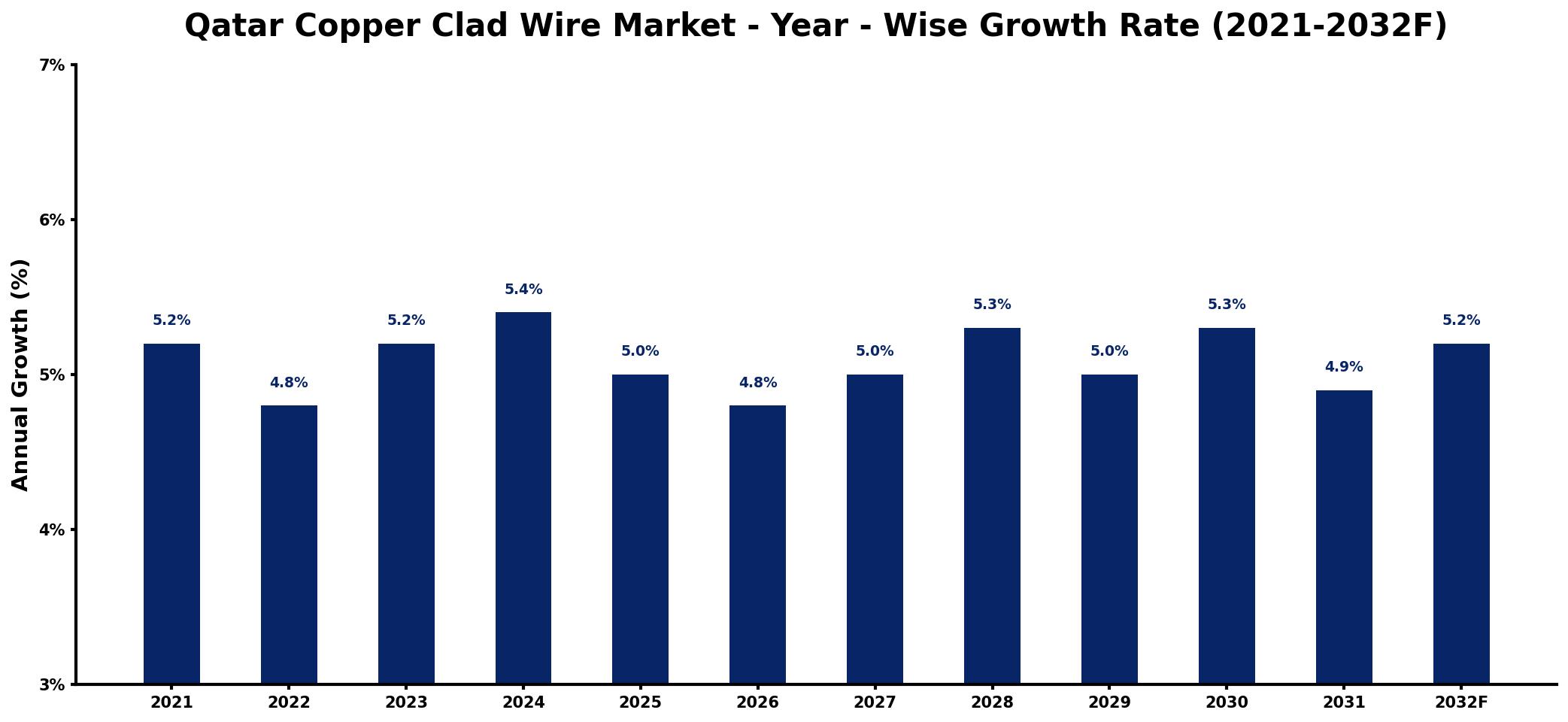
The table below presents the year‑wise growth rates along with the key drivers influencing the market
| Year | Growth Rate | Major Drivers |
| 2021 | 5.2% | Rising demand for electrical components |
| 2022 | 4.8% | Increased investments in construction projects |
| 2023 | 5.2% | Growth in renewable energy sector |
| 2024 | 5.4% | Expansion of manufacturing facilities |
| 2025 | 5.0% | Higher production rates in electronics |
| 2026 | 4.8% | Boost in telecommunications infrastructure development |
| 2027 | 5.0% | Surge in automotive industry requirements |
| 2028 | 5.3% | Growing focus on energy efficiency |
| 2029 | 5.0% | Increased adoption of smart technologies |
| 2030 | 5.3% | improved processing technologies adoption |
| 2031 | 4.9% | increased domestic production output |
| 2032 | 5.2% | increased pharmaceutical industry usage |
Note: Market size estimations and growth projections presented in this report are based on 6Wresearch's proprietary forecasting methodology, utilizing the latest available industry data, government publications, and primary research inputs.
Qatar Copper Clad Wire Market Synopsis
The copper clad wire sector in Qatar is witnessing a surge in demand, particularly due to its vital role in the production of high-frequency cables and printed circuit boards. This demand is closely tied to the growth of the electronics sector, which is increasingly reliant on advanced wiring solutions that enhance performance and efficiency.
Moreover, the strategic investments in infrastructure and urban development within Qatar are significantly boosting the market's prospects. With initiatives aimed at modernizing electrical grids and enhancing telecommunication networks, the need for high-quality copper clad wires is expected to rise steadily in the coming years.
Qatar Copper Clad Wire Market Key Takeaways
- The market is on a growth trajectory, driven by strong demand from the electrical and electronics sectors.
- Qatar's urbanization and infrastructural advancements are creating a heightened need for reliable wiring solutions.
- Technological advancements in manufacturing processes are crucial for maintaining competitive quality standards.
- Fluctuations in copper prices remain a significant challenge for manufacturers.
- Government policies promoting investment in infrastructure are expected to catalyze market growth.
Evaluation of Restraints in Qatar Copper Clad Wire Market
Despite the optimistic outlook, the Qatar copper clad wire market grapples with several restraints that could impede its growth. The volatility in copper prices poses a persistent challenge, as variations can significantly affect production costs and profit margins. Furthermore, the market demands advanced manufacturing technologies capable of meeting stringent electrical and mechanical performance criteria. Compliance with evolving quality standards and certifications adds complexity to operations. Lastly, competition from alternative materials and products necessitates continuous innovation to maintain relevance and competitiveness in the market.
Qatar Copper Clad Wire Market Trends
Currently, there is a noticeable shift towards environmentally friendly and sustainable manufacturing practices within the copper clad wire industry. Companies are increasingly investing in technology that not only enhances production efficiency but also reduces environmental impact. Additionally, the rise of smart technologies and IoT devices is driving the demand for advanced wiring solutions, positioning copper clad wire as a preferred choice due to its conductivity and durability.
Qatar Copper Clad Wire Market Opportunities
The copper clad wire market in Qatar presents substantial growth opportunities, particularly in the realm of telecommunications. The ongoing expansion of 5G networks is expected to necessitate high-performance wiring solutions, bolstering demand for copper clad wires. Additionally, as Qatar aims to diversify its economy, investments in renewable energy and smart infrastructure will create new avenues for market expansion.
Government Initiatives in the Qatar Copper Clad Wire Market
The Qatari government has been proactive in implementing policies that foster growth within the electrical and telecommunications sectors. Initiatives aimed at infrastructure development, including significant public spending on smart grid projects and telecommunications enhancements, are paving the way for increased demand for copper clad wire products. Such policies are not only incentivizing local manufacturing but are also attracting foreign investment, thus strengthening the overall market landscape.
Future Insights of the Qatar Copper Clad Wire Market
Looking ahead to the period from 2026 to 2032, the Qatar copper clad wire market is expected to maintain its upward trajectory. The confluence of increasing infrastructure investments, technological advancements, and a burgeoning electronics sector will drive sustained demand. As urbanization continues to unfold and smart technologies become more prevalent, the necessity for robust, high-performance wiring solutions will only intensify, positioning copper clad wire as a cornerstone of Qatar's evolving electrical landscape.
Qatar Copper Clad Wire Market Latest Developments (2025 - 2026)
Recent developments in the Qatar copper clad wire market include a marked increase in collaborations between local manufacturers and international technology firms aimed at enhancing production capabilities. Moreover, ongoing discussions about regulatory reforms are expected to streamline the certification processes for wiring products, thereby facilitating market entry for new innovations. The industry is also witnessing growing investments in R&D, focusing on developing eco-friendly copper clad wire alternatives that meet changing consumer preferences.
Qatar Copper Clad Wire Market - Key Attractiveness of the Report
- 10 Years of Market Numbers
- Historical Data Starting from 2022 to 2025
- Base Year: 2025
- Forecast Data until 2032
- Key Performance Indicators Impacting the Market
- Major Upcoming Developments and Projects
Key Highlights of the Report:
- Qatar Copper Clad Wire Market Outlook
- Market Size of Qatar Copper Clad Wire Market, 2025
- Forecast of Qatar Copper Clad Wire Market, 2032
- Historical Data and Forecast of Qatar Copper Clad Wire Revenues & Volume for the Period 2022-2032F
- Qatar Copper Clad Wire Market Trend Evolution
- Qatar Copper Clad Wire Market Drivers and Challenges
- Qatar Copper Clad Wire Price Trends
- Qatar Copper Clad Wire Porter's Five Forces
- Qatar Copper Clad Wire Industry Life Cycle
- Historical Data and Forecast of Qatar Copper Clad Wire Market Revenues & Volume By Product Type for the Period 2022-2032F
- Historical Data and Forecast of Qatar Copper Clad Wire Market Revenues & Volume By Aluminium Copper Clad Wire for the Period 2022-2032F
- Historical Data and Forecast of Qatar Copper Clad Wire Market Revenues & Volume By Steel Copper Clad Wire for the Period 2022-2032F
- Historical Data and Forecast of Qatar Copper Clad Wire Market Revenues & Volume By End User for the Period 2022-2032F
- Historical Data and Forecast of Qatar Copper Clad Wire Market Revenues & Volume By Transportation for the Period 2022-2032F
- Historical Data and Forecast of Qatar Copper Clad Wire Market Revenues & Volume By Consumer Electronics for the Period 2022-2032F
- Historical Data and Forecast of Qatar Copper Clad Wire Market Revenues & Volume By Power & Energy for the Period 2022-2032F
- Historical Data and Forecast of Qatar Copper Clad Wire Market Revenues & Volume By Construction for the Period 2022-2032F
- Historical Data and Forecast of Qatar Copper Clad Wire Market Revenues & Volume By General Industrial for the Period 2022-2032F
- Qatar Copper Clad Wire Import Export Trade Statistics
- Market Opportunity Assessment By Product Type
- Market Opportunity Assessment By End User
- Qatar Copper Clad Wire Top Companies Market Share
- Qatar Copper Clad Wire Competitive Benchmarking By Technical and Operational Parameters
- Qatar Copper Clad Wire Company Profiles
- Qatar Copper Clad Wire Key Strategic Recommendations






































