Qatar Digital Forensics Market Size & Growth Rate (2026-2032)
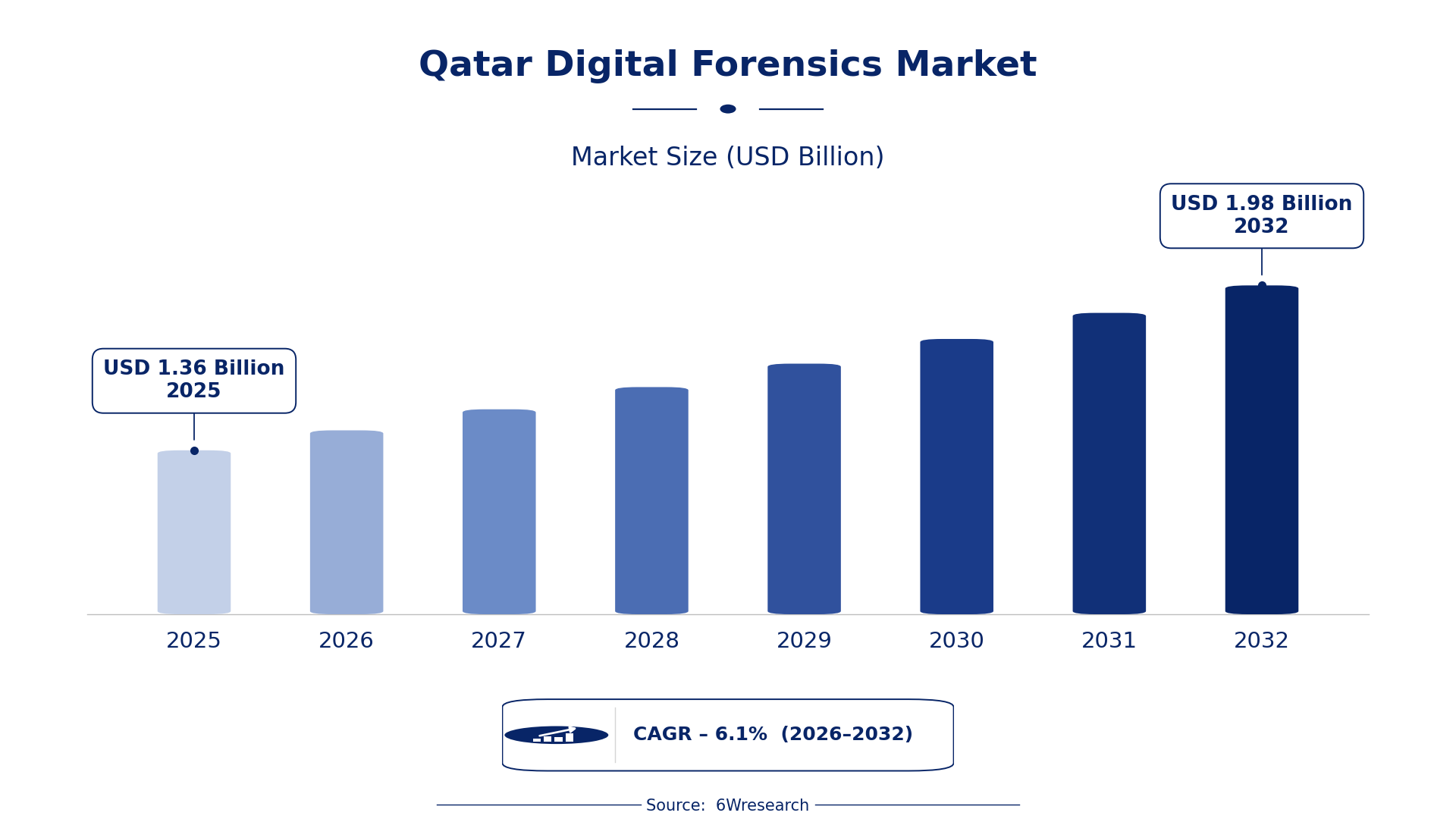
The Qatar Digital Forensics Market was estimated at USD 1361 Million in 2025 and is projected to reach USD 1977 Million by 2032, growing at a CAGR of 6.1% from 2026 to 2032.
Qatar Digital Forensics Market Synopsis
The Qatar Digital Forensics Market is rapidly becoming a crucial asset for organizations confronting escalating cyber threats. As the sophistication of cybercrimes increases, the need for reliable digital forensics tools has never been more pronounced. This shift underscores the urgency for advanced solutions capable of identifying, preserving, and analyzing digital evidence to combat cyber incidents effectively.
The convergence of digital transformation initiatives and expanding digital infrastructure in Qatar has amplified the volume of data generated. Consequently, there is a growing imperative for entities—ranging from law enforcement to private organizations—to invest in digital forensics capabilities. Such investments not only enhance their investigative prowess but also ensure compliance with evolving data protection regulations.
Qatar Digital Forensics Market Year-wise Growth Rate and Key Drivers
This graph illustrates the annual growth rates of the Qatar Digital Forensics Market from 2021 to 2032, highlighting a steady upward trajectory and projected expansion over the forecast period.
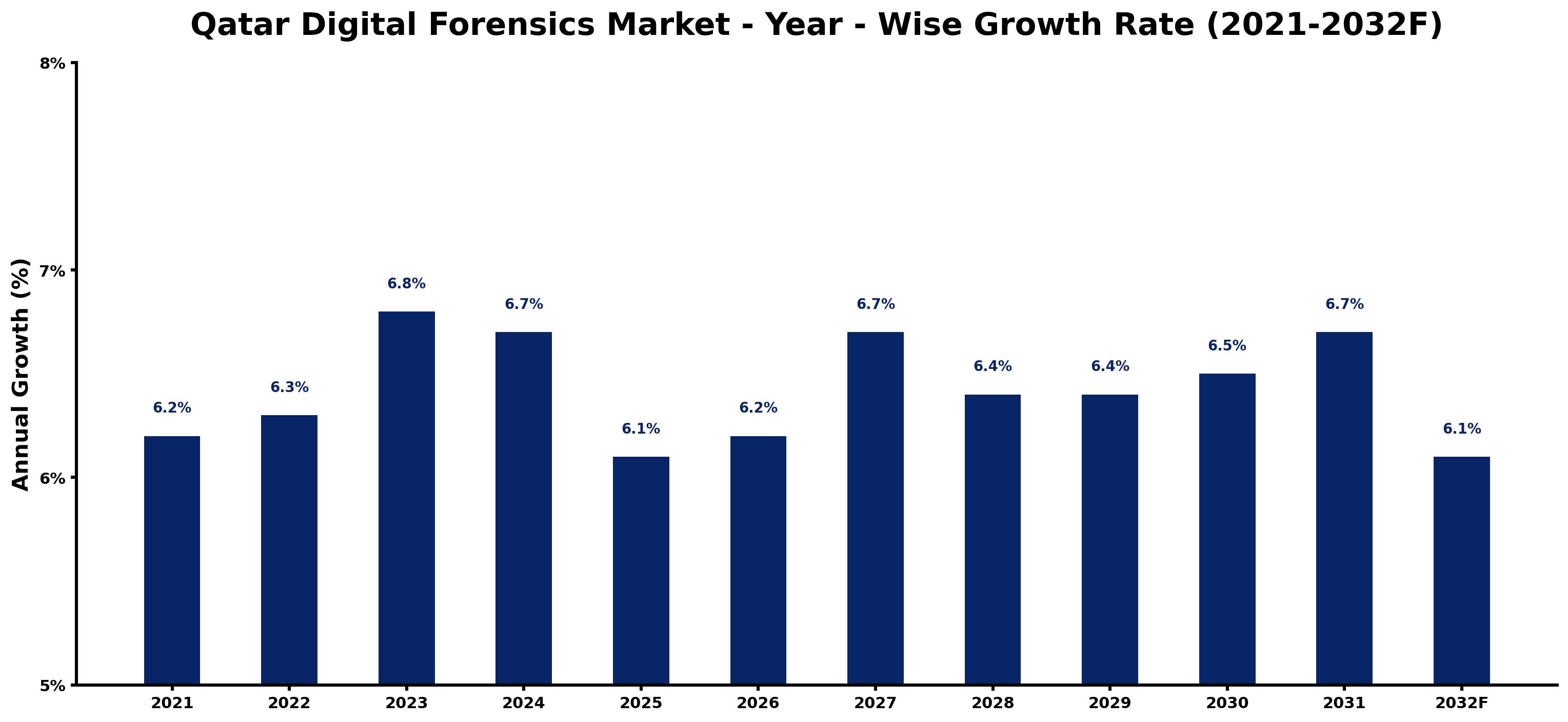
The table below presents the year‑wise growth rates along with the key drivers influencing the market
| Year | Growth Rate | Major Drivers |
| 2021 | 6.2% | Qatar's National Cyber Security Strategy enhancing digital protection. |
| 2022 | 6.3% | Increased cybercrime incidents prompting demand for forensic analysis. |
| 2023 | 6.8% | Growing fintech sector requiring advanced digital investigation tools. |
| 2024 | 6.7% | Regulatory mandates strengthening data security compliance efforts. |
| 2025 | 6.1% | Rising awareness among businesses about digital evidence importance. |
| 2026 | 6.2% | Investment in smart city initiatives driving digital forensics needs. |
| 2027 | 6.7% | Qatar hosting major events increasing cybersecurity measures demand. |
| 2028 | 6.4% | Collaboration with international forensics firms boosting local capabilities. |
| 2029 | 6.4% | Rising mobile device usage escalating demand for forensic services. |
| 2030 | 6.5% | Increased focus on data privacy driving forensics advancements. |
| 2031 | 6.7% | Cybersecurity legislation improving funding for forensic technology adoption. |
| 2032 | 6.1% | Public sector audits necessitating robust digital forensic investigations. |
Note: Market size estimations and growth projections presented in this report are based on 6Wresearch's proprietary forecasting methodology, utilizing the latest available industry data, government publications, and primary research inputs.
Qatar Digital Forensics Market Key Takeaways
Below are some of the specific key takeaways from the market, including:
- The market is set for steady growth, fueled by increasing cyber threats and the demand for robust investigative tools.
- Organizations are prioritizing investments in digital forensics to address compliance and security needs amidst rising data generation.
- Technological advancements, especially in artificial intelligence, are enhancing the efficiency of forensic investigations.
- The COVID-19 pandemic has significantly accelerated the demand for digital forensics services due to a spike in cybercrime.
- Government initiatives are playing a key role in shaping the infrastructure and regulatory framework for digital forensics in Qatar.
Evaluation of Restraints in Qatar Digital Forensics Market
Despite the optimistic growth outlook, the Qatar Digital Forensics Market grapples with several restraints. One major challenge is the rapid pace of technological change, which continuously introduces new forms of cybercrime. As criminal methodologies evolve, forensic professionals must constantly adapt their tools and techniques. on top of that, the integrity and chain of custody of digital evidence remain critical issues, especially with the increasing use of cloud storage and remote data management.
Qatar Digital Forensics Market Trends
Current trends in the Qatar Digital Forensics Market highlight a notable shift toward incorporating artificial intelligence and machine learning into forensic tools. These advancements facilitate faster data analysis and improve accuracy in investigations. Additionally, there’s an increasing focus on collaborative efforts between government and private sectors to enhance cybersecurity frameworks. The demand for real-time monitoring and incident response is also on the rise, reflecting the urgency of mitigating cyber threats before they escalate.
Qatar Digital Forensics Market Opportunities
Looking ahead, significant growth opportunities abound in the Qatar Digital Forensics Market. Organizations are seeking comprehensive solutions that encompass end-to-end data protection and forensic capabilities. The push for compliance with global data protection regulations presents a fertile ground for technology providers. on top of that, ongoing digitalization efforts across various sectors are expected to drive demand for forensic services, particularly in sectors like finance, healthcare, and critical infrastructure.
Government Initiatives in the Qatar Digital Forensics Market
The role of government policy in the Qatar Digital Forensics Market cannot be overstated. As Qatar aims to enhance its cybersecurity framework, public sector initiatives are aligning closely with national objectives for digital safety. This proactive regulatory posture includes establishing standards and guidelines to bolster digital forensic capabilities across different sectors. Such policy support is crucial for ensuring that organizations are equipped to handle the increasing complexities of cyber threats.
- A national cybersecurity strategy launched in late 2022 emphasizes the integration of digital forensics in security protocols.
- Current efforts include the establishment of a dedicated forensic laboratory by the Ministry of Interior to support law enforcement investigations.
- Plans are underway for a comprehensive training program aimed at upskilling law enforcement personnel in digital forensic techniques, scheduled for rollout in early 2026.
- Ongoing collaborations between governmental bodies and private sector partners focus on developing cutting-edge forensic tools and frameworks.
- A proposed regulatory framework aimed at enhancing data protection measures is expected to be introduced in 2025.
Future Insights of the Qatar Digital Forensics Market
Between 2026 and 2032, the Qatar Digital Forensics Market is likely to experience transformative growth driven by ongoing digital advancements. As Qatar continues to strengthen its cybersecurity posture, investments in digital forensics will become more pronounced. The increasing incidence of cyber threats will necessitate that organizations refine their investigative capabilities, pushing the boundaries of existing technologies. This period will also see an emphasis on public-private partnerships, leveraging expertise from various sectors to build a resilient digital infrastructure.
Qatar Digital Forensics Market Latest Developments
In recent months, the Qatar Digital Forensics Market has witnessed a surge in activity as organizations and government agencies ramp up their cybersecurity measures. The focus on enhancing forensic capabilities has led to several key developments that aim to address the rising tide of cyber threats.
- A collaborative initiative launched in early 2023 aims to integrate AI-driven forensic tools into local law enforcement agencies, with implementation ongoing.
- A major technology vendor announced the development of a new digital forensic analysis platform, currently undergoing beta testing, expected to launch by mid-2025.
- In late 2022, a partnership was formed between a leading cybersecurity firm and local universities to enhance educational programs in digital forensics.
- Preparations for a national conference on cybersecurity, focusing on digital forensics, are currently underway, scheduled for Q4 2025.
- A government pilot program that began in early 2023 is exploring the use of blockchain technology in safeguarding digital evidence.
Qatar Digital Forensics Market - Key Attractiveness of the Report
- 10 Years of Market Numbers
- Historical Data Starting from 2022 to 2025
- Base Year: 2025
- Forecast Data until 2032
- Key Performance Indicators Impacting the Market
- Major Upcoming Developments and Projects
Key Highlights of the Report:
- Qatar Digital Forensics Market Outlook
- Market Size of Qatar Digital Forensics Market, 2025
- Forecast of Qatar Digital Forensics Market, 2032
- Historical Data and Forecast of Qatar Digital Forensics Revenues & Volume for the Period 2022-2032F
- Qatar Digital Forensics Market Trend Evolution
- Qatar Digital Forensics Market Drivers and Challenges
- Qatar Digital Forensics Price Trends
- Qatar Digital Forensics Porter's Five Forces
- Qatar Digital Forensics Industry Life Cycle
- Historical Data and Forecast of Qatar Digital Forensics Market Revenues & Volume By Component for the Period 2022-2032F
- Historical Data and Forecast of Qatar Digital Forensics Market Revenues & Volume By Hardware for the Period 2022-2032F
- Historical Data and Forecast of Qatar Digital Forensics Market Revenues & Volume By Software for the Period 2022-2032F
- Historical Data and Forecast of Qatar Digital Forensics Market Revenues & Volume By Services for the Period 2022-2032F
- Historical Data and Forecast of Qatar Digital Forensics Market Revenues & Volume By Type for the Period 2022-2032F
- Historical Data and Forecast of Qatar Digital Forensics Market Revenues & Volume By Computer Forensics for the Period 2022-2032F
- Historical Data and Forecast of Qatar Digital Forensics Market Revenues & Volume By Network Forensics for the Period 2022-2032F
- Historical Data and Forecast of Qatar Digital Forensics Market Revenues & Volume By Mobile Device Forensics for the Period 2022-2032F
- Historical Data and Forecast of Qatar Digital Forensics Market Revenues & Volume By Cloud Forensics for the Period 2022-2032F
- Historical Data and Forecast of Qatar Digital Forensics Market Revenues & Volume By Tool for the Period 2022-2032F
- Historical Data and Forecast of Qatar Digital Forensics Market Revenues & Volume By Vertical for the Period 2022-2032F
- Qatar Digital Forensics Import Export Trade Statistics
- Market Opportunity Assessment By Component
- Market Opportunity Assessment By Type
- Market Opportunity Assessment By Tool
- Market Opportunity Assessment By Vertical
- Qatar Digital Forensics Top Companies Market Share
- Qatar Digital Forensics Competitive Benchmarking By Technical and Operational Parameters
- Qatar Digital Forensics Company Profiles
- Qatar Digital Forensics Key Strategic Recommendations






































