Qatar Distilled Water Market Size, Share & Growth Rate
The Qatar Distilled Water Market was estimated at USD 458 Million in 2025 and is projected to reach USD 663 Million by 2032, growing at a CAGR of 5.4% from 2026 to 2032. This robust growth trajectory is primarily driven by the escalating demand from the healthcare and pharmaceutical sectors, which require high-quality distilled water for various applications. Additionally, the expansion of the cosmetics industry, which incorporates distilled water into formulations, is further solidifying the market's upward momentum.
Qatar Distilled Water Market Year-wise Growth Rate and Key Drivers
This graph highlights how the Qatar Distilled Water Market has steadily grown over the years, supported by major growth factors.
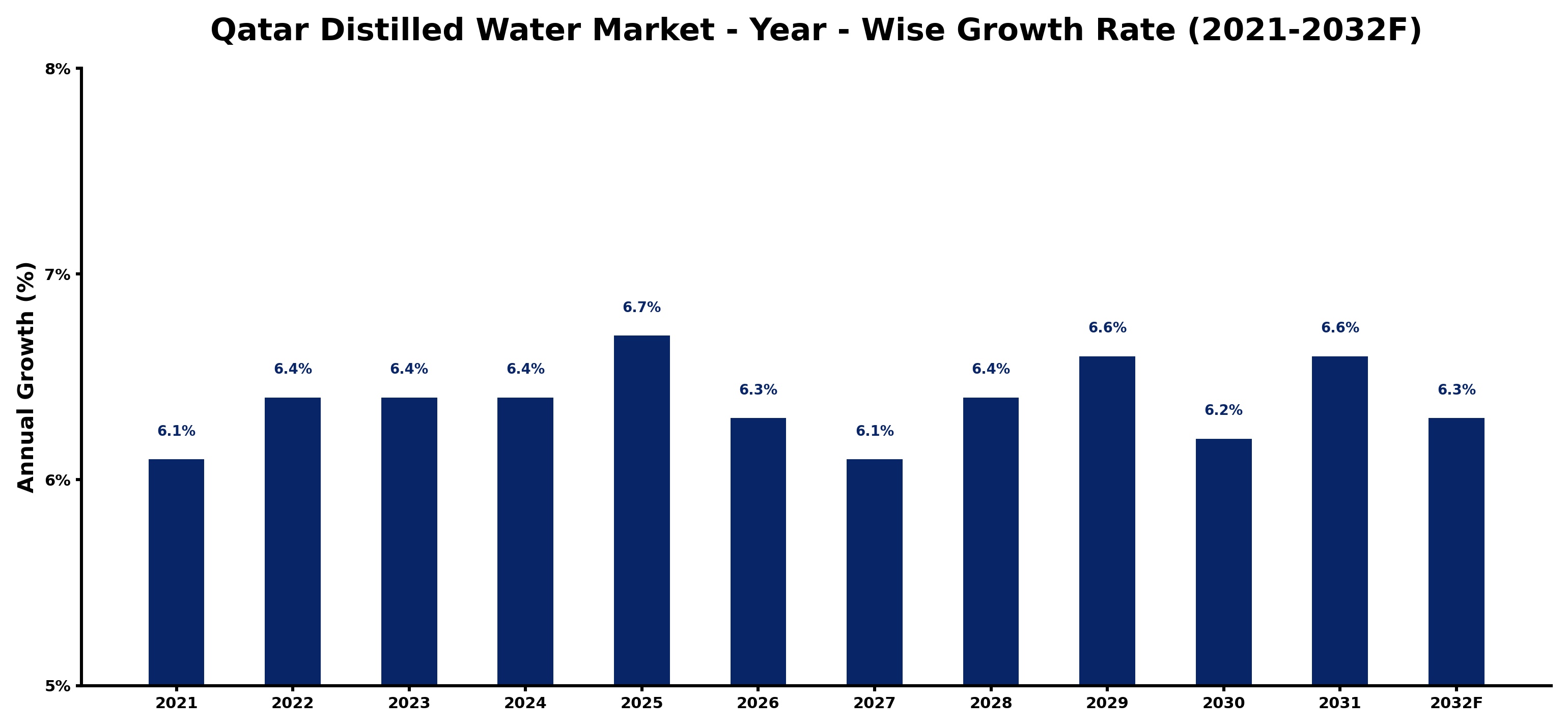
The table below presents the year‑wise growth rates along with the key drivers influencing the market
| Year | Growth Rate | Major Drivers |
| 2021 | 6.1% | Increased health awareness among consumers |
| 2022 | 6.4% | Rising demand for bottled water |
| 2023 | 6.4% | Expansion of retail distribution channels |
| 2024 | 6.4% | Growing population driving consumption |
| 2025 | 6.7% | Increased tourism boosting water sales |
| 2026 | 6.3% | Enhanced production technology adoption |
| 2027 | 6.1% | Sustainability trends influencing choices |
| 2028 | 6.4% | Corporate wellness programs promoting hydration |
| 2029 | 6.6% | Innovative packaging attracting customers |
| 2030 | 6.2% | Rising disposable income enhancing spending |
| 2031 | 6.6% | Increased focus on hydration education |
| 2032 | 6.3% | Industrial activity supported growth |
Note - Market size estimations and growth projections presented in this report are based on 6Wresearch's advanced forecasting approach, validated with industry datasets as of June 2026.
Qatar Distilled Water Market Synopsis
The distilled water market in Qatar is characterized by a significant increase in domestic consumption, coupled with rising export figures. In 2025, the value of distilled water exported reached nearly USD 4 million, a remarkable 44% increase from 2018, indicating a strong demand in regional markets like Saudi Arabia and Kuwait.
The continued investment in healthcare infrastructure is pivotal for market expansion. With Qatar's push towards achieving pharmaceutical self-sufficiency, the reliance on distilled water for medicinal applications is likely to grow, thereby reinforcing its position within the country's export sector.
Qatar Distilled Water Market Key Takeaways
- The Qatar Distilled Water Market is expected to experience steady growth fueled by healthcare and pharmaceutical demands.
- Export activities are on the rise, with significant contributions from neighboring markets.
- Quality assurance remains a top priority as industry players strive to meet stringent standards.
- Investment in technology for advanced purification methods is crucial for market competitiveness.
- The evolving cosmetics and personal care industries represent new avenues for market expansion.
Evaluation of Restraints in Qatar Distilled Water Market
Despite the promising growth, the Qatar Distilled Water market faces notable restraints. Chief among these is the intense competition among producers, coupled with the pressure to maintain high-quality standards. As distilled water is critical in sectors such as pharmaceuticals, electronics, and laboratories, the ability to ensure purity and consistency is essential. Industry participants must continually enhance purification technologies and strengthen quality control measures to mitigate these risks and maintain market relevance.
Qatar Distilled Water Market Trends
The market is witnessing several transformative trends. An increasing emphasis on sustainability has led to the adoption of eco-friendly production practices, which resonate well with the contemporary consumer mindset. Furthermore, advancements in technology are making purification processes more efficient, thereby driving down production costs while improving quality. As the healthcare sector continues to evolve, the integration of distilled water in innovative medical applications is also gaining traction, further solidifying its critical role.
Qatar Distilled Water Market Opportunities
The Qatar Distilled Water market is ripe with opportunities for expansion and investment. The burgeoning pharmaceutical industry, spurred by government initiatives aimed at self-sufficiency, presents a fertile ground for growth. Additionally, as the personal care sector continues to grow, manufacturers can explore collaborations that leverage distilled water's unique properties in product formulations. Furthermore, tapping into export markets beyond the Gulf Cooperation Council (GCC) may yield additional revenue streams.
Government Initiatives in the Qatar Distilled Water Market
The Qatari government has implemented several initiatives aimed at bolstering the distilled water sector. Focused investments in healthcare infrastructure, including modernization and expansion of facilities, are a part of the national strategy to achieve pharmaceutical self-sufficiency. Moreover, policies promoting local production and sustainability are likely to create a favorable environment for market growth. By providing incentives for local manufacturers, the government is setting the stage for increased innovation and quality assurance.
Future Insights of the Qatar Distilled Water Market
Looking ahead to the period from 2026 to 2032, the Qatar Distilled Water market is expected to continue on its growth trajectory. The healthcare sector will remain a primary driver, further compounded by the rising demand for high-purity water across various applications. As technological advancements reduce production costs and enhance product quality, companies that invest in innovation are poised to capture a larger market share. Overall, the market appears well-positioned for sustained growth amidst evolving consumer needs and regulatory landscapes.
Qatar Distilled Water Market Latest Developments (May 2025 - June 2026)
Recently, the market has seen an uptick in new entrants focused on enhancing production efficiency through state-of-the-art purification technologies. Collaborations between distilled water producers and healthcare facilities have increased, aimed at ensuring a steady supply of high-quality water. Additionally, awareness campaigns promoting the importance of distilled water in healthcare and personal care products are expected to elevate its market presence.
Qatar Distilled Water Market - Key Attractiveness of the Report
- 10 Years of Market Numbers
- Historical Data Starting from 2022 to 2025
- Base Year: 2025
- Forecast Data until 2032
- Key Performance Indicators Impacting the Market
- Major Upcoming Developments and Projects
Key Highlights of the Report:
- Qatar Distilled Water Market Outlook
- Market Size of Qatar Distilled Water Market, 2025
- Forecast of Qatar Distilled Water Market, 2032
- Historical Data and Forecast of Qatar Distilled Water Revenues & Volume for the Period 2022-2032F
- Qatar Distilled Water Market Trend Evolution
- Qatar Distilled Water Market Drivers and Challenges
- Qatar Distilled Water Price Trends
- Qatar Distilled Water Porter's Five Forces
- Qatar Distilled Water Industry Life Cycle
- Historical Data and Forecast of Qatar Distilled Water Market Revenues & Volume By Types for the Period 2022-2032F
- Historical Data and Forecast of Qatar Distilled Water Market Revenues & Volume By Pharmaceutical Grade for the Period 2022-2032F
- Historical Data and Forecast of Qatar Distilled Water Market Revenues & Volume By Industrial Grade for the Period 2022-2032F
- Historical Data and Forecast of Qatar Distilled Water Market Revenues & Volume By Applications for the Period 2022-2032F
- Historical Data and Forecast of Qatar Distilled Water Market Revenues & Volume By Drinking for the Period 2022-2032F
- Historical Data and Forecast of Qatar Distilled Water Market Revenues & Volume By Chemical and Biological Laboratories for the Period 2022-2032F
- Historical Data and Forecast of Qatar Distilled Water Market Revenues & Volume By Automotive Cooling Systems and Batteries for the Period 2022-2032F
- Historical Data and Forecast of Qatar Distilled Water Market Revenues & Volume By Medical for the Period 2022-2032F
- Historical Data and Forecast of Qatar Distilled Water Market Revenues & Volume By Others for the Period 2022-2032F
- Qatar Distilled Water Import Export Trade Statistics
- Market Opportunity Assessment By Types
- Market Opportunity Assessment By Applications
- Qatar Distilled Water Top Companies Market Share
- Qatar Distilled Water Competitive Benchmarking By Technical and Operational Parameters
- Qatar Distilled Water Company Profiles
- Qatar Distilled Water Key Strategic Recommendations






































